

How Google Evaluates and Ranks Legal Practices in Local Search
Attorney local SEO services help law firms rank in Google’s Local 3-Pack and localized organic search results by optimizing Google Business Profiles, maintaining citation accuracy across legal directories, driving ethical review velocity, and creating geo-targeted practice pages to satisfy Google’s relevance, distance, and prominence criteria.
Google processes local legal searches through specialized ranking mechanisms governed by strict “Your Money or Your Life” (YMYL) content evaluation. Because legal services directly impact a searcher’s financial security, freedom, and family wellbeing, Google applies higher standards for Experience, Expertise, Authoritativeness, and Trustworthiness (E-E-A-T).
When a prospective client searches for legal representation, the local search algorithm determines results using three primary criteria: relevance, distance, and prominence.
| Ranking Dimension | Traditional Organic Legal SEO | Local Map Pack Optimization |
|---|---|---|
| Primary Goal | Rank practice pages in standard organic listings | Capture top 3 placement in Google Maps pack |
| Key Ranking Signals | Backlink authority, domain age, comprehensive topical depth | Proximity to searcher, GBP optimization, citation consistency |
| Conversion Focus | Educational content, long-form guides, lead magnets | Direct phone calls, consultation forms, driving directions |
| Geographic Scope | Regional, statewide, or multi-jurisdictional reach | Hyperlocal radius surrounding physical office address |
| User Search Intent | Informational research, legal procedural guidance | Immediate transactional intent (“lawyer near me”) |
Relevance, Distance, and Prominence in Legal Algorithms
Understanding how Google balances its core local algorithm signals allows us to build campaigns that sustainably capture high-value legal matters:
- Relevance: How effectively your law firm’s digital presence matches what the user needs. Search engines evaluate relevance by scanning primary and secondary Google Business Profile (GBP) categories, website practice pages, structured schema data, and on-page headings. Detailed guidance on structuring these elements can be found in our In-Depth Guide to Local SEO Lawyers.
- Distance: Proximity measures the physical distance between your verified law office address and the searcher’s current location or specified geographic modifier. While proximity is an unalterable physical fact, clear geographic signals throughout your digital footprint help establish authority across your target territory.
- Prominence: Prominence reflects your firm’s market reputation online and offline. Google assesses prominence through review volume, average review ratings, citations across legal directories, authoritative backlinks from bar associations, and active brand mentions across local news media.

Local Map Pack vs. Traditional Organic SERP Mechanics
The Google Local 3-Pack occupies the most prominent position on mobile and desktop devices for searches with local intent, appearing above standard organic website links roughly 93% of the time.
Studies show that local map packs capture approximately 44% of total search clicks, while standard organic web links earn about 29%, and paid Google search ads capture around 20%. Because 62% of users perform non-branded searches when seeking legal representation, showing up in the Local 3-Pack is critical for capturing searchers who do not yet have a specific attorney in mind.
For multi-market practitioners looking to expand geographic reach, implementing strategies from The City Attorney Guide to Local Search and Specific Geographies ensures your firm captures both Map Pack real estate and organic web rankings simultaneously.
Core Pillars of High-Performing Attorney Local SEO Services
Building dominant local authority requires a structured system that integrates profile management, citation accuracy, reputation velocity, and localized on-page optimization.
For estate planning and elder law practices, specialized roadmaps like The Ultimate Guide to Local SEO Services for Law Firms Helping Estate Planning Attorneys Win the Local Map detail how practice-specific local signals produce compounding returns.
Google Business Profile Optimization and Category Mapping
Your Google Business Profile serves as the front door of your digital practice. Maximizing its conversion and ranking capability requires precise configuration:
- Primary Category Selection: Choose the most specific primary category that describes your core practice area (e.g., “Personal Injury Attorney”, “Criminal Defense Lawyer”, or “Estate Planning Attorney”).
- Secondary Categories: Add complementary categories (such as “Trial Attorney”, “Legal Services”, or “Family Law Attorney”) to broaden relevance without diluting core topical focus.
- Optimized Business Description: Utilize all 750 available characters. Front-load your primary legal services and geographic service territory while explaining your firm’s background clearly without stuffing keywords or adding external URLs.
- Google Q&A Management: Proactively populate your Q&A section with frequently asked client questions, providing clear, informative answers that address client concerns before they call.
- Geotagged Media and Virtual Tours: Upload high-resolution office photography, team portraits, and interior building media on a weekly basis to build consumer trust and reinforce entity location signals. Additional practical strategies can be found in our Insights on Google Business Profile for Lawyers.
Citation Consistency and Legal Directory Authority
Search algorithms cross-reference third-party business directories and data aggregators to confirm that your firm is active and legitimate. Name, Address, and Phone Number (NAP) data must remain 100% uniform across every platform. Even minor differences—such as “Suite 400” versus “Ste. 400″—can fragment location authority.
Establishing authoritative profiles across top directories is vital. Consult our breakdown of the Best Legal Directories to Get Listed to prioritize profiles on platforms like Justia, Avvo, FindLaw, and Martindale-Hubbell. Implementing systematic citation cleanup builds consistent citation equity across every major data ecosystem.
State-Bar-Compliant Review Acquisition and Reputation Velocity
Online reviews directly influence the prominence pillar of Google’s local ranking algorithm. An active law practice should establish a steady review velocity, gathering authentic client feedback consistently rather than in sporadic bursts.
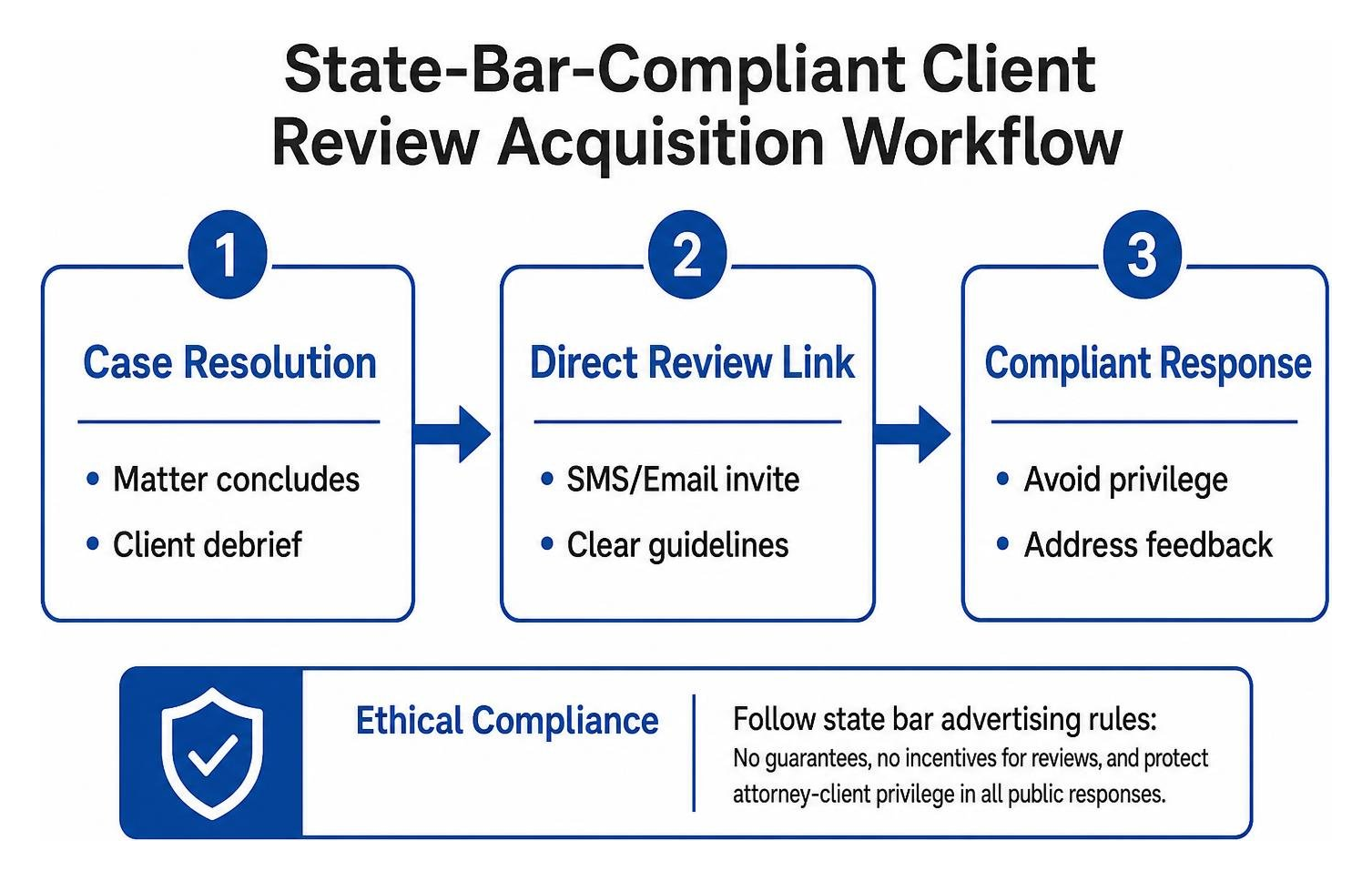
When establishing your review acquisition workflow, select the right Platforms for Gathering Online Reviews for Lawyers to collect feedback across Google, Avvo, and legal directory profiles. Review procurement must strictly adhere to state bar advertising ethics; review requests should never guarantee case outcomes, offer direct financial incentives for feedback, or compromise attorney-client privilege during public review responses. For ethical compliance rules, review How to Win Local Clients Without Crossing Ethical Lines in Legal SEO.
Hyperlocal Practice Pages and Legal Schema Architecture
To rank for searchers located across neighboring towns, municipalities, and judicial districts, law firms must build dedicated practice area pages tied to specific geographic jurisdictions. Rather than creating generic, repetitive pages, each location page should detail municipal court procedures, local filing processes, courthouse locations, and jurisdictional timelines.
Structuring content using topic clusters establishes comprehensive topical authority. Explore Why Your Law Firm Needs Topic Clusters to Establish Real Authority to design search-engine-friendly content hierarchies. Furthermore, implementing schema microdata—specifically Attorney, LegalService, and LocalBusiness JSON-LD markup—helps search engines parse your office locations, practice areas, operating hours, and client ratings accurately.
Advanced Strategies to Dominate Competitive Regional Jurisdictions
In dense, competitive regional markets—such as Northern New Jersey across Passaic County, Bergen County, and Essex County—basic profile setup is only the baseline. Outranking entrenched legal competitors requires advanced tactical execution.
Aligning Local Services Ads with Attorney Local SEO Services
Google Local Services Ads (LSAs), featuring the “Google Screened” badge, occupy the top of search engine results pages above both the Local 3-Pack and traditional organic listings. LSAs operate on a pay-per-qualified-lead model rather than standard pay-per-click.
Integrating LSAs with organic local SEO builds a dual-visibility strategy that commands top-of-page search real estate. Your LSA ranking and lead conversion rates rely directly on your Google Business Profile review score, total review count, and firm responsiveness. Learn how to configure these campaigns effectively in our guide to Local Service Ads for Law Firms Generate More Leads.
Generative Engine Optimization and AI Search Visibility in 2026
Modern search behavior splits attention between traditional search results and AI-driven platforms like Google AI Overviews, ChatGPT, and Perplexity. Generative Engine Optimization (GEO) ensures your practice is cited by Large Language Models when users enter localized legal prompts (e.g., “Who is the most experienced divorce attorney for business owners in Passaic County?”).
Establishing strong entity authority, publishing detailed legal FAQs, and implementing structured schema allows AI engines to ingest, verify, and cite your firm as a credible authority. To understand how AI discovery influences client acquisition, read Why GEO Will Change the Way You Think About SEO for Small Law Firms.
Fighting Map Pack Spam and Listing Redressals
A common hurdle in competitive legal markets is the presence of illegitimate competitors using fake office locations, virtual postal boxes, or keyword-stuffed business names on Google Maps (e.g., “Newark Car Accident Lawyer – Best Injury Law Group” instead of their registered entity name).
Systematically identifying and reporting these policy violations via Google’s Business Redressal Complaint Form removes deceptive listings, allowing compliant law practices to rise naturally in the Local 3-Pack rankings. Practical steps for auditing and correcting common listing errors are outlined in Local SEO for Lawyers Simple Fixes Get More Clients.
In-House Management vs. Dedicated Legal Marketing Agencies: Timeline and ROI
Deciding whether to handle local search optimization internally or partner with a specialized agency requires evaluating resource availability, technical capabilities, and cost efficiency.
Why Fast-Growing Law Practices Invest in Attorney Local SEO Services
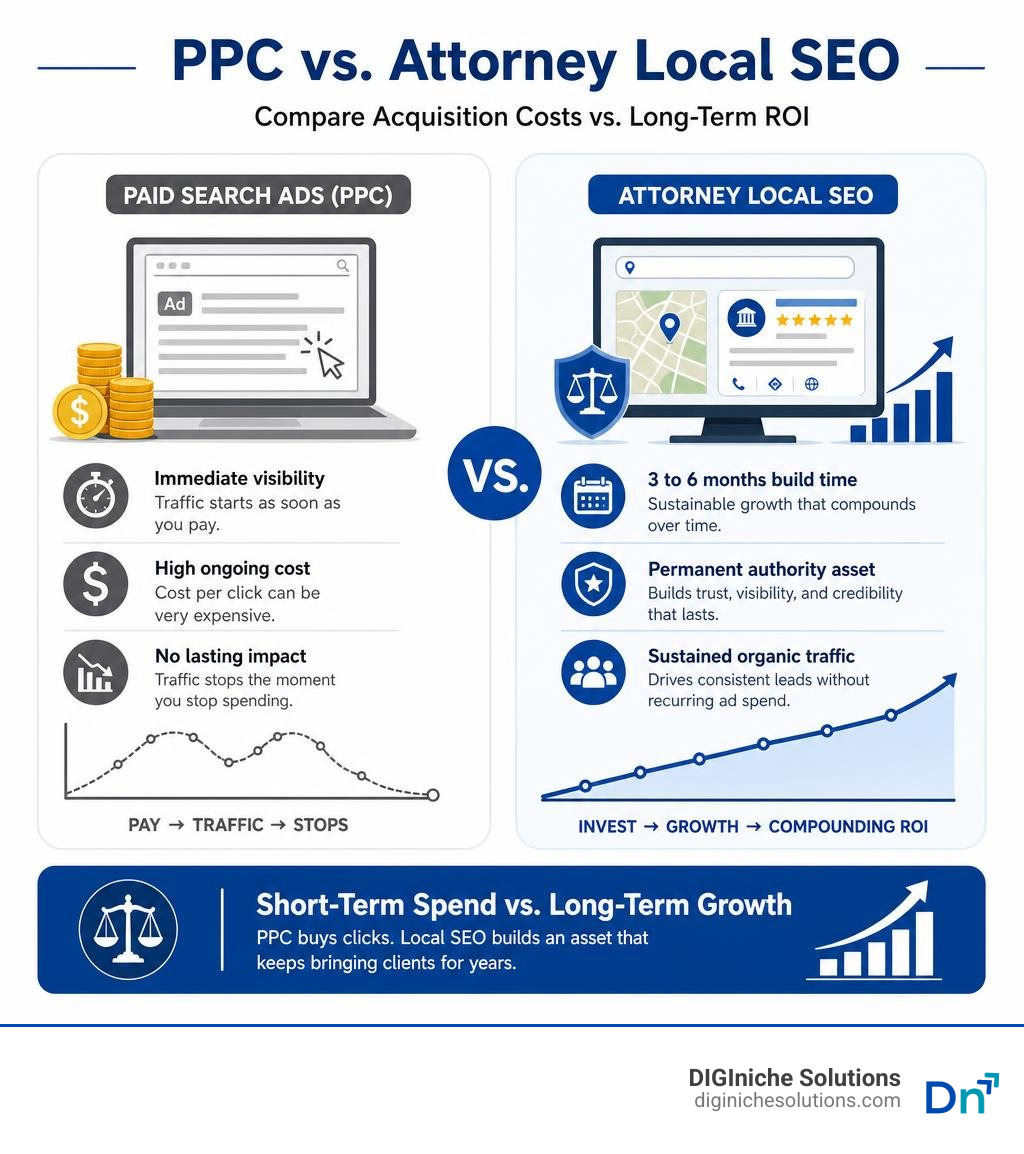
Legal keywords represent 17.52% of the most expensive terms across major search engines, with hyper-competitive clicks in major practice areas often exceeding $100 to $670 per individual ad click.
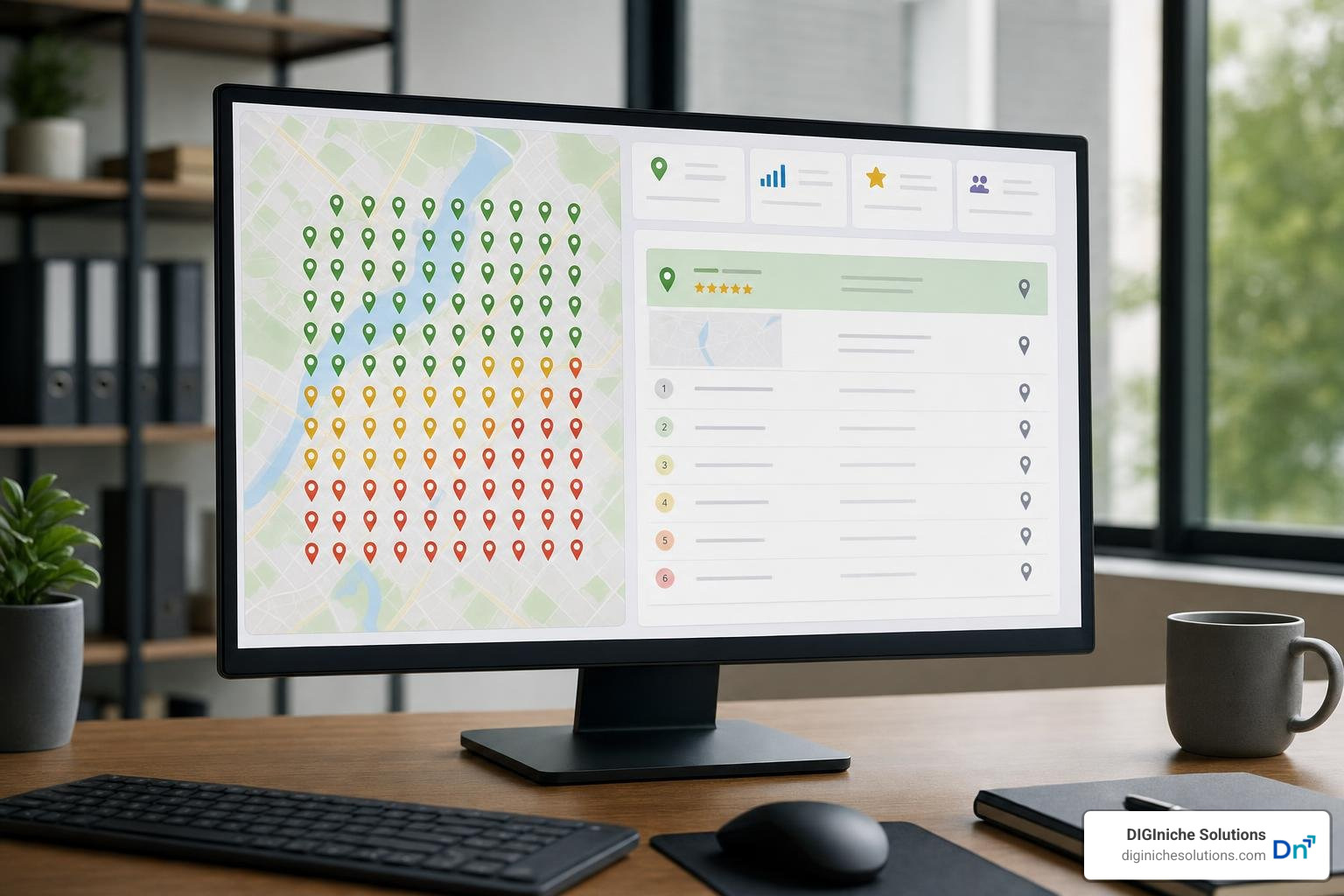
A well-optimized organic legal page can generate approximately 70% of organic search traffic and steady case inquiries for years without recurring ad spend. Specialized agencies bring enterprise tools (such as geo-grid rank trackers and CallRail attribution software), full compliance with state bar advertising regulations, and dedicated market exclusivity models to prevent client conflicts.
For guidance on evaluating external marketing partners, read The Law Firm Guide to SEO What to Look For in a Legal Marketing Agency.
Expected Timelines, Benchmarks, and Avoiding Costly Local SEO Mistakes
Local SEO for law firms requires methodical execution over several months:
- Months 1–2 (Technical Audits & Foundation): Complete GBP verification, correct NAP discrepancies across data aggregators, resolve technical site errors, and embed legal schema.
- Months 3–4 (Content & Citation Expansion): Roll out localized practice area landing pages, build authoritative legal directory profiles, and implement structured review acquisition workflows.
- Months 5–6 (Authority Building & Local Pack Gains): Acquire local community backlinks, suppress Map Pack spam competitors, and optimize conversion pathways to turn local calls into signed retainers.
Avoid critical errors such as keyword stuffing in profile names, creating duplicate location pages, or ignoring negative client feedback. For detailed guidance on navigating recent algorithmic changes, review 7 Post Update Mistakes Youre Making With SEO for Personal Injury Lawyers and How to Fix Them.
Frequently Asked Questions About Legal Search Optimization
Can a law firm rank in neighboring cities without a physical office?
A physical, verifiable street address is strictly required to rank within Google’s Local 3-Pack for a specific municipality. Virtual offices, shared co-working dropboxes, and P.O. boxes violate Google Business Profile policies and risk immediate suspension. However, a law firm can rank organically in neighboring municipalities by creating high-quality, dedicated service-area pages that accurately reflect the jurisdictions served without claiming non-existent physical offices.
How do client reviews and keyword mentions affect local map rankings?
Reviews strongly impact Google’s prominence ranking factor. Review velocity, overall star rating, and review consistency all signal reliability. Furthermore, when clients naturally mention specific services, injuries, or legal procedures within their review text (e.g., “handled my Passaic County municipal court case”), Google’s algorithm parses these terms, frequently triggering your profile to appear for related long-tail search queries.
How does local SEO compare to PPC and billboard advertising for lawyers?
While billboard advertising and broad television campaigns blanket wide geographic markets indiscriminately, local search captures prospective clients at the exact moment of legal need. Paid PPC advertising delivers immediate visibility but requires significant ongoing budgets due to high cost-per-click rates. Local SEO builds a durable digital asset that systematically reduces your firm’s cost-per-lead and overall cost-per-signed-case over time.
Conclusion
Dominating local legal search requires more than occasional website updates or basic directory listings. In competitive regional markets, sustainable growth requires a comprehensive strategy that connects technical search optimization, reputation management, hyper-local practice architecture, and strict advertising compliance into an integrated client-acquisition pipeline.
At DIGIniche Solutions, we help law practices build scalable client pipelines through our proprietary V.E.R.A. Formula:
- Visibility: Dominating Google Local 3-Packs, generative AI engines, and localized organic search results.
- Engagement: Delivering fast, mobile-friendly website experiences with clear, persuasive legal content that resonates with prospective clients.
- Retention: Structuring intake workflows and tracking mechanisms to ensure inquiries turn into signed clients.
- Amplification: Expanding your digital reach across regional jurisdictions, local media, and authoritative community partnerships.
Whether your firm is based in Wayne, Clifton, Passaic, Lyndhurst, Paterson, Bloomfield, Newark, Elizabeth, Nutley, or across Passaic and Bergen Counties, our team builds compliant, revenue-focused campaigns designed to secure high-value cases.
Explore our expert New Jersey legal search marketing and local growth strategies or contact our legal marketing specialists today to build your firm’s local market roadmap.
