Why Attorney Topic Clusters Are the Key to Law Firm SEO Authority
Attorney topic clusters are the most effective way for law firms to build real search authority in 2026 — and most firms still aren’t using them.
Here’s a quick breakdown of what they are and why they matter:
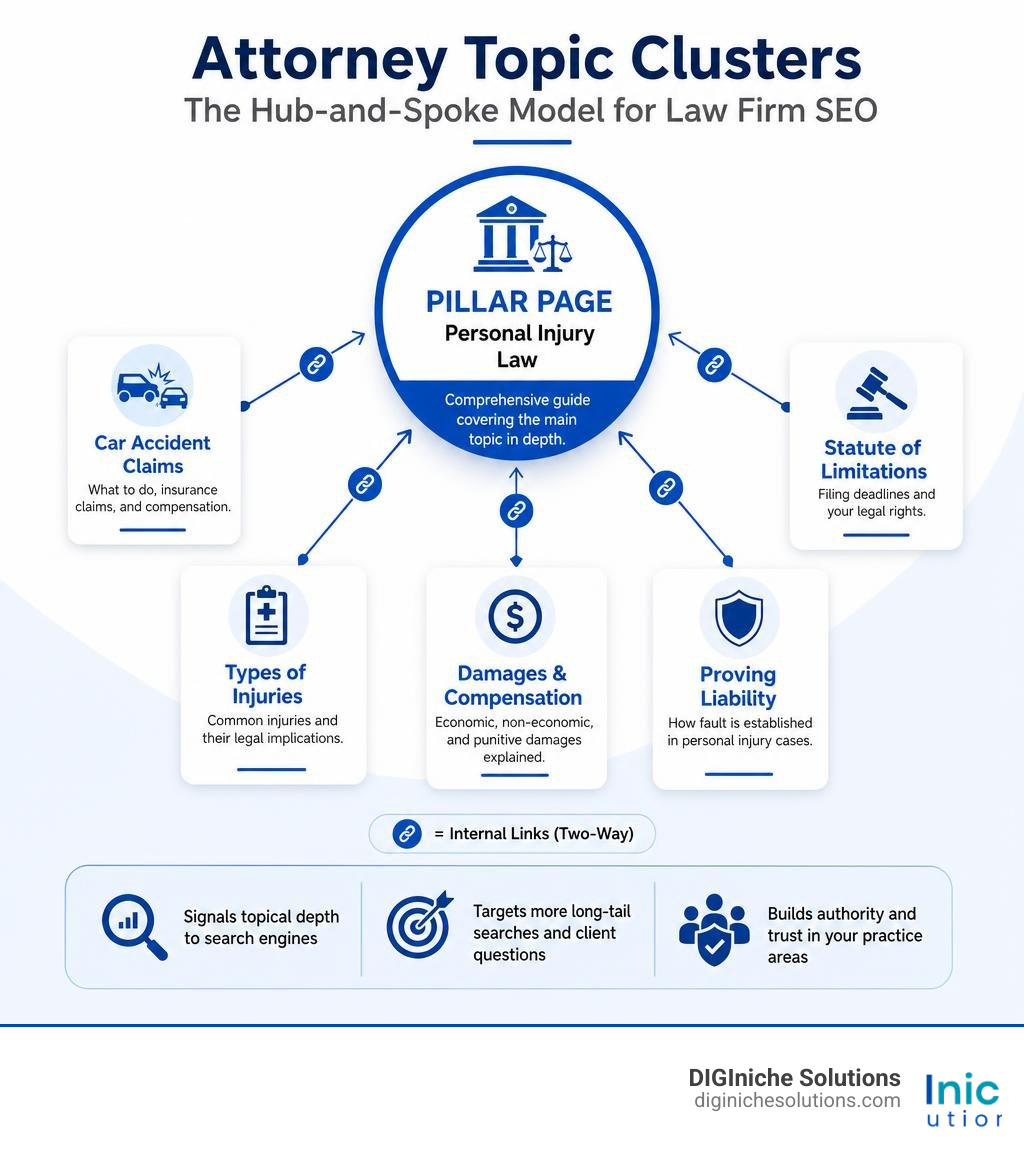
| Component | What It Is | Why It Matters |
|---|---|---|
| Pillar Page | A broad, comprehensive page on a core practice area | Anchors your authority on the topic |
| Cluster Pages | Shorter pages covering specific subtopics | Targets long-tail searches and client questions |
| Internal Links | Two-way links connecting pillar and cluster pages | Signals topical depth to Google and AI engines |
The result? A structured content ecosystem that tells search engines — and AI tools like ChatGPT — that your firm is a specialist, not a generalist.
Here’s the problem most law firms face: you’ve published dozens of blog posts and practice area pages. Your site has plenty of content. But your rankings are flat, and qualified leads aren’t coming in.
The issue isn’t how much you’ve published. It’s how that content is connected — or rather, how it isn’t.
When content lives in silos with no clear structure, Google can’t recognize your firm as an authority on anything. It sees scattered information, not deep expertise. And in 2026, with AI-powered search reshaping how clients find legal help, that distinction matters more than ever.
Firms using structured content clusters are seeing 40–60% increases in organic traffic within six months. That’s not a coincidence — it’s the result of a strategy built around how modern search engines actually evaluate expertise.
I’m Frank Demming, and for over a decade I’ve helped law firms build content systems — including attorney topic clusters — that turn websites into consistent lead-generation engines. In this guide, I’ll walk you through exactly how to build yours, step by step.
Demystifying Attorney Topic Clusters: How They Differ from Traditional Legal SEO
For years, the standard playbook for legal search engine optimization was simple: identify a high-value keyword like “New Jersey personal injury lawyer,” create a page for it, and stuff it with as many variations of that keyword as possible. You would then write random, disconnected blog posts about whatever legal updates popped into your head, hoping some of them would rank.
In 2026, that traditional approach is not just outdated—it is actively hurting your search performance.
Traditional legal SEO focuses on individual keywords in isolation. By contrast, attorney topic clusters focus on topical authority. Instead of treating your website like a filing cabinet of loose papers, clustering organizes your site into a highly structured, interconnected library.
This shift is driven by semantic search. Modern search engines no longer just match exact words on a page. They analyze the relationship between concepts, entities, and search intent. When you build a topic cluster, you demonstrate to search engines that you do not just have a single page about a topic—you have a comprehensive, expert-level understanding of the entire subject. To dive deeper into how modern search dynamics work, check out our comprehensive guide on Law Firm SEO: The Ultimate Guide.
Why Traditional Legal Content Strategies Fail in 2026
The era of mass-produced, thin legal content is officially over. Many law firms have spent thousands of dollars publishing weekly 500-word blog posts that read like dry legal encyclopedia entries. Because these posts do not connect to a broader structural framework, they signal to search algorithms that your firm is a generalist rather than a specialist.
Google’s recent core updates have heavily penalized websites that host thin, disconnected content. If a search engine crawls your site and finds an article on “what to do after a car accident” that does not link to your main car accident practice page, it cannot easily map the semantic relationship between those pages. The search engine treats them as isolated pages, which dilutes your overall authority and causes your rankings to plateau.
Why AI Search Engines Prioritize Attorney Topic Clusters
Search has transformed from a simple indexing machine into an AI-driven understanding engine. Generative AI engines, including Google’s AI Overviews, ChatGPT, Claude, and Perplexity, do not search the web the way traditional search engines used to. They look for structured, authoritative networks of information that they can confidently cite as reliable sources.
The data backs this up. According to recent research from BrightEdge:
- Your Money or Your Life (YMYL) content—which includes legal, healthcare, and finance advice—shows a 68% to 75% overlap between AI citations and organic rankings.
- An analysis of 8,000 AI citations across leading generative AI engines shows that a strong organic search presence and broad web visibility directly lead to AI citations.
- Furthermore, 45% of AI Overviews now appear alongside traditional featured snippets.
If you want ChatGPT or Google’s AI Overviews to cite your firm when a local user asks, “Who is the best business litigation attorney in New Jersey?”, you must have an interconnected content structure. AI engines prioritize sites that cover topics comprehensively because their algorithms can easily crawl and trust the semantic relationships within a structured cluster.
How Topic Clusters Demonstrate E-E-A-T to Search Engines
Google’s Quality Rater Guidelines place immense emphasis on E-E-A-T: Experience, Expertise, Authoritativeness, and Trustworthiness. Because legal advice falls directly under the high-stakes YMYL category, search engines hold legal websites to the absolute highest standards.
Topic clusters are the ultimate vehicle for demonstrating E-E-A-T. By building out a comprehensive hub of information, you prove your deep expertise. You are not just claiming to be a family lawyer; you are proving it by publishing detailed, interlinked guides on asset division, child custody mediation, and tax implications of divorce. This structured depth satisfies user intent, keeps visitors on your site longer, and signals to search engines that your site is a highly trusted resource. For more content strategy advice, read our Digital Marketing for Lawyers Content Marketing Tips.
The Three Essential Components of a Legal Content Hub
To build a successful legal topic cluster, you must understand the three core structural elements that make up the “hub-and-spoke” model. Without all three working in harmony, your cluster will fall apart.
The Pillar Page: Your Practice Area Authority Hub
The pillar page is the foundation of your cluster. It is a comprehensive, long-form guide (typically 2,500 to 4,000 words) that provides a high-level overview of a broad practice area.
For example, if your pillar page is about business law in New Jersey, it should touch on business formation, contract disputes, intellectual property, and employment compliance. It does not go into exhaustive detail on every single subtopic; instead, it introduces each concept and provides a clear pathway for the reader to learn more. A great real-world example of a broad, authoritative business law presence is the Scarinci Hollenbeck Business Law platform, which showcases how structured practice areas establish firm-wide authority.
Cluster Content: Deep Dives into Specific Legal Questions
Cluster pages (or “spokes”) are highly focused articles (typically 1,000 to 2,000 words) that dive deep into specific, long-tail questions. While your pillar page might have a brief paragraph about hiring outside counsel, you should have a dedicated cluster page that answers “When should a New Jersey business retain outside counsel?” in complete detail.
These pages target highly specific, intent-driven searches. They answer the exact questions your clients ask during initial consultations. For instance, a cluster page might address specific state guidelines, such as those detailed by the OAG Outside Counsel regarding state representation, providing clear, factual, and highly authoritative answers that search engines love to feature in AI Overviews.
Internal Hyperlinks: The Semantic Glue Connecting Your Content
The magic of a topic cluster lies in its internal linking structure. This is the structural glue that connects your pillar page to your cluster pages, and your cluster pages back to your pillar page.
Every single cluster page must link back to the main pillar page using descriptive, natural anchor text. Likewise, the pillar page must link out to every supporting cluster page. This bidirectional linking structure creates a semantic network that distributes link equity (ranking power) across your entire site, making it incredibly easy for search engine crawlers to map your content.
Step-by-Step: How to Build Your First Legal Topic Cluster
Ready to transition your law firm’s website from a collection of random pages into an authoritative content ecosystem? Here is a step-by-step implementation guide.
| Strategy Attribute | Traditional Keyword Targeting | Topic Clustering |
|---|---|---|
| Primary Focus | Single, high-volume keywords | Broad topical authority & user intent |
| Content Structure | Isolated, stand-alone pages | Interlinked hub-and-spoke networks |
| Search Intent | Transactional only (“lawyer near me”) | Informational, investigational, & transactional |
| AI Search Compatibility | Low (AI struggles to synthesize loose pages) | High (AI easily crawls and cites structured networks) |
| Long-Term ROI | Low (requires constant new page creation) | High (authority compounds over time) |
Step 1: Choose Core Pillars and Map Your Attorney Topic Clusters
Do not try to build clusters for all of your practice areas at once. Start with your most profitable, highest-value practice area.
- Identify the Core Pillar: Choose a broad topic (e.g., “Personal Injury Claims in New Jersey”).
- Brainstorm Cluster Subtopics: Write down 10 to 15 real questions your clients ask during intake calls. What are they worried about? What steps confuse them?
- Use SEO Tools: Use tools like Google’s “People Also Ask” section, Google Search Console, or SEMrush to find long-tail search terms with clear informational intent (e.g., “How is pain and suffering calculated in NJ?”).
Step 2: Audit and Restructure Existing Content
You do not necessarily have to write everything from scratch. You likely already have a library of blog posts that can be repurposed.
- Audit Your Site: Use Google Search Console to list all your current pages.
- Identify Gaps and Cannibalization: If you have three different short blog posts talking about “car accident statutes of limitations,” consolidate them into one comprehensive, high-quality cluster page.
- Prune and Redirect: Delete outdated, low-performing blog posts that do not fit into any cluster, and set up 301 redirects to your relevant pillar pages. This cleans up your site architecture and maximizes your crawl budget.
Step 3: Execute the Internal Linking Strategy and Schema Markup
Once your content is written and organized, it is time to connect the pieces and apply the technical finishing touches.
- Apply the 3-Click Rule: Structure your site so that a user can reach any cluster page within three clicks from the homepage.
- Use Descriptive Anchor Text: Avoid generic links like “click here” or “read more.” Instead, use context-rich anchor text like “learn about the New Jersey car accident statute of limitations.”
- Implement Schema Markup: Add FAQ schema and LocalBusiness schema to your pages. This helps search engines understand your geographic relevance and increases your chances of securing featured snippets. To learn more about optimizing your firm’s local presence in New Jersey, see our guide on SEO for Lawyers New Jersey.
Frequently Asked Questions About Attorney Topic Clusters
How long does it take to see ranking improvements and AI citation benefits from topic clusters?
Typically, law firms begin to see initial ranking improvements within 3 to 4 months of implementing a structured topic cluster. Because legal content falls under the YMYL category, search engines take time to verify the accuracy and authority of your content.
However, once Google recognizes your structured topical authority, the results compound. AI citation visibility (appearing as a cited source in ChatGPT or Google AI Overviews) usually follows 1 to 2 months after your organic rankings improve.
Do topic clusters help with local law firm SEO?
Absolutely. In fact, they are one of the most overlooked weapons for local SEO. By incorporating jurisdiction-specific cluster content—such as local court procedures, county-specific filing rules, and regional statutes—you signal deep local expertise to search engines. This local entity optimization strengthens your Google Business Profile relevance, helping you dominate the highly competitive local “Map Pack” results.
What are real-world examples of effective topic clusters for personal injury and estate planning?
Let’s look at how two different practice areas can structure their clusters:
Personal Injury Topic Cluster Example:
- Pillar Page: The Complete Guide to Personal Injury Law in New Jersey
- Supporting Cluster Pages:
- Understanding the New Jersey Car Accident Statute of Limitations
- How to Calculate Pain and Suffering Damages in NJ
- What is Comparative Negligence in a Slip and Fall Case?
- How Do Rideshare Accident Claims Work in New Jersey?
- To understand why this structured approach is worth the effort, explore our analysis on Why Personal Injury SEO is Worth It.
Estate Planning Topic Cluster Example:
- Pillar Page: Comprehensive Guide to Estate Planning and Wealth Preservation
- Supporting Cluster Pages:
- What is the Difference Between a Will and a Revocable Living Trust?
- How to Avoid Probate Court in New Jersey
- Choosing a Guardian for Your Minor Children: A Legal Checklist
- How Does the New Jersey Inheritance Tax Work?
Conclusion
Building attorney topic clusters is not a quick-fix marketing trick; it is a fundamental shift in how your law firm establishes digital authority. By organizing your legal expertise into structured, interconnected hubs, you align your website with how both traditional search algorithms and modern AI engines evaluate trust and expertise.
At DIGIniche Solutions, we specialize in helping law firms nationwide and across New Jersey build scalable growth engines. Through our proprietary V.E.R.A. Formula, we focus on:
- Visibility: Ensuring your firm dominates both traditional search engine result pages and generative AI citations.
- Engagement: Creating deep, educational content that answers your prospects’ most urgent questions.
- Retention: Organizing your site architecture to keep potential clients on your site longer.
- Amplification: Structuring your content so it naturally earns authority, backlinks, and local trust.
Do not let your competitors claim the authoritative voice in your practice area. If you are ready to turn your website into a client-signing powerhouse, let’s map out your first legal pillar. Take the first step toward dominating your market and read our guide on how to Dominate Your Local Market with Strategic SEO.