

Why Real Estate Law Firms Are Losing Clients Without Professional PPC Management
PPC management for real estate lawyers is the process of running and optimizing paid search ads — on platforms like Google and Bing — to connect real estate law firms with people actively searching for legal help right now.
If you want the short answer on whether it’s worth it:
| Question | Quick Answer |
|---|---|
| Does PPC work for real estate lawyers? | Yes — especially for landlord-tenant, commercial, litigation, and foreclosure defense |
| How fast can you see results? | Most firms see leads within 4–6 weeks of launch |
| What does it cost? | CPCs range from $30–$85 for real estate law keywords; budgets typically start at $4,000/month |
| What’s the ROI potential? | A well-managed campaign should return $4–$7 for every $1 spent |
| Should you do it yourself? | Not recommended — legal PPC is one of the most competitive ad environments online |
Here’s the reality: 78% of people looking for a lawyer start their search online, and more than 75% never scroll past the first page of results. If your firm isn’t showing up at the top, those potential clients are hiring someone else.
Real estate law is a bit different from other legal niches. A large slice of residential closing business still comes from agent referrals — but that’s only part of the picture. Landlord-tenant disputes, commercial lease negotiations, property litigation, and foreclosure defense? Those clients are actively searching Google right now, often under urgent pressure, and they need to find you fast.
The problem is that most real estate law firms either skip paid ads entirely, or they run campaigns that burn through budget without generating real cases. Poor keyword targeting, sending clicks to a generic homepage, and ignoring mobile users are just a few of the mistakes that silently drain thousands of dollars every month.
That’s exactly where professional PPC management makes the difference.
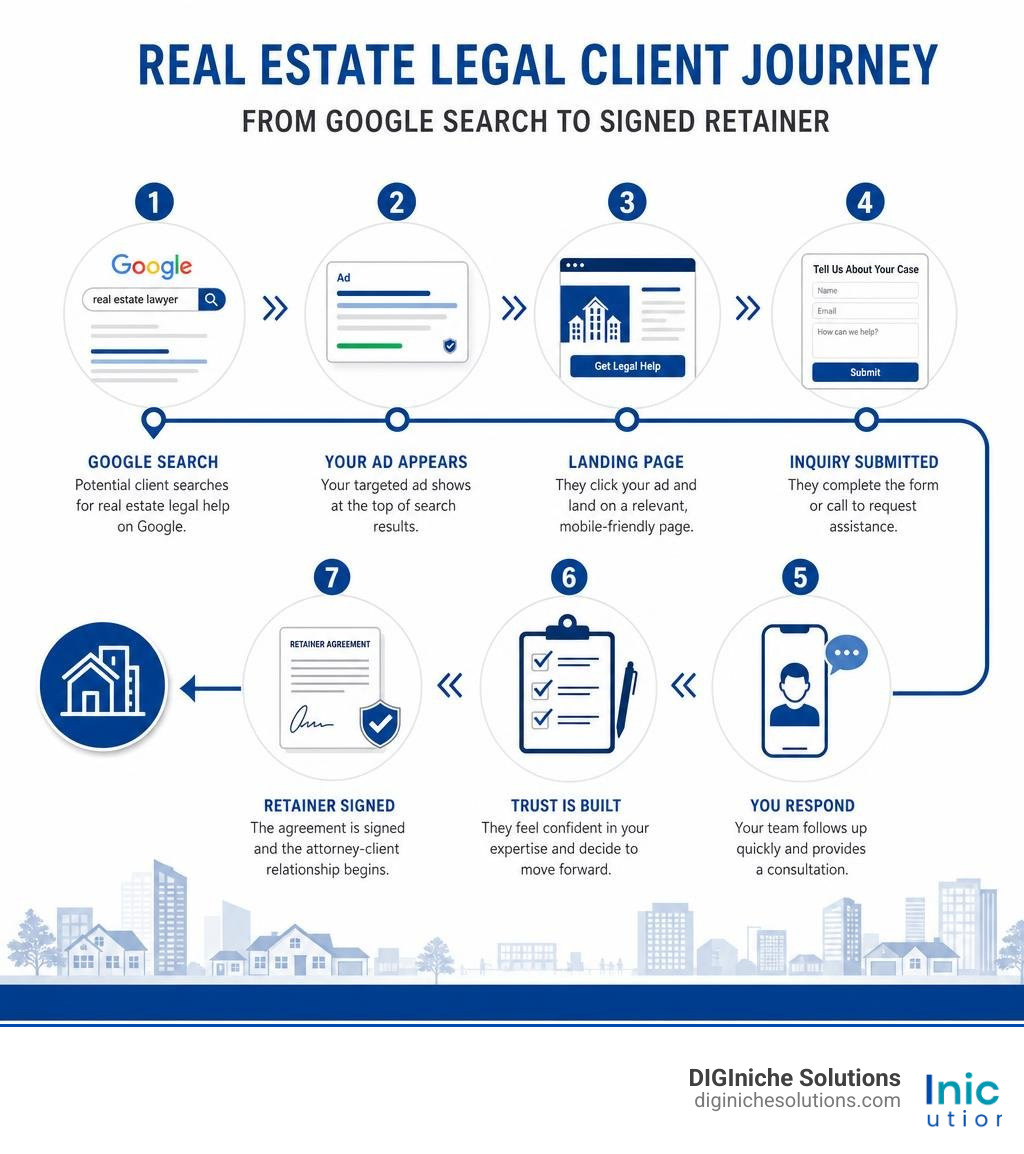
The Strategic Value of PPC Management Real Estate Lawyers Can Leverage
Managing paid advertising in the legal space is not a “set-it-and-forget-it” task. It requires constant attention, deep industry insight, and technical expertise. When done correctly, search engine marketing and pay-per-click (PPC) ads act as a predictable engine for lead acquisition.

Instead of waiting months for organic strategies to kick in, PPC puts your firm in front of motivated prospects the very same day you launch. To understand how to make this work for your practice, you can explore more info about pay-per-click services that help law firms build reliable lead pipelines.
How Real Estate PPC Differs from General PPC
General PPC campaigns—like those for e-commerce stores or local home services—are relatively straightforward. You target a broad product or service, set a modest bid, and direct traffic to a landing page.
In real estate law, campaigns must be highly segmented because the value and intent behind different practice areas vary drastically:
- Routine Residential Closings: These have lower transaction values and face stiff competition. Running ads for standard closings requires tight bidding because the average legal fees ($800 to $1,500) leave thin margins for high client acquisition costs.
- Commercial Real Estate: Commercial lease negotiations, land use, and zoning disputes carry much higher case values (often $6,000 to $20,000+). These B2B clients have larger budgets and are looking for highly specialized expertise.
- Landlord-Tenant Disputes & Evictions: These searches are driven by extreme urgency. Landlords dealing with non-paying tenants or lease violations need immediate help, resulting in exceptionally high conversion rates when ads are structured properly.
- Real Estate Litigation & Foreclosure Defense: These high-stakes cases involve boundary disputes, title defects, or property damage claims. The emotional and financial urgency is high, making PPC an incredibly effective channel.
The Economics of PPC Management Real Estate Lawyers Must Understand
To run a profitable campaign, you have to look past the initial cost-per-click (CPC) and focus on the lifetime value of a client and your overall return on investment (ROI).
In 2026, the average CPC for high-intent legal keywords ranges from $50 to over $300 in highly competitive niches like personal injury. However, real estate law enjoys a more moderate CPC range—typically between $30 and $85. This lower cost entry point makes real estate PPC highly lucrative if your conversion rates are optimized.
Consider the math:
- Ad Spend: $5,000/month
- Average CPC: $50 (resulting in 100 highly targeted clicks)
- Conversion Rate (Click to Lead): 15% (generating 15 inquiries)
- Close Rate (Lead to Signed Client): 33% (resulting in 5 signed cases)
- Average Case Value (Commercial/Litigation): $5,000
- Total Revenue Generated: $25,000
- Return on Ad Spend (ROAS): 5:1 ($5 returned for every $1 spent)
Only 57% of law firms maintain an annual marketing budget, and historical surveys show that almost zero solo practitioners operate with a set budget in place. To get ahead of your competition, you must treat your marketing as a strategic investment. You can read our detailed guide on tips to maximize your law firm marketing budget to ensure every dollar you spend is optimized for high-value returns.
Targeting High-Intent Keywords in PPC Management Real Estate Lawyers Campaigns
The foundation of any successful campaign lies in keyword selection. If you target broad terms like “real estate lawyer,” you will waste thousands of dollars on “tire-kickers” searching for “how to become a real estate lawyer” or “free real estate contract templates.”
Instead, your campaign must focus on long-tail, transactional keywords that signal a direct intent to hire an attorney immediately.
Here is a list of high-intent real estate law keywords that consistently convert:
- Commercial lease negotiation attorney Newark NJ
- Property boundary dispute lawyer near me
- Landlord eviction attorney NJ
- Real estate litigation law firm
- Title defect dispute lawyer
- Commercial real estate closing attorney
By pairing these high-intent terms with a robust list of negative keywords (such as “free,” “cheap,” “salary,” “jobs,” or “LegalZoom”), you prevent your ads from showing up on irrelevant searches, keeping your budget focused entirely on qualified leads.
Budgeting and Bidding Best Practices
Bidding on legal keywords requires a delicate balance of automation and control. Modern ad networks rely heavily on AI-driven automated bidding strategies (such as Target CPA or Maximize Conversions). However, these algorithms require historical data to work effectively.
When launching a new campaign, it is often best to start with manual bidding or Enhanced CPC to establish a baseline of clean traffic. Once your campaign generates consistent monthly conversions, you can transition to automated Smart Bidding to let search engine AI optimize bids in real-time.
To prevent runaway costs, we implement strict budget guardrails, including:
- Dayparting (Ad Scheduling): Only running ads during the hours your intake team is actually available to answer the phone.
- Geotargeting (Presence-Only): Setting your location targeting to “People in or regularly in your targeted locations,” rather than “People interested in your locations,” to avoid paying for out-of-state clicks.
- Device Bid Adjustments: Prioritizing mobile devices, as over 60% of urgent legal searches happen on smartphones.
Partnering with a specialized paid search advertising agency for law firm campaigns ensures that these complex bidding algorithms are managed by experts who protect your daily budget from wasteful spend.
PPC vs. SEO and Referrals: Why Real Estate Firms Need Both
Relying on a single marketing channel is a dangerous strategy. To build a resilient law practice, you need a diversified marketing ecosystem.

While organic search engine optimization (SEO) and professional referral networks are invaluable for long-term growth, they cannot match the speed and precision of a targeted PPC campaign. Utilizing PPC advertising for law firms allows you to capture immediate market share while your organic presence builds in the background.
To help you visualize how these channels complement each other, here is a comparison of the three primary client acquisition methods:
| Feature | Pay-Per-Click (PPC) | Search Engine Optimization (SEO) | Local Services Ads (LSAs) |
|---|---|---|---|
| Speed to Market | Immediate (Within 24-48 hours) | Slow (6 to 12 months) | Moderate (Requires verification) |
| Payment Model | Pay-per-click | Fixed optimization costs | Pay-per-qualified-lead |
| Search Placement | Top of page (below LSAs) | Middle/Bottom of page | Absolute top of page |
| Intent Level | High (Keyword targeted) | High (Content targeted) | High (Local intent) |
| Scalability | High (Adjust budget instantly) | Moderate (Requires content scaling) | Limited by local search volume |
The Limits of Relying Solely on Agent Referrals
Historically, residential real estate lawyers have built their firms entirely on relationships with real estate agents. While these referral networks are highly valuable, they have distinct limitations:
- Referral Fatigue: Agents work with multiple attorneys. If another lawyer offers a quicker turnaround, a lower fee, or better referral incentives, your steady stream of cases can dry up overnight.
- Market Shifts: When interest rates rise or the local housing market cools, transaction volumes drop. If your sole source of business is residential closings referred by agents, your revenue will fluctuate wildly with the market.
- No Control Over Case Mix: Agent referrals will only bring you residential closings. They will not bring you high-value commercial leases, partition lawsuits, or complex zoning cases.
By running independent PPC campaigns, you take control of your firm’s growth. You choose exactly which types of cases you want to bring in, insulating your firm from market downturns and referral dependency.
How PPC Accelerates Growth Faster Than SEO
SEO is a critical long-term asset, but it takes time to rank on the first page of search engine results. If you are a new firm, expanding into a new territory in New Jersey, or launching a new practice area, you cannot afford to wait six to twelve months for organic traffic to arrive.
PPC bypasses the waiting period entirely. The moment your campaign goes live, your firm appears at the very top of search results, directly in front of clients who need your services immediately. By mastering law firm PPC practices for lawyers to master online advertising, you establish immediate market dominance and generate cash flow that can fund your long-term SEO and branding efforts.
Choosing the Right Platforms and Ad Types for Real Estate Law
Not all digital advertising platforms are created equal. A strategy that works for a personal injury attorney might fail spectacularly for a property lawyer.
To maximize your return, you must deploy your budget across the specific platforms and ad formats where your target clients are actively searching.
Google Search Ads and Local Services Ads (LSAs)
Google is the undisputed king of high-intent search. When a commercial landlord needs to evict a non-paying tenant, or a buyer discovers a title defect, they do not browse social media looking for advice—they go straight to Google.
For real estate lawyers, we recommend a dual-action approach on Google:
- Google Search Ads: Traditional text ads that appear right below the search bar. These allow for highly customized messaging, landing page control, and precise keyword targeting.
- Google Local Services Ads (LSAs): These ads appear at the absolute top of the page and feature the highly trusted “Google Screened” badge. Unlike traditional PPC, LSAs operate on a pay-per-lead model, meaning you only pay when a prospect calls or messages your firm directly.
Implementing these 4 types of local law firm ads builds instant credibility. To obtain the Google Screened badge, your firm must pass a rigorous background and license verification check. This badge signals to prospective clients that your firm is fully verified, highly rated, and legally compliant.
Social Media and Retargeting for Property Attorneys
While Google is excellent for capturing active searches, social media platforms like Meta (Facebook and Instagram) are highly effective for audience segmentation and retargeting.
Most people who visit your law firm’s website will not contact you on their first visit. They might get distracted, want to think it over, or need to gather their paperwork. Without retargeting, those visitors are lost forever.
By placing a tracking pixel on your site, we can run highly targeted retargeting ads on Facebook and Instagram. When a past visitor scrolls through their social feed, they will see a professional ad reminding them of your expertise. This keeps your firm top-of-mind and dramatically lowers your overall cost-per-lead. Exploring strategies for maximizing your law firm ads on social media allows you to nurture prospects who are still in the decision-making phase of their legal journey.
Optimizing Landing Pages, Tracking, and Compliance for Maximum ROI
Driving traffic to your website is only half the battle. If your ads direct clicks to a generic, cluttered homepage, visitors will quickly hit the “back” button, wasting your valuable ad spend.
To convert clicks into consultations, you must send users to a dedicated, high-converting landing page designed specifically for the ad they clicked.
Conversion Tracking and Call Attribution
To optimize your PPC campaigns, you must know exactly which keywords, ads, and campaigns are driving actual business. This requires setting up robust conversion tracking and call attribution.
Over 70% of legal leads prefer to contact law firms via phone rather than filling out an online form. To track these calls back to the specific keyword that triggered the ad, we use Dynamic Number Insertion (DNI). DNI dynamically replaces the phone number on your landing page with a unique tracking number for each visitor, allowing us to connect online clicks to offline phone calls.
To measure your campaign’s true performance, you must track these key metrics:
- Click-Through Rate (CTR): The percentage of people who click your ad after seeing it (target: 3% to 5%+).
- Conversion Rate: The percentage of landing page visitors who contact your firm (target: 8% to 15%+).
- Cost-Per-Lead (CPL): The total ad spend divided by the number of leads generated.
- Cost-Per-Acquisition (CPA): The total ad spend divided by the number of signed cases.
Ensuring Compliance with Attorney Advertising Rules
Attorney advertising is heavily regulated by state bar associations. When running PPC campaigns in New Jersey or nationwide, your ads and landing pages must strictly adhere to professional ethics rules.
Key compliance guidelines include:
- Avoiding Misleading Claims: Never guarantee specific outcomes, promise “the best” results, or refer to your firm as “specialists” unless officially certified by the state bar.
- Clear Disclaimers: Ensure your landing pages contain clear disclaimers stating that past results do not guarantee future outcomes, and that contacting the firm does not establish an attorney-client relationship.
- Honest Pricing: If you advertise specific flat fees (such as for residential closings), ensure all terms, exclusions, and additional costs are clearly disclosed.
For a comprehensive understanding of these rules, we always advise reviewing the American Bar Association guidelines on attorney advertising to keep your campaigns fully compliant and ethical.
Frequently Asked Questions About Real Estate PPC
How long does it take to see results from a real estate PPC campaign?
You will typically see initial search engine visibility and lead activity within the first 7 to 14 days of launching your campaign. However, search engine algorithms require a “learning phase” to optimize bidding. Most real estate law firms see their campaigns hit peak optimization and consistent, high-quality lead flow within 4 to 6 weeks.
What are the most common PPC mistakes real estate lawyers make?
The single biggest mistake is sending paid traffic to the firm’s homepage instead of a dedicated landing page. Homepages have too many distractions and dilute the user’s focus. Other common errors include using broad match keywords (which attract irrelevant traffic), failing to set up a comprehensive negative keyword list, and targeting an entire state instead of focusing strictly on the local counties or cities where you actually practice.
What is the typical cost-per-click and cost-per-lead for real estate law?
In 2026, the average cost-per-click (CPC) for real estate law keywords ranges from $30 to $85, depending on the competitiveness of your local market. Due to these moderate click costs, a highly optimized landing page can achieve an average cost-per-lead (CPL) of $80 to $150, which is significantly lower than the $200+ industry average seen in other legal fields.
Conclusion: Partner with DIGIniche Solutions to Dominate Your Local Market
Winning high-value real estate leads online requires more than just bidding on keywords. It demands a comprehensive digital strategy that turns anonymous clicks into signed clients.
At DIGIniche Solutions, we specialize in helping law firms nationwide scale their practices through our proprietary V.E.R.A. Formula. By focusing on Visibility (putting you at the top of Google), Engagement (building high-converting landing pages), Retention (retargeting prospective clients), and Amplification (maximizing your ROI), we build a scalable client-growth ecosystem tailored specifically to your firm’s goals.
Stop letting your competitors win the clients searching for your services. Master online advertising with DIGIniche Solutions and let us build a high-performing PPC campaign that keeps your phone ringing and your calendar booked.
