

Why Strategic SEO for Mass Tort Lawyers Beats Volatile Lead Buying
To sign high-value claimants consistently, executing effective seo for mass tort lawyers requires building owned topical authority rather than renting recycled contacts from lead brokers:
- Target the Full Symptom-to-Litigation Funnel: Create dedicated content clusters that capture early symptom queries, product recall alerts, and active multidistrict litigation (MDL) docket updates.
- Publish Deep Scientific and Diagnostic Proof: Detail exact medical conditions, diagnostic codes, and FDA regulatory timelines to satisfy Google’s strict Your Money or Your Life (YMYL) standards.
- Capitalize on First-Mover Timing: Publish optimized practice hubs within the first 30 to 60 days of emerging litigation to capture top organic rankings before paid auction costs spike.
Paid ads capture less than 10% of search clicks, while the top three organic results earn nearly 70%. When legal clicks regularly exceed $150 to $300 in paid search auctions, organic search visibility provides a compounding, defensible channel to secure exclusive retainers at a fraction of the acquisition cost.
I’m Frank Demming, founder of DIGIniche Solutions, and for more than a decade I have helped law firms build predictable case engines through high-impact marketing and seo for mass tort lawyers. In this guide, I will show you the exact system our agency uses to help growing law practices outrank multi-million-dollar lead aggregators and turn organic search into a reliable source of signed cases.
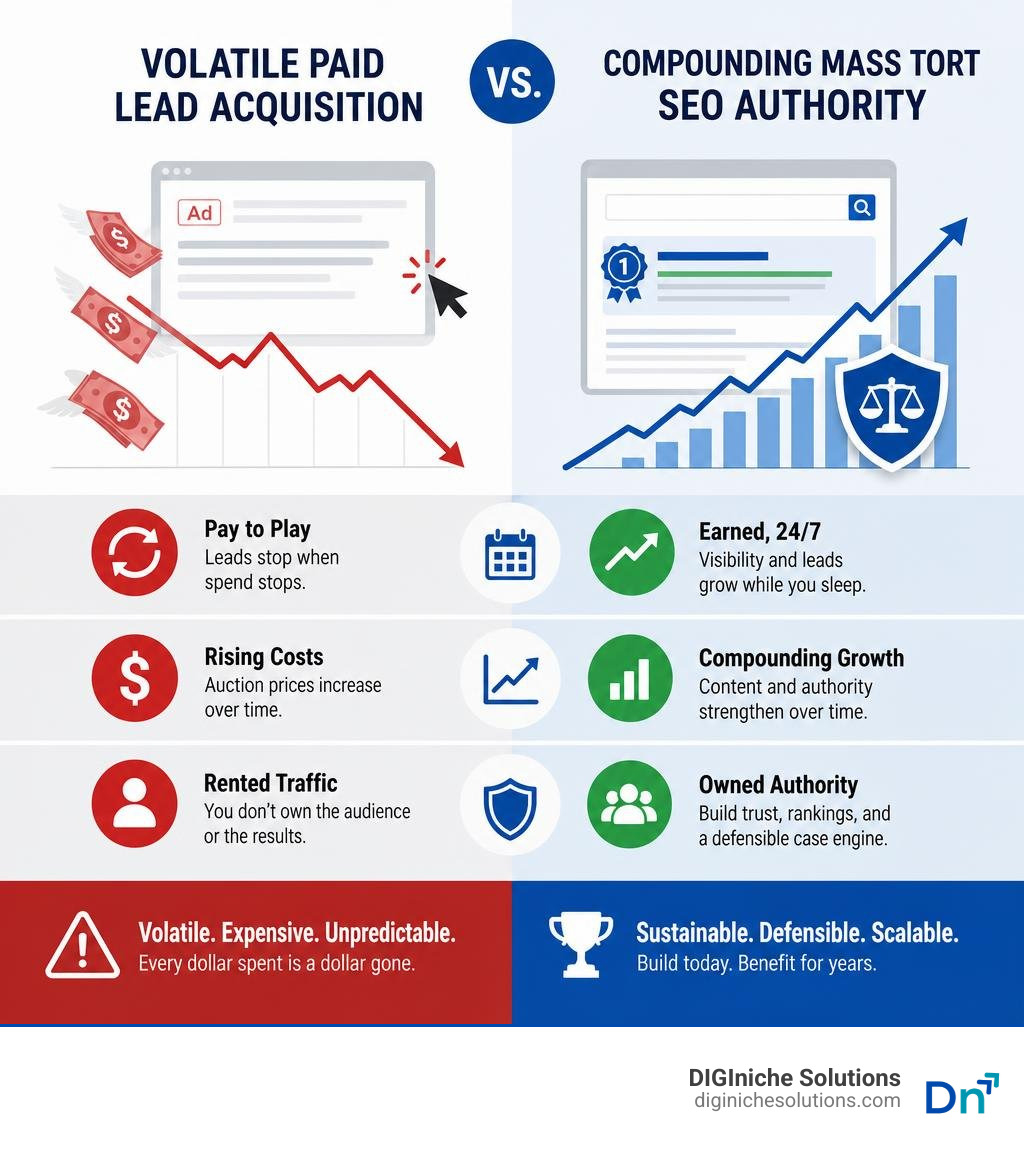
Mass Tort vs. Personal Injury: Why Pay-Per-Lead Models Fail
While traditional personal injury cases are inherently local—think of a car crash in Clifton NJ or an icy slip-and-fall in Passaic County NJ—mass tort litigation operates on a national scope. Potential claimants rarely search for an attorney down the street. Instead, they seek out the foremost authority on a specific defective drug, medical device, or toxic environmental exposure.
Unfortunately, many firms try to fast-track this process by buying leads from aggregators and third-party ad brokers. These lead generation mills often run vague “medical alert” campaigns, gathering consumer inquiries and quietly selling the exact same lead to multiple competing firms. This forces your intake team into a frantic race to dial the phone first, only to reach a confused claimant who has already been contacted by three other law offices.
When firms rely on buying leads, their client acquisition costs skyrocket while lead quality plummets. Organic search changes this equation entirely by meeting claimants at the exact moment they are looking for answers.
| Marketing Attribute | Mass Tort Organic SEO | Paid Lead Aggregators & Ad Farms |
|---|---|---|
| Lead Exclusivity | 100% exclusive; claimants reach out directly to your brand. | Shared; often resold to 3–5 competing law firms. |
| Claimant Intent | High; users actively research symptoms, science, and lawsuits. | Low to Moderate; often prompted by disruptive social ads. |
| Long-Term Cost | Compounding equity; cost per signed claimant decreases over time. | Linear to rising; costs reset to zero every single month. |
| Asset Ownership | You own the digital real estate, rankings, and content library. | You rent temporary access to a third-party pipeline. |
| Regulatory Trust | Transparent E-E-A-T signals aligned with state bar standards. | High regulatory scrutiny from courts and the FTC. |
The Economics of Owned Authority vs. Rented Intake
The primary business problem with paid lead aggregation is that it creates zero residual enterprise value. If you spend $100,000 this month on lead brokers, you might secure a handful of retainers. Next month, your pipeline is completely empty until you write another check.
By understanding Why Personal Injury SEO Is Worth It, law firms realize that organic optimization acts as a permanent capital asset. While paid click prices in mass tort niches fluctuate wildly between $150 and $300+ per click, an authoritative content library continually attracts qualified claimants. In organic search, your target cost per signed claimant typically stabilizes between $400 and $3,500 over the life of a campaign, generating compounding returns that pay-per-lead models cannot match.
Navigating the Multi-District Litigation Lifecycle
Mass tort campaigns are governed by what legal marketing strategists describe as the litigation lifecycle. A tort is not a static practice area; it moves through distinct phases that dictate how prospective plaintiffs search online.
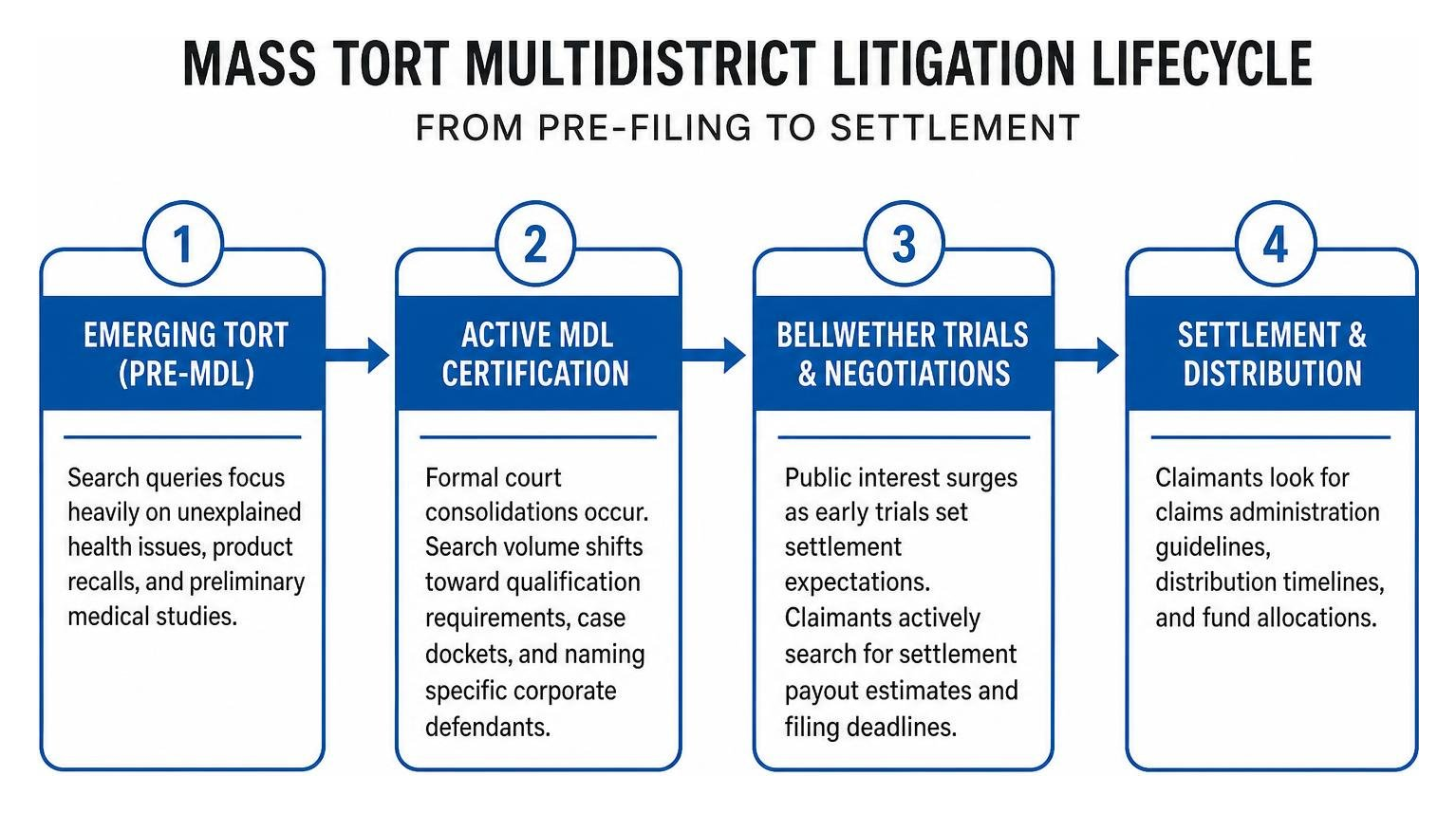
- Emerging Tort (Pre-MDL): Search queries focus heavily on unexplained health issues, product recalls, and preliminary medical studies.
- Active MDL Certification: Formal court consolidations occur. Search volume shifts toward qualification requirements, case dockets, and naming specific corporate defendants.
- Bellwether Trials & Negotiations: Public interest surges as early trials set settlement expectations. Claimants actively search for settlement payout estimates and filing deadlines.
- Settlement & Distribution: Claimants look for claims administration guidelines, distribution timelines, and fund allocations.
Firms that implement the principles laid out in Mass Tort Law Marketing: Authority-First System build content before search volumes peak, capturing dominant organic rankings long before ad auctions become cost-prohibitive.
Core Strategy: The Tort Authority Stack and Keyword Tiering
To capture search visibility against massive aggregators, legal websites must implement a structured framework that demonstrates deep scientific command, named attorney credentials, and litigation milestones. Search engines evaluate legal pages under strict Your Money or Your Life (YMYL) guidelines, meaning shallow, generic landing pages will never achieve top positions.

Understanding Why Your Law Firm Needs Topic Clusters to Establish Real Authority is vital here. Rather than creating a single catch-all page for a major lawsuit, successful firms organize their websites into a multi-tiered keyword taxonomy.
- Tier 1: Core Pillar Hubs: Comprehensive overview pages targeting primary transactional keywords (e.g., “[Drug/Device Name] lawsuit lawyer”). These pages range from 3,000 to 6,000 words, detailing legal theories, procedural histories, and qualification standards.
- Tier 2: Cluster Spoke Content: Supporting pages answering specific informational inquiries, such as diagnostic testing requirements, specific illness connections, FDA warning letters, and MDL docket updates.
- Tier 3: Long-Tail Symptom Queries: Granular articles addressing niche questions (e.g., “[Product Name] side effects timeline” or “[Condition] after medical implant”).
Content Architecture in SEO for Mass Tort Lawyers
A fully realized mass tort content cluster typically requires 40 to 150 individual, highly detailed pages per active litigation. Claimants search using natural, experiential language rather than courtroom terminology. They rarely begin by searching for multidistrict litigation; they search for the physical discomfort they are experiencing.
When you learn How to Pick Attorney Blog Keywords That Turn Readers Into Clients, you can map your content architecture to match claimant awareness stages:
- Symptom & Exposure Articles: Explain physiological mechanisms of harm and medical literature.
- Product Safety & Regulatory Analysis: Document FDA recall notices, corporate internal memorandums, and warning labels.
- Eligibility & Documentation Checklists: Provide clear guidance on exposure dates, medical records needed, and qualifying criteria.
- Streamlined Intake Pages: Present friction-free, secure intake workflows that qualify claimants based on active MDL criteria.
Winning High-Authority Backlinks and Digital PR
In high-stakes legal search, backlinks serve as critical votes of confidence. While standard local businesses might survive on local citations, mass tort litigation demands national-scale authority. Leading mass tort websites consistently secure 50 to 200 high-authority backlinks per quarter for each active litigation area.
Effective link-building strategies include:
- Original Legal & Scientific Analysis: Publishing breakdowns of court rulings, FDA adverse event reporting data, and statistical analyses that journalists, medical writers, and legal industry publications cite.
- Digital PR and Press Releases: Distributing newsworthy updates surrounding bellwether trial milestones, court hearings, and leadership appointments to plaintiff steering committees.
- Legal Directory Listings & Scholarly Citations: Contributing guest commentary to established legal platforms, academic journals, and bar association publications.
Fundamental Pillars of SEO for Mass Tort Lawyers in 2026
Modern search optimization requires a balance between authoritative content, clean technical infrastructure, and unambiguous trust signals. To understand SEO for Law Firms: What Actually Moves the Needle, firms must avoid common technical pitfalls that prevent large content libraries from indexing efficiently.
A frequent debate among attorneys is whether to build separate, stand-alone microsites for each emerging tort or publish everything under subdirectories of their primary domain (e.g., yourfirm.com/mass-torts/case-name/). For the vast majority of firms, using subdirectories on your established domain is far superior. A dedicated subdirectory inherits the cumulative domain rating and backlink profile of your primary website, allowing newly published pages to index and rank significantly faster than an unrated, brand-new domain.
Executing Technical SEO for Mass Tort Lawyers
When managing large content hubs spanning dozens of pages, technical performance directly influences crawl efficiency and organic conversions:
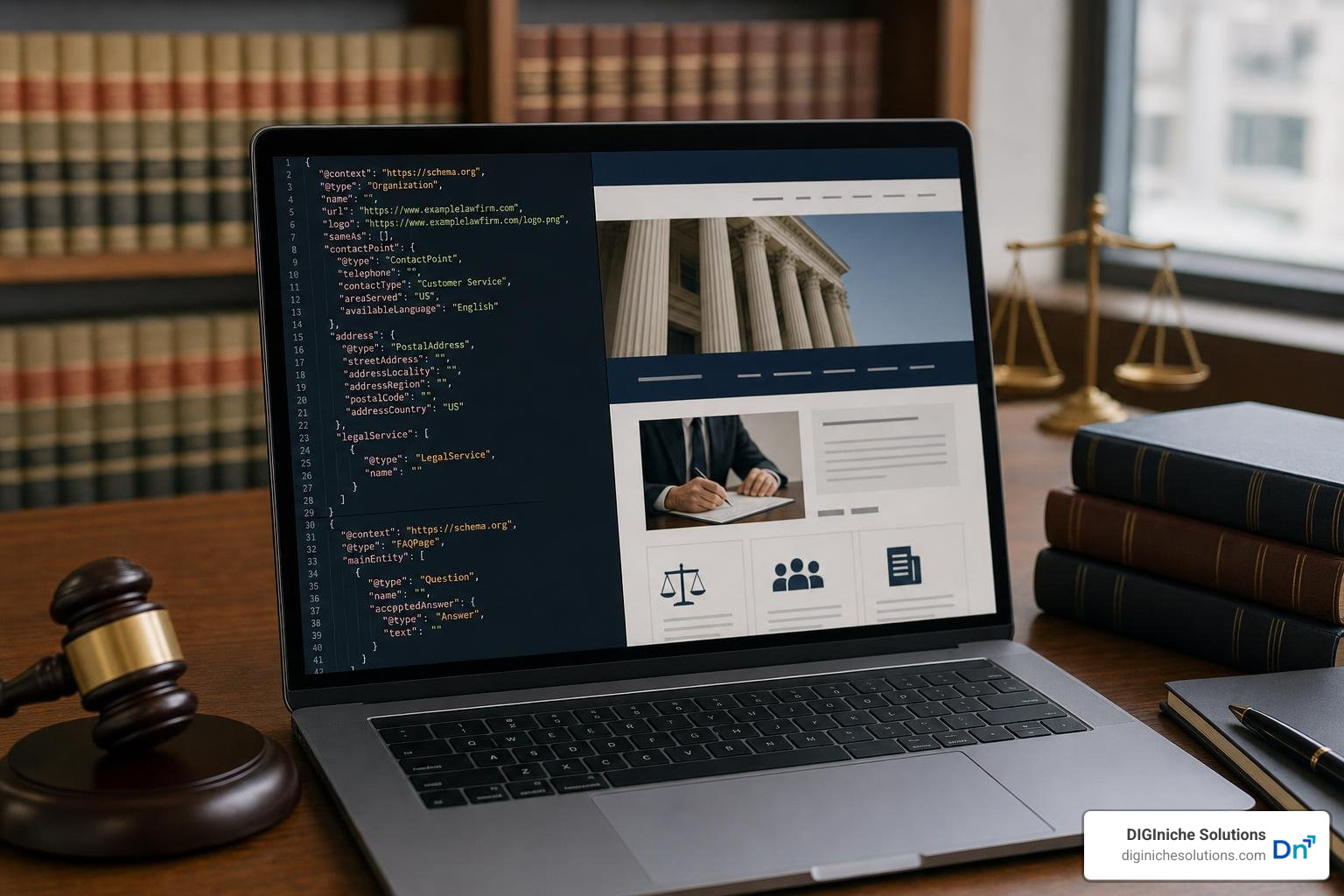
- Structured Data Markup: Implement nested JSON-LD schema, including
LegalService,Attorney,AboutPage, andFAQPageschemas. This explicitly defines your trial attorneys, their active bar admissions, and specific litigation specialties to search crawlers. - Core Web Vitals & INP: Ensure that heavy interactive intake forms and third-party live chat plugins do not degrade your Interaction to Next Paint (INP) score. Debounce dynamic form handlers and defer unnecessary scripts to maintain mobile response times below 200 milliseconds.
- Crawl Budget and Architecture: Ensure your site architecture keeps every critical mass tort landing page within three clicks of the homepage, supported by segmented XML sitemaps for active litigations.
Capturing Spanish-Language Mass Tort Demand
One of the largest, most consistently overlooked opportunities in mass tort litigation is Spanish-language search optimization. Hispanic workers and consumers are disproportionately impacted by numerous environmental, agricultural, and consumer product torts, yet legal competitors rarely create comprehensive Spanish resources.
Spanish search terms often exhibit substantially lower keyword difficulty and up to 30% to 50% lower advertising competition. To capture this demand effectively:
- Build dedicated subfolders (e.g.,
/es/) featuring culturally nuanced, human translations—never rely on automated browser translation plugins that mangle legal and medical nuances. - Implement precise
hreflangannotations to tell search engines which language version corresponds to each page. - Provide a fully bilingual intake process, ensuring Spanish-speaking claimants are immediately greeted by fluent intake specialists.
Generative Engine Optimization (GEO) and AI Search Visibility
Search behavior is transforming rapidly. With the widespread integration of Google AI Overviews, ChatGPT, Perplexity, and Claude into consumer search routines, prospective claimants increasingly receive direct, AI-synthesized summaries before clicking standard blue links.
For law firms exploring How to Rank in ChatGPT: A Step-by-Step Guide for Personal Injury Lawyers and weighing SEO vs GEO: Which Is Better for Your Law Firm?, the core takeaway is clear: generative engines pull information from websites that demonstrate unquestioned authority, clear structured data, and verifiable expertise.
Structuring Answer Blocks for AI Overviews
Generative search engines function as strict trust filters. When evaluating complex medical and legal queries, AI systems actively exclude thin aggregator pages in favor of authoritative sources that present clear, concise answers.
To ensure your practice is cited directly in AI summaries:
- Format Self-Contained Answer Blocks: Structure critical sections of your landing pages into concise, 350-to-450-word blocks that answer specific questions directly (such as eligibility criteria, filing deadlines, or diagnostic requirements).
- Integrate Verifiable Attorney Credentials: Clearly display attorney bios, bar admissions, trial leadership appointments, and professional memberships alongside published content.
- Provide Objective, Cited Evidence: Reference peer-reviewed medical journals, FDA regulatory documents, and official MDL court docket numbers within your content.
Hybrid Acceleration: Balancing Organic SEO with Paid Campaigns
Although organic search provides the most sustainable, cost-effective long-term foundation for client acquisition, active mass tort windows can sometimes be brief. Statutes of limitations and bellwether scheduling create firm deadlines for gathering claimants.
Firms looking to master this dynamic should consult our PPC Management Attorney’s Guide 2026. A balanced hybrid strategy uses targeted pay-per-click ads to secure immediate claimants during the earliest phases of litigation while your comprehensive SEO topic clusters build ranking momentum. Working alongside seasoned practitioners like New Jersey Mass Tort Litigation Lawyers, firms can route organic and paid traffic into dedicated, high-converting qualification funnels.
Ethical Intake and Bar Compliance Rules
Mass tort marketing is subject to strict oversight from state bar associations and the Federal Trade Commission (FTC). Operating multi-jurisdictional campaigns requires absolute transparency:
- Adhere to ABA Model Rule 7.1: Ensure all marketing communications are completely truthful. Avoid exaggerated outcome promises, misleading settlement projections, or deceptive “official lawsuit alert” banners.
- Clear Advertising Disclosures: Include mandatory attorney advertising disclaimers and clearly disclose where legal services will be performed and whether cases may be handled in co-counsel partnerships.
- Pre-Qualification Intake Design: Structure intake questionnaires around specific MDL criteria (e.g., verifying exact exposure dates, brand verification, and documented medical diagnoses) to protect your staff from processing unviable inquiries.
Frequently Asked Questions about Mass Tort SEO
How quickly can a law firm rank for an emerging mass tort?
If your firm already possesses an established domain with healthy topical authority and you publish comprehensive content within the first 30 to 60 days of an emerging MDL announcement, you can achieve first-page organic rankings in as little as 2 to 6 weeks. For mature, highly saturated litigations that have been active for years, ranking on page one typically requires 6 to 12 months of sustained content development and strategic link acquisition.
Should our firm use dedicated microsites or subdirectories?
For almost all law practices, subdirectories (such as yourfirm.com/mass-torts/case-name/) are far more effective than launching separate microsites. Subdirectories leverage your existing domain authority, historical backlink equity, and search engine trust. Microsites start with zero authority and require separate link-building campaigns, significantly increasing your marketing overhead and delaying ranking results.
How do small law firms compete with national lead aggregators?
Small and mid-sized law firms compete successfully by providing scientific depth, local trust, and authentic legal credentials that faceless aggregators cannot replicate. Search engines and AI discovery tools prioritize verified trial attorneys who publish detailed case analyses. Furthermore, regional firms can leverage local trust across their home markets—such as communities throughout Newark NJ, Elizabeth NJ, Paterson NJ, and Lyndhurst NJ—to capture claimants directly before referring or co-counseling cases with national litigation leaders.
Conclusion: Building Compounding Legal Equity
Renting prospective claimants from pay-per-lead brokers is an expensive, volatile treadmill that leaves your practice with zero long-term assets. By establishing a dedicated, search-optimized content engine, your law firm builds proprietary authority that continuously generates exclusive, high-intent claimants across every stage of the litigation clock.
At DIGIniche Solutions, we help legal practices build scalable client-acquisition systems using our proprietary V.E.R.A. Formula (Visibility, Engagement, Retention, Amplification). Whether your practice is located in Wayne NJ, Clifton NJ, Nutley NJ, or anywhere across Bergen County NJ, our team delivers the strategic SEO and digital infrastructure you need to outrank lead aggregators and dominate competitive legal searches.
Ready to take control of your firm’s growth? Explore our specialized SEO for Lawyers New Jersey programs or reach out to our team today to map out a winning mass tort search strategy.
