

The Strategic Value of Attorney Lead Nurturing vs. Cold Acquisition
Attorney lead nurturing beats chasing cold prospects because it converts existing inquiries into signed retainers at higher rates, reduces client acquisition costs, and protects attorney billable time. Most managing partners believe their firm has a lead generation problem when they actually have a pipeline follow-up problem. Pouring capital into top-of-funnel campaigns without an organized follow-up system leads to severe intake waste. When an inquiry comes in, prospective clients are often overwhelmed, anxious, and actively comparing multiple legal practices across New Jersey. If your office fails to engage them with authoritative, reassuring guidance immediately, they move down search results to contact competing practices in Clifton, Wayne, or Newark.
The performance difference between cold acquisition and structured lead workflows is stark. As industry benchmarks show, the average attorney captures only 2.5 billable hours per day despite spending extensive time managing unorganized administrative duties and scattered intake calls. Moreover, client communication failures contribute to roughly 20% of all malpractice claims, with initial intake gaps and missed follow-ups regularly cited as primary root causes.
Implementing structured follow-up protects your staff’s billable time and converts a higher percentage of existing website traffic into signed retainers. A well-designed workflow bridges the gap between cold outreach and closed retainers, turning inquiries into consultations. To achieve this balance, review our approach to lead generation for lawyers made simple alongside proven automation frameworks such as the 5-Step Legal Lead Nurturing Automation Recipe for 2026.
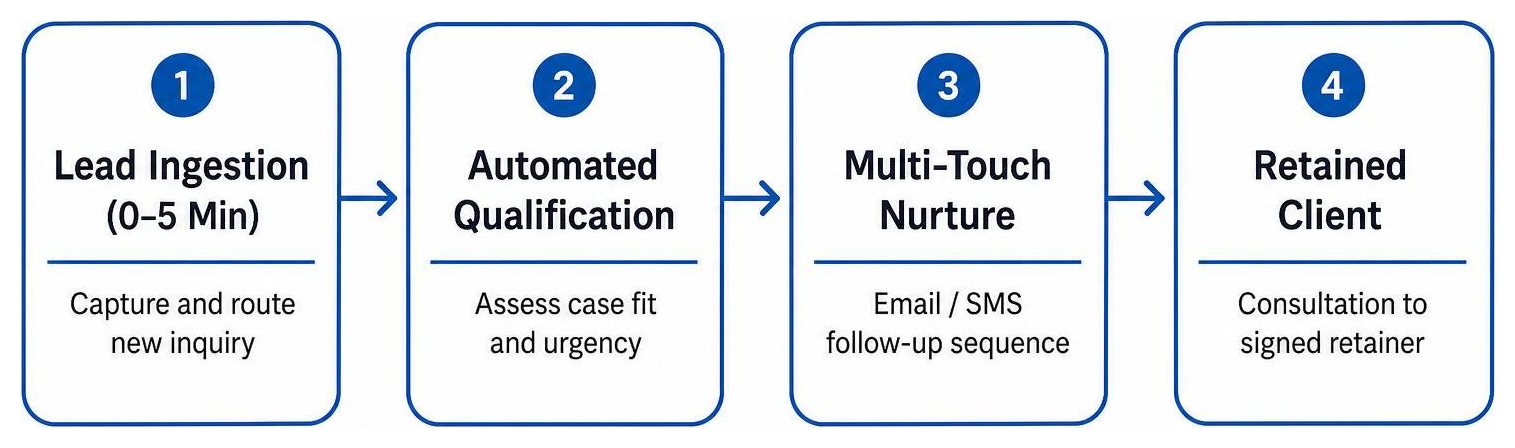
Core Stages of Attorney Lead Nurturing Across the Client Journey
Prospective legal clients move through clear psychological stages before signing an agreement:
- Awareness Stage: The prospect discovers an acute legal challenge—a motor vehicle collision on Route 46, a workplace dispute, or an impending divorce filing. They seek clarity on basic rights and potential exposure.
- Research Stage: The individual compares options, checks local directories, reads client reviews on platforms like Avvo, and evaluates practice authority.
- Consideration Stage: The prospect examines specific firm credentials, practice-area experience, fee structures, and immediate consultation availability.
- Decision Phase: The prospect decides whether to sign a retainer, attend a formal case assessment, or seek alternative representation.
Building systematic trust across each stage requires tailoring message cadences to lead urgency:
| Client Lifecycle Stage | Primary Prospect Concern | High-Intent Strategy (e.g., PI, Criminal) | Long-Cycle Strategy (e.g., Estate Planning, B2B) |
|---|---|---|---|
| Initial Inquiry (0–15m) | “Can someone help me right now?” | Immediate SMS + Direct Call Transfer | Automated Welcome Email + Intake Triage Form |
| Days 1–3 | “Do you understand my specific issue?” | 2x SMS check-ins + Process Checklist | Educational Practice Guide + Video Explainer |
| Days 4–7 | “Why should I choose your practice?” | Case Eligibility Breakdown + Call-to-Action | Firm Case Studies + Peer Endorsements |
| Days 8–14+ | “What happens if I delay action?” | Final Consultation Invite / Status Check | Monthly Newsletter + Regulatory Updates |
Lead Qualification and Practice-Area Segmentation
Not every inquiry warrants immediate attorney intervention. Law offices operating across Passaic County and Bergen County need structured intake qualification to filter out non-viable matters and prioritize high-value prospects. Utilizing proven frameworks like inbound lead qualification for practice founders ensures that intake staff quickly categorize matters by practice type, case viability, and geographic jurisdiction.
Proper segmentation prevents attorneys from reviewing unqualified submissions while ensuring prospective clients receive relevant educational material. Streamlining this process stops firms from burning capital on misaligned campaigns; see our guide on how to stop wasting money on bad digital marketing for law firms to align acquisition budgets with clear qualification criteria.
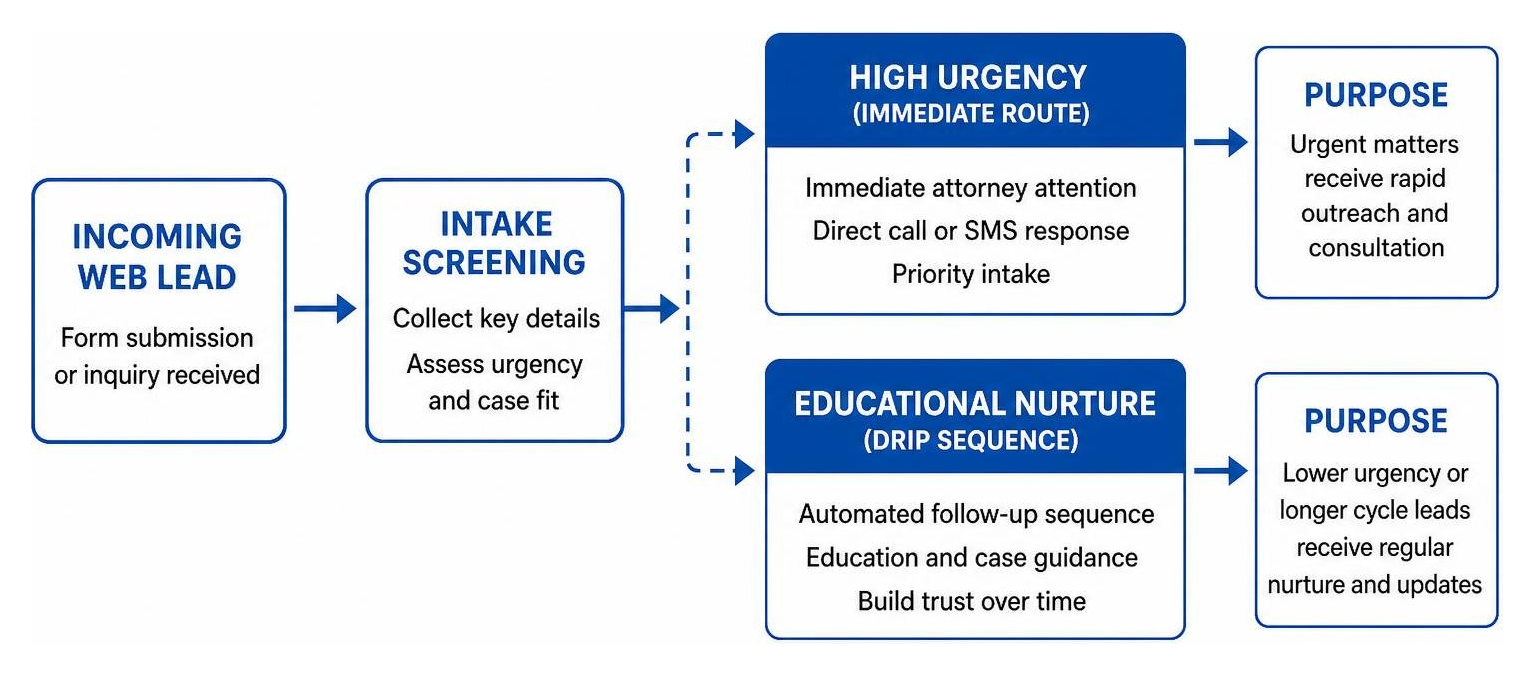
How to Build a Multi-Channel Legal Follow-Up Workflow
An effective legal follow-up system integrates multiple communication channels rather than relying on a single follow-up email. Combining personalized email sequences, automated SMS notifications, and authoritative content assets creates multiple touchpoints that address prospect concerns without overwhelming them.
Modern legal prospects engage across multiple channels: 97% of legal consumers search online for representation, and 85% trust online reviews as much as personal recommendations. Using educational blog posts, client guides, and case timelines within your outreach demonstrates authority. Law firms can turn published articles into high-converting assets by transforming your lawyer blog into a high converting lead engine.
Ideal Follow-Up Cadence and Contact Timeline
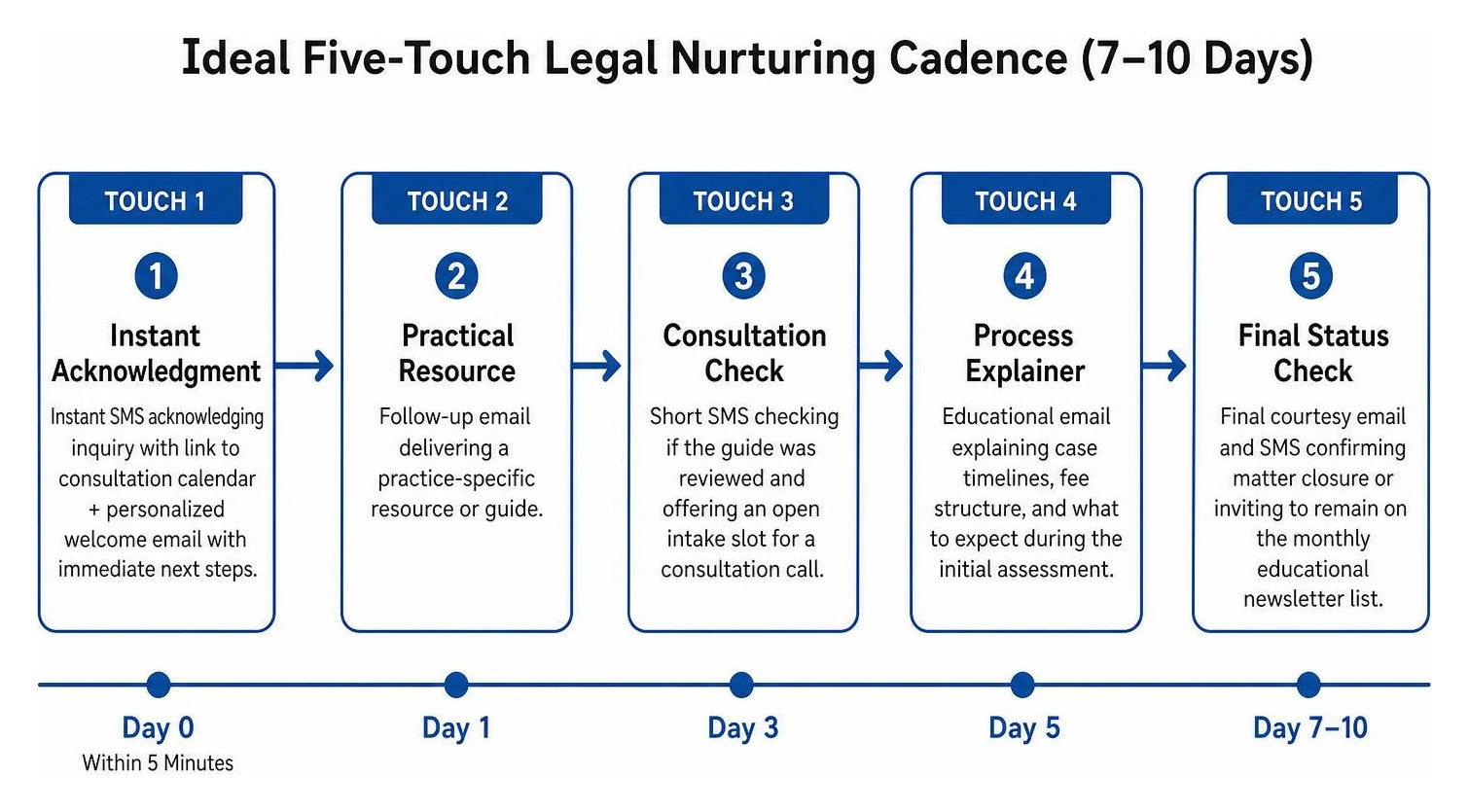
To keep prospects engaged without violating professional boundaries or causing inbox fatigue, use a structured 5-touch sequence deployed across a 7-to-10-day window:
- Touch 1 (Within 5 Minutes): Instant SMS acknowledging inquiry receipt with a direct link to the attorney’s real-time consultation calendar, accompanied by a personalized welcome email outlining immediate steps.
- Touch 2 (Day 1): Follow-up email delivering a practice-specific resource (e.g., “What to Do Immediately Following an Auto Accident in New Jersey” or “The Complete Northern NJ Estate Planning Checklist”).
- Touch 3 (Day 3): Short SMS checking if the prospect had time to review the guide and offering an open intake slot for an exploratory consultation call.
- Touch 4 (Day 5): Educational email breaking down standard case timelines, fee structures, and what to expect during an initial legal assessment.
- Touch 5 (Day 7–10): Final courtesy email and SMS confirming matter closure or inviting the contact to remain on the firm’s monthly educational newsletter list.
Essential Tech Stack for Automated Attorney Lead Nurturing
Executing systematic follow-up requires modern legal technology. Over 70% of practicing attorneys now utilize legal technology platforms daily. Integrating specialized tools creates a smooth handoff between initial contact and calendar booking:
- Legal CRM & Intake Automation: Platforms like Lawmatics, Clio Grow, or MyCase automate lead tracking, client communication logs, and intake forms. Firms utilizing optimized intake capture forms achieve average conversion rates around 18%.
- Lead Enrichment Tools: Utilizing specialized business development tools such as LinkedIn lead enrichment for practice founders helps corporate and transactional firms identify decision-makers and verify company scale before scheduling discovery calls.
- Direct Calendar Routing: Integrated scheduling software (such as Clio Scheduler or Calendly) allows qualified prospects to book directly onto an attorney’s calendar, reducing email back-and-forth and lowering appointment no-show rates.
- Centralized Data Tracking: Connecting your intake tech stack to comprehensive reporting dashboards ensures clear oversight of marketing spend. Implement our modern law firm analytics playbook for smarter practice decisions to evaluate channel-by-channel conversion efficiency.
Common Pitfalls in Legal Intake and How to Avoid Them
Even well-funded digital marketing campaigns struggle if the intake process has communication bottlenecks. Identifying and patching these operational leaks ensures that marketing dollars yield maximum retained revenue.

- Delayed Response Times: Waiting more than 30 minutes to follow up on a web form drastically cuts conversion rates. Leads contacted within the first five minutes convert at significantly higher rates than those contacted hours later.
- Generic Messaging: Sending cold, non-specific legal disclaimers instead of empathetic, practice-specific guidance discourages prospective clients from taking the next step.
- Over-Communication: Sending too many unsolicited text messages can frustrate prospects and risk violating consumer protection standards. Keep sequences within 5 to 7 total touchpoints and provide clear opt-out language (such as “Reply STOP to unsubscribe”) on every SMS.
- Neglecting Inactive Inquiries: Many legal matters have long gestation periods. Archiving non-responsive leads without an automated long-term email newsletter leaves future caseload growth on the table.
- Overpaying for Low-Quality Third-Party Leads: Purchasing shared, non-exclusive inquiries often results in low ROI and wasted staff time. Read our guide on how to get exclusive legal leads for attorneys without going broke to build sustainable, firm-owned acquisition pipelines.
Frequently Asked Questions About Legal Lead Management
Does automated lead follow-up violate state bar advertising rules?
No, provided the prospect initiated contact with your practice. Inbound inquiries—where a consumer submits a web form, requests a consultation, or calls your office—do not constitute prohibited direct solicitation under state bar guidelines, including the rules outlined in publications like the New Jersey Lawyer from the New Jersey State Bar Association. However, firms must ensure all automated messaging remains honest, free from misleading promises of specific outcomes, and includes immediate opt-out functionality.
How do law firms handle high-urgency leads compared to long-cycle inquiries?
High-urgency matters (such as criminal defense arrests, municipal court violations, or severe personal injury incidents) require immediate live-call routing within five minutes, bypassing multi-day educational drip sequences. Conversely, practice areas with longer decision cycles—such as commercial real estate transactions, estate planning, or business formation—benefit from a structured 10-to-14-day educational sequence focusing on asset protection, compliance obligations, and strategic preparation.
What key metrics measure the ROI of legal lead workflows?
Track four core performance indicators to evaluate pipeline health:
- Inquiry-to-Response Speed: The average minutes elapsed between lead submission and first contact.
- Sequence-to-Consultation Rate: The percentage of raw inquiries that convert into completed attorney discovery calls.
- Consultation-to-Retained Rate: The percentage of evaluated consultations that sign a formal retainer agreement.
- Cost Per Signed Client (CPA): Total acquisition spend divided by the total number of retained cases per marketing channel.
Conclusion
Chasing cold prospects across disconnected marketing campaigns creates intake burnout, drives up customer acquisition costs, and leaves your firm vulnerable to inconsistent case volume. By establishing a dedicated nurturing workflow, law firms across Passaic, Bergen, and Essex counties can turn routine inquiries into predictable, high-value client retainers while protecting attorney billable hours.
At DIGIniche Solutions, we help legal practices build scalable client-growth systems using our proprietary V.E.R.A. Formula—delivering Visibility, Engagement, Retention, and Amplification. Whether your firm operates in Wayne, Clifton, Paterson, Bloomfield, or Newark, our team builds the marketing funnels and automation engines your practice needs to thrive.
Ready to optimize your intake pipeline and increase consultation bookings? Scale your firm with a proven client-growth framework today.
