

Turn Your Lawyer Blog Into a Reliable Source of Qualified Cases
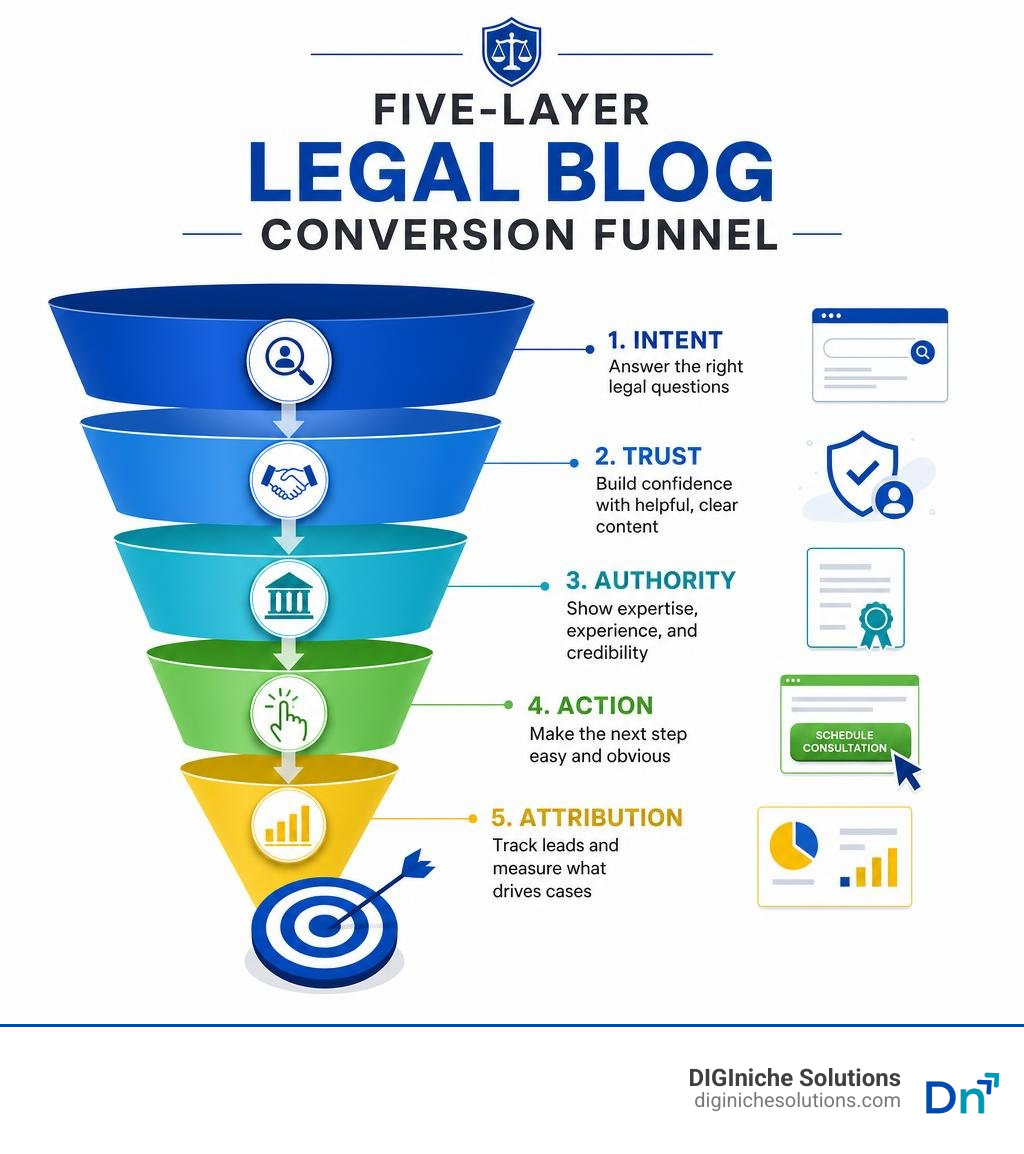
An effective SEO for lawyers blog does more than bring in traffic. It answers the legal questions your future clients ask, proves your firm’s credibility, and gives readers a clear next step toward a consultation.
Start with these five moves:
- Publish attorney-reviewed articles based on real intake questions.
- Target specific practice-area, problem, and location keywords.
- Link each blog post to a relevant service page and consultation path.
- Use clear headings, direct answers, current legal sources, and named attorney bylines.
- Track calls, forms, and signed cases – not just rankings or page views.
Legal search is different from most marketing. A person looking for help with a custody dispute, arrest, injury, or immigration issue may have an urgent deadline and may contact only a few firms. Your blog needs to earn trust quickly while meeting Google’s higher standards for legal content.
That means avoiding generic articles written for search engines alone. Build useful pages around your attorneys’ real experience, the laws in your jurisdiction, and the questions clients bring to your office. Then connect that helpful content to the practice pages and intake process that turn attention into retained matters.
I am Frank Demming, and I have spent more than a decade helping law firms improve lead generation through SEO, PPC, website optimization, and conversion strategy. In this guide to building an SEO for lawyers blog, I will show you how to turn useful legal content into a more predictable source of qualified cases.
Proven Architecture of an Effective SEO for Lawyers Blog
Most law firm websites suffer from an organizational identity crisis. Articles are dumped into an unorganized archive, intermingling updates about a summer associate barbecue with vital procedural guides on filing a commercial claim. When prospective clients land on such a site, they face friction; when Google’s search bots crawl it, they see disjointed pages rather than a coherent legal knowledge base.
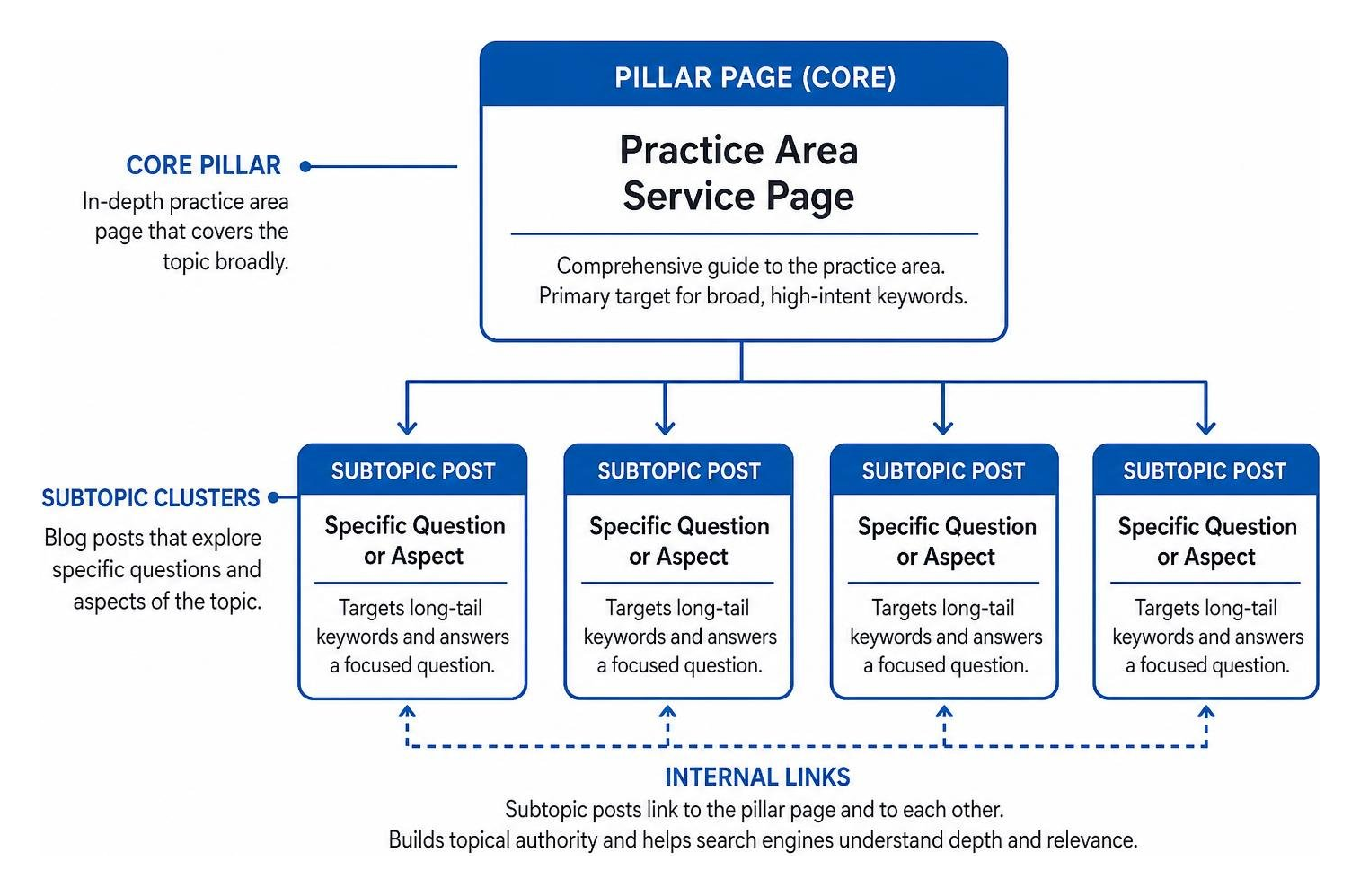
To build a blog that consistently ranks and converts, you must establish an intentional architecture. A flat website structure ensures any high-value article or practice area landing page sits within two to three clicks of your homepage. By building topical clusters, your blog stops acting as an isolated stream of opinions and starts serving as a supporting framework for your primary service offerings.
Understanding why your law firm needs topic clusters to establish real authority helps clarify how search engines evaluate depth: they reward sites that systematically cover every facet of a legal topic rather than those publishing random, disconnected posts.
Satisfying YMYL Standards and E-E-A-T
Google places legal content into the high-stakes classification known as Your Money or Your Life (YMYL). A poorly prepared recipe blog might leave someone with an unappealing dinner, but inaccurate legal information can cause missed filing deadlines, waived claims, financial ruin, or loss of freedom. Because the consequences are severe, search algorithms evaluate legal content under the strictest E-E-A-T (Experience, Expertise, Authoritativeness, and Trustworthiness) guidelines.
To clear this high algorithmic bar, your firm’s blog must prove real-world practitioner involvement:
- Named Attorney Bylines: Never publish content under “Admin” or “Staff.” Attribute every article to a licensed attorney with a headshot and a link to a comprehensive bio detailing bar admissions, court jurisdictions, and trial background.
- Reviewed-By Tags: If professional marketing writers assist with drafting, include a clear “Reviewed and Verified by [Licensed Attorney]” notice along with the date of review.
- First-Hand Experience: Reference authentic local court procedures, statutory codes, and anonymized procedural hurdles encountered in real litigation.
- Verifiable Legal Citations: Cite exact statutory numbers, court decisions, and official administrative rules rather than offering broad summaries.
Reviewing practical guides such as SEO for Lawyers: Content Creation Tips and Tricks helps reinforce why superficial content is quickly filtered out of competitive YMYL searches.
Structuring Internal Links and Practice Area Hubs
Internal links are the pathways that pass authority (PageRank) and guide human visitors toward retaining your firm. An informational blog post should never leave a reader at a dead end. Instead, contextual internal links placed within the body copy should seamlessly connect the educational article back to its corresponding core practice area page.
For instance, an article discussing the steps to take after a multi-vehicle collision should link directly to your commercial vehicle accident landing page. Similarly, distinct blog posts within the same practice silo should cross-reference one another using descriptive, keyword-rich anchor text. For a comprehensive breakdown of site-wide optimization, review law firm SEO the ultimate guide to align your site hierarchy from top to bottom.
How to Conduct Legal Keyword Research That Generates Retained Cases
Keyword research for lawyers requires understanding the distinction between educational searches and hiring searches. Broad national terms may generate massive traffic numbers, but if a reader in a distant jurisdiction lands on your site, they cannot hire your firm.
In competitive areas like personal injury, criminal defense, and family law, pay-per-click costs frequently range from $150 to over $700 per click. Effective organic keyword targeting lets you capture high-value search intent systematically without paying for every visit.
| Query Type | Example Search Query | Primary User Intent | Typical Conversion Action |
|---|---|---|---|
| Transactional | Car accident lawyer near me | Immediate legal representation | Direct phone call or emergency intake form submission |
| Commercial Investigation | How to choose the best divorce attorney | Comparing firm qualifications and fees | Downloading an intake checklist or scheduling a consultation |
| Informational (High Intent) | How long after an arrest do you see a judge? | Urgent procedural guidance | Contacting an attorney for immediate defense help |
| Informational (Broad) | History of personal injury law | Academic research / General interest | Reading and exiting without retaining counsel |
Step 1: Mapping High-Intent Topics for Your SEO for Lawyers Blog
The best keyword source is already sitting inside your office: your intake department. When prospective clients call your firm, what specific questions, fears, and procedural uncertainties do they express?
Answering these real-world questions in your articles captures prospective clients at the exact moment they need guidance. Rather than targeting vanity terms, learn how to pick attorney blog keywords that turn readers into clients by focusing on problem-oriented long-tail phrases. Roughly 83% of organic website searches stem from long-tail keywords, which carry higher hiring intent than broad phrases.
Analyzing Search Intent Across the Legal Funnel
Legal consumers move through clear decision stages before retaining an attorney:
- Top of the Funnel (ToFu – Awareness): The searcher realizes they have a legal challenge (e.g., “signs of nursing home neglect”).
- Middle of the Funnel (MoFu – Consideration): The searcher understands their problem and evaluates legal solutions (e.g., “nursing home neglect settlement timeline”).
- Bottom of the Funnel (BoFu – Decision): The searcher is ready to hire an attorney in their local area (e.g., “nursing home abuse lawyer in Clifton NJ”).
Your blog posts should primarily address top- and middle-of-the-funnel inquiries, creating a direct path to bottom-of-the-funnel service pages. Understanding why your law firm needs custom content marketing will help you produce content that addresses each stage instead of relying on generic cookie-cutter posts.
On-Page Optimization and Content Formatting for Search and AI Engines
A well-optimized legal article must satisfy two audiences: stressed human readers who scan content on mobile screens, and search engine crawlers that index semantic structure.

Ensure your on-page elements meet the following standards:
- Title Tags: Keep titles between 55 and 65 characters. Place the primary keyword and location qualifier near the front, followed by your firm name.
- Meta Descriptions: Write compelling summaries under 155 characters that include an actionable next step for the reader.
- Header Architecture: Maintain a clean heading hierarchy (H1 for page title, H2 for major sections, H3 for supporting points).
- Image Optimization: Limit descriptive alt text to 125 characters or fewer to maintain accessibility and clear context.
Optimizing Generative AI Overviews for an SEO for Lawyers Blog
In 2026, over 78% of legal search queries trigger an AI Overview at the top of Google, and organic CTR on traditional blue links drops by roughly 61% when an AI summary is present. However, law firms directly cited within those AI Overviews earn a 35% higher CTR than the standard organic results below them.
To earn citations in Google AI Overviews, ChatGPT, Claude, and Perplexity:
- Lead with Direct Answers: Research shows that 44.2% of LLM citations are extracted from the first 30% of a web page. Place direct, self-contained answers (50 to 170 words) immediately below question-based H2 or H3 headers.
- Provide Information Gain: Avoid rephrasing basic definitions. Provide unique value through direct statutory references, step-by-step procedural workflows, and specific state bar guidance.
- Maintain Consistent Entity Data: AI systems rely on corroboration across third-party sources (such as bar directories and legal publications) to confirm your firm’s authority.
Technical On-Page Optimization and Legal Schema
Structured data (schema markup) translates your website’s content into machine-readable code that search engines interpret with precision. Essential schema types for law firm blogs include:
- LegalService & Attorney Schema: Declares your firm’s official business name, physical office address, licensed attorneys, and practice jurisdictions.
- FAQPage Schema: Outlines question-and-answer pairs within an article to help search engines extract direct answers for SERP rich snippets.
- Article Schema: Confirms the publishing date, author credentials, publisher identity, and modification history.
Combine schema markup with strong technical site performance. Your pages should load in under 2.5 seconds to meet Core Web Vitals standards, and your design must be fully responsive for mobile devices. For more technical fundamentals, review the Nine SEO Fundamentals for Lawyers – DC Bar framework.
Promoting Content, Building Authority Links, and Ensuring Ethics Compliance
Publishing quality content is only half the battle. To rank for competitive practice area terms, your law firm must build third-party authority through ethical backlink acquisition and digital public relations.

Effective promotion requires a strategic approach to off-page visibility, which you can explore further in our guide on digital marketing for lawyers content marketing tips.
Acquiring High-Authority Legal Backlinks Ethically
Search engines evaluate backlinks as votes of confidence. However, in YMYL verticals, link quality and relevance matter far more than link volume. A single contextual link from an established legal publication or local bar association carries far more weight than hundreds of generic directory links.
Valuable backlink opportunities include:
- Digital PR & Media Outreach: Provide expert legal commentary for journalists via platforms like Qwoted and Connectively (formerly HARO).
- Vetted Legal Directories: Maintain consistent, complete profiles on established directories like Avvo, Justia, Martindale-Hubbell, and FindLaw.
- Local Business & Community Links: Partner with local chambers of commerce, sponsor community events, or participate in regional legal education panels.
- Bar Association Contributions: Author educational articles or legal analysis pieces for state and local bar association journals.
Avoid automated link packages, private blog networks (PBNs), and paid link schemes. Google’s algorithms detect and penalize artificial link networks, which can severely damage your firm’s organic visibility.
State Bar Advertising Compliance and Disclaimer Protocols
Every public page on your website, including your blog, is considered commercial attorney advertising and must comply with state ethics rules.
Essential ethical safeguards include:
- Adherence to ABA Model Rules 7.1 & 7.2: Never make false, deceptive, or misleading statements. Avoid unsubstantiated superlatives like “the best attorney” or “top-rated litigator.”
- Restricting Specialization Claims: Do not refer to yourself as a “specialist” or “expert” unless you hold an official state bar certification in that practice area. Instead, use phrases like “focused on” or “concentrating in.”
- Mandatory Disclaimers: Display clear notices stating that blog content is for educational purposes only and does not establish an attorney-client relationship.
- Case Results and Testimonials: If discussing past case outcomes, include required disclaimers stating that past results do not guarantee future outcomes. Never reveal confidential client information without express written consent.
Frequently Asked Questions About Law Firm Blog SEO
How long does it take to see results from a law firm blog SEO campaign?
Legal SEO is an ongoing strategy that compounds over time. In low-to-moderate competition markets, initial ranking movement often appears within 60 to 90 days, with measurable improvements in organic traffic and phone inquiries developing over 6 to 12 months. In hyper-competitive metro markets (such as personal injury in major cities), breaking onto the first page of search results often requires 12 to 18 months of consistent content publication, technical maintenance, and authority building.
How do state bar advertising rules affect legal blogging?
Because blog posts are treated as attorney advertising under state bar oversight, all content must adhere strictly to ethical advertising standards. You must avoid guaranteeing specific case outcomes, refrain from making unprovable comparative claims, and include proper disclaimers stating that the article is for informational purposes and does not create an attorney-client relationship. Additionally, author bylines and firm office locations should be clearly identifiable.
Can law firms use AI to write SEO blog content?
Law firms may use generative AI tools to assist with keyword research, topic ideation, and initial drafting, but unedited AI-generated copy should never be published directly. Under Google’s YMYL quality guidelines, all legal content must be verified, refined, and approved by a licensed attorney. Direct attorney oversight ensures statutory accuracy, prevents hallucinations, satisfies E-E-A-T standards, and protects your firm from ethics violations.
Conclusion
A well-planned law firm blog is one of the most sustainable assets your practice can build. By establishing a clean topic cluster architecture, meeting Google’s strict YMYL and E-E-A-T guidelines, optimizing for conversational AI search engines, and adhering strictly to state bar advertising ethics, your blog transitions from a neglected archive into a consistent case-generation engine.
At DIGIniche Solutions, we help law practices scale their organic presence using our proprietary V.E.R.A. Formula (Visibility, Engagement, Retention, and Amplification). We combine technical search engine optimization, attorney-level content development, and intake tracking systems to ensure your marketing investment translates directly into signed cases. If you are ready to expand your practice, explore our dedicated services for SEO for lawyers in New Jersey and let us help you build a reliable growth engine for your firm.
