

What Most Law Firms Get Wrong About Tracking Their SEO
Attorney SEO analytics is the practice of measuring how well your law firm’s website performs in search — and more importantly, whether that performance is actually bringing in new cases.
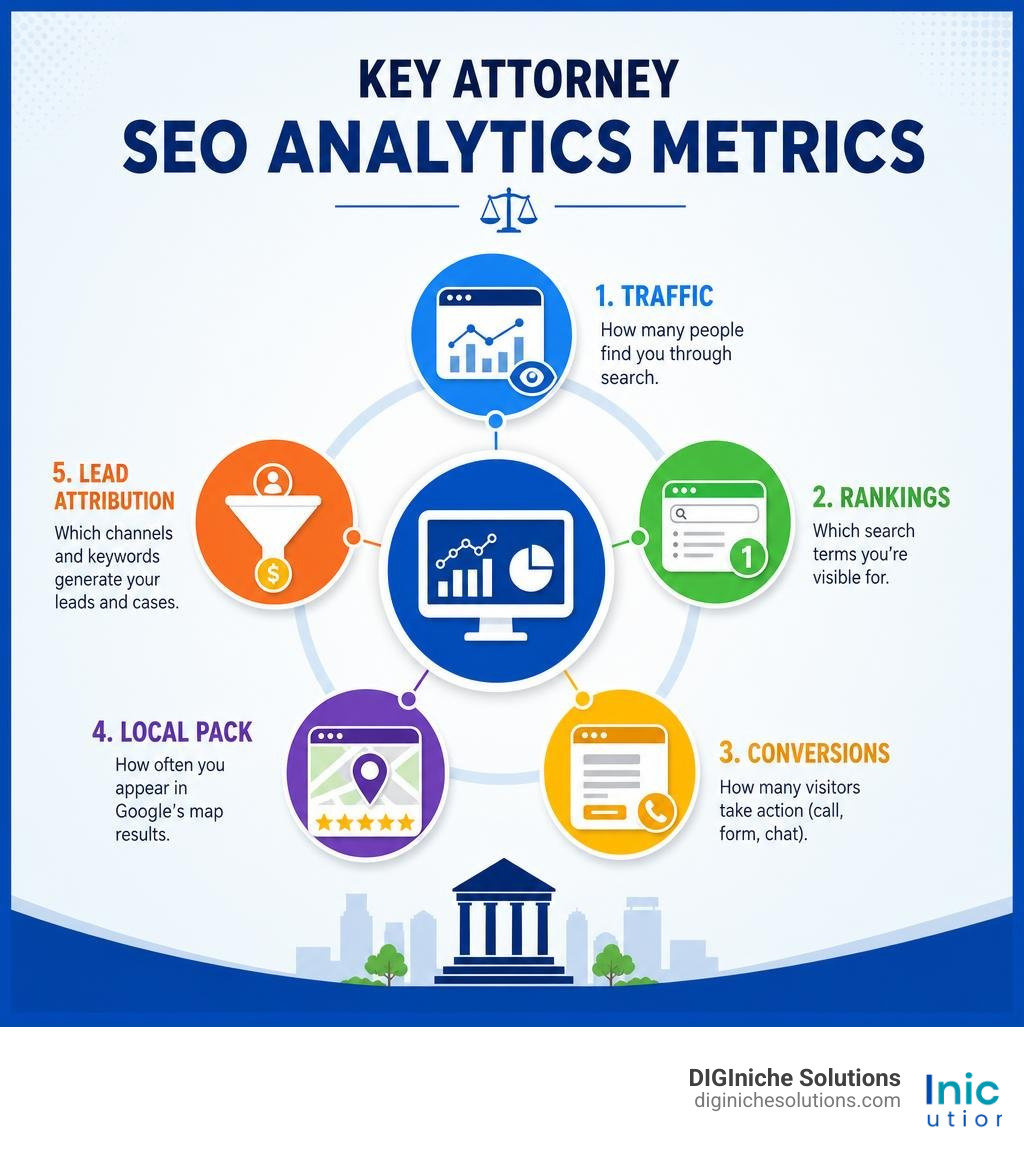
Here’s a quick snapshot of the key metrics you should be tracking:
| Metric | What It Tells You |
|---|---|
| Organic traffic | How many people find you through search |
| Keyword rankings | Which search terms you’re visible for |
| Conversion rate | How many visitors take action (call, form, chat) |
| Engagement rate | Whether visitors find your content useful |
| Cost per lead | What each SEO-generated lead actually costs you |
| Local pack visibility | How often you appear in Google’s map results |
Most law firms are only shown half the picture by their SEO agency. Rankings go up, a report gets sent, everyone feels good — but the question that actually matters goes unanswered: are you getting more cases?
The gap between “our rankings improved” and “our revenue grew” is where most legal marketing falls apart.
With 96% of people using search engines to seek legal advice, your online visibility isn’t optional. But visibility without proper tracking is just guesswork.
That’s the problem this guide solves.
I’m Frank Demming, a digital marketing strategist with over a decade of experience helping law firms build lead-generation systems — including mastering attorney SEO analytics to connect real marketing spend to real case results. In the sections below, I’ll walk you through exactly what to track, how to track it, and what your agency may not be telling you.
The Core Metrics of Attorney SEO Analytics

When we talk to managing partners in New Jersey and across the country, we often see them drowning in data. Their agency sends a 40-page PDF filled with charts that look impressive but mean very little to the firm’s bottom line. To keep your sanity and your budget intact, you must focus on the core metrics of attorney SEO analytics.
Organic traffic—the number of visitors coming to your site from non-paid search engine results—is your foundation. But tracking raw traffic numbers can be highly misleading. If your traffic spikes because a blog post about a celebrity divorce goes viral, but you are a New Jersey personal injury firm, that traffic is useless. We want to see qualified traffic that exhibits high search intent.
Keyword rankings are another metric that agencies love to highlight. While it is great to rank #1 for “best criminal defense attorney in Newark,” rankings fluctuate daily based on search history, device type, and proximity. Rather than obsessing over individual terms, look at your overall keyword footprint. Are you growing the total number of high-value keywords ranking on page one?
Bounce rate used to be the go-to metric for measuring user friction, but in Google Analytics 4 (GA4), we now look closely at engagement rate. An engaged session is defined as a visit that lasts longer than 10 seconds, has two or more page views, or triggers a conversion event. For law firms, an engagement rate above 50% is generally considered healthy.
Finally, your conversion rate is the ultimate truth-teller. It measures the percentage of website visitors who take a desired action, such as calling your office, filling out a contact form, or starting a live chat. If your traffic is rising but your conversions are flatlining, your SEO agency is driving the wrong audience to your site. To learn more about setting up these foundational measurements, read our Monitoring SEO Performance Guide for Law Firms.
Tracking Rankings vs. Actual Client Leads
It is incredibly easy for an agency to manipulate search rankings to make themselves look good. They target low-competition, high-volume search terms that have zero transactional value. You might rank #1 for “what to do if your dog eats chocolate in NJ,” but unless you specialize in veterinary malpractice, that rank won’t pay the office light bill.
There is a vast difference between search volume and case value. This is where the case-value keyword framework comes into play. For example, a keyword like “truck accident lawyer” may only have a fraction of the search volume of a broad term like “traffic ticket advice,” but the average value of a truck accident case makes it infinitely more valuable. We must segment keywords by search intent:
- Informational Intent: Users looking for answers to legal questions (e.g., “how long does a divorce take in NJ?”). These users are early in the client journey.
- Transactional/Commercial Intent: Users actively looking to hire an attorney (e.g., “personal injury lawyer near me”). These are your highest-value prospects.
If you want to understand why ranking for high-value transactional terms is a game-changer for your firm’s finances, read our breakdown on Why Personal Injury SEO is Worth It.
Leveraging Free Tools for Attorney SEO Analytics
You do not need to spend thousands of dollars on enterprise software to get world-class data. Google provides an incredibly powerful suite of free tools that every law firm should utilize.
Google Analytics (GA4) is your window into user behavior. It tells you where your visitors came from, what pages they viewed, and whether they converted. Google Search Console (GSC) is your direct line to Google’s search engine. It shows you the exact queries people typed to find your site, your average ranking for those queries, and how many times people clicked your links.
Additionally, tools like PageSpeed Insights are crucial for evaluating your site’s technical health. Google uses mobile-first indexing, meaning it primarily evaluates the mobile version of your website for ranking. If your site takes longer than 3 seconds to load on a smartphone, you will lose both search engine rankings and potential clients.
To make sure your technical foundation is solid, make sure your site meets the core speed standards:
- Largest Contentful Paint (LCP): Under 2.5 seconds.
- Interaction to Next Paint (INP): Under 200 milliseconds.
- Cumulative Layout Shift (CLS): Under 0.1.
For a deeper dive into technical optimizations and user experience improvements, explore our 7 Tips for Improving a Law Firm Website’s SEO.
Measuring Local SEO and Lead Attribution
For local law practices, particularly in competitive areas like New Jersey, local SEO is your primary source of immediate phone calls. Google’s local pack—the map section that displays the top three local listings—captures a massive 42% of all clicks for location-intent search queries.
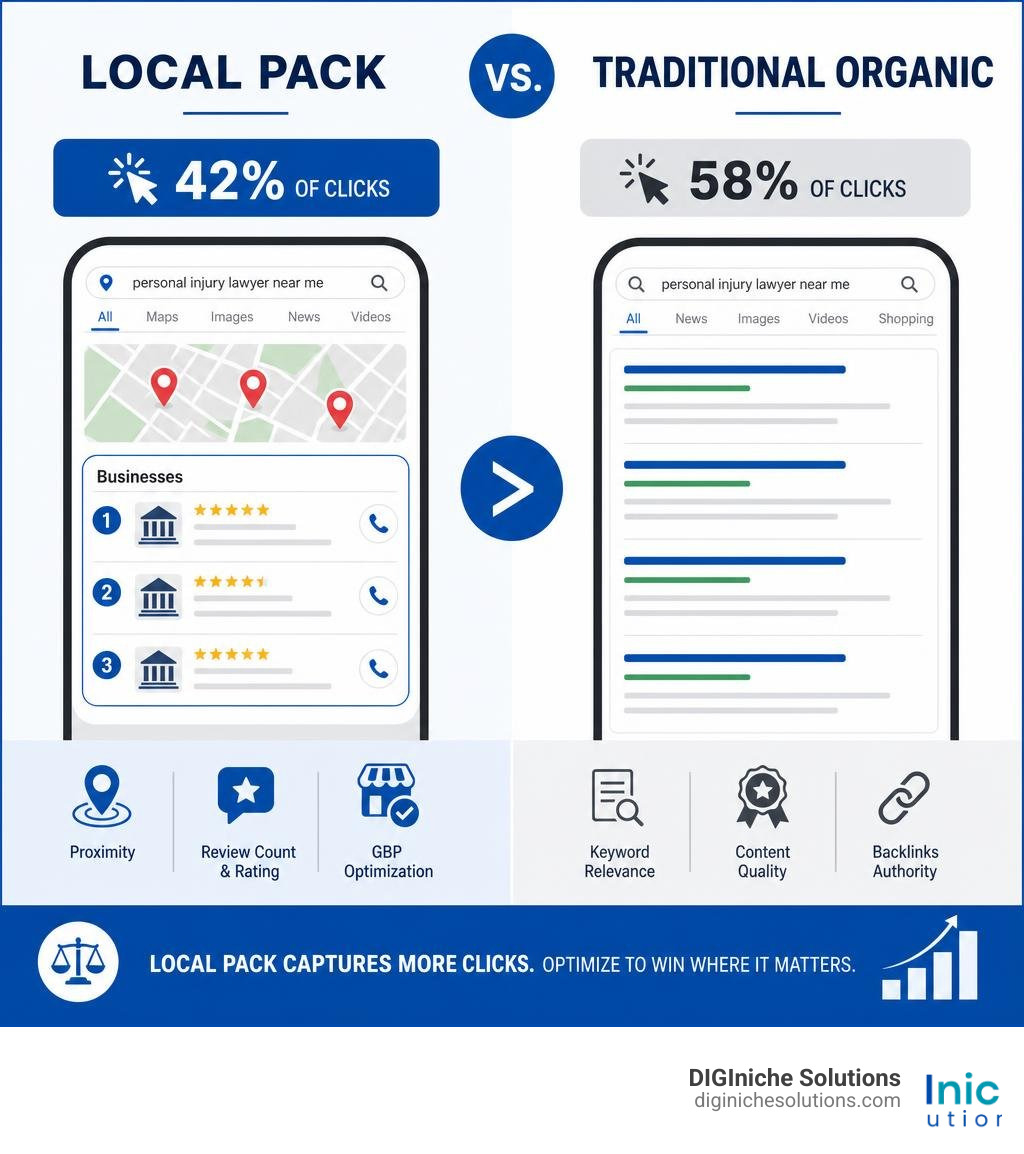
To dominate the local pack, your Google Business Profile (GBP) is your non-negotiable foundation. But simply claiming your profile isn’t enough. You need to actively manage it by securing consistent, high-quality client reviews and maintaining absolute NAP (Name, Address, Phone number) consistency across every directory on the web.
| Search Feature | Click Share | Primary Ranking Factors |
|---|---|---|
| Google Local 3-Pack | 42% | Proximity, Review Count/Rating, GBP Optimization |
| Traditional Organic Results | 28% | Content Depth, Backlinks, On-Page SEO, Schema |
| Paid Search Ads (PPC) | 3-5% | Bid Amount, Ad Relevance, Quality Score |
If your physical office is in Cherry Hill, but your local citations list different variations of your address, Google’s algorithm will lose trust in your location authority, hurting your rankings. To fix these local signals and drive more foot traffic, check out our guide on Local SEO for Lawyers: Simple Fixes to Get More Clients.
Attributing Calls, Forms, and Consultations
One of the biggest secrets in digital marketing is that many agencies do not set up proper conversion attribution. They show you “clicks” and “impressions,” but they cannot tell you which specific blog post or search query caused a client to pick up the phone and call your firm.
To solve this, you must implement dynamic call tracking. Using tools like CallRail, you can display a unique phone number to users who arrive on your site via organic search. When they call, the software attributes that call back to the exact search query and landing page that brought them there.
Furthermore, integrating your website forms, live chat, and call tracking directly with your law firm’s CRM (such as Clio, MyCase, or LawPay systems) allows you to track a lead from the initial search click all the way to a signed retainer agreement. This is how you calculate your true return on investment (ROI). For a comprehensive breakdown of setting up this end-to-end tracking system, refer to our pillar resource: Law Firm SEO: The Ultimate Guide.
Evaluating User Behavior and Engagement Rate
Getting people to your website is only half the battle. Once they arrive, how do they behave? This is where user behavior data plays a major role in evaluating your SEO success.
If a user searches for “New Jersey divorce laws,” clicks on your link, and leaves within 5 seconds, Google interprets this as a bad user experience. This behavior is called “pogosticking,” and it signals to search engines that your content did not answer the user’s question.
By analyzing metrics like average engagement time and pages per session, you can determine if your content is genuinely engaging. If users are spending an average of three minutes on your practice area pages and navigating to your attorney bio pages, you are successfully building trust. If you want to optimize your site design to keep users engaged longer, read our actionable 7 Tips for Improving a Law Firm Website’s SEO.
Setting Benchmarks and Avoiding Common Data Mistakes

You cannot measure progress without a starting point. Before launching any campaign, we must establish clear benchmarks based on your specific practice area, location, and competition.
Setting SMART goals (Specific, Measurable, Attainable, Relevant, and Time-bound) is critical. For example, instead of saying “we want more traffic,” a SMART goal would be: “Increase organic leads for our family law practice in Bergen County by 20% over the next six months.”
Because family law and personal injury have completely different search behaviors, your benchmarks must reflect your practice area. To learn how we tailor these benchmarks specifically for matrimonial and custody practices, check out our guide on Search Engine Optimization for Family Law Attorneys.
Common Pitfalls in Attorney SEO Analytics
When analyzing legal SEO data, we frequently catch agencies making major mistakes—either out of ignorance or a desire to hide poor performance.
The first mistake is relying on thin, AI-generated content. Ever since Google rolled out stricter guidelines for Your Money or Your Life (YMYL) websites—which includes all legal and medical sites—publishing unverified AI content is search engine suicide. Legal content requires demonstrated Experience, Expertise, Authoritativeness, and Trustworthiness (E-E-A-T). Every page must be written or thoroughly reviewed by qualified legal professionals.
Another common issue is keyword cannibalism, which happens when multiple pages on your website target the exact same keyword search intent. When this occurs, Google gets confused about which page to rank, often resulting in neither page ranking well.
Finally, do not panic over short-term ranking fluctuations. Google updates its algorithm hundreds of times a year. A temporary drop in rankings over a week is normal. Look at the 90-day and 180-day trends to see the true trajectory of your campaign. To avoid these data traps, review our Monitoring SEO Performance Guide for Law Firms.
Measuring Long-Term Evergreen Content Value
Many attorneys treat SEO like a utility bill—they expect immediate results the moment they pay. But SEO is a compounding asset, not an ongoing expense like PPC.
While a Google Ads campaign stops delivering leads the second you stop paying, high-quality evergreen content continues to generate organic leads for years. A comprehensive guide on “What to do after a car accident in New Jersey” can rank on page one and capture clients consistently without any ongoing per-click costs.
When evaluating your content marketing, look at the long-term compounding ROI. By using our case-value framework, you can measure the lifetime value of the clients generated by a single evergreen asset against the initial cost of producing that content. To see how this compounding math works in practice, read Why Personal Injury SEO is Worth It.
Monthly Reporting: What Your SEO Dashboard Should Include
You should never have to guess what your marketing agency is doing. A transparent, professional monthly SEO report should be easy to read and focus strictly on business growth.
Every monthly report we deliver at DIGIniche Solutions includes:
- Executive Summary: A high-level, jargon-free translation of what happened this month and what it means for your bottom line.
- Organic Lead Attribution: The exact number of phone calls, form completions, and chat leads generated specifically by organic search.
- Local Map Pack Performance: Changes in your local visibility, review acquisition rates, and direct actions taken on your Google Business Profile (calls, website clicks, driving directions).
- Keyword Footprint Growth: A look at how many high-value transactional and informational keywords have moved into the top 3 and top 10 positions.
- Technical Health Audit: A quick confirmation that your site is loading fast, has no crawl errors, and passes Core Web Vitals on mobile.
Frequently Asked Questions About Law Firm SEO Tracking
How long does it take to see measurable SEO results?
SEO is a long-term strategy. Most law firms begin to see measurable improvements in keyword visibility and organic traffic within 3 to 6 months. However, significant, consistent lead generation and strong compounding ROI typically build between months 6 and 12, continuing to expand thereafter.
Why is my organic traffic up but my signed cases are down?
This is almost always a search intent or intake problem. If your SEO agency is targeting broad informational keywords instead of localized transactional terms, you will get readers, not clients. Alternatively, if your website is driving phone calls but your front desk is letting them go to voicemail or failing to follow up immediately, your intake process is breaking the lead-generation pipeline.
What is the difference between SEO and GEO for law firms?
Traditional SEO focuses on optimizing your website to rank in standard search engine results pages (like Google’s blue links). GEO (Generative Engine Optimization) is the process of optimizing your legal content so that AI search platforms (like ChatGPT, Gemini, and Google’s AI Overviews) pull your firm’s information, statistics, and citations when answering conversational queries from users.
Conclusion
At the end of the day, attorney SEO analytics should not be a mystery. If your current marketing agency is hiding behind technical jargon, complex spreadsheets, or vanity metrics like “impressions” without showing you real case growth, it is time to ask hard questions.
At DIGIniche Solutions, we do things differently. Our proprietary V.E.R.A. Formula is designed to build a highly visible, engaging, and scalable client-growth ecosystem for your law firm:
- Visibility: We make sure your firm dominates both the local map pack and traditional organic results.
- Engagement: We optimize your website’s speed, design, and content to keep potential clients on your pages longer.
- Retention: We implement clear user journeys and trust signals that convert casual visitors into qualified consultations.
- Amplification: We use data-driven insights to compound your search authority, turning your website into an automated lead-generation asset.
Whether you are looking to dominate the search results in New Jersey or scale your practice nationwide, we are here to help you connect your marketing spend to real revenue.
Ready to stop guessing and start growing? Read our comprehensive Law Firm SEO: The Ultimate Guide to unlock the true potential of your online presence, or contact us today to schedule an audit of your firm’s current SEO performance.
