

Introduction
Top immigration strategies in New Jersey center on four core areas: executing robust removal defense tactics before the Newark Immigration Court, navigating adjustment of status versus consular processing, securing crimmigration relief and inadmissibility waivers, and structuring employment- or family-based visa petitions. Working with a skilled immigration attorney in Newark, NJ ensures strict procedural compliance with local Executive Office for Immigration Review (EOIR) judges and U.S. Citizenship and Immigration Services (USCIS) field offices across Essex County, Passaic County, and Bergen County.
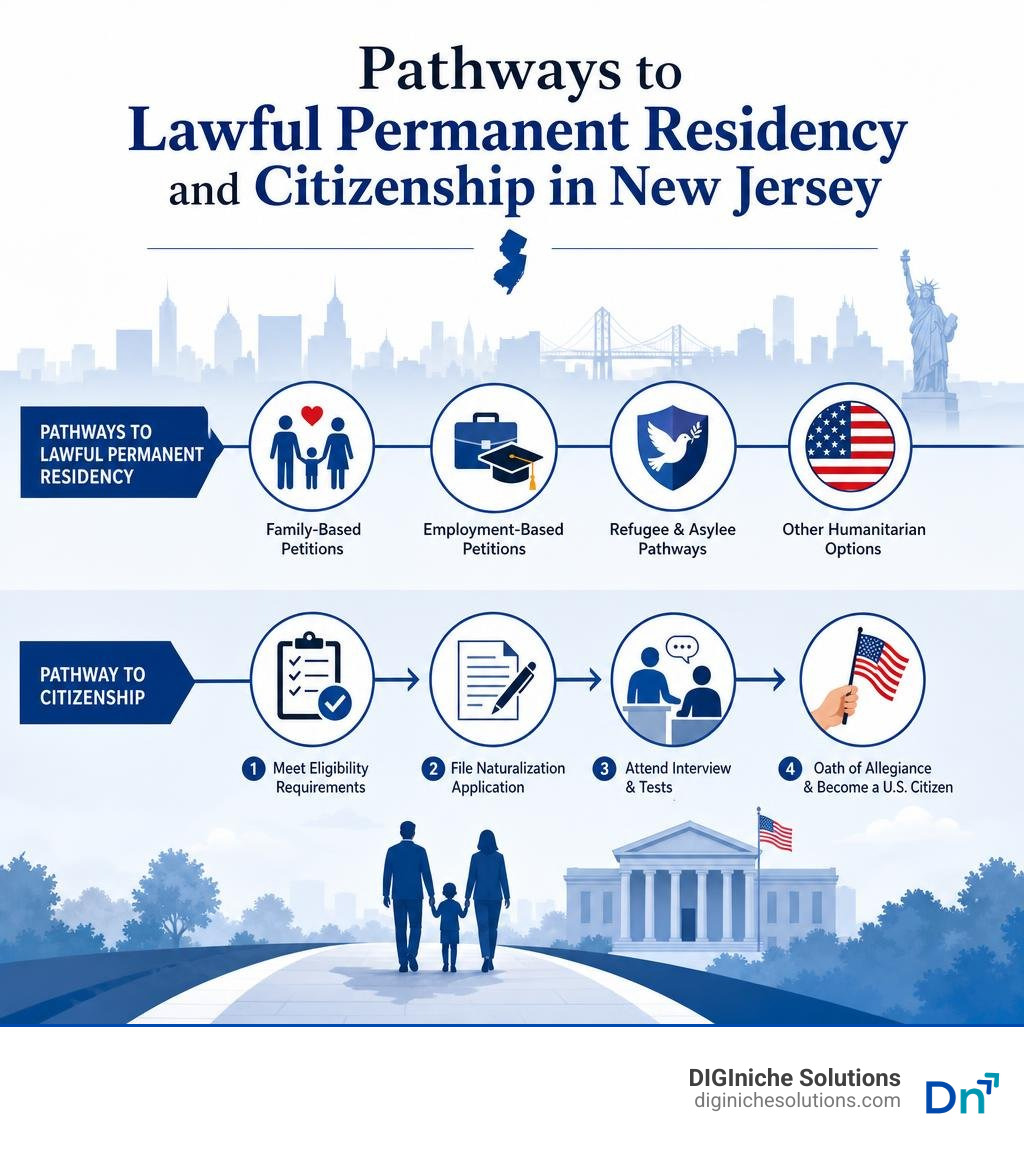
Whether you are defending against deportation, sponsoring a family member, obtaining employment authorization, or pursuing naturalization as a U.S. citizen, having an effective legal roadmap protects your rights at every procedural stage.
1. Navigating Newark Immigration Court Proceedings and Deportation Defense

The Executive Office for Immigration Review oversees immigration court proceedings across northern New Jersey. Being placed in removal proceedings begins with a Notice to Appear (NTA) issued by the Department of Homeland Security (DHS). From there, your case moves through procedural phases, starting with short Master Calendar Hearings and concluding with an Individual Calendar Hearing where your full substantive defense is presented before an immigration judge.
Having dedicated advocacy during these hearings ensures that evidentiary records are built meticulously. For respondents held in custody, prompt legal intervention can secure bond hearings, preventing prolonged stays in local detention facilities and allowing respondents to prepare their defense alongside their families in communities like Newark, Elizabeth, or Paterson.
Removal Defense Tactics in Essex County Immigration Courts
Defending against removal requires matching statutory forms of relief to your background and fear of return:
- Asylum, Withholding of Removal, and CAT Protection: Individuals who face persecution in their home countries based on race, religion, nationality, political opinion, or membership in a particular social group can apply for asylum. If statutory bars apply, an attorney may pursue Withholding of Removal or relief under the United Nations Convention Against Torture (CAT).
- Cancellation of Removal: Available to both Lawful Permanent Residents (under INA § 240A(a)) and non-permanent residents (under INA § 240A(b)) who meet specific residency, moral character, and exceptional and extremely unusual hardship thresholds regarding their qualifying U.S. citizen or permanent resident family members.
- Prosecutorial Discretion & Administrative Closure: In appropriate instances, respondents can request that DHS exercise prosecutorial discretion to dismiss or close cases, enabling individuals to pursue affirmative relief directly before USCIS.
To evaluate reputable courtroom advocates, review listings such as the Best Immigration Lawyers in Newark, NJ directory to find counsel experienced in local EOIR proceedings.
Understanding Criminal Convictions and Relief Options
The intersection of criminal law and immigration—often termed “crimmigration”—presents distinct legal risks. In New Jersey, even offenses classified as disorderly persons offenses in municipal courts (such as shoplifting or minor drug possession) can be categorized as crimes involving moral turpitude (CIMT) or aggravated felonies under the Immigration and Nationality Act (INA).
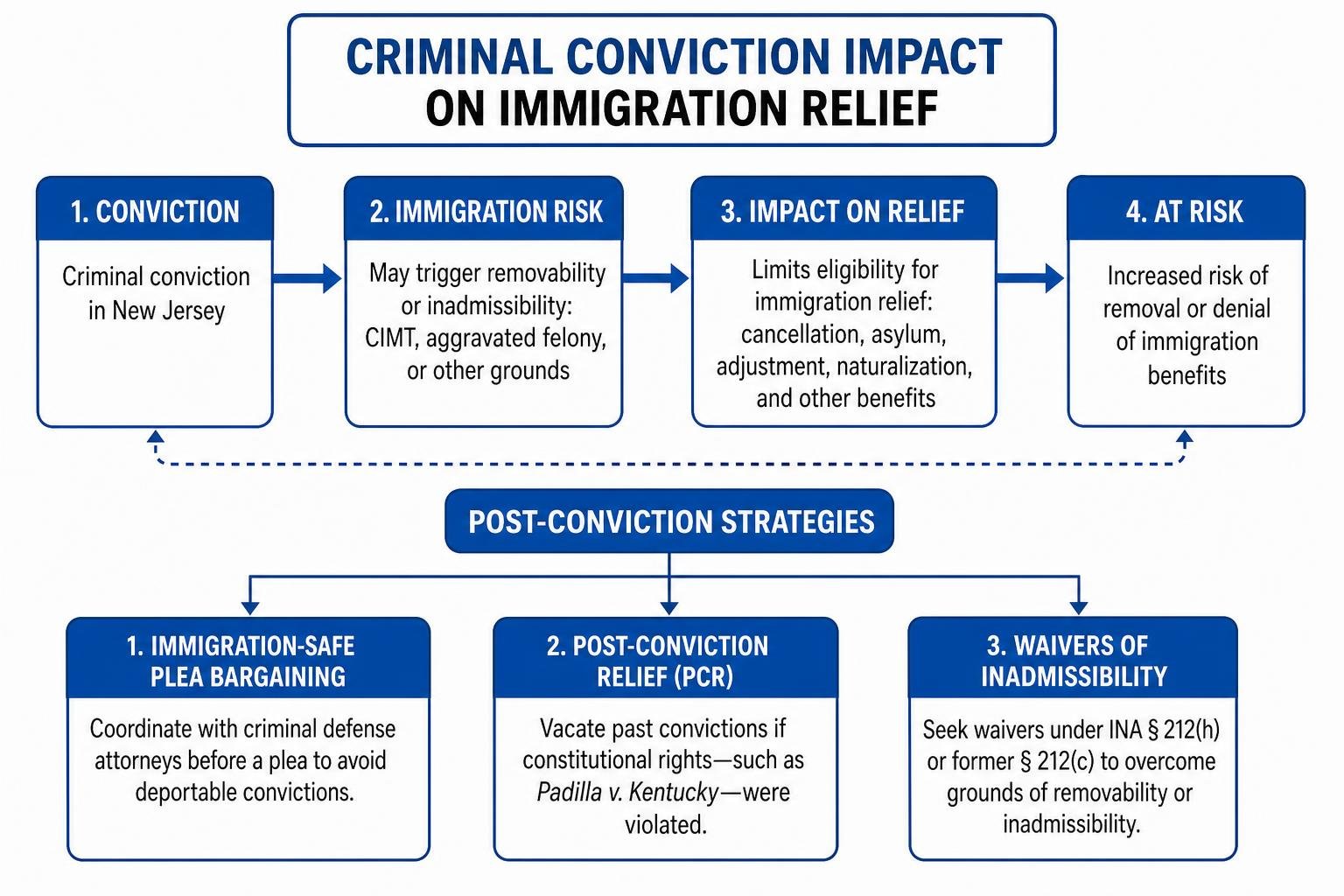
Strategic crimmigration defense involves:
- Immigration-Safe Plea Bargaining: Coordinating with criminal defense attorneys before a plea is entered to avoid statutory definitions of deportable convictions.
- Post-Conviction Relief (PCR): Vacating past guilty pleas in New Jersey state courts if constitutional rights—such as the mandatory advice regarding immigration consequences under Padilla v. Kentucky—were violated.
- Waivers of Inadmissibility: Seeking relief under sections such as INA § 212(h) or former § 212(c) for historic convictions to eliminate statutory grounds of removability.
2. Comprehensive Visa and Green Card Legal Strategies

Securing legal status in the United States requires determining whether a non-immigrant (temporary) visa or an immigrant visa (permanent residency/green card) fits your personal or commercial goals.
| Category | Temporary Non-Immigrant Visas | Lawful Permanent Resident (Green Card) |
|---|---|---|
| Primary Purpose | Specific temporary purpose (work, study, visit) | Permanent right to live and work in the U.S. |
| Duration | Fixed period with extensions tied to status (e.g., 3–6 years) | 10-year renewable card; permanent underlying status |
| Dual Intent | Restricted on many visas (e.g., B-1/B-2, F-1); permitted on H-1B/L-1 | Inherent intent to permanently reside |
| Path to Citizenship | None directly; requires transition to immigrant category | Eligible to apply for naturalization after 3 to 5 years |
| Travel Flexibility | Tied to active visa validity and underlying petition | Broad travel rights, subject to abandonment rules |
Employment and Family-Based Visa Pathways
New Jersey serves as a commercial and corporate hub, creating high demand for both employment sponsorships and family reunifications:
- Employment Petitions: Skilled professionals utilize H-1B specialty worker visas, L-1A/L-1B intra-company transferee visas for multinational executives and managers, and O-1 visas for extraordinary talent. Permanent employment pathways typically rely on the PERM Labor Certification process through the Department of Labor, culminating in EB-2 or EB-3 immigrant petitions. Renowned corporate practitioners like Anthony F. Siliato – Meyner and Landis LLP assist businesses with compliance audits, I-9 verification, and corporate transfers across northern New Jersey.
- Family-Based Petitions: U.S. citizens and permanent residents can sponsor immediate relatives (spouses, unmarried minor children, parents) through Form I-130 without preference quota backlogs. Other family members qualify under preference categories (F1, F2A, F2B, F3, F4), which are subject to annual visa availability.
Adjustment of Status Versus Consular Processing
Applying for permanent residency follows one of two distinct legal avenues:
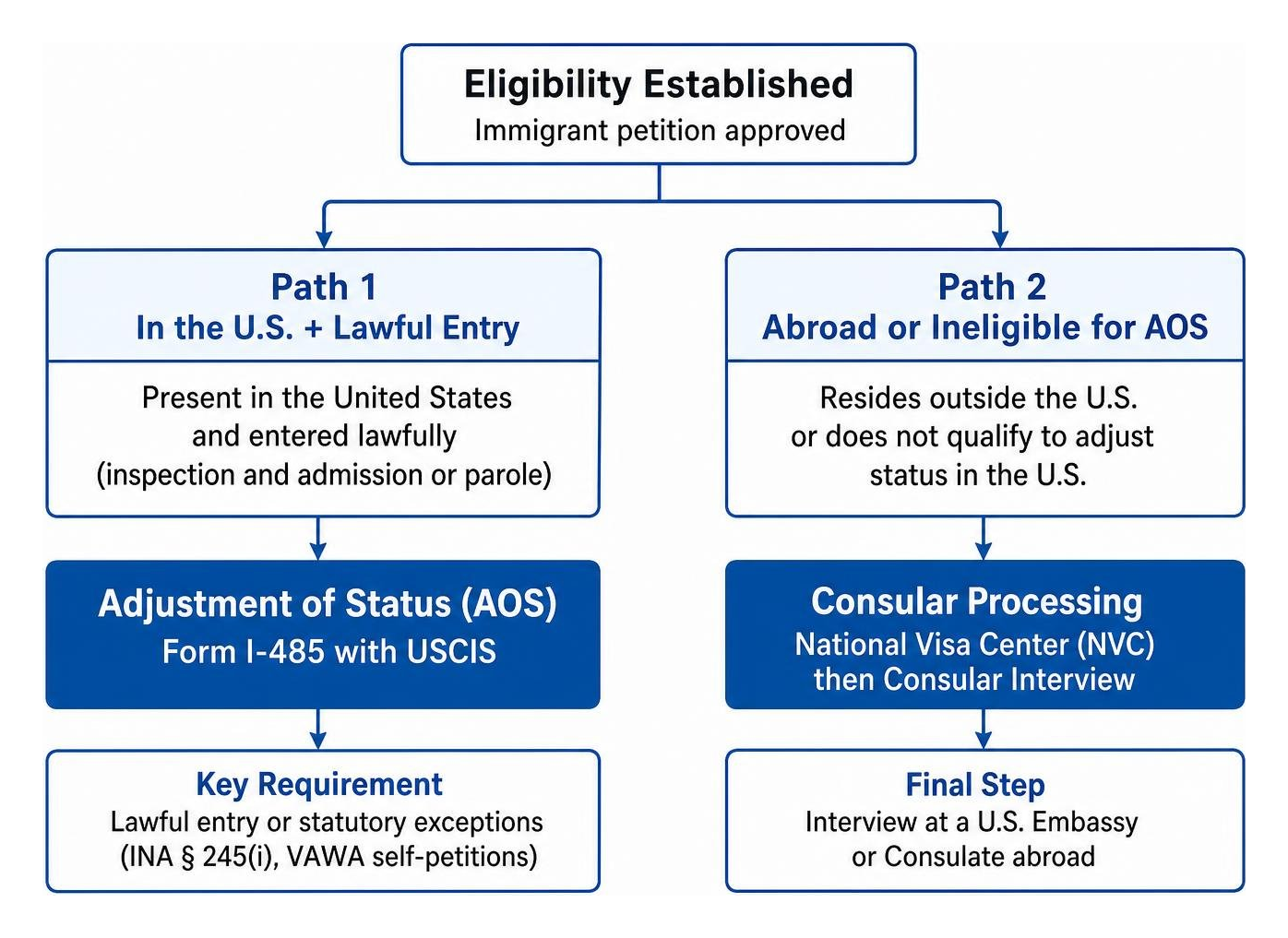
- Adjustment of Status (AOS): Managed via Form I-485 through USCIS while remaining physically present inside the United States. It requires demonstrating lawful entry (inspection and admission or parole) or qualifying for statutory exceptions such as INA § 245(i) or VAWA self-petitions.
- Consular Processing: Used when the applicant resides abroad or is ineligible to adjust status inside the U.S. Files are processed through the National Visa Center (NVC) and culminate in an interview at a U.S. Embassy or Consulate abroad.
Overcoming Denials with Inadmissibility Waivers and Appeals
When USCIS or a consular officer identifies grounds of inadmissibility—such as unlawful presence, misrepresentation, or specific medical conditions—an applicant is not automatically out of options:
- I-601 & I-601A Provisional Waivers: For individuals with unlawful presence, the I-601A provisional waiver allows applicants to apply for relief inside the U.S. before departing for their consular interview, minimizing family separation by proving extreme hardship to a qualifying U.S. citizen or permanent resident spouse or parent.
- Administrative Appeals & Motions (Form I-290B): If an application is improperly denied, legal counsel can file a Motion to Reopen (presenting new facts) or a Motion to Reconsider (arguing incorrect application of law) before the Administrative Appeals Office (AAO).
- Federal Litigation: Persistent agency delays or unlawful decisions can be challenged in federal district court through Mandamus actions or petitions for review before the U.S. Court of Appeals for the Third Circuit.
3. How to Choose the Right Immigration Attorney Newark NJ
Selecting legal representation determines how effectively your case is structured and defended. As we highlight in the city attorney guide to local search and specific geographies, locating counsel rooted in your specific geographic jurisdiction provides tangible benefits during local agency interactions.
Key Qualities to Look for in an Immigration Attorney Newark NJ
When vetting legal practitioners, prioritize the following criteria:
- Active Bar Licensure & Good Standing: Confirm active standing with the New Jersey State Bar or another state bar, and verify no disciplinary history.
- AILA Membership: Active participation in the American Immigration Lawyers Association (AILA) indicates that counsel maintains up-to-date knowledge on shifting policy memoranda.
- Direct Attorney Involvement: Confirm that your substantive filings are prepared and reviewed by a licensed attorney rather than handed off entirely to administrative staff.
- Verified Local Experience: Familiarity with the judges at Newark Immigration Court and officers at local USCIS field offices helps set realistic timeline and evidentiary expectations.
When to Hire an Immigration Attorney Newark NJ for Complex Filings
While simple renewal forms might appear manageable alone, certain red flags require immediate legal representation:
- Instances of prior deportation, expedited removal, or voluntary departure orders.
- Accusations of immigration fraud, marriage fraud, or willful misrepresentation.
- Gaps in lawful status resulting in accrual of unlawful presence.
- Humanitarian petitions involving domestic violence under the Violence Against Women Act (VAWA), U-Visas for crime victims, or T-Visas for trafficking survivors.
Fee Structures and Multilingual Legal Support
Immigration matters are handled through two main fee arrangements:
- Flat-Fee Structures: Common for defined filings such as naturalization, marriage-based green cards, or H-1B petitions. Flat fees give predictability by covering the preparation, submission, and interview representation under one clear cost.
- Hourly Billing: Generally utilized for contested deportation defense, federal court litigation, or responding to complex Requests for Evidence (RFEs).
Given that northern New Jersey is home to vibrant international communities, top law offices offer multilingual representation—including fluent Spanish and Portuguese legal teams—ensuring nuanced personal declarations and evidence translations are prepared without error.
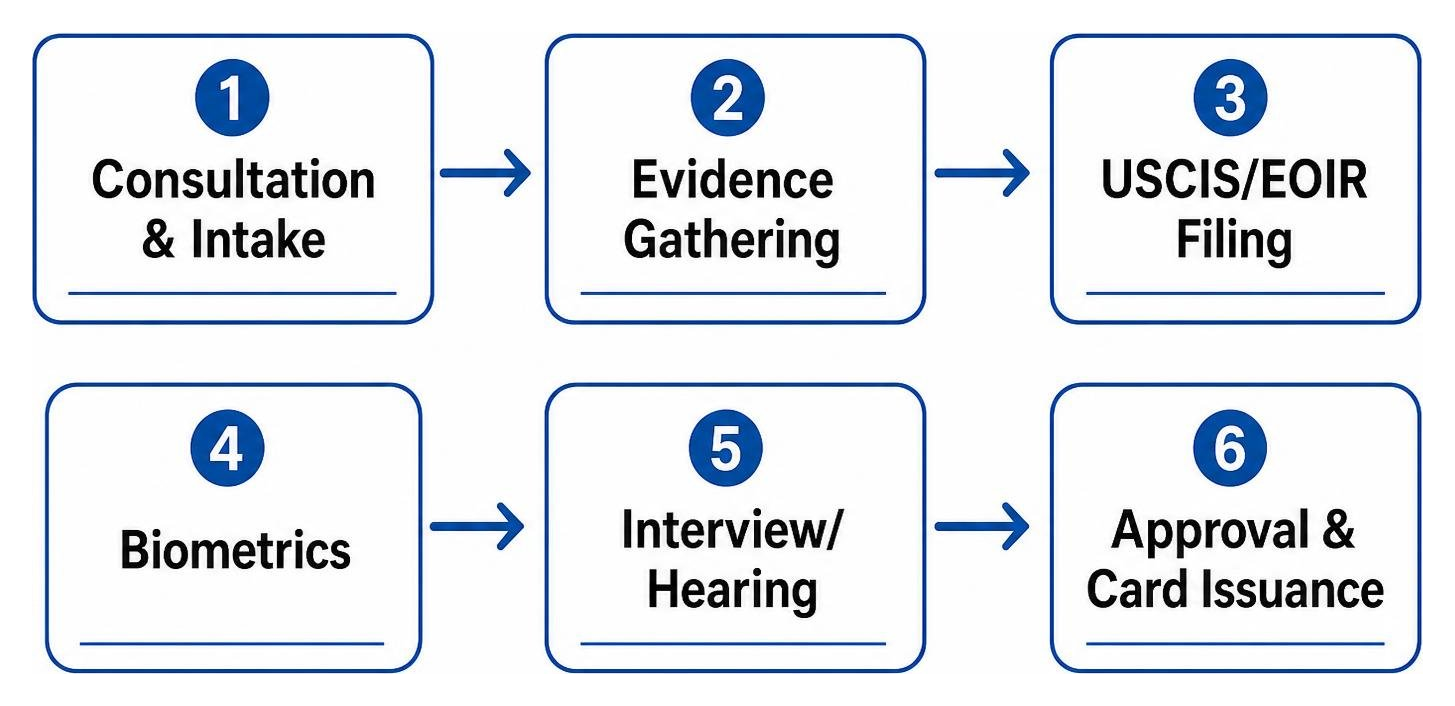
4. Step-by-Step Roadmap of a New Jersey Immigration Case
Understanding the timeline of your case minimizes uncertainty and keeps your documentation organized from day one.
Initial Consultation and Document Preparation Checklist
Your initial legal consultation establishes the evidentiary foundation of your matter. Bring the following items:
- Identity & Vital Records: Current and expired passports, birth certificates, marriage certificates, divorce decrees, and government-issued IDs.
- Immigration History Documents: Copies of prior visas, I-94 arrival/departure records, I-797 Notice of Action receipts, employment authorization cards, and any prior correspondence with USCIS or the NVC.
- Court & Removal Records: Any Notice to Appear (NTA), immigration judge decisions, or voluntary departure verifications.
- Criminal Records (if applicable): Certified copies of police reports, charging documents, plea agreements, and final judgment of convictions for any arrest, regardless of outcome or expungement.
- Financial Documentation: Recent federal tax returns (Form 1040 with W-2s/1099s), pay stubs, and employment verification letters for Form I-864 Affidavit of Support obligations.
USCIS Processing Timelines and Case Milestones
- Filing & Receipt Notice: Within 2–4 weeks of submission, USCIS issues Form I-797C Notice of Action confirming receipt and assigning a unique case tracking number.
- Biometrics Screening: Applicants receive an appointment at an Application Support Center (ASC) for fingerprinting, photographs, and background checks.
- Requests for Evidence (RFE): If an adjudicator needs supplementary proof, an RFE is issued with a strict deadline (often 30 to 87 days). Meticulous responses prevent denials.
- In-Person Interview: Scheduled at the local USCIS field office where the officer examines original documents, evaluates credibility, and confirms statutory eligibility.
- Final Adjudication: Upon approval, green cards or certificates of naturalization are delivered via secure mail or presented during formal swearing-in ceremonies.
Frequently Asked Questions About New Jersey Immigration Law
What is the practical difference between a temporary visa and a green card?
A temporary non-immigrant visa (such as a B-2 visitor, F-1 student, or H-1B worker visa) grants authorization to enter and stay in the United States for a defined timeframe and a specific purpose. Non-immigrant status requires maintaining compliance with underlying terms and does not automatically confer permanent residence.
In contrast, a Permanent Resident Card (Green Card) grants permanent legal authorization to live and work indefinitely anywhere in the United States. Lawful permanent residents also enjoy international travel flexibility (subject to physical presence requirements) and gain an established pathway to apply for full U.S. citizenship via naturalization after three or five years.
Do I need a lawyer if my immigration case appears straightforward?
Even an ostensibly simple application can involve hidden technicalities. Unintentional omissions, misunderstandings of statutory questions, or submitting outdated forms can trigger delays, costly re-filings, or fatal denials.
Furthermore, an attorney evaluates your broader background for latent inadmissibility issues—such as prior status violations, uncertified historical arrests, or strict public charge requirements—ensuring your paperwork is accurate and complete before federal agencies review your file.
How much does it typically cost to hire legal representation in Essex County?
Legal representation costs vary based on case complexity, whether the matter is affirmative (filed before USCIS) or defensive (litigated in immigration court), and the expected duration of the proceedings. Routine family petitions or naturalization applications typically range from $1,500 to $5,000 in attorney fees, while complex deportation defense, waiver applications, or business immigration filings may range higher.
These legal fees are separate from mandatory USCIS government filing fees. Reputable law firms provide written retainer agreements detailing every anticipated expense and often offer structured monthly payment plans to accommodate client budgets.
Conclusion
Successfully navigating U.S. immigration laws requires strategic foresight, technical accuracy, and persistent advocacy. Whether you are uniting your family, growing your enterprise with global talent, or fighting to stay in the country, working with seasoned legal counsel protects your rights at every procedural stage.
For legal professionals seeking to expand their reach across competitive New Jersey markets, DIGIniche Solutions delivers tailored digital marketing ecosystems designed to connect qualified attorneys with individuals and businesses who need top-tier immigration representation.
