

Why Estate Planning Attorneys Can’t Afford to Ignore PPC in 2026
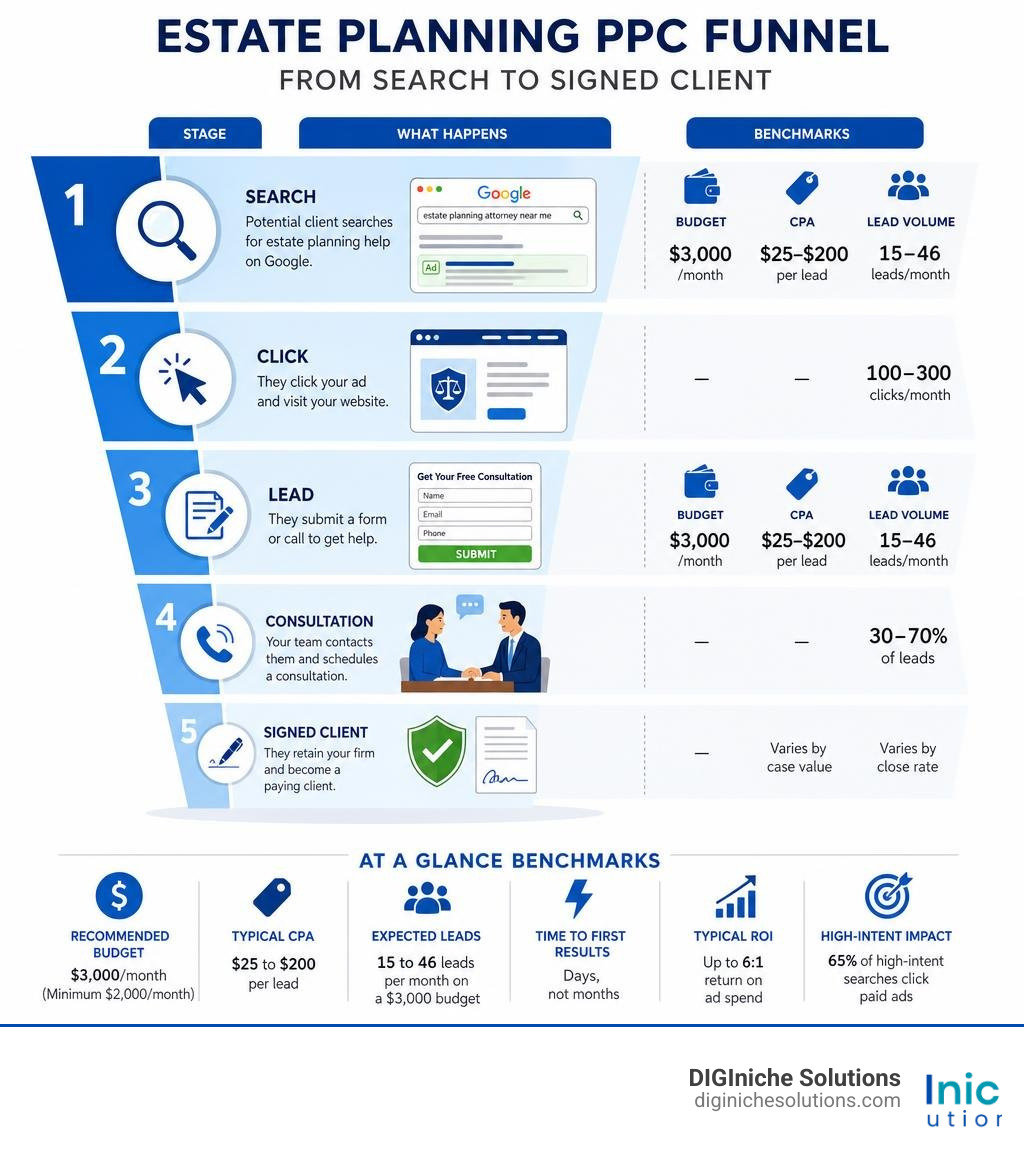
PPC management for estate planning attorneys is the practice of running and optimizing paid search ads — primarily on Google — to attract people actively searching for wills, trusts, powers of attorney, and related legal services.
Here’s what you need to know at a glance:
| What You Want to Know | Quick Answer |
|---|---|
| What is it? | Paid ads on Google targeting people searching for estate planning attorneys |
| Typical cost per lead | $25 to $200 depending on market and targeting |
| Recommended starting budget | $3,000/month (minimum $2,000/month) |
| Expected leads per month | 15 to 46 leads on a $3,000 budget |
| Time to first results | Days, not months |
| Typical ROI | Up to 6:1 return on ad spend |
If your estate planning firm is struggling to get new clients online, you’re not alone. Most people searching for estate planning help go straight to Google — and 65% of high-intent searches result in a click on a paid ad, not an organic result.
That’s a problem if your firm isn’t showing up at the top.
SEO is valuable, but it takes 6 to 12 months to build momentum. PPC puts your firm at position one today — in front of people who are ready to hire an attorney right now.
One estate planning firm generated 729 leads in just five months using a well-managed PPC campaign, averaging more than 145 leads per month at a cost of only $25.02 per lead.
That kind of result doesn’t happen by accident. It requires the right keywords, compelling ad copy, conversion-focused landing pages, and smart ongoing management.
This guide breaks down exactly how estate planning PPC works, what it costs, and how to get the most out of every dollar you spend.
Why PPC Management Estate Planning Services Are Essential in 2026
In 2026, the digital legal market is more crowded than ever. Word-of-mouth referrals, while still the bedrock of any respectable practice, are no longer enough to scale a law firm. When modern consumers face a major life milestone—like having a baby, buying a home, or navigating complex tax laws—they do not wait for a recommendation. They search Google.
With ad positions above organic results receiving 45% to 50% of all clicks on commercial searches, relying solely on organic visibility means you are voluntarily giving up half of your potential client base. This is where strategic PPC Advertising for Law Firms becomes your most powerful client acquisition tool.
PPC provides immediate visibility. Instead of waiting months for SEO efforts to bear fruit, paid search campaigns allow you to leapfrog the organic rankings and position your firm at the absolute top of the search engine results page (SERP) the moment your campaign goes live. For estate planning attorneys looking to build a predictable, scalable pipeline of high-intent clients, PPC is not just an option—it is an absolute necessity.
How Estate Planning PPC Differs from General Legal Ads
While personal injury or criminal defense ads target high-urgency, high-drama situations (like a car crash or an arrest), estate planning is a highly deliberate, research-heavy, and deeply emotional practice area.
People do not look for a trust attorney in a state of panic at 2:00 AM. They search because they are thinking about their legacy, their children, or their hard-earned assets. Because of this, estate planning Pay Per Click campaigns must be approached with a unique blend of sensitivity and trust-building messaging.
Fortunately, this deliberateness works in your favor financially. The cost per click (CPC) for estate planning keywords typically ranges from $5 to $75, which is significantly lower than the eye-watering $150+ CPCs frequently seen in personal injury law. However, because prospects take more time to evaluate their options and compare firms, your ads and follow-up processes must be incredibly tight to convert that curiosity into a consultation.
Key Components of PPC Management Estate Planning Campaigns
To build a high-performing PPC campaign, you cannot simply throw money at Google Ads and hope for the best. A successful campaign relies on several moving parts working in perfect harmony:
- Niche-Specific Keyword Databases: Targeting broad terms like “lawyer” will drain your budget in minutes. You need a mix of high-intent terms (e.g., “living trust attorney near me”) and informational queries.
- Emotionally Resonant Ad Copy: Your copy must balance professional authority with genuine empathy, directly addressing the searcher’s core concerns.
- Dedicated Landing Pages: Sending ad traffic to your homepage is the single fastest way to waste money. You must guide users to highly relevant, conversion-optimized landing pages.
- Advanced Conversion Tracking: You must track every phone call, form fill, and chat inquiry back to the specific keyword that triggered it.
- Precision Campaign Structure: Organizing your ad groups by specific services (e.g., wills vs. asset protection) ensures Google awards you a high Quality Score, lowering your overall costs.
Managing these complex moving parts is why many firms partner with a specialized Paid Search Advertising Agency for Law Firm to handle the heavy lifting.
Benchmarks, Budgets, and Cost Per Acquisition (CPA)
Understanding the financial benchmarks of estate planning PPC is critical to setting realistic expectations and calculating your return on investment. Below is a realistic breakdown of what a well-optimized campaign looks like in a mid-sized market in 2026:
| Metric | Industry Benchmark |
|---|---|
| Average Cost Per Click (CPC) | $15.00 – $50.00 |
| Click-to-Contact Conversion Rate | 8% – 18% |
| Cost Per Lead (CPL) | $25.02 – $100.00 |
| Cost Per Acquisition (CPA / Signed Case) | $65.00 – $200.00 |
| Average Case Value | $3,000 – $5,000+ |
| Target Return on Ad Spend (ROAS) | 4:1 – 8:1 |
Typical Cost Per Lead and CPA Ranges
In our experience managing campaigns nationwide and across New Jersey, a highly optimized estate planning campaign can expect a cost per lead (CPL) of around $25.02 in less competitive markets, scaling up to $100+ in highly competitive metro areas.
When it comes to your Cost Per Acquisition (CPA)—the actual cost to sign a new client—you can expect a range of $65 to $200. With an average estate planning engagement valued at $3,500, spending $200 to acquire that client yields an exceptional return on investment. In fact, many well-optimized legal campaigns achieve a consistent 6:1 ROI, turning modest ad budgets into substantial revenue generators.
Setting Your Monthly Ad Spend and Budget Thresholds
If you want your campaign to succeed, you must feed the Google Ads algorithm enough data to learn and optimize. For this reason, we recommend an absolute minimum budget threshold of $2,000 per month.
For firms looking to see consistent, predictable growth in mid-sized markets, a starting monthly budget of $3,000 to $4,000 is highly recommended. At a $3,000 budget, you can expect to generate between 15 to 46 highly qualified leads per month. If you are operating with a limited budget, check out our guide on Tips to Maximize Law Firm Marketing Budget to ensure you aren’t wasting precious ad dollars.
PPC vs. SEO: Building a Coordinated Digital Marketing Strategy

Many attorneys view PPC and SEO as rivals, but the smartest firms treat them as partners. While SEO builds long-term authority and drives “free” organic traffic over 6 to 12 months, PPC delivers immediate, high-intent traffic.
When integrated correctly, PPC and SEO can deliver 30% to 50% more qualified leads than relying on a single channel alone.
Furthermore, your PPC campaigns act as a testing ground for your SEO strategy. By analyzing which paid keywords convert into actual paying clients, you can direct your SEO team to write content targeting those exact terms, ensuring your organic strategy is backed by real conversion data. To learn how to balance these two powerhouses, read our breakdown on How to Maximize Your Law Practice Marketing Budget.
The Role of Local Services Ads (LSAs) and Google Screened
In addition to traditional Google Search Ads, estate planning firms in 2026 must leverage Google Local Services Ads (LSAs). These are the “Google Screened” ads that appear at the very top of the search results page, even above traditional PPC ads.
LSAs operate on a pay-per-lead model rather than pay-per-click. This means you only pay when a prospective client actually calls or messages your firm through the ad. The “Google Screened” badge acts as a powerful trust signal, assuring prospects that your license has been verified and your business is in good standing. To understand how to split your budget between these ad types, explore the 4 Types of Local Law Firm Ads.
Aligning PPC with Advanced Tax and Estate Planning Content
Modern estate planning is not just about simple wills; it is increasingly focused on complex tax minimization and wealth preservation strategies. With the permanent basic exclusion amount (BEA) and GST tax exemption established at $15 million under post-OBBBA regulations in 2026, high-net-worth (HNW) families are actively looking for sophisticated solutions.
Your PPC ads can target ultra-specific, high-value keywords related to advanced wealth transfer. For instance, you can drive high-intent traffic to specialized landing pages that address complex tax-saving structures. To align your ad copy with what wealthy clients are searching for, you can reference the latest legal insights on:
- Leveraging Unused Estate Tax Exemption with Incomplete Gift Trusts and General Powers of Appointment – KJK | Kohrman Jackson Krantz
- The foundational strategies discussed in PPC’s Estate Planning Book – The Practical Guide You Can Trust
- The shifting landscape analyzed in Estate planning in a post-OBBBA world
- Tax-saving mechanisms highlighted by Trust & Estate Tax Planning | Minimize Tax & Preserve Wealth
- The core tools outlined in the Estate Tax Planning Lawyer: 2026 Essential Guide
- Advanced multi-generational trust planning found in Dynasty Trusts and Estate Planning Strategies in 2025: Step-Up in Basis, Estate Tax Changes, and Generational Wealth Transfer – Boland Law Group, PLLC – Over 50 Years of Legal Excellence
By targeting niche keywords like “dynasty trust attorney NJ” or “incomplete gift trust estate planning,” you can bypass the low-value leads and attract clients with significant estates who require premium, high-fee legal services.
Overcoming the Biggest Challenges in Estate Planning PPC
Running a successful campaign under the ppc management estate planning umbrella comes with its own unique set of hurdles. If you do not prepare for these challenges, your ad budget can disappear with very little to show for it.
Filtering Out Low-Quality Leads and Irrelevant Traffic
Because Google’s automated matching options have become increasingly broad, your ads can easily show up for completely irrelevant search terms. For example, someone searching for “free online will template” might see your ad and click it, costing you money even though they have zero intention of hiring an attorney.
To combat this, we implement a strict keyword matching strategy:
- Avoid Broad Match: Stick strictly to Exact Match and Phrase Match keywords.
- Build a Robust Negative Keyword List: Block search terms containing words like “free,” “cheap,” “template,” “DIY,” “jobs,” or “classes.”
- Conduct Weekly Search Term Reviews: Audit the actual searches that triggered your ads and immediately negate any irrelevant terms.
Managing Long Sales Cycles and Nurturing Prospects
Unlike a personal injury victim who needs a lawyer immediately, estate planning prospects often take weeks or even months to make a decision. They are researching options, discussing plans with their spouses, and evaluating their budgets.
To prevent these prospects from forgetting about your firm, you must implement remarketing campaigns. By placing a tracking pixel on your website, you can serve targeted display, video, or social media ads to users who previously visited your landing page but did not convert. This keeps your firm top-of-mind throughout their deliberate decision-making process.
Best Practices for Maximizing Estate Planning PPC Results
To get the absolute highest return on your ad spend, you need to master the art of conversion. You can find deeper strategies on how to optimize your ad performance in our guide to Maximizing Your Law Firm Ads.
Crafting Emotion-Driven and Solution-Oriented Ad Copy
The best estate planning ads do not just list your credentials; they speak directly to the prospect’s emotional state. They address the peace of mind that comes with protecting one’s family, or the relief of avoiding probate court.
- Instead of: “Experienced Estate Planning Attorney in New Jersey.”
- Try: “Protect Your Family’s Future. Custom, Comprehensive Wills & Trusts. Call Today.”
Always use ad extensions (like site links, callouts, and structured snippets) to provide searchers with additional trust signals, phone numbers, and direct paths to specific services.
Designing High-Converting, Dedicated Landing Pages
With more than 60% of legal searches happening on mobile devices, your landing pages must be lightning-fast and perfectly optimized for smartphones.
Your landing page should feature:
- A clear, compelling headline that matches the ad they clicked.
- A prominent, clickable call-to-action (CTA) like “Schedule Your Free Consultation.”
- Strong trust signals, including attorney badges, client testimonials, and security logos.
- A simple, short contact form that takes less than 30 seconds to fill out.
Measuring ROI and Scaling Your Campaigns
To determine if your campaign is truly successful, you must look beyond click-through rates and focus on your actual return on investment.
Calculate your average case value and compare it to your Cost Per Acquisition (CPA). If your average estate planning package costs $4,000, and you spend $200 on ads to sign a client, you are achieving a stellar 20x return on that specific client’s acquisition cost. Once you establish a profitable baseline, you can confidently scale your budget to capture more market share.
Choosing the Right Partner for PPC Management Estate Planning
Managing a highly technical, constantly evolving Google Ads campaign while running a busy law practice is a recipe for burnout. To get the best results, you need a specialized team that understands the nuances of the legal industry.
At DIGIniche Solutions, we do not just chase cheap clicks. We utilize our proprietary V.E.R.A. Formula to deliver:
- Visibility: Placing your firm at the top of the SERPs when high-value prospects are searching.
- Engagement: Crafting highly persuasive ad copy and landing pages that compel users to take action.
- Retention: Keeping your brand top-of-mind through smart remarketing and lead-nurturing campaigns.
- Amplification: Scaling your success across multiple channels to build a highly dominant, localized digital presence.
Frequently Asked Questions about Estate Planning PPC
What is a realistic cost per lead for estate planning PPC?
While highly competitive metropolitan areas can see lead costs climb, a well-optimized campaign can achieve a cost per lead (CPL) between $25.02 and $100.00. Your exact CPL will depend heavily on your local market competition, the quality of your landing pages, and your keyword targeting strategy.
How long does it take to see results from an estate planning PPC campaign?
Unlike SEO, which takes months to build authority, PPC provides immediate visibility. Your ads can appear at the top of Google within hours of launching your campaign. While it takes about 30 to 90 days of data collection to fully optimize your bids and keywords, many firms begin receiving qualified phone calls and form submissions within the very first week.
Should my firm use both Google Ads and Local Services Ads (LSAs)?
Yes, absolutely. Combining traditional Google Search Ads (PPC) with Local Services Ads (LSAs) allows your firm to dominate the top of the search engine results page. LSAs build immediate trust with the “Google Screened” badge and secure phone calls on a pay-per-lead basis, while traditional PPC ads allow you to target complex, high-value keywords that LSAs cannot reach.
Conclusion
In the competitive landscape of 2026, a passive marketing strategy will leave your firm in the shadows. Implementing an expert, highly targeted approach to ppc management estate planning is the fastest, most predictable way to grow your client base, sign high-value estate tax cases, and build a highly profitable practice.
At DIGIniche Solutions, we specialize in helping estate planning attorneys nationwide and across New Jersey dominate their local markets. Our proprietary V.E.R.A. Formula is designed to turn search traffic into a scalable, predictable client-growth ecosystem.
Ready to take your law firm’s growth to the next level? Explore our comprehensive guide on Law Firm PPC Practices for Lawyers to Master Online Advertising or contact our team today to schedule your free campaign strategy consultation. Let us build a legacy of growth for your firm.
