

Why Your Choice of Attorney Practice Area Defines Your Entire Legal Career
Choosing an attorney practice area is one of the most important decisions any lawyer will ever make. It shapes your daily work, your earning potential, and whether you actually enjoy showing up every morning.
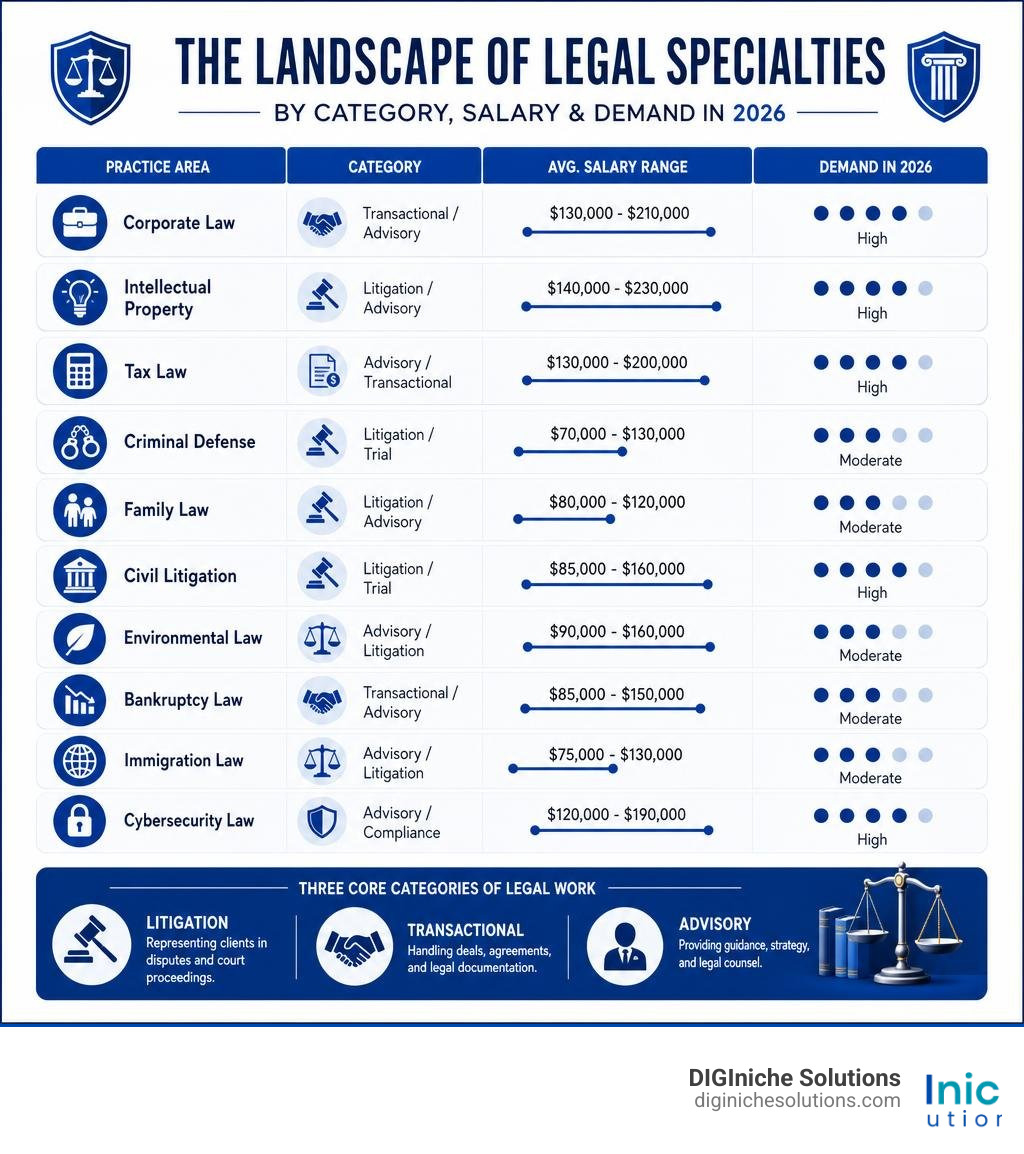
Here are the most common attorney practice areas at a glance:
| Practice Area | Type of Work | Avg. Salary Range |
|---|---|---|
| Corporate Law | Transactional / Advisory | $130,000 – $210,000 |
| Intellectual Property | Litigation / Advisory | $140,000 – $230,000 |
| Tax Law | Advisory / Transactional | $130,000 – $200,000 |
| Criminal Defense | Litigation / Trial | $70,000 – $130,000 |
| Family Law | Litigation / Advisory | $80,000 – $120,000 |
| Civil Litigation | Litigation / Trial | $85,000 – $160,000 |
| Environmental Law | Advisory / Litigation | $90,000 – $160,000 |
| Bankruptcy Law | Transactional / Advisory | $85,000 – $150,000 |
| Immigration Law | Advisory / Litigation | $75,000 – $130,000 |
| Cybersecurity Law | Advisory / Compliance | $120,000 – $190,000 |
The legal profession is broader than most people realize. There are over 70 core practice areas and nearly 190 sub-specialties across the United States. That’s a lot of paths to choose from — and a lot of ways to get it wrong if you’re not informed.
Whether you’re a law student figuring out your first job, an attorney thinking about switching specialties, or just trying to understand how the legal world is organized, this guide breaks it all down in plain language.
I’m Frank Demming, a digital marketing strategist with over a decade of experience helping law firms grow their online presence — and understanding the attorney practice area landscape is something I work with every day when helping legal professionals attract the right clients in the right markets.
Understanding the Core Attorney Practice Area Categories
To make sense of the legal landscape, we must first look at how the law is divided. At its most basic level, legal work falls into three primary buckets: litigation, transactional, and advisory.
When you are Exploring Practice Areas and Practice Settings, you will find that these categories dictate your day-to-day work environment, the skills you use, and how you interact with clients.
- Litigation is all about dispute resolution. If two parties cannot agree, they head toward court (or an arbitration table). Litigators spend their time drafting motions, conducting discovery, taking depositions, and occasionally arguing in front of a judge or jury.
- Transactional Law is focused on building things and preventing disputes before they start. Transactional lawyers write contracts, structure business deals, facilitate mergers, and ensure their clients are legally protected as they grow.
- Advisory Law is consultative. These attorneys help clients navigate complex regulatory webs, stay compliant with state and federal laws, and plan for the future.
Here is a quick look at how litigation and transactional roles differ:
| Dimension | Litigation Law | Transactional Law |
|---|---|---|
| Primary Goal | Resolve existing disputes/lawsuits | Structure deals and prevent future disputes |
| Work Environment | Courthouses, depositions, adversarial meetings | Boardrooms, office desks, collaborative negotiations |
| Key Skills | Persuasive writing, oral advocacy, trial strategy | Meticulous drafting, negotiation, business acumen |
| Pace of Work | Dictated by court deadlines and emergencies | Dictated by deal timelines and client business cycles |
Civil Litigation and Personal Injury Law
Civil litigation is a massive umbrella covering any non-criminal dispute between individuals, businesses, or government entities. From breach of contract to property disputes, civil litigators handle the entire process from initial filing through trial and appeal. Interestingly, despite the dramatic courtroom scenes we see on television, over 90% of civil litigation cases are settled before the trial begins.
Within civil litigation, personal injury (PI) law is one of the most prominent sub-specialties. Personal injury lawyers represent individuals who have been physically or psychologically injured due to the negligence of another party. This includes motor vehicle accidents, slip-and-falls, medical malpractice, and product liability.
Because the personal injury market is highly competitive, digital marketing plays a massive role in how these attorneys acquire clients. Understanding Why Personal Injury SEO is Worth It is crucial for modern PI firms. To stand out in search results, firms must implement advanced tactics, which are discussed in our guide on Personal Injury SEO Secrets Revealed: What Experts Don’t Want You to Know About Ranking in 2026.
In the real world, top-tier litigators like Michael T. van der Veen | van der Veen, Hartshorn & Levin demonstrate how high-stakes civil litigation and personal injury representation often overlap, securing multi-million dollar verdicts for catastrophically injured clients. Similarly, attorneys like Susan M. Sharko specialize in complex mass torts and product liability litigation, managing massive national settlement programs and defending major pharmaceutical or medical device manufacturers.
Criminal Defense and Trial Advocacy
Criminal defense is the area of law most familiar to the public. These attorneys represent individuals accused of committing crimes, ranging from minor traffic offenses and DWIs to serious felony charges. Unlike civil litigators, criminal defense attorneys operate in a system where their clients’ physical liberty is directly on the line.
A successful criminal defense practice requires exceptional trial advocacy skills, deep knowledge of constitutional protections (such as search and seizure laws), and a strong understanding of forensic science. For example, highly specialized trial lawyers like Mark Thiessen – Attorney Profile | Thiessen Law Firm hold triple board certifications in criminal law and DUI defense, utilizing scientific expertise in blood testing and toxicology to cross-examine state experts.
From a business perspective, running a criminal defense firm requires a highly visible digital footprint. Because individuals facing arrest need immediate help, having a Website Essential to Criminal Defense Marketing is a non-negotiable asset. A firm’s online strategy should incorporate the 7 Must-Haves for Criminal Defense Websites to build immediate trust with families in crisis. Additionally, navigating the strict rules of pay-per-click advertising means firms must understand the Complexities of Online Criminal Lawyer Ads to avoid account suspensions while maximizing their lead generation.
High-Paying and Specialized Legal Fields
While passion should always play a role in choosing your attorney practice area, it is no secret that compensation varies wildly across specialties. Highly complex, specialized fields that protect corporate capital or intellectual assets consistently command the highest salaries in the legal market.

Corporate Law and Business Transactions
Corporate law centers on the lifecycle of business entities. Corporate attorneys advise businesses on their legal rights, responsibilities, and relations. Their work includes business formation, drafting shareholder agreements, negotiating commercial leases, managing private equity investments, and facilitating massive mergers and acquisitions (M&A).
Attorneys in this field must have a strong grasp of both local and national business environments. Experienced corporate practitioners like Mark F. Enenbach | Attorney | McGrath North Mullin & Kratz, PC LLO guide companies through everything from commercial leasing and zoning disputes to labor compliance, tax planning, and corporate governance.
Corporate law is highly lucrative, with average salaries ranging from $130,000 to $210,000, and partners at major firms earning far into the seven figures. It is an excellent fit for analytical minds who enjoy business strategy and collaborative negotiation rather than adversarial courtroom battles.
Intellectual Property and Patent Law as a Lucrative Attorney Practice Area
Intellectual Property (IP) law protects human intellect and creativity. This includes patents, trademarks, copyrights, and trade secrets. Because technology and scientific innovation drive the global economy, IP and patent law have become some of the highest-paying attorney practice areas in the country, with average salaries ranging from $140,000 to $230,000.
IP law is generally split into two areas:
- IP Prosecution: Helping inventors and creators secure patents or trademarks from government regulatory bodies. This work requires a hard science or engineering background (such as chemistry, biology, or software engineering) to pass the specialized “Patent Bar.”
- IP Litigation: Defending or prosecuting patent infringement, copyright violations, or trade secret misappropriation in federal courts.
High-stakes IP litigators like Michael W. De Vries, P.C. | Lawyers | Kirkland & Ellis LLP represent the pinnacle of this field, securing multi-million (and sometimes multi-billion) dollar jury verdicts in complex patent and trade secret disputes for global technology and life sciences corporations.
High-Demand and Emerging Practice Areas in 2026
As society evolves, so does the legal landscape. In 2026, several emerging fields are experiencing rapid growth, driven by technological advancements, regulatory shifts, and changing cultural norms.

- Cybersecurity and Privacy Law: With data breaches becoming daily news, companies face strict state, federal, and international data protection regulations. Cybersecurity lawyers help businesses draft privacy policies, comply with regulations, and manage the legal fallout of data breaches.
- Cannabis Law: As state-level legalization continues to expand nationwide, a complex web of regulatory, licensing, tax, and compliance issues has emerged, creating a massive demand for specialized business attorneys.
- Environmental Law and Renewable Energy: Climate change litigation, environmental compliance, and the transition to renewable energy systems (such as wind and solar farms) have turned environmental law into a dynamic, fast-growing specialty.
Family Law and Estate Planning Dynamics
Family law and estate planning are deeply personal practice areas that deal with major life transitions. Family law encompasses divorce, child custody, adoption, domestic violence protections, and prenuptial agreements. Estate planning focuses on wealth preservation, drafting trusts, wills, powers of attorney, and navigating probate court.
Because these practices rely on local, individual clients, building a dominant local search presence is essential. To capture local leads, family law practices must invest in Search Engine Optimization for Family Law Attorneys and implement 5 Proven Strategies for Family Law Attorneys to Dominate Google Results.
Similarly, estate planning firms looking for immediate, high-quality cases often rely on targeted advertising. Reading The Ultimate Guide to PPC Management for Estate Planning Attorneys can help firms capture clients actively searching for immediate legal help.
In the real world, compassionate advocates like Colleen M. Quinn – Quinn Law Centers demonstrate how these practices intersect. Her work spans adoption, surrogacy, assisted reproduction law, and estate planning, illustrating how technical legal precision must be balanced with profound empathy for families at emotional crossroads.
Bankruptcy and Financial Restructuring
Bankruptcy law is governed by federal law under Title 11 of the U.S. Bankruptcy Code. It helps individuals and businesses facing overwhelming debt obtain a fresh start while ensuring creditors are treated fairly.
- Consumer Bankruptcy: Focuses on Chapter 7 (liquidation) and Chapter 13 (reorganization) for individuals trying to save their homes or wipe out credit card debt.
- Corporate Bankruptcy: Focuses on Chapter 11 reorganizations, helping distressed companies restructure their debts, renegotiate contracts, and continue operating.
Because financial distress carries a heavy emotional burden, marketing these services requires a careful, educational approach. Our Beginner’s Guide to Bankruptcy Attorney Marketing highlights how firms can build trust and position themselves as compassionate problem solvers during a client’s most difficult financial moments.
How to Choose and Transition Between Legal Specialties
Whether you are a law student or an experienced practitioner, finding the right attorney practice area requires balancing your personal interests, your skill set, and market realities.
Selecting Your Ideal Attorney Practice Area
When evaluating which path to take, consider the following key factors:
- Personality and Work Style: Do you thrive on high-stress conflict and public speaking? Litigation might be your home. Do you prefer quiet, deep-focus writing, research, and collaborative problem-solving? Transactional or advisory law is likely a better fit.
- Market Demand: Some specialties are highly sensitive to economic cycles. For example, M&A and real estate transactional work can slow down during recessions, while bankruptcy and commercial litigation often see a counter-cyclical boost.
- Geographic Factors: Where you live matters. If you want to practice communications law, you will likely need to be near Washington, D.C. If you want to handle high-level corporate law or international trade, major commercial hubs like New York, Northern New Jersey, or Chicago are ideal.
- Hands-On Experience: Use your law school years wisely. Take specialized courses, participate in clinical programs, and secure internships. Consulting directories like the Hiring a Lawyer: List of Legal Practice Areas – FindLaw or researching firm rankings in the Chambers USA Guide | Top USA Law Firms & Lawyers Rankings can give you a clear picture of how different practices operate in the real world.
For those practicing in New Jersey, utilizing resources from the New Jersey State Bar Association (NJSBA.com) is an excellent way to network, find mentors, and stay updated on local practice trends. Many regional powerhouses, such as the Northern New Jersey offices of Duane Morris LLP, offer multi-practice environments where young attorneys can rotate through different departments to find their perfect fit.
Frequently Asked Questions About Legal Practice Areas
What are the highest-paying attorney practice areas?
Corporate law, intellectual property (particularly patent litigation in life sciences and technology), and tax law consistently rank as the highest-paying practice areas. Average starting salaries at major national law firms in these fields can exceed $200,000, with experienced partners earning significantly more.
Do all legal practice areas require courtroom litigation?
Not at all. In fact, the vast majority of legal work is transactional or advisory. Tax law, corporate transactional law, real estate development, estate planning, and patent prosecution are almost entirely office-based, focusing on contracts, compliance, planning, and negotiations rather than courtroom battles.
How do emerging technologies like AI impact legal specialties?
Artificial intelligence is rapidly transforming the legal landscape. While AI is automating routine tasks like document review, contract analysis, and basic legal research, it is also creating entirely new legal challenges. Cybersecurity, data privacy, and intellectual property disputes surrounding AI-generated content are some of the fastest-growing legal sub-specialties in 2026. Firms with a National Practice – Nissenbaum Law Group are increasingly advising commercial clients on the legal boundaries of implementing AI and digital infrastructure into their business models.
Conclusion
At the end of the day, your chosen attorney practice area is more than just a professional label — it dictates the shape of your daily life, the clients you serve, and your long-term career satisfaction.
But choosing a specialty is only the first step. To truly thrive in today’s competitive legal landscape, your firm must be visible to the clients who need you most.
At DIGIniche Solutions, we specialize in helping law firms across New Jersey and nationwide scale their practices. Through our proprietary V.E.R.A. Formula — which delivers Visibility, Engagement, Retention, and Amplification — we build scalable client-growth ecosystems tailored to your specific practice area.
Whether you are looking to attract high-value personal injury cases, build a steady pipeline of family law clients, or expand your corporate advisory practice, we are here to help you dominate your market.
Ready to scale your practice? Let us show you how to Grow Your Law Firm with Local SEO and turn your legal expertise into a powerful client-acquisition engine.
