

Core Factors Driving Law Firm Google Ranking Success in 2026
Achieving consistent visibility on search engines requires understanding how Google evaluates your digital footprint. Google uses over 200 ranking signals to determine which websites deserve prime real estate. For legal practices, mastering modern law firm SEO means aligning with Google’s five foundational pillars: Meaning, Relevance, Quality, Usability, and Context.
Search algorithms have evolved beyond basic keyword counting. Systems like RankBrain, BERT, and Google’s deep learning models interpret context and user intent. In fact, 79% of law firms consider SEO to be their most effective marketing channel because organic placement delivers high-intent prospective clients without per-click fees.
Because legal matters directly impact a client’s health, financial well-being, freedom, and family stability, Google categorizes attorney websites under the strict Your Money or Your Life (YMYL) standard. This classification subjects your site to heightened quality assessments.
| Ranking Signal Attribute | Commercial / Transactional Queries | Informational Queries |
|---|---|---|
| Primary User Intent | Hiring an attorney immediately (e.g., “Passaic car accident lawyer”) | Researching legal processes (e.g., “statute of limitations in NJ”) |
| Ideal Page Format | Dedicated service page with immediate intake CTAs | Comprehensive guides, FAQs, and step-by-step breakdowns |
| Top Ranking Weights | Proximity, Google Business Profile signals, local reviews | Topical depth, factual citation accuracy, structured schema |
| Conversion Focus | Direct phone calls, quick forms, click-to-dial | Newsletter signups, downloadable checklists, consultation booking |
Satisfying Algorithmic Search Intent and Modern UX
Google rewards pages that solve a searcher’s problem quickly and thoroughly. When a prospective client lands on your website, search engines track behavioral signals such as dwell time, click-through rates, and bounce rates to determine whether your page satisfied their intent.
If an injured person searches for immediate legal help, sending them to an academic blog post forces them to hit the back button—a behavior known as pogo-sticking that signals poor relevance to Google. Conversely, presenting a clear layout with immediate contact options, transparent credentials, and localized practice details keeps them engaged. Applying proven methods for improving a law firm website’s SEO ensures every page guides visitors toward taking the next step.
How E-E-A-T and YMYL Impact Law Firm Google Ranking
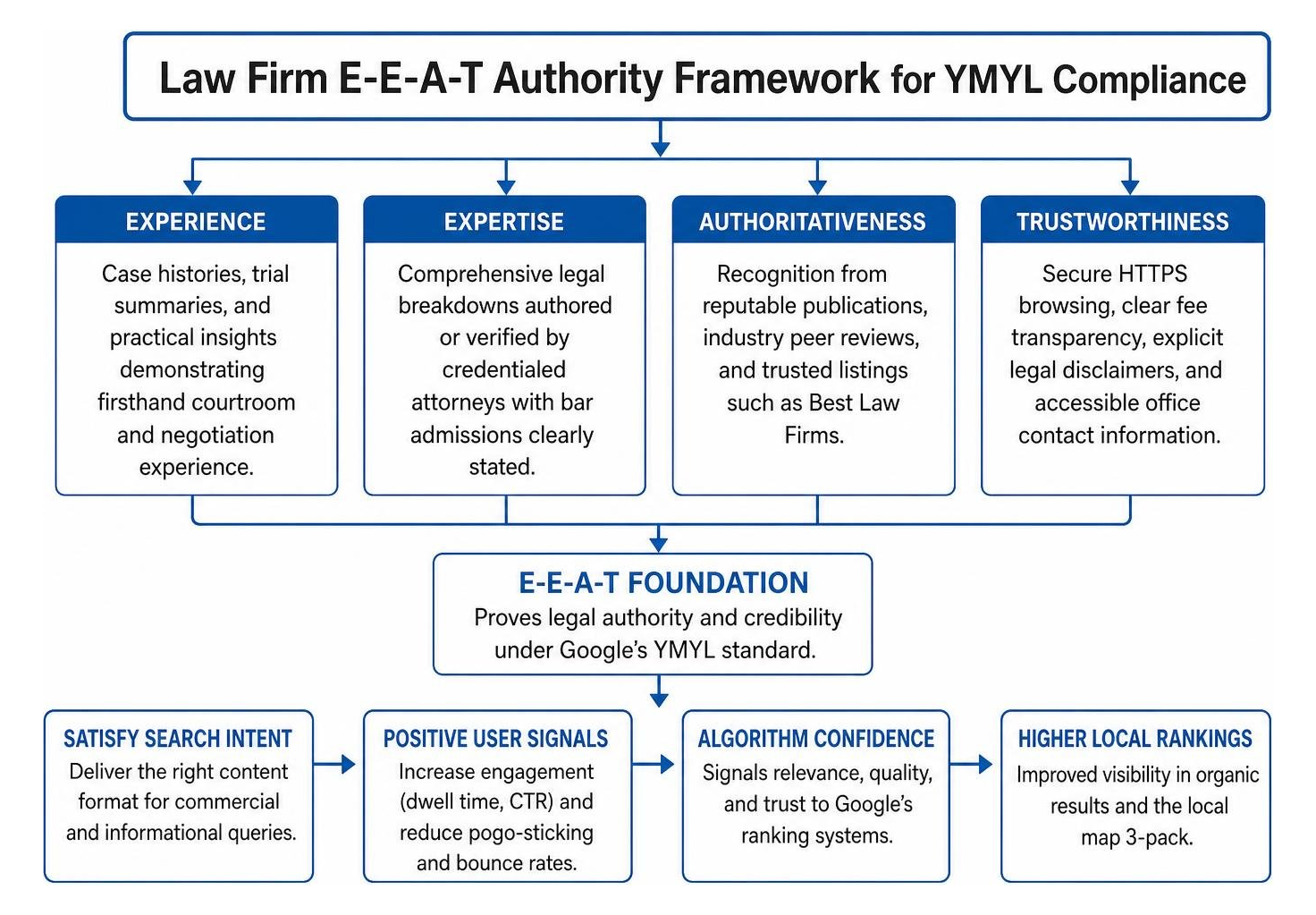
Google’s Search Quality Rater Guidelines heavily emphasize Experience, Expertise, Authoritativeness, and Trustworthiness (E-E-A-T). For law practices, establishing strong E-E-A-T requires tangible proof of legal authority:
- Experience: Case histories, trial summaries, and practical insights demonstrating courtroom and negotiation experience.
- Expertise: Comprehensive legal breakdowns authored or verified by credentialed attorneys with bar admissions clearly stated.
- Authoritativeness: Recognition from reputable publications, industry peer reviews, and trusted listings such as New Jersey – Best Law Firms.
- Trustworthiness: Secure HTTPS browsing, clear fee transparency, explicit legal disclaimers, and accessible office contact information.
Dominating Local Search and the Google Business Profile Map Pack
The local map 3-pack captures 40% to 60% of all clicks for local-intent legal searches. When someone searches for legal representation in their immediate vicinity, the map pack appears above standard organic blue links roughly 93% of the time. Implementing comprehensive local SEO for lawyers is the fastest way to turn local search intent into phone consultations.
Google ranks local profiles based on three primary pillars:
- Relevance: How accurately your profile matches the searcher’s specific need.
- Distance: The physical proximity of your law office to the searcher or specified geographic query.
- Prominence: The online reputation, directory citations, and brand recognition your firm commands across the web.
Optimizing Your Google Business Profile for Client Conversion
Your Google Business Profile (GBP) is often the first touchpoint a prospective client encounters. To maximize ranking power and engagement, proper setup is critical:
- Primary Category Selection: Choose the most specific primary category that matches your core revenue driver (e.g., “Personal Injury Attorney” or “Estate Planning Attorney”) rather than a generic “Law Firm” label.
- 750-Character Description: Leverage our specialized insights on Google Business Profile for lawyers by placing your primary practice areas and geographic locations in the first two sentences.
- Visual Assets: Upload high-resolution office interior, exterior, and team photos. Listings featuring regular photo updates receive 35% more clicks than unmanaged profiles.
- Google Q&A: Seed the profile’s Q&A section with common intake questions—such as fee structures and consultation processes—and answer them directly from your verified business account.
Review Velocity, Local Citations, and Geographic Prominence
Total review count matters, but review velocity—the steady, consistent stream of new client reviews—is an even stronger algorithmic signal. Earning 2 to 4 genuine reviews per month signals active, reliable service to Google.
Maintain exact Name, Address, and Phone number (NAP) consistency across every directory. Inconsistent suite numbers or outdated phone lines dilute your geographic trust score. Build local authority by securing listings on prominent state directories and verified lawyer registries like Best Lawyers in Wayne, NJ.
Technical SEO, Core Web Vitals, and Mobile Architecture
A technically sound website provides the foundation that allows high-quality content and authoritative backlinks to perform. If search crawlers encounter indexing errors, broken redirects, or slow-loading scripts, your rankings will suffer regardless of your legal acumen.
Mobile Usability and Speed Requirements for Law Firm Google Ranking
With over 60% of legal searches taking place on mobile devices, Google evaluates websites using mobile-first indexing. Your mobile experience is the primary version Google indexes.
Law firms must satisfy Google’s Core Web Vitals benchmarks:
- Largest Contentful Paint (LCP): Main content must load within 2.5 seconds.
- Interaction to Next Paint (INP): Interactive response time must stay under 200 milliseconds.
- Cumulative Layout Shift (CLS): Visual layout stability must maintain a score under 0.1.
Ensure font sizes are at least 16px, click-to-call buttons are prominently placed above the fold, and site assets are optimized using modern compression (such as WebP formats) and clean CSS delivery.
Legal Schema Markup and Crawlability Standards
Structured data transforms legal copy into machine-readable entities that search engines interpret with precision. Implementing schema eliminates guesswork for search algorithms:
- LegalService Schema: Defines your firm’s entity type, geographic service radius, physical coordinates, and operating hours.
- Attorney Schema: Connects individual lawyers to their state bar licenses, areas of practice, and professional bios.
- FAQPage Schema: Structures question-and-answer content, dramatically improving eligibility for rich results and AI snippet extraction.
Pair structured markup with an updated XML sitemap, clean canonical tags, and an uncluttered site architecture to ensure every core practice page remains accessible within three clicks of the homepage.
Building Topical Authority and High-Impact Legal Backlinks
Topical authority means thoroughly addressing a legal practice area so completely that search engines view your firm as the definitive resource for that subject.
Creating Topic Clusters for Practice Areas
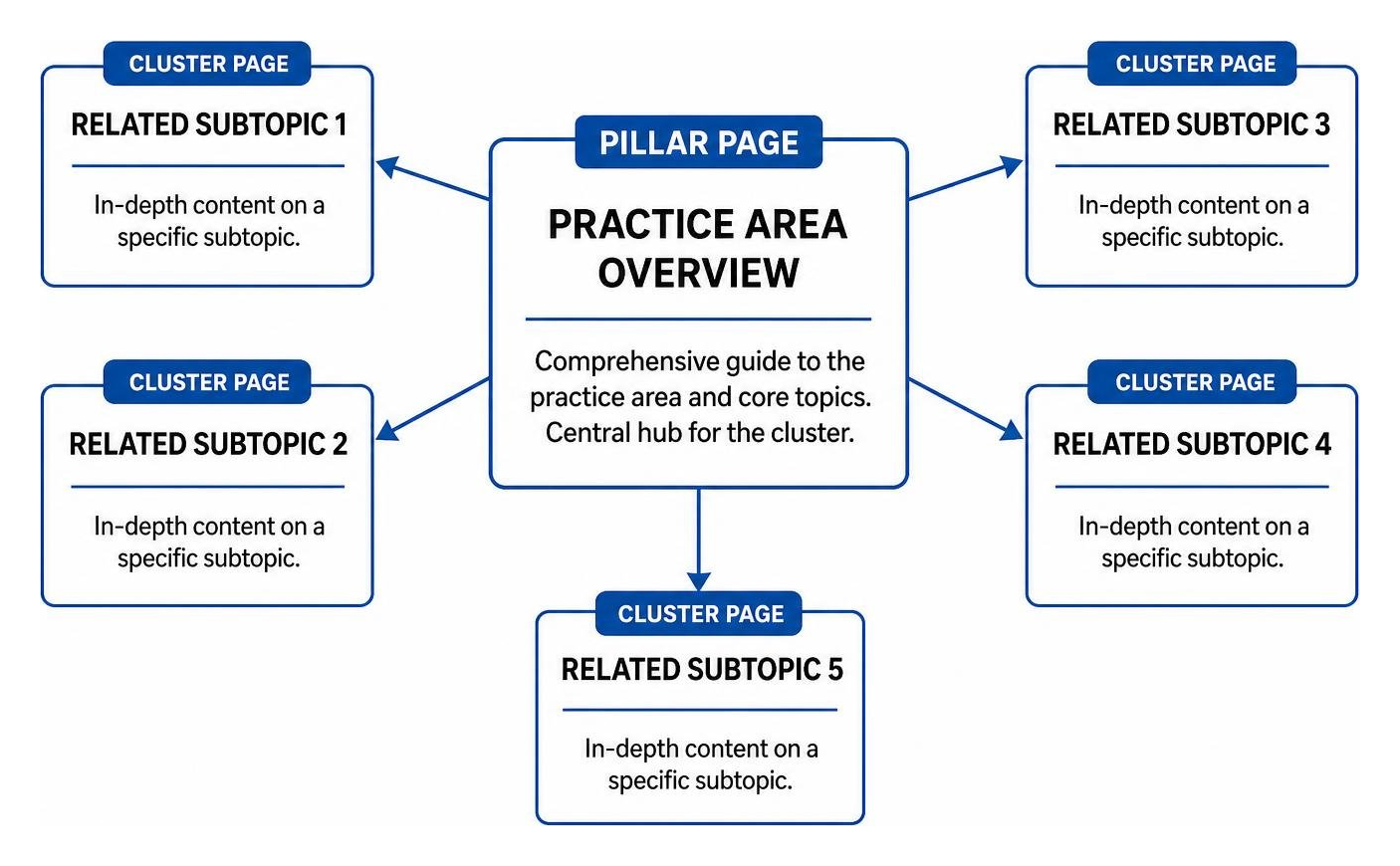
Rather than relying on a single, generic page to rank for dozens of complex terms, organize your website into structured topic clusters.
A topic cluster consists of:
- A Core Pillar Page: A comprehensive overview of a primary practice area (e.g., “Family Law”).
- Supporting Cluster Pages: In-depth articles addressing specific sub-topics, state statutes, and procedural questions (e.g., “Child Custody Mediation Procedures” or “Dividing Marital Assets”).
- Contextual Internal Links: Strategic links passing authority between the supporting guides and the core service landing page.
Structuring content this way proves your jurisdictional breadth to search engines while smoothly guiding prospective clients through each stage of their research.
Acquiring Authoritative Legal Inbound Links
Backlinks act as verified third-party votes of confidence. In the legal sector, link quality far outweighs sheer volume. A single contextual link from an accredited law school, state bar publication, or respected local business association provides significantly more authority than dozens of low-quality links from generic directories.
Effective authority-building strategies include:
- Publishing original legal industry surveys, verdict studies, and local statutory summaries that journalists cite as resources.
- Writing contributed guest columns for legal trade associations and regional business journals.
- Sponsoring local community initiatives, charity runs, and civic events.
- Securing verified profiles on high-authority directories such as Best Lawyers in Clifton, NJ.
Navigating AI Search Engines and Avoiding Fatal SEO Pitfalls
Search engine results are undergoing significant transformation with Google’s AI Overviews and conversational AI models. Adapting your marketing strategy ensures your firm remains visible across both traditional search results and generative summaries.

Generative Engine Optimization for AI Overviews
Generative AI platforms utilize Retrieval-Augmented Generation (RAG) to decompose user queries and extract direct, factual passages from authoritative sources. To maximize your chances of getting cited:
- Front-Load Direct Answers: Research indicates that approximately 44% of AI citations are pulled from the top 30% of a webpage. Provide a direct, self-contained 40 to 60-word answer immediately beneath your primary section headings.
- Incorporate Semantic Structure: Use bulleted steps, comparison tables, and distinct subheadings to answer follow-up legal procedural questions.
- Cite Primary Statutes: Reference relevant legal codes and regulatory guidelines directly in the text to reinforce institutional credibility.
Common Legal SEO Mistakes to Avoid
Many law firms inadvertently undermine their search performance by relying on outdated strategies. Avoid these critical missteps:
- Using Generic Marketing Slogans in H1s: Replace ambiguous headers like “Compassionate Advocacy When You Need It Most” with explicit practice and geographic identifiers such as “Passaic County Personal Injury Lawyers.”
- Publishing Thin Practice Pages: Combining all legal capabilities onto a single generic page fails to provide sufficient depth for competitive queries.
- Neglecting Algorithm Updates: Avoid outdated link-building tactics and review mistakes outlined in our guide on SEO for personal injury lawyers.
- Deploying Unedited AI Copy: Publishing unverified AI-generated content without attorney review creates legal inaccuracies and violates Google’s YMYL quality standards.
Frequently Asked Questions About Law Firm Search Optimization
How long does it take to see organic ranking improvements?
Measurable improvements generally appear within 3 to 6 months for local maps and lower-competition terms. Highly competitive practice areas in major metropolitan markets typically require 9 to 12 months of consistent technical refinement, content expansion, and authority link acquisition.
What is the most critical local ranking factor for attorneys?
Selecting the exact primary category on your Google Business Profile is the single most influential controllable local ranking factor. Proximity to the searcher, consistent review velocity, and uniform NAP citations across the web closely follow in ranking weight.
How does Google’s AI Overview affect attorney web traffic?
While AI Overviews can reduce click-through rates on purely informational definitions, firms cited directly within the AI summary capture a 35% higher click-through rate than standard organic listings beneath it. Optimizing for direct, factual answers turns AI summaries into a consistent source of qualified client inquiries.
Conclusion
Securing a dominant organic search presence is not about chasing algorithmic shortcuts or keyword stuffing. Sustainable search engine prominence requires a cohesive framework: technically pristine site performance, strict E-E-A-T alignment, active local profile management, and comprehensive, attorney-verified content.
At DIGIniche Solutions, we help legal practices build scalable client-acquisition systems using our proprietary V.E.R.A. Formula:
- Visibility: Capturing top-tier local map pack and organic SERP placements.
- Engagement: Designing fast, intuitive user experiences that educate prospects and foster trust.
- Retention: Structuring comprehensive practice hubs that keep potential clients informed.
- Amplification: Generating high-impact digital PR, reviews, and authoritative links that compound over time.
Ready to transform your organic search visibility into a consistent pipeline of high-value cases? Partner with our team for specialized SEO for lawyers in New Jersey and build a digital foundation designed for long-term growth.
