

Why Every Personal Injury Lawyer Should Care About Facebook Ads for Distracted Driving Accidents
Facebook ads for distracted driving accident cases are one of the most direct ways personal injury law firms can reach injured victims at the exact moment they’re searching for help.
Here’s a quick answer if that’s all you need:
How to use Facebook ads to get distracted driving accident clients:
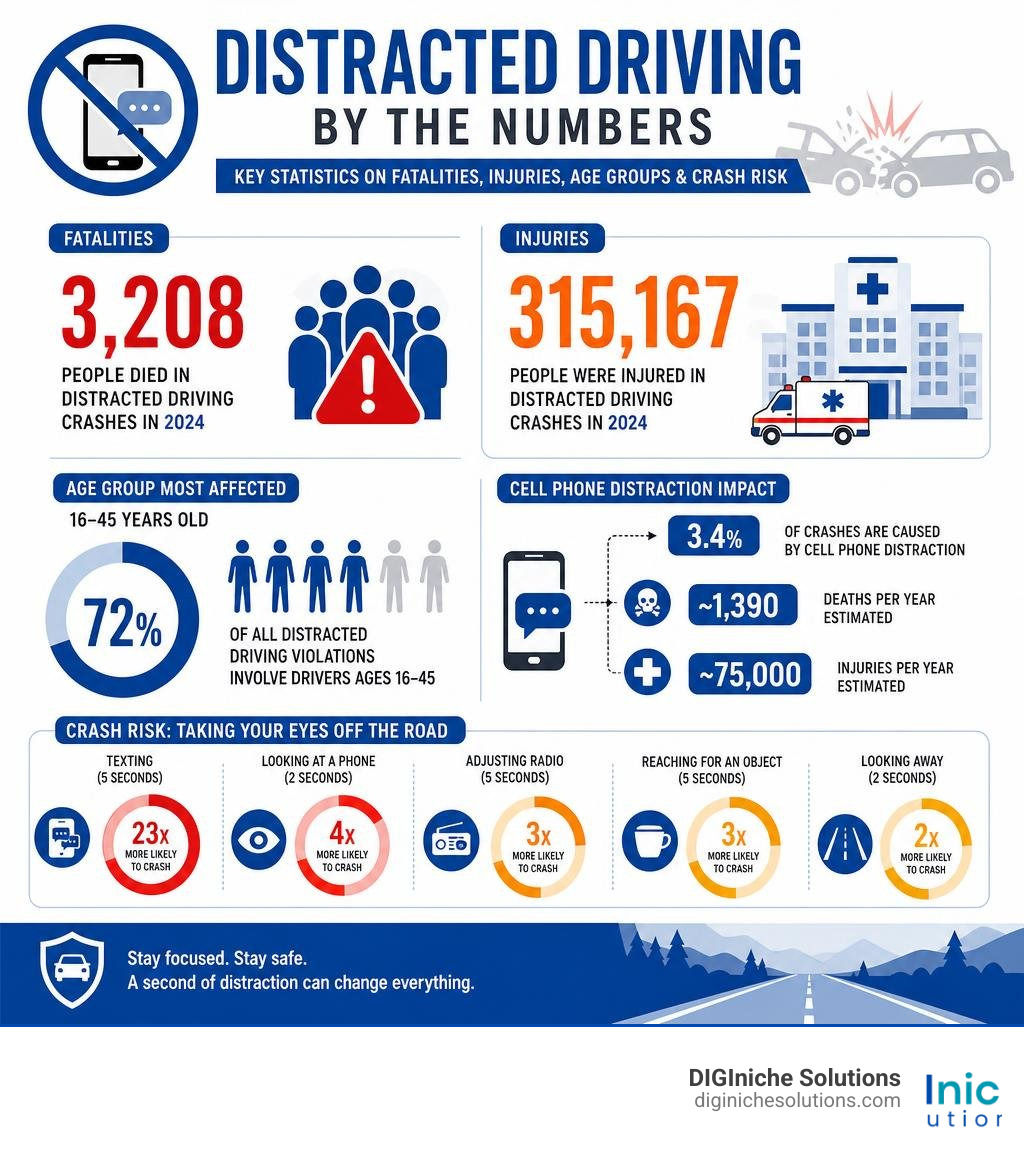
- Target the right audience – Focus on ages 16-45 (Gen Z and Millennials), who make up 72% of all distracted driving violations
- Use emotional video ads – Show real consequences, not just statistics
- Lead with hard-hitting stats – 3,208 people died from distracted driving in 2024; 315,167 were injured
- Include a clear call to action – “Free consultation” or “Know your rights” offers convert well
- Retarget warm audiences – Follow up with people who watched your video or visited your site
Distracted driving is a crisis hiding in plain sight. In 2024 alone, over 315,000 people were injured in distracted driving crashes across the U.S. That’s hundreds of thousands of potential clients — many of whom don’t yet know they have a case.
At the same time, most law firms are still relying on billboards and TV spots to reach those people. Meanwhile, Facebook puts your ad directly in front of the right person, in the right place, at the right time — often on the very device that caused the accident in the first place.
The opportunity is real. But only if you know how to run these campaigns correctly.
I’m Frank Demming, and for over a decade I’ve helped personal injury law firms generate consistent, high-quality leads through targeted digital marketing — including facebook ads distracted driving accident cases specifically. Let’s break down exactly how to build a campaign that brings in cases, not just clicks.
Why Law Firms Need a Facebook Ads Distracted Driving Accident Campaign
To understand why a dedicated facebook ads distracted driving accident campaign is so vital in 2026, we have to look at the sheer scale of the distracted driving problem. For years, personal injury firms relied heavily on broad-spectrum branding. Billboards, late-night television, and radio spots dominated the landscape. But these mediums lack one critical component: precision.
According to the National Highway Traffic Safety Administration (NHTSA), distracted driving claimed 3,208 lives and injured an estimated 315,167 people in 2024 alone. Over the longer ten-year period spanning 2012 to 2023, more than 38,984 people died in distraction-affected crashes. While official records attribute roughly 300 deaths per year directly to cell phone use, meta-analyses reveal that the actual median percentage of crashes caused by cell phone distraction is closer to 3.4%. If we apply this realistic 3.4% rate, cell phone distractions alone account for approximately 1,390 deaths and 75,000 injuries annually.
When an individual is involved in one of these collisions, their lives are turned upside down in an instant. Using a cell phone while driving increases a driver’s crash risk by a staggering 400%. Yet, millions of people continue to scroll, text, and stream while behind the wheel.
This is where digital lead generation becomes a game-changer. By utilizing targeted paid social campaigns, we can position your firm as the immediate solution for victims suffering from these devastating accidents. Traditional advertising hopes a victim remembers your phone number from a billboard they passed three weeks ago. Facebook ads, however, meet users where they are active daily.
If you want to understand the foundational mechanics of how paid social works for legal practices, our guide on Facebook Ads for Lawyers Explained breaks down the core structural differences between social media marketing and traditional search engine marketing. Additionally, referencing official safety guidelines like the NHTSA Distracted Driving Dangers resources in your educational ad copy builds immediate authority and trust with your audience.
High-Impact Ad Formats and Creative Strategies for Distracted Driving Cases
To stand out in a cluttered Facebook feed, your creative assets must be arresting, empathetic, and highly interactive. The average user scrolls through yards of content daily; your ad must break that pattern immediately.
One of the most effective ways to do this is through immersive, platform-native ad formats. For instance, back when mobile advertising was evolving, brands experimented with highly interactive takeover ads. A famous example was Mazda’s immersive distracted driving ad, which simulated a car skidding across the user’s mobile screen, complete with a sudden crash sound and a cracked-screen visual effect. The ad was designed to show—rather than simply tell—how quickly a distraction can shatter reality.
We can adapt these immersive concepts using modern Facebook Canvas (Instant Experience) and video formats. When a user interacts with your ad, it should trigger an immediate psychological halt.
When designing your creative assets, prioritize these three formats:
- Short-Form Video Ads: 15-to-30-second videos that immediately drop the viewer into the aftermath of a crash or show the split-second decision to look at a phone.
- Carousel Ads: Step-by-step interactive carousels that walk victims through what they should do immediately after a distracted driving accident (e.g., call the police, seek medical care, take photos, contact a lawyer).
- Instant Experiences: Immersive mobile landing pages built directly inside Facebook that load instantly and let users read case studies, watch client testimonials, and submit an inquiry form without ever leaving the app.
To explore how these formats fit into a broader marketing budget, check out our comprehensive breakdown of Facebook Advertising systems.
How to Structure a Facebook Ads Distracted Driving Accident Video
If you are using video—which we highly recommend as your primary creative driver—you must design it around the “5-second rule.” At 55 mph, taking your eyes off the road to read or send a text for just 5 seconds is equivalent to driving the entire length of a football field with your eyes closed. Your video ad must capture attention within that exact same 5-second window.
Structure your video ad using this high-converting framework:
- The Hook (0–3 seconds): Start with a jarring visual or a powerful question. For example, show a close-up of a phone screen lighting up with a notification, followed by the sound of screeching tires. Do not start with your firm’s logo; start with the human element.
- The Problem (4–10 seconds): Clearly define the threat. Explain that distracted driving takes three forms: visual (taking eyes off the road), manual (taking hands off the wheel), and cognitive (taking your mind off driving). Highlight that these behaviors increase crash risks exponentially, as documented in the Geotab Distracted Driving Facts index.
- The Solution (11–20 seconds): Introduce your law firm as the advocate for victims. Explain that you know exactly how to hold distracted drivers—and their insurance companies—accountable.
- The Call to Action (21–30 seconds): Give a clear, simple instruction. “Inured by a texting driver? Click below to schedule your free, confidential case review today.”
Targeting the Right Demographics with Your Facebook Ads Distracted Driving Accident Campaign
An incredible creative asset will still fail if it is shown to the wrong audience. Fortunately, Facebook’s targeting capabilities allow us to segment and reach the exact demographics most impacted by distracted driving.
Data shows that younger drivers are disproportionately responsible for distraction-affected accidents. Gen Z and Millennials (ages 16-45) account for a massive 72% of all distracted driving violations, with male drivers aged 16-45 committing 59% of those infractions.
To maximize your return on ad spend, we recommend structuring your campaign into three distinct target audiences:
- The Youth & Young Adult Demographics (Ages 18–35): Focus your messaging on peer-to-peer accountability, the sudden ruin of a promising future, and the legal realities of a crash.
- The Parent Demographic (Ages 35–55): Focus your messaging on family safety, protecting children from negligent drivers, and securing the financial future of a household after an unexpected injury.
- Commercial and Fleet Driver Targets: Highlight cases involving distracted commercial truck or delivery drivers. These cases often involve massive insurance policies and clear liability.
By utilizing custom audiences and lookalike audiences built from your firm’s historical client data, we can find users who share characteristics with your past successful cases. To understand how to narrow these audiences down to your specific geographic market, read our strategic guide on Local Targeting in Facebook Ads: Why Law Firms Need It.
Leveraging Real-World Evidence and Legal Consequences in Ad Copy
When writing ad copy for a facebook ads distracted driving accident campaign, lean heavily on real-world legal strategies and successful case outcomes. Victims want to know that you have the technical knowledge and resources to win their case.
For example, highlight how your firm uncovers hidden evidence, such as subpoenaing cell phone logs and data records to prove a driver was actively texting or using social media apps at the exact second of impact. This strategy was central in a landmark $1.5 Million Settlement for Woman Hit by Distracted Company Driver Who Ran Stop Sign | Joye Law Firm Injury Lawyers , where cell phone records were subpoenaed to directly contradict the negligent driver’s denial of phone use. Showing potential clients that you know how to break through corporate and insurance denials is highly persuasive.
Additionally, reference local and state hands-free laws to educate the public while establishing your expertise. For example, strict state laws like Illinois’ Public Act 103-0310 and statute 625 ILCS 5/12-610.2 explicitly ban all handheld device use, including streaming videos and accessing social media while driving. Mentioning these specific statutory violations in your copy shows that you understand the precise legal levers needed to secure a maximum recovery, as detailed in the Elgin Distracted Driving Accident Lawyer – Briskman Briskman & Greenberg Personal Injury & Car Accident Lawyers resource.
To help your audience understand what qualifies as actionable negligence, you can present a clear breakdown of distractions in your ad copy or landing pages:
| Distraction Type | Driving Behavior Impact | Estimated Crash Risk Increase |
|---|---|---|
| Visual (Looking at phone/screen) | Eyes off road for ~5 seconds | Up to 400% increase |
| Manual (Handling device/typing) | Slowed braking response time | Equivalent to 4 beers in 1 hour |
| Cognitive (Web surfing/navigating apps) | Reduced headway and speed deviation | 10% average simulator crash risk increase |
Integrating Facebook Ads with Local Enforcement and Public Safety Campaigns
One of the smartest ways to boost the relevance and organic reach of your Facebook ads is to align them with national and local public safety initiatives. When your ads run alongside highly visible law enforcement campaigns, they benefit from a compounding effect.
For instance, the NHTSA runs a massive annual nationwide campaign called “Put the Phone Away or Pay,” which typically peaks during distracted driving awareness crackdowns in April. Law enforcement agencies nationwide participate by increasing patrols and issuing citations to distracted drivers. You can see how these initiatives are rolled out publicly on social media via the Put the Phone Away or Pay is a nationwide campaign running from … campaign page.
By launching your law firm’s ads to coincide with these enforcement periods, your messaging piggybacks on the heightened public awareness. Your copy can directly address these events: “With local police actively cracking down on texting drivers this month, the dangers of distracted driving are clearer than ever. If you were injured by someone who refused to put their phone away, we are here to help you hold them accountable.”
Furthermore, you can cite academic research to back up your claims. Studies published by Examining the effects of texting, web surfing, and navigating apps on urban driving behavior and crash risk | Traffic Safety Research show that using social media feeds, texting, and interacting with navigation apps directly degrades driver safety by altering speed, reducing safe headway, and increasing crash risks in urban environments. Sharing this data positions your firm as a deeply informed advocate for traffic safety.
Frequently Asked Questions about Distracted Driving Ads
What is the average crash risk increase associated with smartphone use while driving?
Using a cell phone or smartphone while driving increases a driver’s crash risk by 400%. Simulator studies indicate that typing, reading, or navigating apps causes a 10% increase in immediate crash risk, while drastically slowing driver response times to a level comparable to an individual who has consumed four beers in a single hour.
How can law firms prove a driver was distracted at the time of an accident?
To establish liability in a distracted driving case, personal injury attorneys can subpoena the driver’s cellular carrier records to match timestamps of calls, text messages, or data usage with the exact time of the accident. Additionally, lawyers leverage police reports, witness statements, and nearby business surveillance or traffic camera footage to build a comprehensive case.
Why should personal injury law firms use Facebook ads over traditional TV PSAs?
Facebook ads offer precise demographic and geographic targeting, allowing law firms to reach specific audiences (such as drivers aged 16-45 or parents within a specific county) at a fraction of the cost of traditional television. Furthermore, social media campaigns provide interactive, clickable formats that yield measurable engagement metrics, enabling real-time campaign optimization.
Conclusion

Running a successful campaign for facebook ads distracted driving accident cases requires a delicate balance of emotional storytelling, strict demographic targeting, and authoritative legal messaging. By educating the public on the real-world dangers of distracted driving while highlighting your firm’s ability to uncover critical evidence, you can build a steady stream of high-value cases.
At DIGIniche Solutions, we specialize in helping law firms in New Jersey and nationwide scale their client acquisition. Through our proprietary V.E.R.A. Formula—which focuses on Visibility, Engagement, Retention, and Amplification—we build scalable digital marketing ecosystems that turn online attention into signed cases.
However, generating high-quality leads is only half the battle. If your firm doesn’t have a seamless intake process, those valuable leads will slip through the cracks. Leading legal intake professionals emphasize that personal injury leads require immediate, empathetic action. Best practices include answering inbound calls on the second ring, conducting daily follow-ups via call, text, and email for at least two weeks, and using customized, compassionate automation rather than generic out-of-the-box templates.
Are you ready to dominate your local market and secure more distracted driving cases? Let us build, manage, and optimize your paid social campaigns. Explore our specialized services today at Facebook Ads for Lawyers and take the first step toward predictable, scalable growth.
