

Why Most Law Firms Struggle to Grow Online (And What Actually Works)
The most effective digital marketing strategies for law firms in 2026 combine these core channels:
- Local SEO — Rank in Google’s map pack for high-intent searches like “divorce lawyer near me”
- Google Business Profile optimization — Your single most important free digital asset
- Practice area content — Deep, attorney-authored pages that build topical authority
- Pay-per-click (PPC) ads — Fast-track visibility for competitive keywords
- Generative Engine Optimization (GEO) — Structure content so AI tools like ChatGPT and Google AI Overviews recommend your firm
- Reputation management — Generate and manage reviews across Google and legal directories
- Video content — Short, authentic videos that build trust before a prospect ever calls
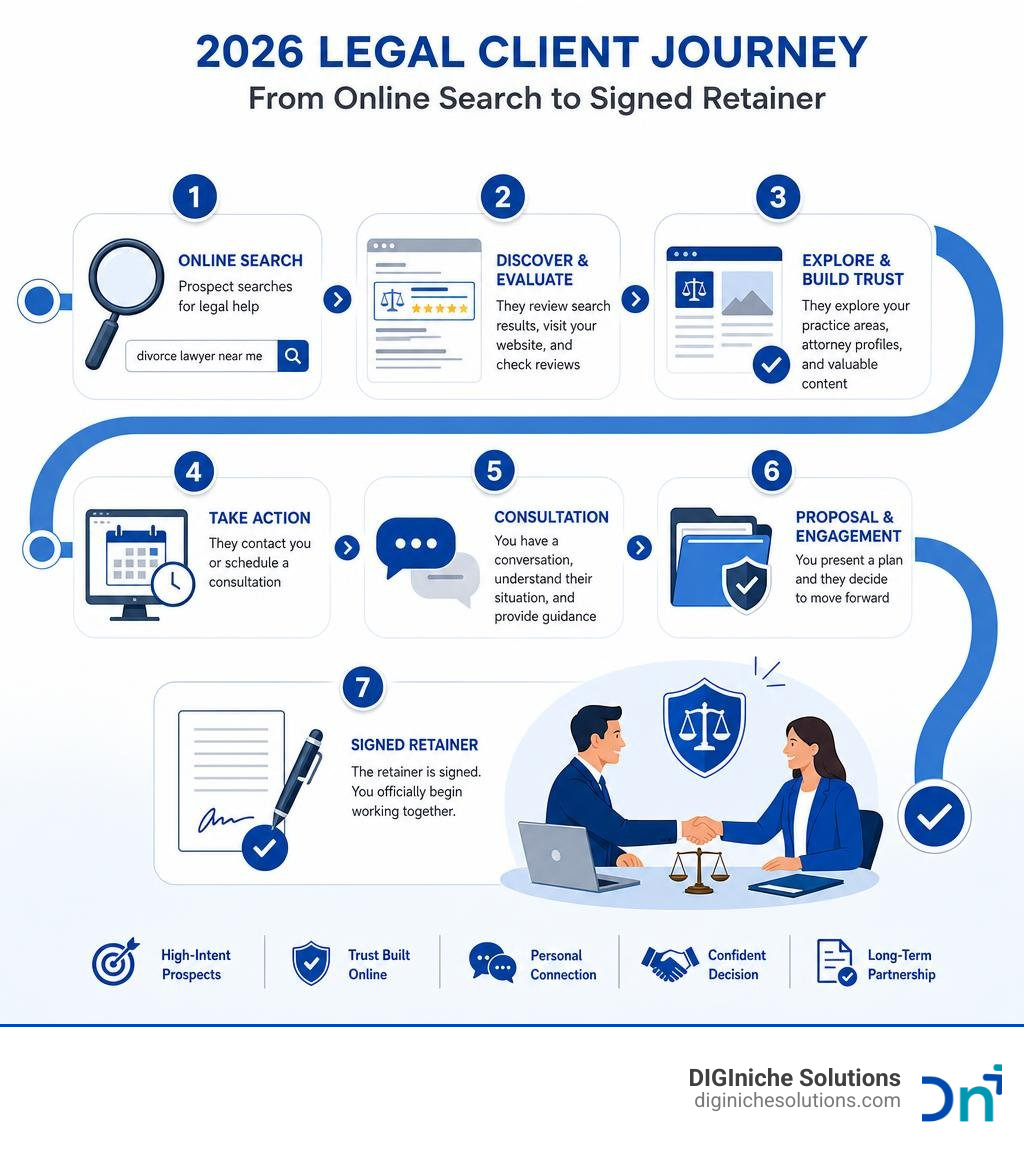
Here is the reality most law firms face: 96% of people searching for legal help start online. They are not asking friends first. They are not opening a phone book. They type a query, scan the top results, check reviews, and make a decision — often before they ever contact an attorney.
Research shows that prospects complete 78% of their buyer journey before reaching out to a single firm.
That means your online presence is not just a marketing channel. It is your first impression, your credibility check, and your intake system — all rolled into one.
Yet 41% of law firms have no measurable marketing KPIs. Many more are spending money on tactics that generate traffic but not signed cases.
The gap between firms that grow predictably and firms that rely on inconsistent referrals almost always comes down to one thing: a system, not just a presence.
I’m Frank Demming, and for more than a decade I’ve specialized in building exactly those systems — helping attorneys master digital marketing strategies for law firms through SEO, PPC, and conversion-focused web strategy. In the sections below, I’ll walk you through what actually moves the needle in 2026.
Handy digital marketing strategies for law firms terms:
The Economics of Legal Client Acquisition: SEO vs. PPC
When we sit down with managing partners in New Jersey to audit their marketing, the first question is almost always: “Should we invest in SEO or should we run PPC ads?”
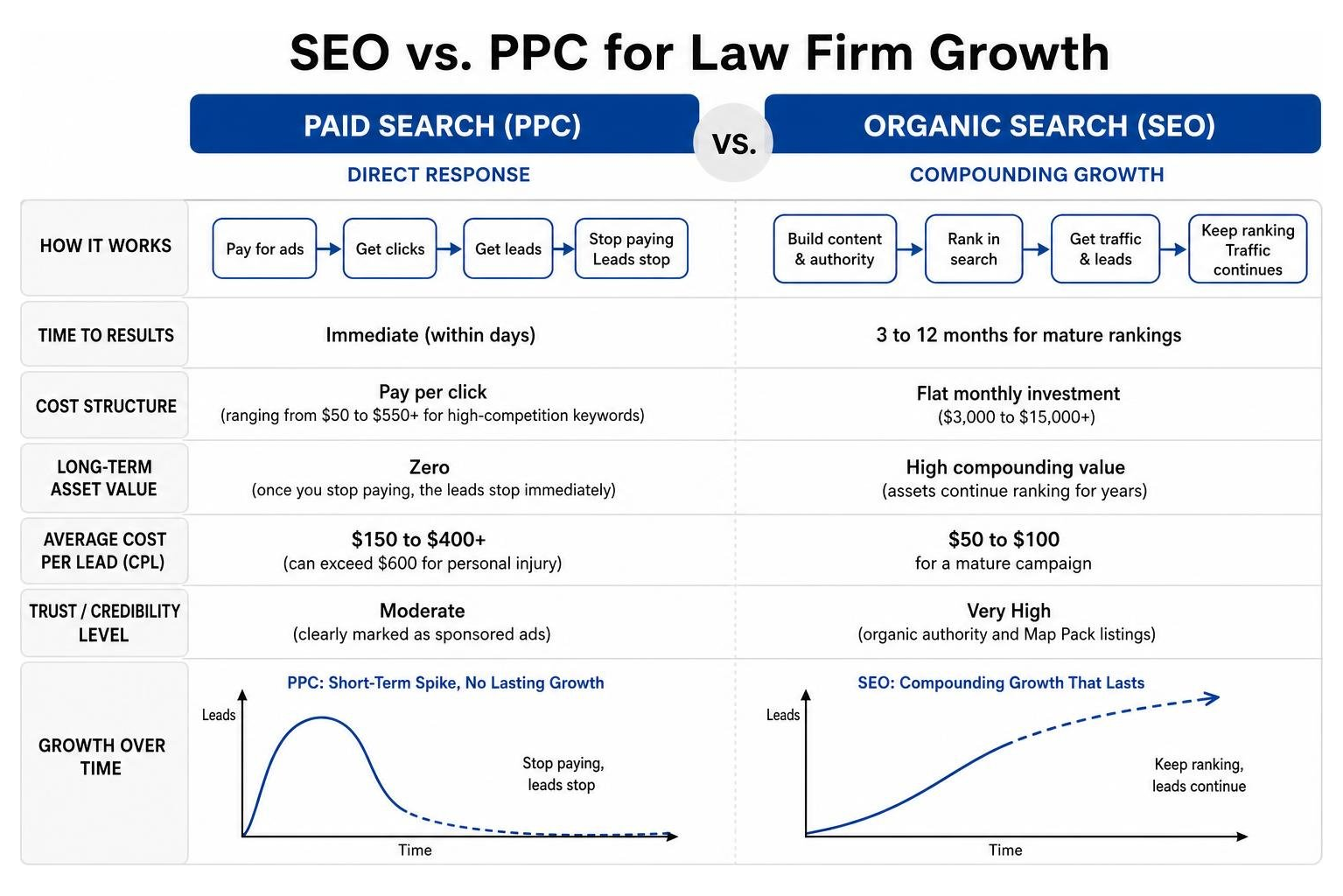
The short answer is that they serve two completely different financial purposes in your firm’s growth ecosystem. PPC is your sprint; SEO is your marathon.
To make sense of where your hard-earned capital should go, let’s break down the actual economics of both channels in 2026.
| Metric | Pay-Per-Click (PPC) Advertising | Organic Search (SEO) |
|---|---|---|
| Time to Results | Immediate (within days) | 3 to 12 months for mature rankings |
| Cost Structure | Pay per click (ranging from $50 to $550+ for high-competition keywords) | Flat monthly investment ($3,000 to $15,000+) |
| Long-Term Asset Value | Zero (once you stop paying, the leads stop immediately) | High compounding value (assets continue ranking for years) |
| Average Cost Per Lead (CPL) | $150 to $400+ (can exceed $600 for personal injury) | $50 to $100 for a mature campaign |
| Trust/Credibility Level | Moderate (clearly marked as sponsored ads) | Very High (organic authority and Map Pack listings) |
The Reality of Paid Search: Fast but Expensive
If you need cases signed by next Tuesday, paid acquisition is the way to go. Through PPC Advertising for Law Firms and traditional search campaigns on Google or Bing, you can leapfrog the organic rankings to place your brand directly in front of active searchers.
However, legal PPC is one of the most fiercely competitive and expensive advertising markets on earth. In major metropolitan areas across New Jersey, bidding on high-intent terms can cost hundreds of dollars per click. For instance, a personal injury click for a car accident query can easily average $150 to $300, while specialized niches like mesothelioma lawsuits can exceed $700 per single click.
If your landing page converts at a standard 5% rate, you are looking at thousands of dollars just to acquire a single lead, let alone a signed client. This is why connecting your Pay Per Click campaigns directly to your CRM is vital. In 2026, we utilize value-based bidding to feed client outcome data back to Google Ads, training the algorithm to target high-value cases rather than raw clicks.
The Compounding Power of Organic Search
In contrast, investing in Law Firm SEO Services Boost Your Legal Websites builds a permanent marketing asset. When you rank organically on the first page of Google, you don’t pay for clicks. Whether 10 or 1,000 prospects find you, your distribution cost remains virtually zero.
Over a 12-to-24-month horizon, a mature organic search strategy regularly delivers a client acquisition cost that is 40% lower than paid-only campaigns. The traffic from organic search is also highly qualified, as users naturally trust organic results more than paid advertisements.
We always recommend a diversified 60/40 split for firms looking to scale: allocate 60% of your budget to building long-term organic assets and 40% to capturing immediate, high-intent leads via paid channels.
Core Digital Marketing Strategies for Law Firms in 2026
To win in the New Jersey legal market, your firm must dominate where local clients actually look. Because search behavior is highly localized—especially for personal injury, family law, and criminal defense—your local search presence is the ultimate battleground.
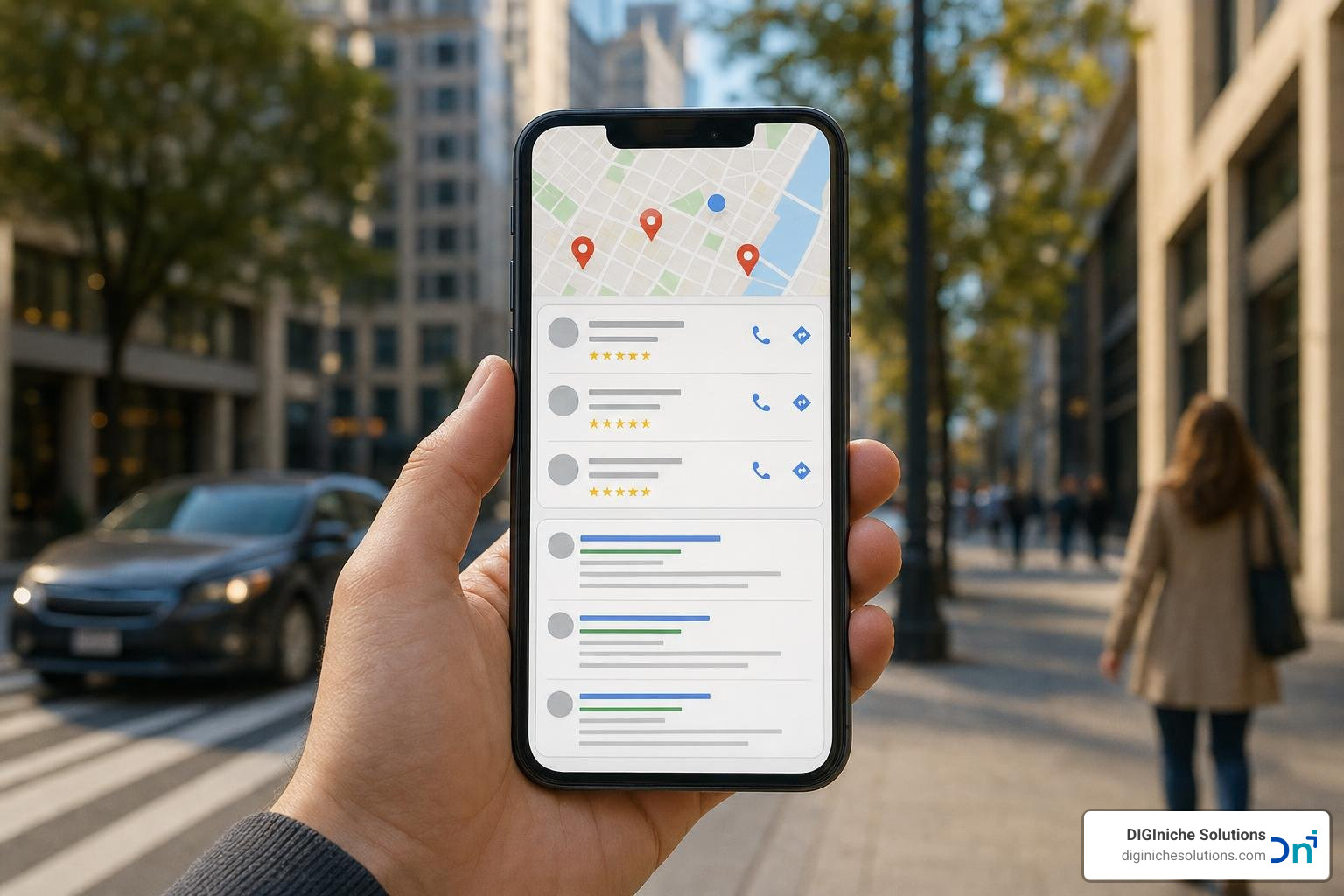
The foundation of modern local search is your Google Business Profile (GBP). If your GBP is not fully optimized, you are practically invisible to half of your market. To build a dominant local presence, we must implement a multi-layered local SEO playbook:
- Primary Category Alignment: Ensure your primary GBP category matches your highest-value practice area (e.g., “Personal Injury Attorney” rather than just “Law Firm”).
- Hyper-Local Landing Pages: Do not just link your GBP to your homepage. Instead, link your local map listings directly to city-specific practice pages. For example, pointing your Newark office GBP to a dedicated Newark-focused personal injury page can boost conversion rates by 30%.
- NAP Consistency: Your Name, Address, and Phone number (NAP) must be identical across every digital touchpoint. This includes your website, social media, and major legal directories like Avvo, Justia, and FindLaw.
- Continuous Updates: Update your GBP photos quarterly with authentic team and office photos. Google’s algorithm favors active profiles, and listings with 50+ real photos receive significantly more engagement than those relying on stock photography.
For a deeper dive into establishing this baseline, review our comprehensive resource on Law Firm SEO The Ultimate Guide.
Implementing High-ROI Digital Marketing Strategies for Law Firms
To turn casual search traffic into signed retainers, your content strategy must go beyond generic blog posts. Publishing thin, 500-word articles like “What is a personal injury claim?” will no longer cut it. Google classifies all legal content as YMYL (Your Money or Your Life), subjecting your site to the highest standards of E-E-A-T (Experience, Expertise, Authoritativeness, and Trustworthiness).
To build absolute topical authority in your practice areas, we recommend building out structured content clusters. This means writing one deep, comprehensive pillar page (1,500 to 2,500 words) for each major sub-practice area (e.g., “Motorcycle Accidents in New Jersey”) and supporting it with 15 to 20 highly specific, educational child pages.
For additional guidance on planning these assets, read our expert Digital Marketing for Lawyers Content Marketing Tips and find out Why Your Law Firm Needs Custom Content Marketing to set your firm apart.
Furthermore, integrating video is no longer optional. One in four prospective clients prefer watching video FAQs over reading text, and half prefer video testimonials over written ones. Recording simple, authentic, unedited videos on your phone to explain common legal questions can dramatically humanize your brand and increase website conversion rates.
Ethical Guardrails for Digital Marketing Strategies for Law Firms
As attorneys, your marketing must not only be effective—it must be strictly compliant. Unlike general business marketing, legal marketing is heavily regulated by state bar associations and the ABA Model Rules of Professional Conduct.
- ABA Model Rule 7.1: This rule strictly prohibits any false or misleading communications. You must never make exaggerated guarantees, promise specific outcomes, or create unjustified expectations.
- ABA Model Rule 7.2: This rule governs advertising and referral agreements. For example, New Jersey attorneys must navigate specific guidance regarding referral relationships and fee-splitting.
- Client Confidentiality: You must protect client confidentiality at all costs. Never share case details, testimonials, or success stories online without express, written client consent. When responding to public reviews—even negative ones—never disclose sensitive case facts.
- Attorney Disclaimers: Ensure every digital asset, landing page, and social media profile contains visible, compliant disclaimers such as “Attorney Advertising” and “Prior results do not guarantee a similar outcome.”
Before launching any campaign, we recommend consulting Your Go-To Handbook for Digital Marketing for Law Firms and reviewing our guide on How to Stop Wasting Money on Bad Digital Marketing for Law Firms to ensure your campaigns are built on a legally compliant, high-performing foundation.
Generative Engine Optimization (GEO): Optimizing for AI Search
The search landscape has shifted dramatically. In 2026, AI-enhanced experiences like Google AI Overviews, ChatGPT, and Perplexity capture over 50% of high-intent legal queries. In fact, AI Overviews have reduced traditional click-through rates by roughly 34-35% for top organic positions.
To survive and thrive, your firm must optimize for AI search. This process is known as Generative Engine Optimization (GEO) or Answer Engine Optimization (AEO).

AI engines do not read websites the way traditional search crawlers do. They look for clear entities, structured data, and direct, authoritative answers. To optimize your firm’s digital footprint for AI recommendation, we focus on three core technical pillars:
- Structured Q&A Formats: AI engines favor direct answers. Structure your content with clear, plain-language legal explanations. Place a concise, direct answer to the user’s question in the first 100 words of your practice pages, followed by detailed, structured FAQs.
- Advanced Schema Markup: Implement robust LocalService, Attorney, and FAQ schema markup. This helps search engines and AI models identify your firm as a verified, connected local entity rather than an isolated website page.
- Indexable Video Transcripts: Search engines treat video transcripts as primary indexable assets. Adding clear, text-based transcripts to your video guides ensures AI engines can easily read, synthesize, and cite your video content in AI summaries.
This level of optimization requires a modern, technically flawless website. To ensure your digital storefront is up to par, explore our articles on Website Design and discover what the Best Law Firm Websites Have in Common to maximize your visibility in AI-driven search results.
Frequently Asked Questions about Legal Marketing
How much budget should a law firm allocate to digital marketing?
The ideal marketing budget depends on your firm’s size, practice area, and aggressive growth goals. As a general industry benchmark, solo practitioners and small firms in New Jersey typically allocate 2% to 4% of their gross revenue to marketing, while mid-sized to large firms seeking aggressive growth spend 4% to 8% (or more) of their revenue.
To make this practical, let’s look at the average monthly spend and channel allocations we recommend for firms in 2026:
- Solo Practitioners ($1,500 – $3,000/mo): Focus heavily on organic foundations. We recommend allocating 60% to Local SEO and GBP optimization, 20% to targeted PPC or Local Service Ads (LSAs), 15% to content and authentic video creation, and 5% to marketing tools.
- Mid-Sized Firms ($4,000 – $8,000/mo): Balance organic growth with active lead generation. Allocate 50% to comprehensive SEO and content clusters, 30% to optimized PPC campaigns, 15% to high-quality video production and social media, and 5% to advanced conversion tracking tools.
- Large/Aggressive Firms ($10,000 – $25,000+/mo): Dominate multiple channels. Allocate 40% to enterprise-level SEO and link acquisition, 35% to multi-channel paid search (Google, Bing, and LSAs), 20% to professional video production, brand awareness, and retargeting, and 5% to advanced attribution and CRM systems.
Regardless of your budget size, the goal is to achieve an acceptable revenue-to-cost ratio of 5:1, meaning your marketing spend should generate at least five times its cost in signed case revenue. To learn how to structure your budget for maximum efficiency, read our guide on Tips to Maximize Law Firm Marketing Budget.
How do law firms ethically manage online reviews and reputation?
Online reviews are your digital currency. A staggering 87% of consumers read online reviews before choosing a local business, and 53% of legal consumers will not even consider a law firm with a rating below 4 stars.
However, soliciting and managing reviews as an attorney comes with strict ethical guidelines:
- No Incentives: You must never offer discounts, gift cards, or any form of compensation in exchange for a review. Doing so violates both Google’s terms of service and state bar ethics rules.
- Protect Confidentiality in Responses: When responding to reviews—especially negative ones—you must never disclose confidential client information. Even if a reviewer leaves a highly critical, inaccurate review, your response must remain professional, objective, and compliant with confidentiality rules. A simple, compliant response format is: “Thank you for your feedback. We take all client concerns seriously. Please contact our managing partner directly at [Phone] so we can discuss and resolve your experience.”
- Diversify Platforms: While Google Business Profile reviews are critical for local SEO, prospective clients also vet attorneys on third-party legal directories. Actively build your review presence on platforms like Avvo, Martindale-Hubbell, and Justia to reinforce your authority.
For a step-by-step blueprint on building an ethical social proof system, explore our resources on Law Firm Reputation Management and Reputation Management for Lawyers Digital Marketing.
Can solo and small law firms compete with larger firms online?
Yes, absolutely. While large, national firms have massive marketing budgets, they often spread their resources thin across broad, generic campaigns. Solo practitioners and small firms can outmaneuver them by being faster, hyper-local, and highly specialized.
Here is how small firms can win:
- Hyper-Local Dominance: Focus your SEO efforts on highly specific geographic markets. A large firm might target broad keywords like “New Jersey personal injury lawyer,” but a small firm can dominate localized, high-intent terms like “car accident lawyer in Cherry Hill” or “DUI defense attorney in Morristown.”
- Niche Specialization: Build your brand as the absolute authority in a narrow legal niche. Instead of marketing yourself as a general “family lawyer,” focus your content, video, and SEO around “high-asset divorce mediation” or “grandparent visitation rights.”
- Leverage Local Service Ads (LSAs): Google Local Service Ads operate on a pay-per-lead model rather than pay-per-click, making them highly cost-effective for smaller budgets. LSAs place your verified firm at the absolute top of search results, allowing you to compete directly with larger firms for high-intent local leads.
To learn how to deploy these highly effective, cost-efficient paid leads, see our guide on how Local Service Ads for Law Firms Generate More Leads.
Conclusion
In 2026, successful legal marketing is no longer about chasing the latest digital trend or running isolated, disconnected campaigns. The law firms that dominate their local markets are the ones that build a cohesive, compounding marketing ecosystem.
At DIGIniche Solutions, we help New Jersey law firms transition from unpredictable referral pipelines to highly predictable, scalable growth systems. We do this through our proprietary V.E.R.A. Formula:
- Visibility: Placing your firm at the top of local search, map packs, and AI-driven answer engines.
- Engagement: Capturing attention with authentic, authoritative content and video that builds immediate trust.
- Retention: Streamlining your digital touchpoints and intake workflows to ensure leads never slip through the cracks.
- Amplification: Scaling your success through strategic paid search, reputation management, and multi-channel brand authority.
Whether you are a solo practitioner in Cherry Hill or a multi-partner firm in Newark, we can help you build a dominant online presence that translates directly into signed cases and real revenue growth.
Ready to take your firm’s growth to the next level? Explore our specialized SEO for Lawyers New Jersey services or connect with our team today to schedule your custom strategy session. Let’s build a client-growth ecosystem that moves the needle for your practice.
{“@context”: “https://schema.org”, “@graph”: [{“@type”: “Article”, “headline”: “Law Firm Digital Marketing Strategies | DIGIniche Solutions”, “description”: “Discover digital marketing strategies for law firms, from SEO to PPC, GEO, reviews, and video. Build predictable case growth—learn what works.”, “author”: {“@type”: “Person”, “name”: “Frank Demming”}, “publisher”: {“@type”: “Organization”, “name”: “DIGIniche Solutions”, “logo”: {“@type”: “ImageObject”, “url”: “https://firebasestorage.googleapis.com/v0/b/ai-templates.appspot.com/o/bot%2FquvpOvl0dyaayAvcqKuS%2Flogo%2FDigiNiche%20Icon%20-%20cropped-more.jpg?alt=media&token=38dbb34c-0ce4-4e2c-9a64-c60c4c1fe839”}}, “datePublished”: “2026-08-17T12:04:37+00:00”, “dateModified”: “2026-08-17T12:04:50.009404”, “mainEntityOfPage”: {“@type”: “WebPage”, “@id”: “https://diginichesolutions.com/seo-for-law-firms-what-actually-moves-the-needle/”}, “image”: “https://images.bannerbear.com/direct/4mGpW3zwpg0ZK0AxQw/requests/000/153/635/325/NnaW7b28GYDe5OKrz4VwORxZl/cf3ede15455fb5665ef823a45979c2b44ce8f3cd.jpg”}, {“@type”: “FAQPage”, “mainEntity”: [{“@type”: “Question”, “name”: “What are the most effective digital marketing strategies for law firms in 2026?”, “acceptedAnswer”: {“@type”: “Answer”, “text”: “The article identifies Local SEO, Google Business Profile optimization, practice area content, PPC ads, Generative Engine Optimization, reputation management, and video content as the core digital marketing strategies for law firms in 2026.”}}, {“@type”: “Question”, “name”: “Why do law firms need a strong online presence?”, “acceptedAnswer”: {“@type”: “Answer”, “text”: “According to the article, 96% of people searching for legal help start online, and prospects complete 78% of their buyer journey before contacting a firm. A law firm’s online presence acts as its first impression, credibility check, and intake system.”}}, {“@type”: “Question”, “name”: “Why do many law firms struggle to grow with digital marketing?”, “acceptedAnswer”: {“@type”: “Answer”, “text”: “Many law firms struggle because they lack measurable marketing KPIs or spend money on tactics that generate traffic but not signed cases. The article says predictable growth comes from having a system, not just an online presence.”}}, {“@type”: “Question”, “name”: “Should law firms invest in SEO or PPC advertising?”, “acceptedAnswer”: {“@type”: “Answer”, “text”: “The article explains that SEO and PPC serve different purposes in a law firm’s growth strategy. PPC is described as a sprint for fast visibility, while SEO is a marathon for long-term growth.”}}, {“@type”: “Question”, “name”: “Why is Google Business Profile important for law firms?”, “acceptedAnswer”: {“@type”: “Answer”, “text”: “The article describes Google Business Profile as a law firm’s single most important free digital asset. Optimizing it helps firms appear for high-intent local searches and supports visibility in Google’s map pack.”}}]}]}