

Why Finding the Right SEO Attorney Marketing Expert Changes Everything
An SEO attorney specialist is a digital marketer who focuses exclusively on helping law firms rank higher in search engines and attract more qualified clients online. If you’re trying to find the right one for your firm, here’s a quick overview:
What to look for in a legal SEO specialist:
- Proven legal industry experience – Track record with law firms in your practice area
- Bar compliance knowledge – Understands ABA advertising rules and ethical guidelines
- Local SEO expertise – Knows how to rank in Google Maps and local search results
- Transparent reporting – Shows you leads and signed cases, not just traffic numbers
- Content and technical skills – Handles both on-page content and behind-the-scenes site health
- No long-term lock-in – Confident enough in results to offer flexible terms
Right now, 74% of lawyers use their firm website to market their services — but only 28% have hired a specialist to help them do it well. That gap is costly.
When a potential client needs a divorce attorney or personal injury lawyer, they open Google. They click one of the top three results. They call. If your firm isn’t showing up, those cases go to someone else — every single day.
That’s the visibility problem most law firms face. Not a lack of skill. Not a lack of reputation. Just a lack of the right digital presence.
This expert roundup brings together insights from legal SEO professionals who live and breathe attorney marketing. I’m Frank Demming, and for over a decade I’ve helped law firms generate consistent, high-quality leads through SEO, PPC, and digital strategy built specifically for the legal industry — the kind of SEO attorney marketing work that turns search rankings into signed cases. The tools and resources these experts share below are the ones that actually move the needle.
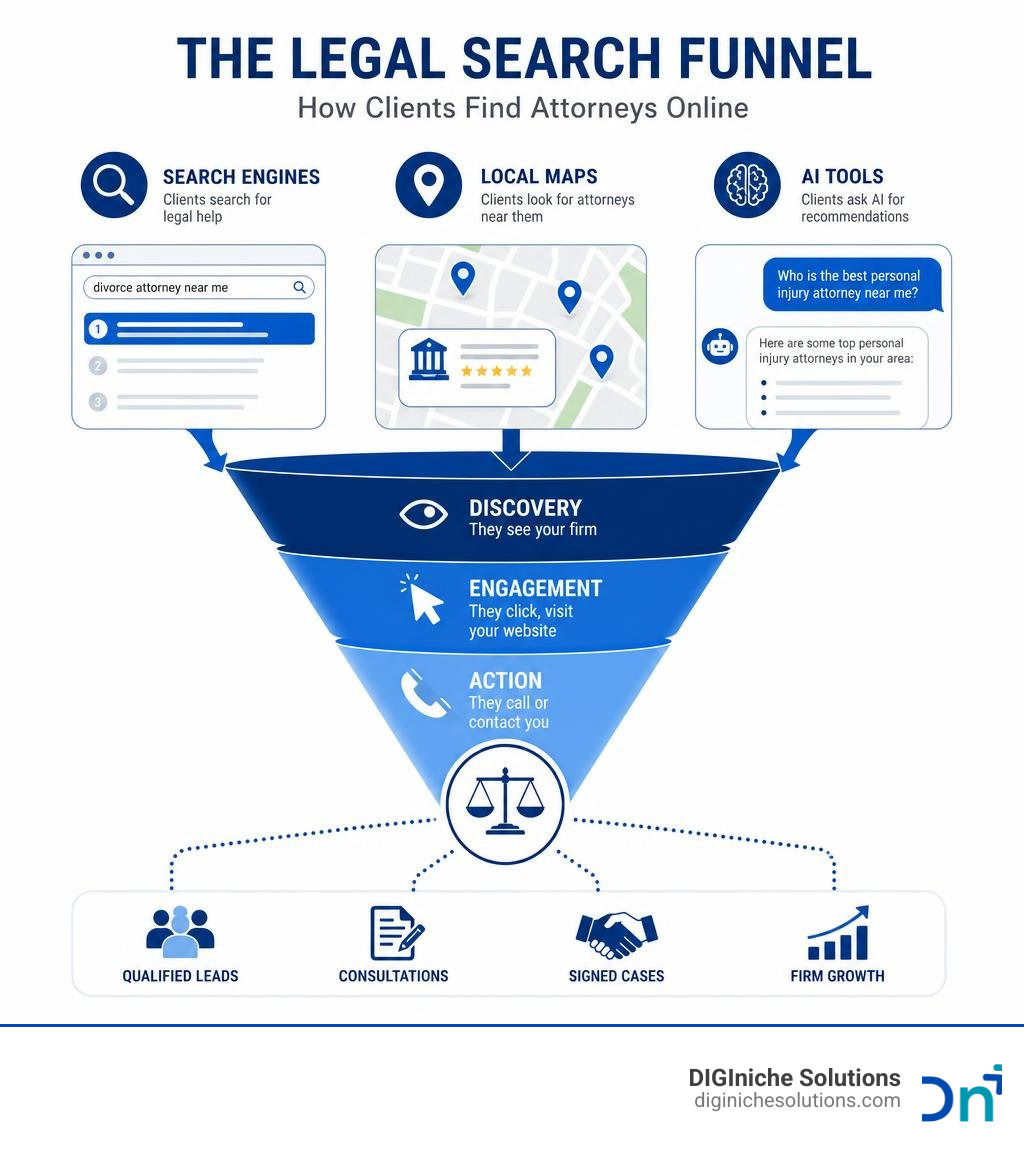
Easy seo attorney word list:
Understanding the Role of a Legal SEO Specialist
Many law firms treat legal marketing as a single, massive bucket. They assume that any digital marketer who can rank a local bakery or an e-commerce store can handle search engines for a law firm. In reality, legal client acquisition is one of the most competitive, highly regulated, and complex landscapes in the digital marketing world.
An SEO attorney marketing specialist is not just a generalist who knows how to insert keywords into a blog post. They are specialists who understand the unique friction points a potential client experiences when they are looking for legal representation. They know how to map out content that targets high-intent keywords, build authoritative backlinks from reputable legal networks, and optimize local search signals so your firm shows up exactly when and where people need you. For a deeper dive into selecting the right partner, check out our guide on The Law Firm Guide to SEO: What to Look for in a Legal Marketing Agency.
Why General Marketers Fall Short for SEO Attorney Needs
General digital marketers often stumble when handling legal websites because they do not understand the strict boundaries of bar rules and legal ethics. In the legal world, a single misplaced word can trigger a regulatory violation. For example, using words like “specialist,” “expert,” or “expert attorney” in certain jurisdictions without meeting highly specific state bar criteria can lead to disciplinary action. General marketers might also make the mistake of publishing “outcome guarantees” or misleading claims on your practice area pages, which violates ABA rules and local state bar guidelines.
Furthermore, general marketers often fail to grasp the nuance of legal practice areas and search intent. They might drive thousands of visitors to your site by targeting broad, informational keywords (like “what is a tort?”), but none of those visitors will ever convert into a signed case. A specialized legal SEO strategist knows how to separate low-intent informational queries from high-intent transactional queries (such as “car accident lawyer in Newark NJ”). They understand how to structure your site’s navigation and practice pages to appeal to both search engine algorithms and prospective clients who are ready to hire.
Key Ranking Factors and Technical Essentials for Law Firms
To win the search engine optimization game in 2026, we have to look closely at what search algorithms actually prioritize. Google’s ranking factors are constantly evolving, but the core pillars of search visibility remain rooted in content quality, backlink profiles, user experience, and technical health.
According to industry data, 66% of web pages have absolutely no backlinks, and 26% only have links from three sites or less. In the hyper-competitive legal niche, a site with zero authority signals simply will not rank on the first page. Building a robust, high-performing legal website requires a multi-pronged approach. To learn more about how these factors work together, read our comprehensive resource on Law Firm SEO: The Ultimate Guide.
Building E-E-A-T for SEO Attorney Sites
Google places legal websites in the “Your Money or Your Life” (YMYL) category because the information on these sites can directly impact a person’s financial well-being, freedom, and safety. Because of this, Google applies incredibly high standards for E-E-A-T: Experience, Expertise, Authoritativeness, and Trust.
To build these signals, we must ensure that every piece of content on your site is written or thoroughly reviewed by qualified legal professionals. You can showcase this by:
- Creating detailed attorney bio pages that link to bar profiles, court admissions, and published works.
- Including verified author schema and clear bylines on all blog posts and legal guides.
- Featuring real-world case results, client testimonials, and industry awards.
- Ensuring your site’s visual elements are professional, high-quality, and trustworthy.
For practical steps on upgrading your site’s visual trust signals, consult our Attorney SEO Image Guide: Making Your Law Firm Look Good to Google. For general layout and content tips, you can also explore our checklist of 7 Tips for Improving a Law Firm Website’s SEO.
Technical SEO and Schema Markup Essentials
Your website can have the most brilliant legal content in the world, but if search engine crawlers cannot easily read, index, and navigate your pages, you will not rank. Technical SEO is the foundation of your entire digital presence.
First and foremost is mobile optimization. Google primarily uses the mobile version of your website for evaluation and ranking. If your site is slow, clunky, or hard to read on a smartphone, your rankings will plummet. A responsive website with a single codebase that adapts perfectly to all screen sizes is mandatory. Additionally, your site speed must be lightning-fast—pages should load in under 2.5 seconds, as users will abandon a site that takes longer than 3 seconds to load.
Another critical technical element is schema markup (structured data). By implementing schema markup specifically designed for legal services—such as “Attorney,” “LegalService,” and “LocalBusiness” schema—you hand-feed search engines structured details about your firm. This structured data allows Google to display rich snippets in search results, including your office hours, physical address, phone number, and star ratings, which significantly boosts your click-through rates.
Common Mistakes in Legal SEO Campaigns
Even seasoned firms make critical mistakes that actively damage their search visibility. One of the most common is keyword cannibalism, which happens when multiple pages on your website target the exact same keyword, causing Google to get confused about which page to rank. For instance, if you have five different blog posts all trying to rank for “New Jersey personal injury lawyer,” they will end up competing against each other and dragging down your overall rankings.
Other frequent mistakes include:
- Thin content: Publishing short, generic 300-word articles that fail to answer the user’s questions or offer real value.
- Keyword stuffing: Force-feeding keywords into paragraphs in a way that feels unnatural and spammy.
- Broken links and poor navigation: Frustrating users and search crawlers with 404 errors and confusing menu structures.
- Duplicate content: Copying practice area descriptions from other websites or using the exact same text for multiple location pages.
Traditional SEO vs. Generative Engine Optimization (GEO)
As we navigate 2026, the search landscape is experiencing its most dramatic evolution since the launch of Google itself. Traditional SEO—which focuses on ranking web pages in a standard list of ten blue links—is now sharing the stage with Generative Engine Optimization (GEO).
With the rise of AI-powered search engines, potential clients are finding legal help in entirely new ways. To see how these shifts play out in the real world, you can read our analysis in Attorney SEO Case Studies: The Good, the Bad, and the Google-Friendly.
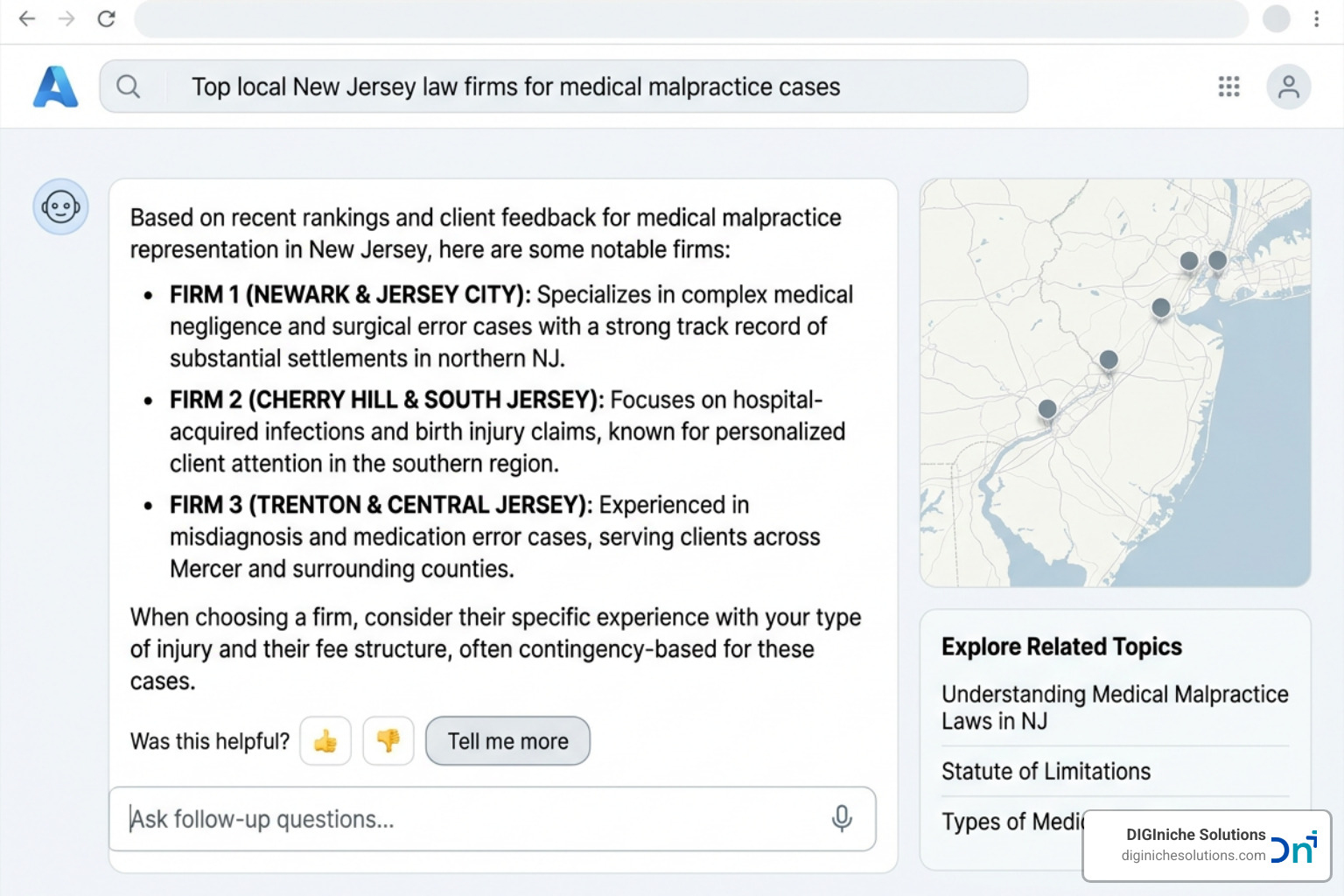
How AI Search Engines Impact Legal Discovery
AI platforms like ChatGPT, Google Gemini, and Perplexity are changing how consumers research and select legal representation. Instead of searching “medical malpractice attorney near me” and scrolling through websites, a user might type: “My doctor misdiagnosed my condition in New Jersey, and I need a highly-rated medical malpractice lawyer who has experience with hospital negligence. Who do you recommend?”
The AI engine will not return a simple list of links. Instead, it synthesizes information from across the web, analyzes review sentiment, reads news articles, scans directory listings, and provides a direct, conversational recommendation of two or three specific law firms, citing its sources.
According to pioneering research from Princeton, Georgia Tech, and IIT Delhi, implementing tailored GEO strategies can boost your firm’s visibility in AI-generated search responses by up to 40%. To achieve this, law firms must optimize for entity clarity (ensuring AI systems recognize your firm as a distinct, highly authoritative legal “entity”), format content using clear headings and structured data, and actively build high-quality digital PR and brand mentions across the web.
Local SEO Strategies for the Modern SEO Attorney
For most law firms, client acquisition is fundamentally local. If you are a criminal defense attorney in Newark or a family law attorney in Cherry Hill, you need to reach people in your immediate geographic area. This is where local SEO and Google Maps optimization become your most powerful tools. For a comprehensive look at ranking locally, refer to our Local SEO Guide for Lawyers.
To rank in Google’s coveted Local 3-Pack (the map listings that appear at the very top of local search results), you must optimize several critical proximity and authority signals:
- Google Business Profile (GBP): Claim and fully complete your GBP listing. Ensure your law firm’s name, address, and phone number (NAP) are identical to the information on your website.
- Select Accurate Categories: Choose highly specific primary and secondary categories (e.g., “Personal Injury Attorney” rather than just “Attorney”).
- Optimize for Proximity: Google heavily weights how close your physical office is to the user searching, so make sure your local landing pages clearly reflect your target neighborhoods.
Backlinks, Citations, and Reviews for Legal SEO Success
A successful local SEO campaign relies on three external pillars: high-quality backlinks, consistent citations, and a steady stream of positive client reviews.
Backlinks act as digital votes of confidence. However, not all links are created equal. Getting a backlink from a local NJ legal directory or an industry publication carries far more weight than a hundred low-quality links from unrelated sites. You can learn more about building regional authority through our specialized resource on SEO for Lawyers New Jersey.
Citations – any online mention of your firm’s name, address, and phone number on directories like Yelp, Avvo, FindLaw, and YellowPages – must be completely consistent. Inconsistent citations confuse search engine algorithms and dilute your local authority.
Finally, client reviews are the single most influential factor in getting hired, according to Clio’s Legal Trends Report. Google prioritizes businesses with a steady volume of fresh, high-rating reviews. We always recommend implementing an automated review acquisition system to ethically ask satisfied clients for feedback right after their case wraps up.
Ethical Compliance and Bar Rules for Legal Marketing
As we implement these digital strategies, we must always keep ethical compliance at the forefront. Legal marketing is subject to strict oversight by the American Bar Association (ABA), the Solicitors Regulation Authority (SRA) where applicable, and local state bars, such as the New Jersey Office of Attorney Ethics. The ABA Model Rules of Professional Conduct are a useful starting point, but every campaign should also be reviewed against the rules in the attorney’s specific jurisdiction.
When optimizing your website and building local campaigns, you must ensure that:
- All content is completely truthful, accurate, and free of misleading statements.
- You avoid making comparison claims (e.g., “We are the best trial lawyers in NJ”) unless they can be objectively verified.
- Any listed case results include clear disclaimers stating that past results do not guarantee future outcomes.
- All paid advertisements, local service ads, and website disclosures strictly adhere to local jurisdiction rules.
By partnering with a specialized legal marketing team that understands these guidelines, you can aggressively grow your online presence without ever risking your professional reputation or bar standing.
Frequently Asked Questions about Legal SEO
To help you map out your marketing budget and growth strategy, we have put together a comparison of organic search engine optimization and paid search advertising (PPC):
| Marketing Channel | Initial Cost | Time to Results | Long-Term ROI | Asset Ownership |
|---|---|---|---|---|
| Organic SEO | Moderate to High (Retainer) | 6 to 12 Months | Compounding & High | Yes (You own the rankings and content) |
| Paid Search (PPC) | High (Cost-Per-Click) | Immediate | Linear (Stops when budget stops) | No (You are renting space from Google) |
How long does it take to see results from legal SEO?
SEO is a long-term investment, not a quick fix. Generally, law firms can expect to see measurable increases in search traffic within the first 6 months of a campaign. Consistent, highly qualified leads typically start rolling in between months 6 and 12. By months 18 to 24, your organic digital pipeline begins to compound, generating a steady stream of cases without requiring you to pay for every single click.
How should law firms balance PPC and organic SEO?
For sustainable, long-term growth, we recommend a balanced approach. Paid search (PPC) and Local Services Ads (LSAs) are fantastic for generating immediate leads while your organic presence is being built. However, relying solely on PPC means you are constantly “renting” your leads. By combining PPC with organic SEO, you can capture immediate market share while building long-term equity in your website, eventually lowering your overall cost-per-acquisition.
What metrics should we track to measure SEO ROI?
Many agencies try to blind attorneys with “vanity metrics” like impressions, ranking positions for obscure keywords, or raw traffic numbers. While these metrics are helpful indicators, they do not pay the bills.
To measure the true return on your investment, you should focus on:
- Organic Conversion Rate: The percentage of website visitors who actually contact your firm.
- Total Qualified Leads: The number of phone calls, contact forms, and chat inquiries from people who actually have a viable legal matter.
- Cost Per Signed Case: The total amount spent on marketing divided by the number of actual clients retained.
For a deeper look into the metrics that truly matter, read our guide on Tracking Your Law Firm’s SEO: What Your Agency Isn’t Telling You and discover how to properly monitor your campaigns with Monitoring SEO Performance: Guide for Law Firms.
Integrating modern legal technology into your practice can also yield massive financial returns alongside your marketing efforts. Industry data shows that law firms using specialized payment and billing systems can achieve a 39% faster payment collection rate, reclaim up to $140,400 in lost billable revenue annually, and reduce time spent on invoicing by 468 hours per year.
Conclusion
Winning the digital race in 2026 requires more than just a basic website and a few keyword-stuffed blog posts. It demands a sophisticated, highly compliant strategy that blends traditional search engine optimization with the emerging world of Generative Engine Optimization (GEO).
At DIGIniche Solutions, we specialize in helping law firms across New Jersey and nationwide break through growth plateaus. Our proprietary V.E.R.A. Formula—delivering Visibility, Engagement, Retention, and Amplification—creates a scalable client-growth ecosystem designed to attract higher-value cases and maximize your firm’s revenue.
Ready to transform your digital presence and dominate your local market? Start your journey today by exploring Law Firm SEO: The Ultimate Guide or contact us directly to build a customized growth plan for your practice.
