

The Complete Framework of Search Engine Marketing for Lawyers
Search engine marketing (SEM) for law practices is not a single tool. It is an interconnected system designed to capture high-intent prospects across every layer of the search engine results page (SERP).
To master search marketing, attorneys must understand the distinct roles played by Pay-Per-Click (PPC) advertising, Local Services Ads (LSAs), and organic Search Engine Optimization (SEO). While PPC and LSAs provide immediate visibility on paid ad slots, organic SEO builds lasting digital equity across traditional web links and local map listings.
Because legal services fall squarely under Google’s strict “Your Money or Your Life” (YMYL) content guidelines, legal websites are held to the highest standards of Experience, Expertise, Authoritativeness, and Trustworthiness (E-E-A-T). Furthermore, American Bar Association (ABA) Model Rules 7.1 through 7.3 strictly regulate attorney advertising. Marketing campaigns must avoid misleading statements, unsubstantiated claims of being the “best,” or unwarranted promises regarding case outcomes.
Understanding search intent layers prevents law firms from wasting paid ad spend on informational seekers. Legal queries break down into three specific tiers:
- Tier 1: High-Intent Transactional Queries: Searchers who need an attorney immediately (e.g., “hire car accident lawyer near me,” “emergency DUI defense attorney”). These belong in paid search and LSA campaigns.
- Tier 2: Research & Commercial Investigation Queries: Searchers comparing representation options or evaluating costs (e.g., “how much does a divorce lawyer cost,” “contingency fee vs hourly billing”). These are ideal for dedicated landing pages and local service content.
- Tier 3: Informational Queries: Searchers looking for legal knowledge or procedural answers (e.g., “what to do after a minor car accident,” “statute of limitations personal injury”). These should be captured purely through organic SEO content rather than costly paid ad clicks.
When implementing PPC Advertising for Law Firms, understanding the financial and tactical differences between search channels is vital for proper budget allocation:
| Search Channel | Primary Cost Model | Time to First Lead | Average Conversion Rate | Best Use Case |
|---|---|---|---|---|
| Google Local Services Ads (LSA) | Pay-Per-Lead (Viable inquiries only) | 24 to 48 Hours | 15% – 25% | Immediate, local trust capture with pay-per-lead protection |
| Traditional Google Ads (PPC) | Pay-Per-Click (Billed per ad click) | 24 to 48 Hours | 5% – 12% | Precision targeting for high-value transactional cases |
| Google Business Profile (Local 3-Pack) | Organic (Investment in local optimization) | 3 to 6 Months | 10% – 20% | Capturing localized “near me” searches in target geographic areas |
| Organic Legal SEO | Organic (Investment in content and technical authority) | 6 to 12 Months | 3% – 8% | Compounding authority, educational queries, lowering blended CPA |
Integrating SEO and PPC in Search Engine Marketing for Lawyers
The most successful legal practices do not treat SEO and PPC as opposing strategies. They use them sequentially and symbiotically.

PPC functions as an immediate 6-month launch vehicle. When launching a new practice area or market footprint, organic search rankings take time to mature. Running paid search ads provides immediate client cash flow from day one. As local map rankings and organic practice pages climb to the top of Google over months 6 through 12, firms can systematically trim bids on saturated keywords to rely on organic traffic, lowering their overall blended cost per acquisition.
Simultaneously, using a Lawyer Pay Per Click Advertising Powerful Strategy allows firms to harvest real-world search query data. By identifying which paid search terms generate the highest conversion rates and retained cases, managing partners can deploy organic SEO resources to target those exact queries organically.
This approach prevents keyword cannibalization by allocating high-cost transactional keywords to targeted ad campaigns while letting organic content capture broad informational volume at zero incremental cost per click.
Navigating AI Overviews and Generative Search Engines
The search landscape has evolved dramatically with the expansion of AI Overviews and answer engines like ChatGPT, Claude, and Perplexity. Approximately 58.5% of Google searches in the United States now end without a click, and informational legal queries trigger AI Overviews at a rate approaching 99.9%.
However, local transactional queries (such as finding an attorney in a specific city) trigger AI Overviews only 7.9% of the time, keeping the Google Local 3-Pack and paid ads dominant for immediate lead generation.
To thrive across both traditional search and answer engines, law firms must implement Generative Engine Optimization (GEO). Research reveals that 44.2% of citations by large language models originate from the top 30% of a webpage’s content. To earn direct citations, pages must place direct answers, clear legal definitions, and statutory references right at the top of the content.
Integrating structured data—such as LegalService, Attorney, and FAQPage Schema—makes website architecture easily machine-readable following Schema.org structured data guidelines to help search engines accurately index practice areas and attorney credentials.
Paid Search Architecture: Eliminating PPC Waste and Maximizing Quality Score
Legal search keywords represent some of the most expensive pay-per-click real estate in the world, with clicks routinely exceeding $50 to $200+ per click. Mismanaged campaigns can easily drain tens of thousands of dollars without generating a single signed client.
The primary reason law firms waste money in Google Ads is bidding on competitive “trophy keywords” (such as broad search terms like “lawyer” or “attorney”) while failing to manage query matching. Poorly structured accounts frequently rely on broad match keywords without sufficient historical data, causing their budget to bleed on searches for legal templates, bar study aids, pro bono services, or legal jobs.
To safeguard your budget, law firms must implement a robust negative keyword list containing 200 to 400 terms prior to launching any campaign. Exclude words such as:
- pro bono, free, cheap, legal aid, public defender
- salary, jobs, careers, internships, law school, LSAT
- forms, templates, DIY, definitions, statutes, Wikipedia, Reddit
Furthermore, legal campaigns must utilize Dynamic Number Insertion (DNI) to integrate inbound call tracking directly into advertising and CRM analytics. To protect against malicious competitor clicks and automated click fraud, implementing automated IP-exclusion filters preserves your daily budget for genuine prospects. Refer to our PPC Management Attorneys Guide 2026 for comprehensive ad protection workflows.
Optimizing Quality Score to Cut Legal CPCs
Google determines ad positioning using the Ad Rank formula:
$$text{Ad Rank} = text{Max CPC Bid} times text{Quality Score} + text{Ad Assets / Format Impact}$$
Quality Score is graded on a scale of 1 to 10 and is evaluated based on three primary factors:
- Expected Click-Through Rate (CTR): How likely users are to click your ad when shown.
- Ad Relevance: How closely your ad copy matches the specific search intent of the query.
- Landing Page Experience: Page load speed, mobile usability, transparent contact options, and relevance to the search term.
Achieving a Quality Score of 8 to 10 effectively cuts your Cost Per Click in half compared to a competitor with a Quality Score of 5. For a firm spending $10,000 monthly, that represents $5,000 in saved ad budget or twice the case lead volume for the same investment.
Explore actionable ways to refine your campaign copy through Maximizing Your Law Firm Ads.
High-Converting Landing Page Design for Retaining Inquiries
Directing paid search traffic to your law firm’s generic homepage is one of the most expensive marketing mistakes you can make. While standard homepages convert at an average of 2% to 4%, dedicated legal landing pages convert at 8% to 15%.
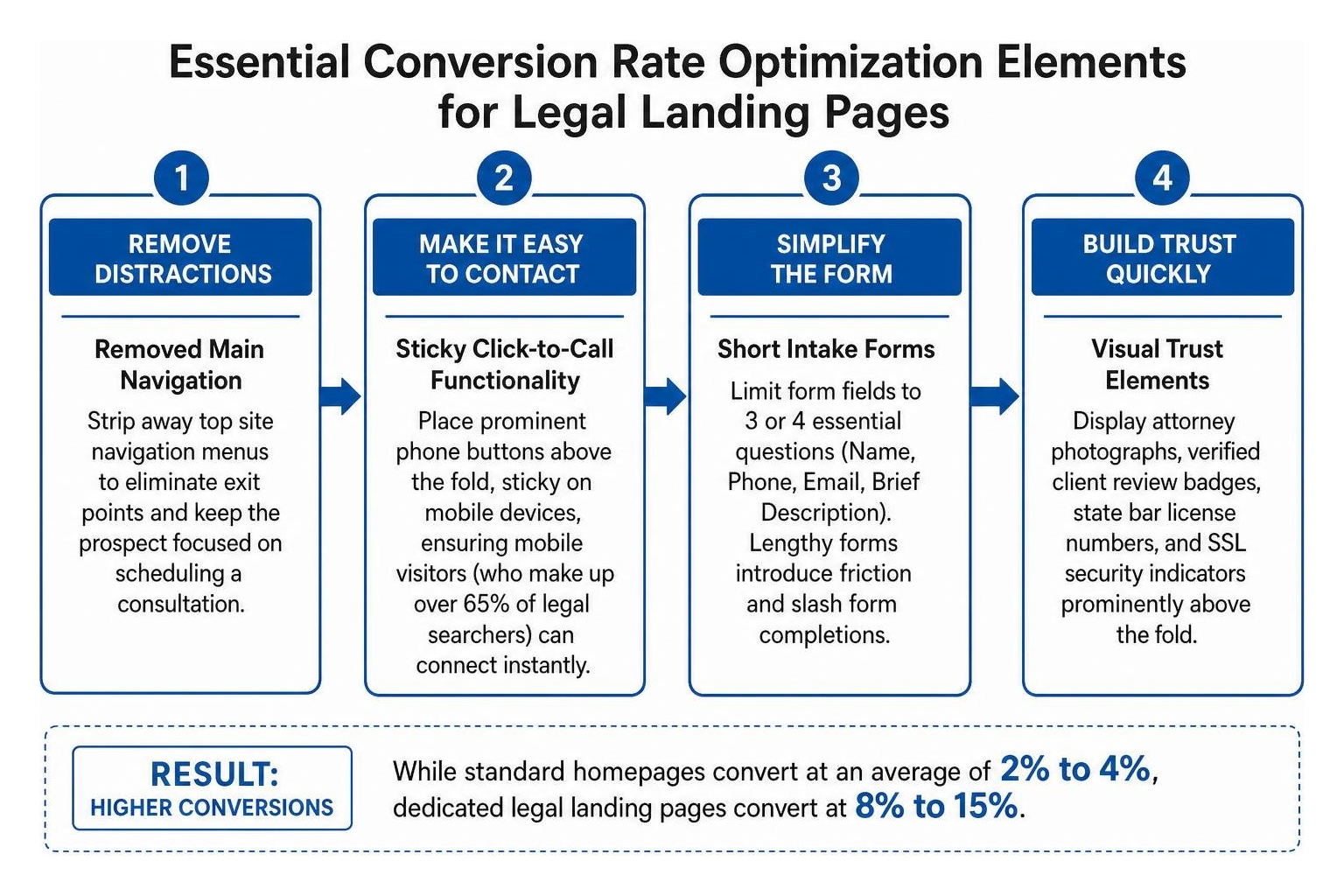
High-converting legal landing pages require specific architectural elements:
- Sticky Click-to-Call Functionality: Place prominent phone buttons above the fold, sticky on mobile devices, ensuring mobile visitors (who make up over 65% of legal searchers) can connect instantly.
- Short Intake Forms: Limit form fields to 3 or 4 essential questions (Name, Phone, Email, Brief Description). Lengthy forms introduce friction and slash form completions.
- Removed Main Navigation: Strip away top site navigation menus to eliminate exit points and keep the prospect focused on scheduling a consultation.
- Visual Trust Elements: Display attorney photographs, verified client review badges, state bar license numbers, and SSL security indicators prominently above the fold.
- Sub-2-Second Load Speed: Optimize technical Core Web Vitals (Largest Contentful Paint under 2.5 seconds and Cumulative Layout Shift under 0.1). A one-second delay can drastically reduce mobile conversions.
Discover how focused landing pages convert high-intent traffic by reading How Professional PPC Management Helps Attorneys Win High-Value Cases.
Google Local Services Ads and Local Map Pack Domination
Google Local Services Ads (LSAs) appear at the absolute top of the search engine results page, positioned above traditional PPC ads and organic listings. LSAs display your firm’s name, star rating, total review count, operating hours, and the Google Screened badge.

Unlike standard PPC campaigns that charge per click regardless of whether the user contacts your firm, LSAs operate on a direct pay-per-lead model. You are billed only when a prospect calls or messages your firm directly through the ad. Furthermore, Google provides a formal lead dispute process, allowing firms to request refunds for invalid leads such as wrong numbers, out-of-service areas, or inquiries for practice areas you do not handle.
LSAs are heavily influenced by geographic proximity, your responsiveness to incoming calls, and your review score. For many practices, allocating 40% to 50% of their initial paid marketing budget toward LSAs provides a lower cost-per-lead compared to standard search ads. See our full guide on how Local Service Ads for Law Firms Generate More Leads.
Google Business Profile and Local Citation Health
Directly below paid ads sits the Google Local 3-Pack (Map Pack), which captures roughly 42% of all clicks on local-intent legal searches. Dominating this section requires an optimized Google Business Profile (GBP) and a consistent citation footprint across the web.
Key actions to optimize your GBP and local search visibility include:
- Name, Address, Phone (NAP) Consistency: Ensure your firm’s name, physical address, and phone number are 100% identical across your GBP, website footer, state bar listings, and legal directories.
- Precise Primary Category Selection: Choose the most specific primary category matching your core practice (e.g., “Personal Injury Attorney” rather than simply “Legal Services”).
- Systematic Review Acquisition via SMS: Implement an automated workflow to send review requests via text message immediately upon successful case resolution. Text messages achieve open rates near 98%, compared to just 20% for email.
- Prompt Review Responses: Respond professionally to all positive and negative reviews within 24 to 48 hours without compromising client confidentiality or violating state ethics rules.
Learn more about multi-channel local visibility by exploring 4 Types of Local Law Firm Ads.
Intake Velocity: Turning Search Traffic into Retained Cases
A law firm can build world-class search visibility, but if its intake system is slow, that marketing spend is wasted. Intake speed is not merely an administrative task; it is a critical driver of marketing ROI.
Data shows that organizations contacting inbound leads within five minutes are approximately seven times more likely to qualify them than those that delay. Furthermore, there is a 70%+ probability that a prospective client will hire the very first attorney or firm they speak with live.
Consider the math behind intake latency:
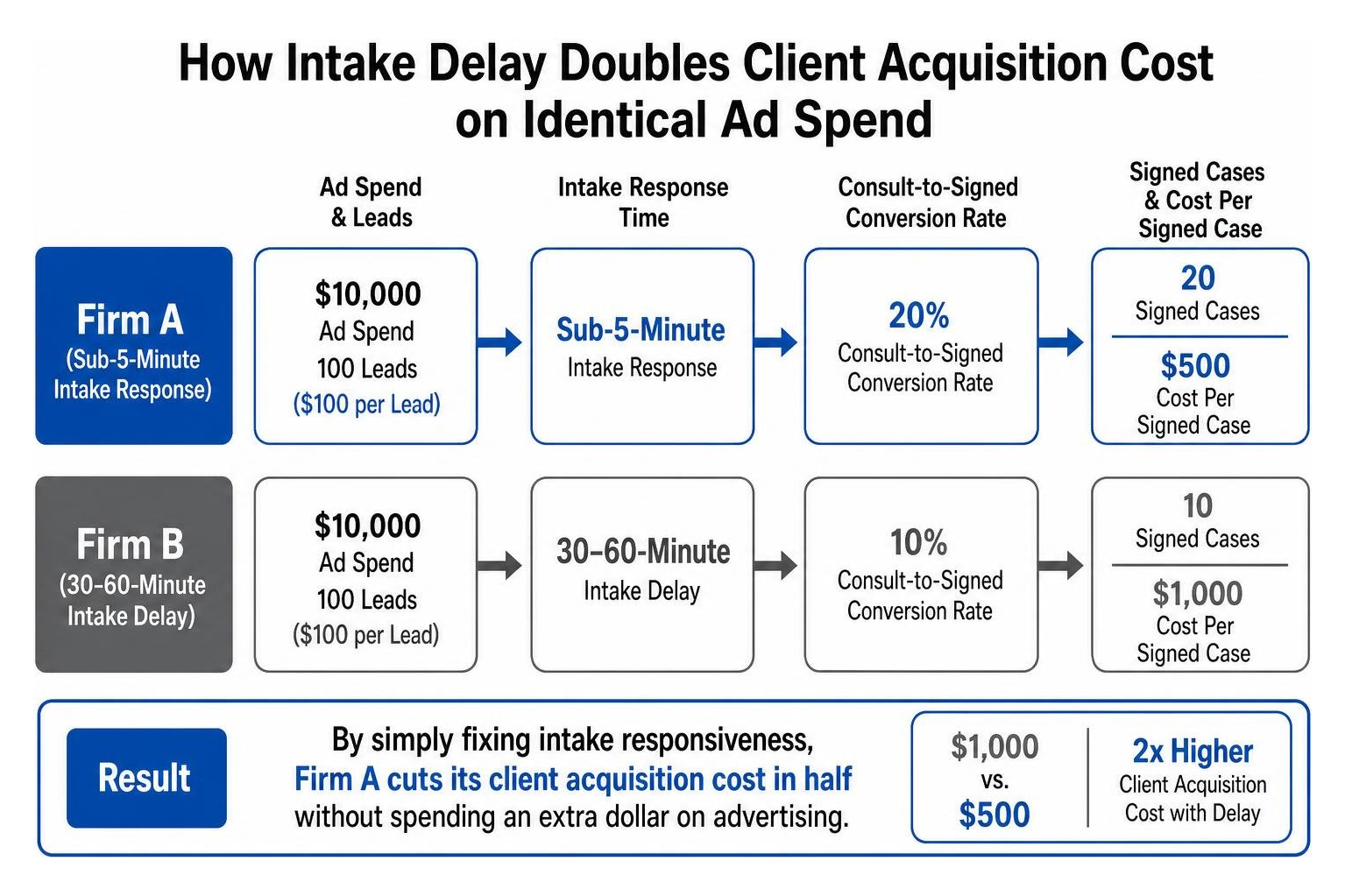
If Firm A and Firm B each generate 100 leads at an ad spend of $10,000 ($100 Cost Per Lead):
- Firm A (Sub-5-minute intake response): Achieves a 20% consult-to-signed conversion rate, securing 20 signed cases. Cost Per Signed Case = $500.
- Firm B (30-to-60-minute intake delay): Experiences drop-offs as prospects call other lawyers, converting at only 10% (10 signed cases). Cost Per Signed Case = $1,000.
By simply fixing intake responsiveness, Firm A cuts its client acquisition cost in half without spending an extra dollar on advertising.
To eliminate intake leakage:
- Implement 24/7/365 live answering services or dedicated intake specialists to handle after-hours and weekend inquiries.
- Connect website forms and call tracking directly to your legal CRM (such as Clio or Filevine) with automated SMS and email notifications sent to staff instantly.
- Conduct regular monthly audits of your firm’s intake calls to evaluate staff empathy, speed, and qualification screening.
Unit Economics: Measuring Case Acquisition and Search Marketing Performance
Evaluating legal marketing based on vanity metrics like impressions, clicks, or generic traffic numbers obscures whether your investment is truly profitable. Search marketing must be managed using clear unit economics.
To understand your true campaign profitability, explore our framework on how to Target and Connect Through Law Firm Internet Marketing.
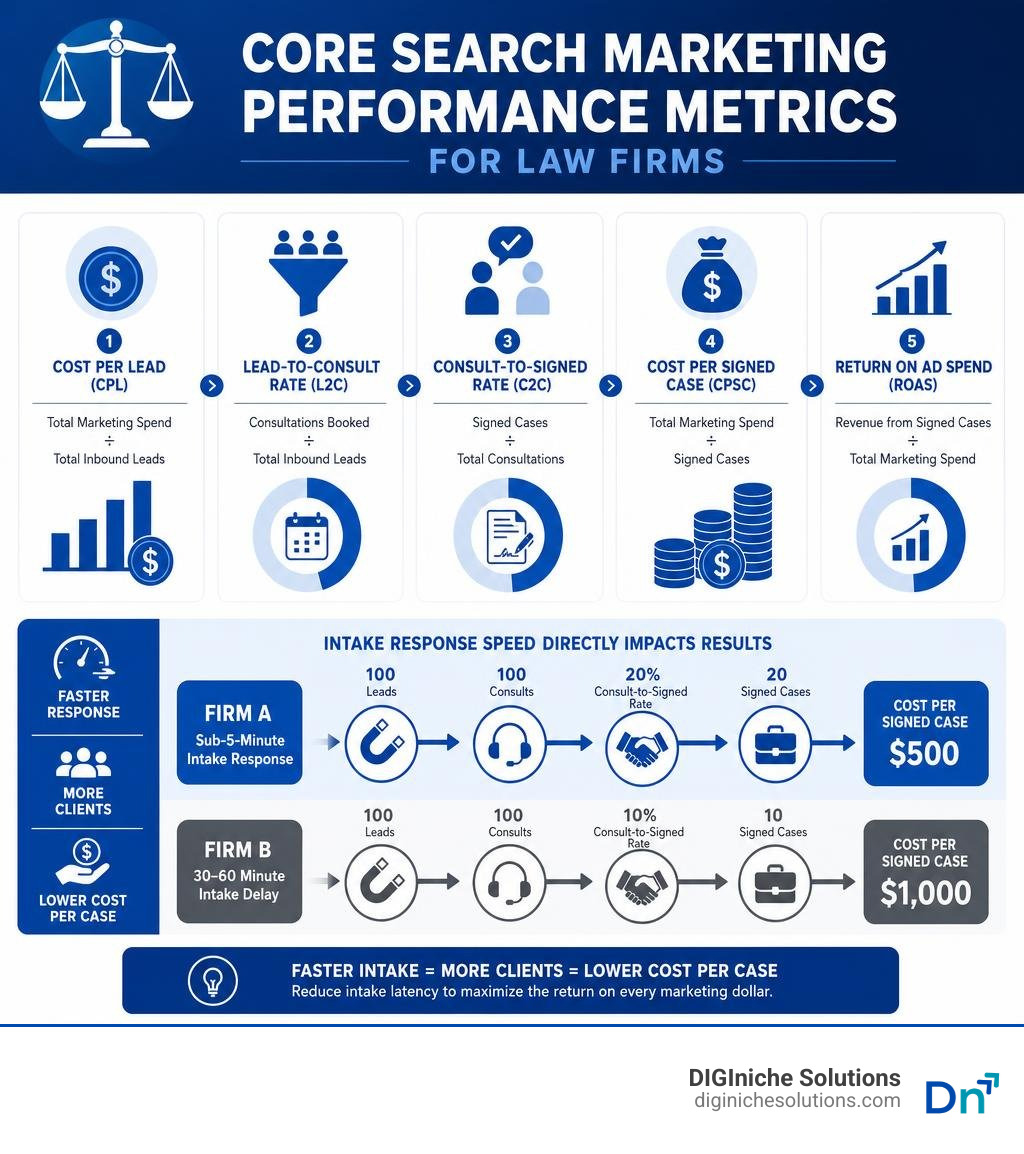
Every law firm must track these five essential marketing metrics:
- Cost Per Lead (CPL): Total marketing spend divided by total qualified leads received. $$text{CPL} = frac{text{Total Channel Spend}}{text{Total Inbound Leads}}$$
- Consult-to-Signed Rate (C2C): The percentage of consultations that result in a retained client. $$text{C2C Rate} = left( frac{text{Signed Cases}}{text{Total Consultations Conducted}} right) times 100$$
- Cost Per Signed Case (CPA): Total channel spend divided by total signed cases. $$text{CPA} = frac{text{Total Marketing Spend}}{text{Total Retained Cases}}$$
- Client Lifetime Value (CLV): The average gross fee generated by a retained client across their matter lifecycle.
- Referral Rate (RR): The percentage of signed clients who eventually generate secondary referrals or return for future legal matters.
Tracking Real Case ROI in Search Engine Marketing for Lawyers
To maintain campaign profitability, law firms must implement closed-loop CRM attribution. This involves passing search query parameters and Google Click IDs (GCLID) from web forms and call tracking numbers directly into your legal case management software.
When a retainer agreement is signed and fees are collected, that revenue is mapped back to the originating keyword and search channel. This data reveals which search queries generate profitable casework and which deliver non-viable inquiries. For a deeper look at eliminating unprofitable ad channels, read How to Stop Wasting Money on Bad Digital Marketing for Law Firms.
Frequently Asked Questions About Legal Search Marketing
What is the ideal monthly search marketing budget for a small to mid-sized law firm?
A viable monthly search marketing budget depends on practice area competition and geographic market size. Solo practitioners and boutique firms targeting less competitive practice areas (such as estate planning or traffic defense) typically budget between $2,500 and $5,000 per month across SEO, LSAs, and PPC.
Mid-sized firms handling competitive verticals like personal injury, criminal defense, or family law in active metro areas generally allocate $6,000 to $15,000+ per month. For maximum efficiency, initial paid budgets should balance roughly 40% to 50% toward Local Services Ads and 50% to 60% toward targeted Google Search Ads, while maintaining a consistent monthly investment in organic and local SEO.
How quickly can a law firm expect to sign cases from search marketing?
Google Ads and Local Services Ads can generate qualified consultation requests within 24 to 48 hours of campaign launch. Because paid ads place your firm immediately in front of users with urgent legal needs, initial case retainers often occur within the first one to three weeks.
In contrast, organic SEO and Google Business Profile optimization build authority over a 6 to 12-month horizon. As organic rankings mature, they create a compounding pipeline of inbound leads that systematically reduces your firm’s long-term reliance on paid advertising.
Why are personal injury and legal keywords so expensive in Google Ads?
Legal keywords command some of the highest cost-per-click rates in digital advertising due to high case lifetime values and intense auction competition. A single catastrophic personal injury or commercial litigation matter can yield tens or hundreds of thousands of dollars in legal fees.
Because the potential return on a single signed case is substantial, law firms are willing to bid aggressively for top search positions. This competitive auction dynamic drives up average CPCs, making negative keyword hygiene, Quality Score optimization, and rapid intake protocols essential to keep campaigns profitable.
Conclusion: Building a Scalable Legal Client Acquisition Engine
Search marketing is not about collecting vanity clicks or ranking for irrelevant search terms. It is about building a dependable client acquisition system that captures prospective clients when they need legal help, guides them through a seamless conversion experience, and signs them into retained matters through rapid intake workflows.
At DIGIniche Solutions, we help law firms build scalable client-growth ecosystems through our proprietary V.E.R.A. Formula:
- Visibility: Capturing premier top-of-page real estate across Google LSAs, Google PPC Search Ads, Local Map Packs, and organic search.
- Engagement: Designing mobile-first, high-converting landing pages that address client concerns and encourage immediate contact.
- Retention: Assisting firms in streamlining intake systems, call tracking, and response times to ensure no viable lead is lost.
- Amplification: Leveraging review generation, CRM attribution, and compounding organic authority to continuously lower client acquisition costs.
If your law firm is ready to move away from inconsistent referrals and build a predictable case pipeline, explore our dedicated approach to strategic SEO and search growth for legal practices or contact our team today to schedule your strategy session.
