

Why Most Law Firms Are Losing Money on PPC (And How to Fix It)
PPC for law firms is a paid digital advertising model where your firm pays only when a potential client clicks your ad on Google or another search platform. Done right, it puts your firm at the top of search results the moment someone types “divorce attorney near me” or “DUI lawyer tonight.”
Here’s a quick breakdown of what it is and how it works:
| What | How It Works |
|---|---|
| What is legal PPC? | You bid on keywords. Your ad appears at the top of Google. You pay per click. |
| Who sees your ads? | People actively searching for a lawyer right now — high intent, ready to hire |
| How fast does it work? | Traffic starts the day your campaign goes live |
| What does it cost? | Varies by practice area — from ~$15/click (estate planning) to $300+/click (personal injury in major metros) |
| What’s the goal? | Signed cases, not just clicks |
The legal industry is the most expensive paid search vertical on Google — full stop. A single click for “personal injury lawyer Los Angeles” can cost more than $300. That’s not a typo.
But here’s the thing most law firms miss: high cost per click does not mean bad ROI.
A personal injury firm spending $8,000 per month on Google Ads that signs just two cases worth $50,000 each is generating a return that almost no other industry can touch. The math works — when the campaign is built correctly.
The problem? Most law firms treat PPC like a slot machine. They set up an account, fund it, and hope the phone rings. That approach is how firms quietly donate tens of thousands of dollars to Google with nothing to show for it.
This guide gives you a practical, proven framework to stop guessing and start signing cases.
I’m Frank Demming, and for more than a decade I’ve specialized in lead generation, SEO, and PPC for law firms — helping attorneys build predictable, profitable pipelines of qualified cases. If you’re ready to stop wasting ad spend and start seeing real results, you’re in the right place.
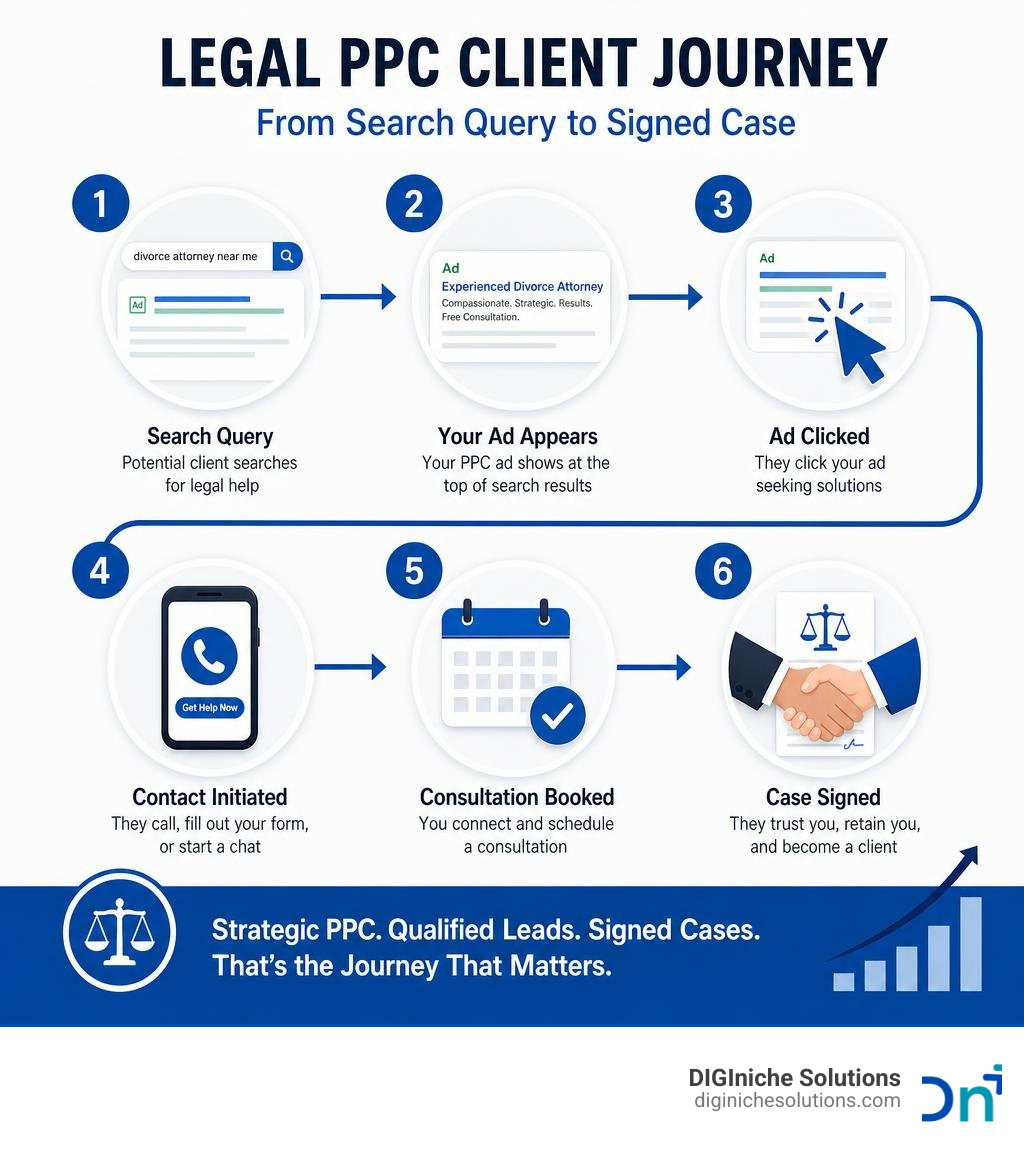
Terms related to ppc for law firms:
What is ppc for law firms and Why is it So Expensive?
To win the digital race in New Jersey, you have to understand the playing field. PPC for law firms is an auction-based marketplace. Every time someone in Newark, Jersey City, or Cherry Hill searches for legal representation, Google runs a lightning-fast auction to determine which ads appear at the very top of the page.
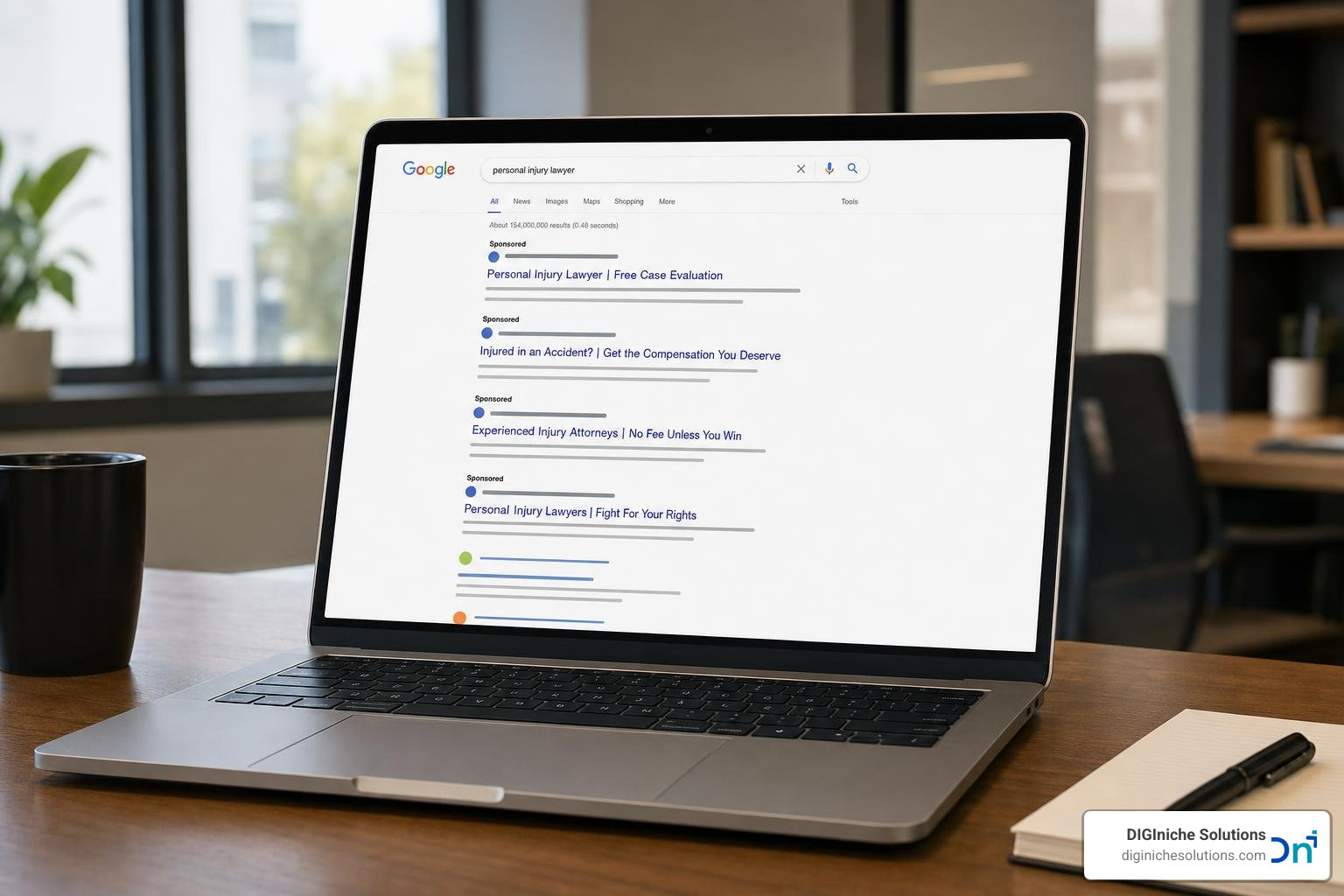
Why are these clicks so incredibly expensive? It boils down to two simple forces: extreme competition and high client lifetime value (LTV).
Unlike a local plumber or retail shop selling a $50 product, a single retained client for a New Jersey law firm can represent thousands, or even hundreds of thousands, of dollars in fees. Because the financial payoff of signing a major personal injury or commercial litigation case is so massive, law firms are willing to bid astronomical amounts to secure that top spot.
Furthermore, Google’s search layout has evolved. With right-side ads long gone and up to four paid ads now taking up the top of the search engine results page (SERP), organic listings are pushed further down the page. To get immediate visibility, many firms choose to pay the premium. If you want to dive deeper into how pay-per-click functions as a core business driver, you can read More info about pay-per-click services.
To navigate these high costs without draining your budget, local firms must understand the unique dynamics of the New Jersey landscape, tailoring campaigns to specific regional search behaviors and local market demands.
PPC vs. SEO: Immediate Visibility vs. Long-Term Growth
At DIGIniche Solutions, we often hear attorneys ask: “Should I invest in SEO or PPC?”
The honest answer is that they serve different stages of the client acquisition journey. Search Engine Optimization (SEO) is a long-term play. It builds organic authority, trust, and a lasting digital footprint that brings in “free” clicks over six to twelve months. But you cannot pay your bills today with traffic that arrives next year.
PPC is “pay-to-play.” The moment your campaign goes live, your firm secures immediate, first-page visibility. This makes PPC the ultimate tool for capturing immediate market demand.
Interestingly, these two channels are not rivals; they are partners. Data shows that firms using online search ads are hired 25% faster than firms that do not. When you show up in both the paid ads and the organic local map pack, your credibility compounds. To learn more about balancing these channels and running a waste-free digital program, read Learn about digital marketing for law firms.
The Economics of ppc for law firms
Let’s demystify the math behind a profitable PPC campaign. Many generalist agencies focus on Cost Per Click (CPC) or Cost Per Lead (CPL) as their primary metrics. We believe those are vanity metrics. The only metric that truly impacts your bottom line is your Cost Per Signed Case (also known as Client Acquisition Cost, or CAC).
Consider how average lead-to-case conversion rates (which hover around 14% across the industry) shape the true cost of client acquisition:
- Personal Injury (Auto Accidents): With average CPCs ranging from $75 to $250+ in competitive NJ metro areas, the typical cost per signed case runs between $3,000 and $8,000. While this sounds high, a single successful recovery easily offsets this acquisition cost.
- DUI / Criminal Defense: Clicks are moderately priced, resulting in a typical cost per signed case of $500 to $1,500.
- Estate Planning: Lower competition keeps the floor lower, with a cost per signed case averaging $200 to $600.
If you are running a personal injury firm in New Jersey and your average case fee is $15,000, spending $4,000 to acquire that client is highly profitable.
9 Tips for a Profitable Legal PPC Campaign
Stepping into the Google Ads auction without a clear plan is an expensive mistake. To ensure your marketing dollars are positioned for maximum return, we have compiled nine essential tips to optimize your campaigns, drive down acquisition costs, and bring in high-value signed cases.

Before diving into the tips, let’s look at how standard Google Search Ads compare to Google’s Local Services Ads (LSAs):
| Feature | Standard Google Ads (PPC) | Local Services Ads (LSAs) |
|---|---|---|
| Payment Model | Pay-per-click (regardless of lead quality) | Pay-per-lead (only for valid calls/messages) |
| Ad Placement | Absolute top of the page, below LSAs | Very top of the page, above standard ads |
| Trust Badge | None (uses standard ad extensions) | Google Screened Badge (requires background check) |
| Targeting | Highly customizable keywords and match types | Category-level targeting (e.g., “Divorce Lawyer”) |
| Lead Control | Total control over ad copy & landing pages | Google controls the profile layout and format |
To build an ad strategy that dominates both formats, read Discover powerful lawyer PPC strategies.
1. Segment Campaigns by Practice Area
One of the fastest ways to burn your legal marketing budget is to lump all of your legal services into a single, generic campaign. A user searching for a “car accident lawyer” has completely different search intent, urgency, and expected case value than someone looking for an “estate planning attorney.”
By segmenting your campaigns into distinct, practice-specific structures, you gain complete control over your budget allocation. This allows you to set higher bids for high-value personal injury keywords while maintaining a separate, controlled budget for family law or estate planning.
For a deeper dive into tailored campaign structures, check out Read our guide on estate planning PPC.
2. Target High-Intent Keywords and Avoid the Intent Gap
In legal PPC, there is a massive difference between informational search intent and transactional search intent. This is what we call the “intent gap.”
- Informational Intent: “What is the statute of limitations for a slip and fall in NJ?” The user is researching. They are looking for free information, not necessarily looking to hire a lawyer today. Bidding on these broad terms will cost you a fortune in non-converting clicks.
- Transactional Intent: “slip and fall lawyer Jersey City free consultation.” This user has an active, urgent need and is actively looking to retain counsel.
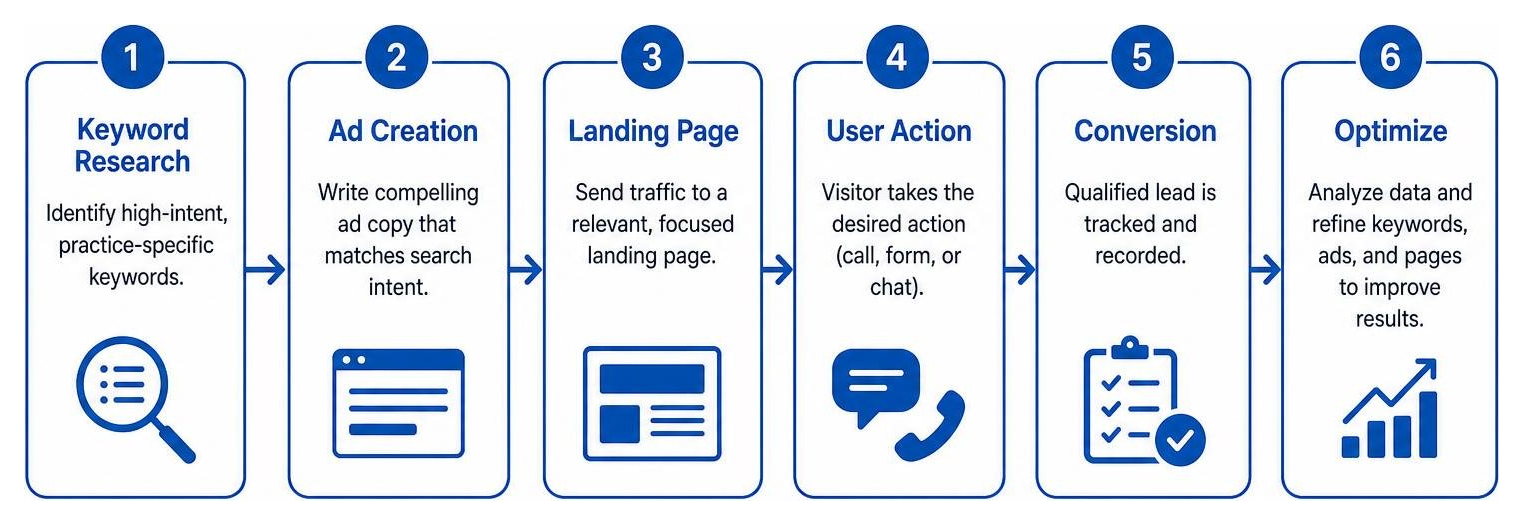
To maximize your budget, focus your initial campaigns on long-tail, high-intent keywords (four-to-six-word phrases). While these search queries have lower search volume, they carry significantly lower CPCs and convert at a much higher rate because the searcher is ready to take action.
3. Build a Massive Negative Keyword Library
In PPC, what you don’t pay for is just as important as what you do. Negative keywords allow you to tell Google exactly which search queries should never trigger your ads.
Without a robust negative keyword list, your ads will appear for searches like “free legal advice,” “law school scholarships,” “legal aid NJ,” or “how to file a lawsuit myself.” Every click on those terms is wasted money.
Before launching any campaign, we implement a comprehensive, legal-specific negative keyword library of over 18,000 terms to instantly filter out DIY seekers, job hunters, and out-of-state searches. To see how negative targeting saves your budget, read How to stop wasting money on ads.
4. Design Dedicated, High-Converting Landing Pages
Never, under any circumstances, send paid PPC traffic to your law firm’s homepage.
Your homepage is a general directory. It has menus, attorney bios, blog posts, and links to multiple practice areas. When a stressed user clicks your ad looking for a “DUI defense lawyer Newark” and lands on a homepage talking about real estate, commercial litigation, and corporate law, they will click the back button immediately.
Instead, build dedicated, distraction-free landing pages that match the exact search query.
Essential Landing Page Elements
- A strong, matching headline: If the ad promised a “No Fee Unless We Win” personal injury consultation, that exact phrase must be the main headline on the landing page.
- Real attorney photos: Avoid generic stock photos of gavels or courthouses. People hire people, not building facades.
- Low-friction forms: Keep your contact forms short (name, phone, email, and a brief description).
- Prominent call-to-action (CTA): A large, click-to-call button must be highly visible, especially on mobile devices.
- Trust signals: Display your Google reviews, peer badges, and successful case results clearly.
To learn how to continuously improve these conversion rates, read Why you should A/B test landing pages. For a broader perspective on building a system that turns clicks into signed clients, explore Building a Law Firm PPC Strategy That Actually Signs Cases.
5. Leverage Local Services Ads (LSAs) and the Google Screened Badge
If you want to capture the highest-intent leads at the absolute top of the Google search results, you must leverage Google’s Local Services Ads (LSAs).
LSAs operate on a pay-per-lead model rather than pay-per-click. This means you only pay when a prospective client calls your office or sends a direct message through the platform.
To run LSAs, your firm must undergo a rigorous background check and license verification process to earn the Google Screened badge. This green checkmark acts as an instant trust signal. Law firms with the Google Screened badge see 30% to 50% higher click-through rates compared to standard search ads.
To understand how LSAs fit into your local ad mix, check out Learn about local law firm ads and read our in-depth guide More on Local Service Ads.
6. Implement Bulletproof Call and Conversion Tracking
If you are not tracking where your leads are coming from, you are not running a marketing campaign — you are running a spending exercise.
Because over 65% of legal searches happen on mobile devices, the vast majority of your PPC leads will come in the form of direct phone calls rather than form submissions. To track these accurately, we use Dynamic Number Insertion (DNI).
DNI automatically swaps out the phone number on your landing page based on the specific keyword the user searched. This allows us to connect a phone call back to the exact Google ad and keyword that generated it. By integrating this call data with your law firm’s CRM (like Clio or Filevine), you can track a lead from the initial click all the way to a signed retainer, calculating your exact return on investment.
7. Optimize for Mobile Users and Late-Night Searchers
In 2026, mobile optimization is no longer optional. With nearly half of smartphone users spending five to six hours per day on their devices, your landing pages must load in under two seconds on mobile networks.
Furthermore, user behavior varies dramatically by practice area. For example, criminal defense and DUI campaigns often generate their highest-quality, most urgent leads during late-night and weekend hours (10 PM to 6 AM).
If you are running criminal defense ads, you must adjust your ad scheduling and bidding strategies to remain highly visible during these peak hours. More importantly, you must have an active answering service or live chat ready to capture these leads instantly. An unanswered call at 2 AM is a lost client who will simply click on the next competitor’s ad.
8. Maintain Strict Ethical and State Bar Compliance
Legal advertising is subject to strict ethical rules governed by the American Bar Association (ABA) and state-specific bar associations. In New Jersey, the NJ State Bar has highly specific guidelines regarding what you can and cannot say in your ad copy.
- No Unverifiable Claims: You cannot use terms like “the best personal injury lawyer” or “most successful DUI attorney” unless those claims are backed by verifiable facts.
- Expert vs. Specialist: Under ABA Model Rule 7.2, you cannot state or imply that you are a certified “specialist” or “expert” unless you have been formally certified by an accredited organization or the state bar, and you state the certifying organization clearly in your ad.
- Office Address Requirements: Many state bars require legal advertisements to prominently display the physical office location of at least one attorney responsible for the ad.
Failing to comply with these rules can result in costly penalties, ad suspension, or disciplinary action from your state bar. To make sure your ad copy remains fully compliant, read Ethics of lawyer advertisements.
9. Integrate PPC with Your Broader Marketing Funnel
PPC is an incredible tool for capturing immediate demand, but it shouldn’t exist in a vacuum. At DIGIniche Solutions, we use our proprietary V.E.R.A. Formula (Visibility, Engagement, Retention, Amplification) to turn standard PPC campaigns into scalable client-growth ecosystems.
For example, when a user clicks your Google search ad but leaves your landing page without filling out a form, they shouldn’t be lost forever. By implementing cross-channel retargeting, we can show customized follow-up ads to that user on Facebook or Instagram later in the week. This omnichannel approach builds brand awareness, keeps your firm top-of-mind, and significantly lowers your overall client acquisition cost.
To explore how to expand your legal marketing funnel into paid social media, check out Explore Facebook ads for lawyers.
Common Mistakes That Cause Law Firms to Waste Money on PPC
Even the most well-funded campaigns can fail if they fall into common tactical traps. If you are managing your own campaigns or working with a generalist agency, watch out for these budget-draining mistakes:
- The Broad Match Trap: Leaving your keywords on Google’s default “broad match” setting. This gives Google the freedom to match your ads to highly irrelevant search queries, costing you hundreds of dollars per click on non-viable terms.
- “Set-It-and-Forget-It” Management: PPC campaigns require active, weekly optimization. Failing to review your search terms report, adjust bids, and update negative keyword lists will quickly lead to budget drift and wasted spend.
- Ignoring Click Fraud: Competitors and automated bots can click on your high-cost ads to drain your daily budget. Implementing advanced click-fraud protection software is essential to protect your ad spend.
- Directing Traffic to Generic Homepages: As mentioned, sending high-intent searchers to a cluttered homepage is the fastest way to drive up your bounce rate and lower your Quality Score.
To learn how to avoid these common pitfalls and master the technical nuances of the platform, read How to master online advertising. For a step-by-step breakdown of managing campaign performance, explore PPC for Lawyers: 9 Tips for Success – Clio.
Frequently Asked Questions About Legal Advertising
How much does ppc for law firms cost?
The actual cost of ppc for law firms depends heavily on your geographic market and practice area. In highly competitive New Jersey metro areas, a personal injury keyword can range from $100 to $200+ per click, while family law or estate planning clicks typically cost between $15 and $50. Most small to mid-sized firms start with a monthly ad spend of $3,000 to $10,000 to gather enough data to optimize performance.
How long does it take to see results from a legal PPC campaign?
Unlike SEO, which takes months to build authority, PPC can generate traffic and phone calls almost immediately. However, a new campaign typically undergoes a 60-to-90-day optimization phase. During this time, we analyze search query data, build out negative keyword lists, and refine bidding strategies to bring down your cost per signed case.
Can a small law firm compete with large firms in Google Ads?
Absolutely. Because Google’s ad auction relies on Ad Rank (which is calculated using both your bid amount and your Quality Score), a small firm with a highly optimized landing page, fast mobile loading speeds, and a precise keyword strategy can easily outperform a massive firm with a sloppy, high-budget campaign. You don’t have to outspend your competition; you just have to outsmart them.
Conclusion
PPC for law firms is one of the most powerful client acquisition channels available, but it requires precision, constant optimization, and a deep understanding of the legal landscape. When executed correctly, it provides a predictable, scalable stream of high-value signed cases that can transform your practice.
At DIGIniche Solutions, we don’t just focus on clicks or impressions. We use our proprietary V.E.R.A. Formula to build comprehensive, compliant, and highly profitable marketing funnels tailored specifically for law firms in New Jersey.
Ready to stop donating your hard-earned budget to Google and start signing more cases? Contact us today to schedule your complimentary PPC analysis and learn how we can help you grow your practice.
