

Why PPC Management for Attorneys Is One of the Smartest Investments a Law Firm Can Make
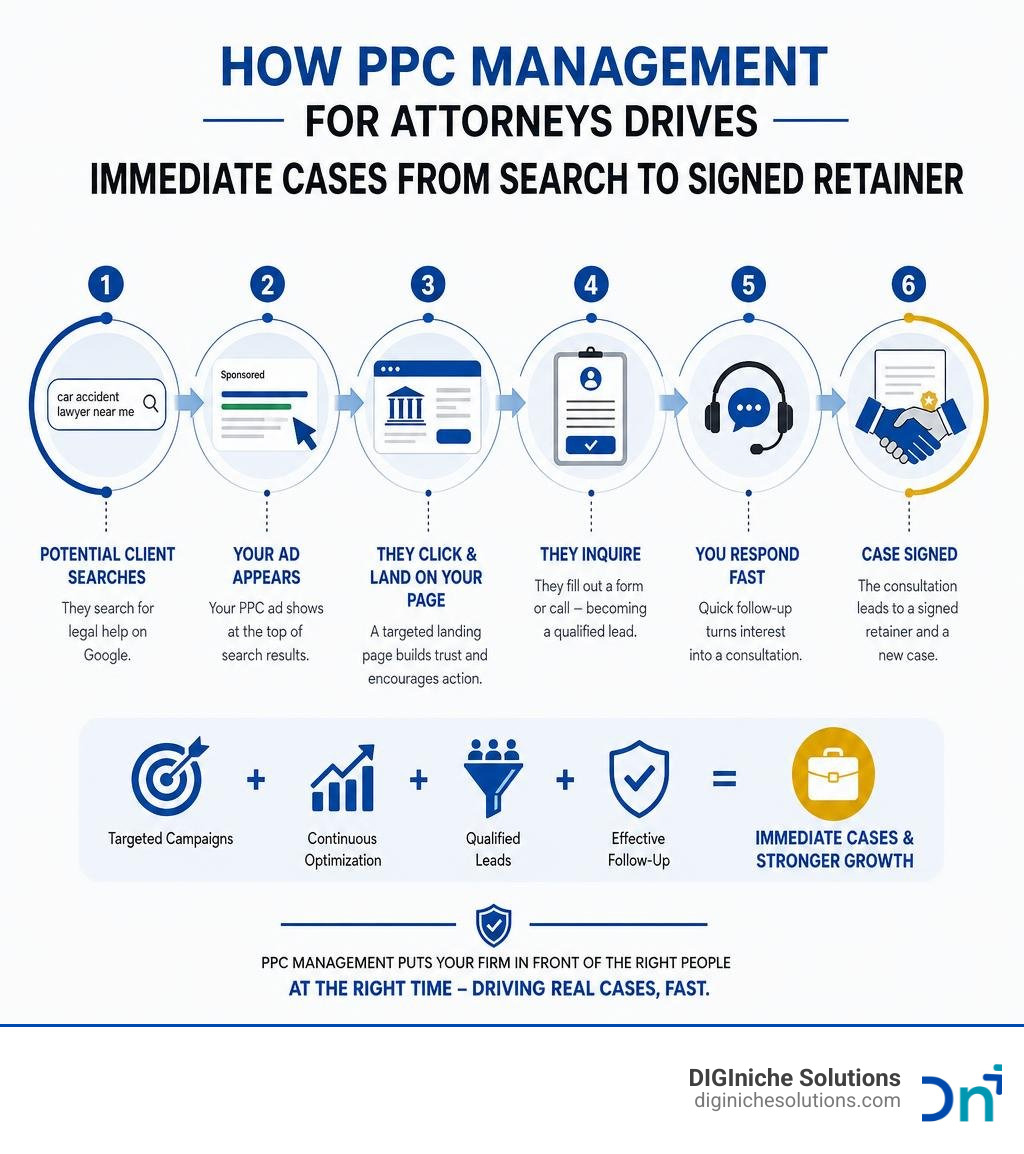
PPC management for attorneys is the process of planning, running, and continuously optimizing paid search campaigns so your law firm appears at the top of Google the moment a potential client types in “car accident lawyer near me” or “divorce attorney in [your city].”
Here’s a quick snapshot of what you need to know:
| Question | Quick Answer |
|---|---|
| What is attorney PPC? | Paid ads on Google (and other platforms) where you pay per click |
| Who should use it? | Law firms that need cases now, not 6–12 months from now |
| How much does it cost? | $3,000–$15,000+/month in ad spend depending on practice area |
| How fast does it work? | Leads can start coming in within days of launch |
| What makes it different from SEO? | Immediate visibility vs. long-term organic growth |
| Biggest risk? | Wasted spend from poor setup and no ongoing optimization |
Legal PPC is not like running ads for a coffee shop. You’re competing in one of the most expensive advertising environments on Google, where a single click on “car accident lawyer near me” can cost $300 to $500 or more. Without the right structure, tracking, and daily attention, that budget disappears fast with little to show for it.
But here’s the upside: a signed personal injury case can be worth tens of thousands of dollars. The math works — when the campaign is built and managed correctly.
That’s the gap this guide closes.
I’m Frank Demming, and for over a decade I’ve specialized in lead generation, SEO, and PPC management for attorneys — helping small to mid-sized law firms turn ad spend into a predictable stream of qualified cases. In this guide, I’ll walk you through everything you need to know to run profitable legal PPC campaigns, avoid common mistakes, and build a system that signs cases, not just clicks.
Ppc management for attorneys terms to remember:
What is Law Firm PPC and How Does It Work?

At its core, Pay-Per-Click (PPC) advertising is an auction-based digital marketing model where search engines like Google allow us to place highly targeted ads in front of users. The magic of PPC is that you only pay when someone actually clicks on your ad.
However, running PPC Advertising for Law Firms is fundamentally different from standard e-commerce or retail campaigns. In most industries, a click might cost $1.50, and the goal is to sell a $30 product. In the legal sector, a click can easily cost $100 or more, but the lifetime value of a single signed client can range from thousands to hundreds of thousands of dollars.
When a user types a query into Google, an instantaneous auction occurs. Google doesn’t just award the top spot to the highest bidder. Instead, it uses an algorithm called Ad Rank, which evaluates:
- Your Bid: The maximum amount you are willing to pay for a click.
- Quality Score: A 1-to-10 rating of your ad’s relevance, expected click-through rate (CTR), and landing page user experience.
- Ad Extensions: The expected impact of additional information like phone numbers, location details, and sitelinks.
Google provides additional detail on how this auction system works in its official guide to Ad Rank in Google Ads.
By focusing on these metrics, we can outsmart the competition rather than simply trying to outspend them, securing premium placements at a lower actual cost-per-click (CPC).
Key Benefits of ppc management for attorneys
When it comes to scaling a law firm’s caseload in competitive areas like New Jersey, relying solely on referrals or waiting months for organic search engine optimization (SEO) to kick in isn’t always viable. Professional ppc management for attorneys provides several game-changing advantages:
- Immediate Visibility: The #1 paid position on Google receives more clicks than anything else on the first page of results, including Google local listings and the #1 organic spot. While SEO is a marathon, PPC is a sprint that gets you to the top of the search engine results pages (SERPs) on day one.
- Targeted Reach: You can target prospects by precise geographic parameters, specific devices (like mobile-only for car accident victims), and exact search queries.
- Capturing High-Intent Clients: When someone searches for a “DUI defense lawyer in Newark” at 11 PM on a Friday night, they are not looking for a blog post or general information. They are ready to hire. PPC puts your firm in front of them at their exact moment of need.
Using a Lawyer Pay Per Click Advertising Powerful Strategy ensures that your marketing budget directly targets active prospects rather than passive viewers.
High-Performing Ad Types for Legal Practices
To maximize your return on investment, we utilize a mix of ad formats tailored to how legal consumers search for and choose attorneys online.
- Search Ads: Traditional text-based ads that appear at the very top of Google when users search for specific legal keywords. These are the workhorses of legal lead generation.
- Local Service Ads (LSAs): These pay-per-lead ads sit at the absolute top of the Google search results, featuring a “Google Screened” badge. You only pay when a qualified lead calls or messages your firm directly. To learn more about local options, read about the 4 Types of Local Law Firm Ads.
- Remarketing Ads: Many prospects visit your website, read a few pages, and leave without calling. Remarketing allows us to display targeted ads to those previous visitors as they browse other sites or social media, keeping your firm top-of-mind.
- Display Ads: Visual banner ads placed across millions of websites on the Google Display Network. These are highly effective for building brand awareness and trust. Explore the Best Display Advertising Platforms for Law Firms to see how this fits your growth plan.
- Video Ads: Highly engaging video content running on YouTube to tell your firm’s story, highlight successful case results, and humanize your practice.
Why Professional ppc management for attorneys is Essential in 2026

Google Ads is built to make it incredibly easy for beginners to set up a campaign. However, Google’s default settings are designed to maximize Google’s revenue, not yours. If you set up a campaign and leave it on autopilot, it will act like a digital “Tamagotchi” pet — but instead of needing virtual food, it will rapidly consume your real-world bank account.
Professional ppc management for attorneys is essential because managing campaigns in-house often leads to costly mistakes. Google’s automated recommendations frequently push broad match keywords, which can lead to your ads showing up for completely irrelevant terms. Without daily monitoring, search term auditing, and continuous Quality Score optimization, your cost-per-lead will skyrocket.
Eliminating Wasted Spend with Negative Keywords and Geo-Targeting
The secret to a highly profitable legal PPC campaign isn’t just about who you target; it’s about who you actively exclude.
We use two primary mechanisms to protect your budget:
- Negative Keywords: This is a list of terms that prevent your ads from showing. For instance, if you are a personal injury attorney, you do not want to pay $150 for a click when someone searches “pro bono car accident lawyer,” “lawyer jobs in NJ,” or “how to file a claim without a lawyer.” By building a robust negative keyword library, we can immediately cut wasted ad spend by 20% to 40%.
- Geo-Targeting: In New Jersey, geographic precision is everything. If your physical office is in Newark, you likely do not want to pay for clicks from Cape May unless you have a virtual consultation system set up. We configure your campaigns to target specific counties, cities, or custom radiuses. Crucially, we adjust Google’s location settings to “Presence” only. This prevents your ads from displaying to out-of-state users who are merely researching NJ laws but cannot hire you.
Ethical and Compliance Considerations in Legal Advertising
Attorneys are bound by strict ethical rules governed by the state bar association. In New Jersey, advertising rules are highly regulated. You must ensure that your ad copy and landing pages do not make misleading comparative claims, guarantee specific outcomes, or refer to your firm as an “expert” or “specialist” unless you hold a certified trial attorney designation recognized by the Supreme Court of New Jersey.
When managing PPC campaigns, we write compliant ad copy that highlights your firm’s unique value proposition—such as “Available 24/7” or “Free Case Evaluations”—without crossing ethical boundaries. Keeping up with local compliance is a core pillar of integrated New Jersey law firm marketing strategies.
Flat-Fee vs. Percentage-of-Spend Management Models
How you pay for PPC management directly impacts your campaign’s performance. Many traditional agencies charge a percentage-of-ad-spend fee (typically 15% to 20%). The problem with this model is an inherent conflict of interest: the agency is financially incentivized to encourage you to spend more money, regardless of whether that extra spend actually generates more signed cases.
At DIGIniche Solutions, we advocate for transparent, flat-fee management models. A flat-fee structure aligns our incentives with your business goals. We focus entirely on lowering your cost-per-lead and maximizing your ROI, rather than trying to inflate your monthly ad budget. To understand how to avoid agency traps, read our advice on How to Stop Wasting Money on Bad Digital Marketing for Law Firms.
Setting Up a Successful Google Ads Campaign
A successful campaign starts with a clean, organized account structure. We segment campaigns by specific practice areas (e.g., separating “Car Accidents” from “Slip and Fall” or “DUI” from “Drug Crimes”) rather than lumping everything into one generic campaign. This allows us to control budgets at the practice-area level and ensure that searchers are shown highly relevant ads that match their exact search intent.
To master these setups, you can explore Law Firm PPC Practices for Lawyers to Master Online Advertising.
Determining Your Monthly PPC Budget and CPC Benchmarks
Because 96% of Google’s profit historically comes from Google Ads, the auction environment is incredibly competitive. To succeed, you must understand the realistic economics of your practice area in the New Jersey market.
For competitive niches like personal injury, a law firm may need to spend $300 to $500 or more per click on high-intent keywords like “car accident lawyer near me.” In highly competitive markets, it can cost around $700 to generate a single qualified phone call and up to $3,500 in ad spend to secure a single signed car accident case. Therefore, to acquire five new car accident cases in a month, a personal injury firm should expect a starting budget of $12K+ per month.
For other practice areas, the costs are much more accessible. Here is a realistic breakdown of average CPC and cost-per-case metrics across different legal practice areas in NJ:
| Practice Area | Average CPC Range | Average Cost Per Signed Case | Recommended Starting Monthly Budget |
|---|---|---|---|
| Personal Injury | $150 – $350+ | $3,000 – $5,000 | $10,000 – $15,000+ |
| Criminal Defense / DUI | $50 – $120 | $500 – $1,500 | $3,000 – $6,000 |
| Family Law / Divorce | $20 – $80 | $600 – $1,800 | $3,000 – $5,000 |
| Estate Planning / Probate | $15 – $50 | $300 – $800 | $2,500 – $4,000 |
Setting a realistic budget ensures you can generate enough clicks to feed Google’s machine-learning algorithm with the conversion data it needs to optimize. For more budgeting strategies, read our guide on Tips to Maximize Law Firm Marketing Budget.
Step-by-Step Campaign Launch and Timeline for Results
PPC is not a “set-it-and-forget-it” marketing channel. It requires a structured, phased rollout to gather data, optimize bids, and scale profitably.
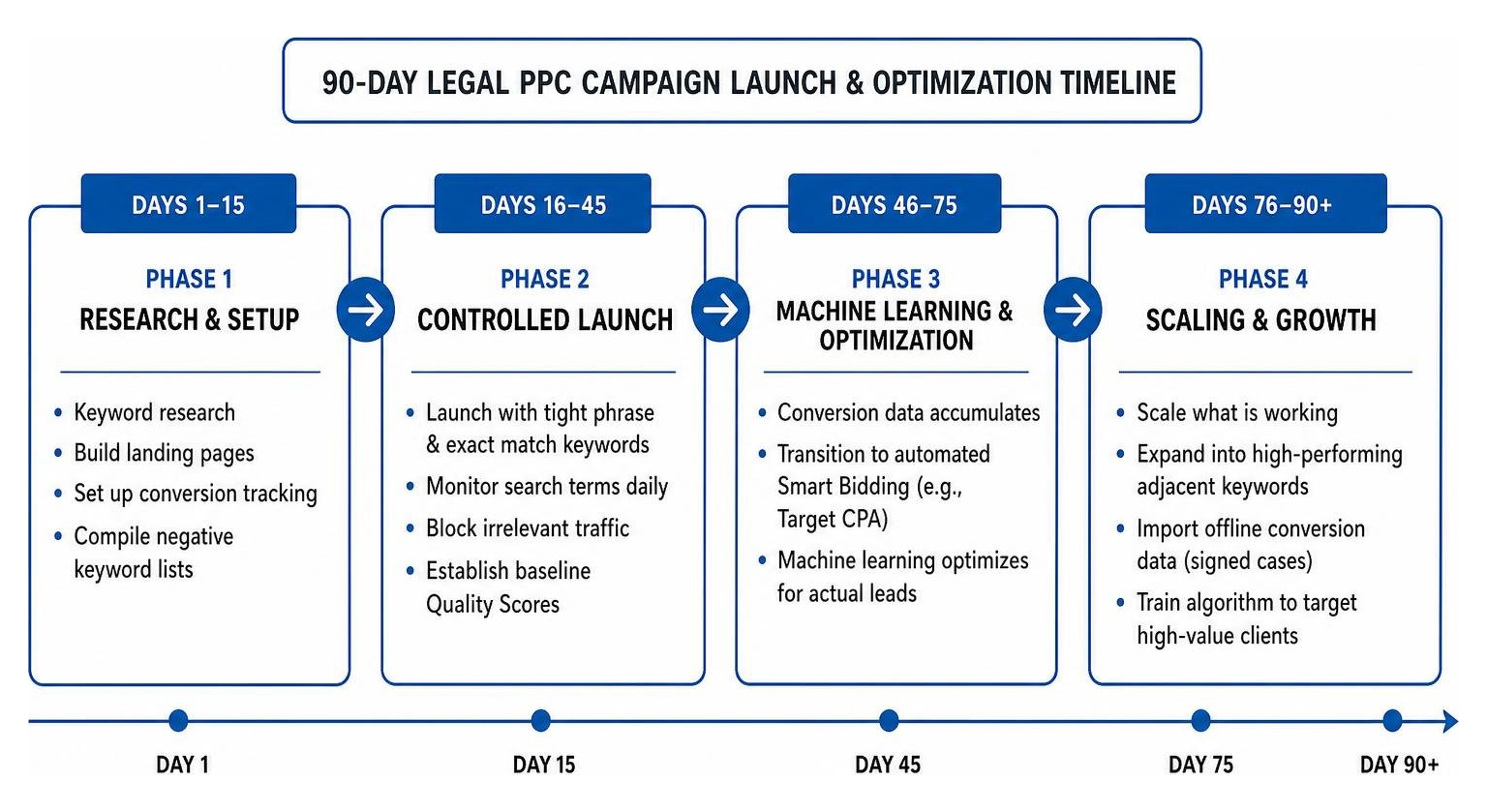
- Phase 1: Research & Setup (Days 1–15): We perform keyword research, build dedicated landing pages, set up advanced conversion tracking, and compile our negative keyword lists.
- Phase 2: Controlled Launch (Days 16–45): We launch campaigns with tight phrase and exact match keywords. We monitor search terms daily to block irrelevant traffic and establish baseline Quality Scores.
- Phase 3: Machine Learning & Optimization (Days 46–75): As conversion data accumulates, we transition from manual bidding to automated Smart Bidding strategies (like Target CPA) to let Google’s machine learning optimize for actual leads.
- Phase 4: Scaling & Growth (Days 76–90+): We scale what is working, expand into high-performing adjacent keywords, and begin importing offline conversion data (signed cases) back into Google to train the algorithm to target high-value clients.
Tracking, Measuring, and Optimizing PPC Performance
If you aren’t tracking your conversions with absolute precision, you aren’t running a PPC campaign; you are running a spending exercise. To measure true ROI, we must track every action a user takes after clicking your ad. Learn more about setting up these foundational systems in our overview of Pay Per Click.
We implement multi-channel tracking, including:
- Dynamic Number Insertion (DNI): Using tools like CallRail, we dynamically swap the phone number on your landing page based on the traffic source. This attributes every phone call back to the exact keyword and ad that triggered it.
- Form Submission Tracking: Capturing every contact form submission and chat interaction.
- Offline Conversion Tracking: Integrating your legal CRM (like Clio or Filevine) with Google Ads. This allows us to feed data on which leads actually turned into signed cases back to Google, teaching the algorithm to bid more aggressively on keywords that drive revenue, not just clicks.
Essential Metrics Beyond Clicks and Impressions
While clicks and impressions are interesting, they are vanity metrics. To evaluate the true health of your campaign, we focus on the KPIs that impact your bottom line:
- Conversion Rate (CVR): The percentage of ad clicks that turn into a lead (call, form, or chat). A healthy law firm landing page should target a combined conversion rate of 5% to 12%.
- Cost Per Lead (CPL): Total ad spend divided by the number of leads generated.
- Cost Per Signed Case (CPA): The total amount of ad spend required to get a signed retainer. This is the ultimate metric of PPC success.
- Search Impression Share: The percentage of times your ad was shown out of the total times it was eligible to appear. This tells us if there is room to scale your budget.
Optimizing Landing Pages to Convert Clicks into Signed Cases
Sending paid traffic to your firm’s homepage is the single biggest reason legal PPC campaigns fail. A homepage is designed to introduce your firm, list all your attorneys, and cover multiple practice areas. It has too many distractions.
Instead, we build dedicated, practice-specific landing pages that match the exact intent of the searcher. If a user searches for a “truck accident lawyer in Newark,” they should land on a page dedicated exclusively to truck accidents in Newark—complete with a bold headline, trust signals (such as client testimonials and case results), and a prominent, click-to-call phone number above the fold.
We continuously test and refine these pages to maximize conversions. Learn why this process is so critical in our article on the Reasons to A B Test Your Law Firm Landing Pages, and explore localized landing page strategies designed to capture high-intent local leads.
Integrating PPC and SEO for a Comprehensive Strategy
Some agencies will tell you that you only need SEO, while others will argue that PPC is the only channel that matters. The truth is that the most successful law firms in New Jersey use both. They treat paid and organic search as complementary forces that work together to dominate the SERPs.
How PPC and SEO Work Together to Dominate the SERPs
When you run PPC and SEO concurrently, you unlock powerful marketing synergies:
- Keyword Data Sharing: PPC provides instant data on which keywords generate the highest-quality leads and signed cases. We can immediately take those high-converting paid terms and hand them to our SEO team to guide your long-term content strategy.
- Dominating SERP Real Estate: If your firm ranks #1 organically, has a prominent Google Business Profile in the local 3-pack, and runs paid search ads at the top of the page, you effectively crowd out your competitors. This multi-touch presence builds immense brand authority and trust.
- Compounding Growth: PPC captures immediate, urgent leads while your SEO campaign builds a sustainable, compounding asset that lowers your average cost-per-lead over time.
By aligning your paid strategy with organic efforts, you build a highly resilient client-acquisition engine. Check out our Digital Marketing for Lawyers Content Marketing Tips to see how to align your content, and learn about localized search performance to maximize your local visibility.
Frequently Asked Questions about PPC for Law Firms
What are the most common pitfalls in law firm PPC management?
The most common mistakes we see when auditing law firm accounts include:
- Homepage Routing: Sending paid traffic to a general homepage instead of a dedicated, high-converting landing page.
- Broad Match Pitfalls: Allowing Google to match your ads to broad, irrelevant terms, which wastes thousands of dollars on non-converting clicks.
- Poor Intake Processes: If your firm doesn’t answer the phone promptly, has no live chat option, or doesn’t follow up with leads within minutes, your PPC budget is wasted. Speed-to-lead is critical in legal marketing.
- Lacking Call Tracking: Running campaigns without knowing which keywords actually generated the phone calls.
To learn more about keeping your budget safe from these mistakes, read our playbook on How to Maximize Your Law Practice Marketing Budget.
Choosing the Right Partner for ppc management for attorneys
Should you manage your ads in-house or hire an agency? Managing legal PPC in-house has a incredibly steep learning curve, and mistakes are financially painful.
When choosing a specialized agency, look for:
- 100% Account Ownership: Never let an agency build your campaigns inside their Google Ads account. If you ever part ways, you should retain full ownership of your data, campaign structures, and historical performance.
- Transparent Billing: Ensure your ad spend is paid directly to Google, and the agency’s management fee is a separate, flat monthly rate.
- Legal Industry Specialization: Generalist agencies lack the specialized negative keyword libraries and landing page structures required to navigate the hyper-competitive legal niche.
Discover how to evaluate your options with our guide on choosing a Paid Search Advertising Agency for Law Firm.
How does Google determine where my ad is placed?
Google uses the Ad Rank algorithm to determine ad positioning. Ad Rank is calculated every time a search is performed using your bid amount, your Quality Score (which measures ad relevance, expected CTR, and landing page experience), and the expected impact of your ad extensions. This means a highly optimized campaign with a Quality Score of 9 can beat a competitor with a Quality Score of 4, even if they are bidding twice as much.
For tips on maximizing your Quality Scores, check out Maximizing Your Law Firm Ads.
Conclusion
At DIGIniche Solutions, we specialize in helping New Jersey law firms build scalable client-acquisition systems. We don’t just focus on generating cheap clicks or raw leads; we focus on signing real, high-value cases.
Our proprietary V.E.R.A. Formula is designed to deliver:
- Visibility: Dominating the top of Google Search and Local Service Ads.
- Engagement: Capturing prospects with high-converting, mobile-responsive landing pages.
- Retention: Keeping your firm top-of-mind through smart remarketing and CRM follow-ups.
- Amplification: Sharing data across PPC and SEO to build a compounding, scalable growth ecosystem.
If you are ready to stop wasting your marketing budget and start predictably signing more cases, we are here to help. Get started with professional PPC management by scheduling a free, no-obligation audit of your existing campaigns today.
