

Why Personal Injury Lead Generation Determines Whether Your Firm Grows or Stalls
Personal injury lead generation is the process of attracting, capturing, and converting people who have been injured and need legal representation into signed clients for your law firm.
Here’s a quick breakdown of how it works and what your options are:
| Channel | Cost Per Lead | Conversion Rate | Speed to Results |
|---|---|---|---|
| Referrals | Near $0 | 60–80% | Slow to build |
| Organic SEO | Low–Moderate | 25–40% | Months |
| Google Ads (PPC) | High | 30–45% | Days |
| Social Media Ads | Low | 20–35% | Days |
| Bought Leads (shared) | $20–$350 | 15–25% | Immediate |
| Live Transfers | $1,200–$1,500 | Highest | Immediate |
The personal injury market exceeds $53 billion annually in settlements and verdicts. Auto accidents alone account for roughly 52% of all PI cases. That means the opportunity is enormous — but so is the competition.
The hard truth? Most firms don’t have a quality problem. They have a pipeline problem.
Some months the phone rings. Other months it doesn’t. That inconsistency is exactly what drives attorneys to search for better ways to fill their caseload — whether that’s buying leads, running ads, or building organic search traffic that compounds over time.
There’s no single “best” channel. What matters is knowing which channels fit your firm’s size, budget, and intake capacity — and how to avoid the common traps that drain budgets without producing signed cases.
I’m Frank Demming, and for more than a decade I’ve helped law firms build predictable client pipelines through SEO, PPC, and strategic personal injury lead generation systems that actually convert. In this guide, I’ll walk you through every major channel, the real costs involved, and how to make smarter decisions about where to put your marketing dollars.
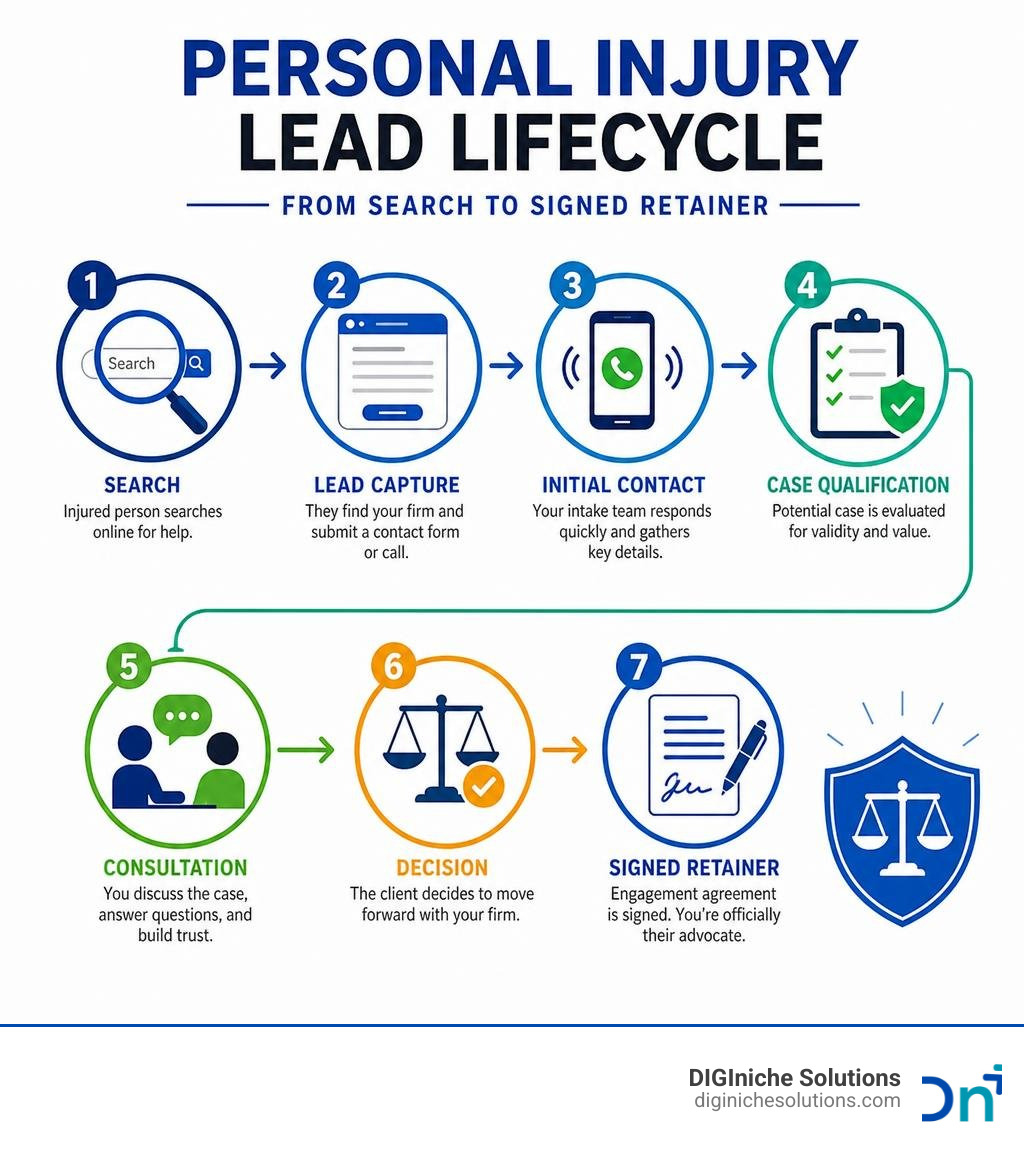
Personal injury lead generation further reading:
Understanding Personal Injury Lead Generation and Core Acquisition Channels
To build a thriving personal injury practice, we must first understand the landscape of client acquisition. The personal injury legal market is highly competitive, with billions of dollars at stake annually. According to industry statistics, auto accidents constitute approximately 52% of all personal injury cases, followed by premises liability (around 15%), workers’ compensation (12%), and medical malpractice (7%).
A major driver behind the constant demand for personal injury attorneys is how insurance companies handle claims. Insurance adjusters systematically undervalue injury claims by 40% to 65% using automated valuation software. This creates a massive incentive for injured parties to seek legal help, as represented claimants recover an average of 3.5 times more financial compensation than unrepresented claimants.
To capture these cases, we look at several core acquisition channels. While word-of-mouth referrals will always deliver the highest conversion rates, relying solely on them limits your firm’s growth. To scale, we must leverage digital channels like search engine optimization (SEO), pay-per-click (PPC) advertising, and targeted social media campaigns.

Investing in organic search is a foundational pillar for any firm looking to build long-term value. To understand why this channel is so powerful, explore our guide on Why Personal Injury SEO Is Worth It. Unlike paid channels where the lead flow stops the moment you stop paying, a well-optimized website acts as a compounding asset that continues to bring in cases month after month.
Organic Search and Personal Injury Lead Generation Secrets
When an accident victim is sitting in a hospital room or on their couch trying to figure out how they will pay their medical bills, they turn to search engines. This is why organic search is one of the most valuable sources of high-intent leads.
To win in organic search, your firm must master Local SEO. This means optimizing your Google Business Profile, ensuring absolute consistency of your Name, Address, and Phone number (NAP) data across the web, and systematically collecting authentic client reviews. In highly competitive markets like New Jersey, ranking in Google’s Local Pack (the map section at the top of search results) can instantly transform your lead volume.
However, ranking on the first page of Google requires more than just basic keyword stuffing. To learn the advanced strategies that top-performing firms use, read about the Personal Injury SEO Secrets Revealed: What Experts Don’t Want You to Know About Ranking in 2026.
We also need to avoid the common errors that firms make after search engine algorithm updates. For a deep dive into keeping your rankings stable, read about the 7 Post-Update Mistakes You’re Making with SEO for Personal Injury Lawyers and How to Fix Them. Furthermore, as artificial intelligence changes how consumers search, we must adapt our content strategies. Learn how to stay ahead by reading How to Rank in ChatGPT: A Step-by-Step Guide for Personal Injury Lawyers.
To tie all of these organic strategies together, we have compiled a comprehensive list of actionable tactics. Check out our Personal Injury Lawyer Marketing Tips for Legal Firm to start optimizing your organic pipeline today.
Paid Search and Social Media Tactics
While organic search builds long-term value, paid search offers immediate visibility. Google Ads allows your firm to bid on high-intent search queries like “car accident lawyer near me” and appear at the very top of search results instantly.
However, because personal injury keywords are some of the most expensive in the entire advertising industry—often exceeding $200 per click in major New Jersey metro areas—your campaigns must be mathematically precise. A single unoptimized campaign can drain thousands of dollars in hours. One of the most effective ways to protect your budget is by building a robust negative keyword list. Excluding terms like “jobs,” “salary,” “definition,” or competitor brand names can save 15% to 25% of your total ad spend.
To build a highly profitable paid search strategy, read our comprehensive guide on Lawyer Pay-Per-Click Advertising: Powerful Strategy.
In addition to Google Ads, social media platforms like Facebook and Instagram offer excellent opportunities to target prospective clients. While search ads target active search intent, social media ads target passive demographic behaviors. This is highly effective for specific case types, such as distracted driving accidents, where visually engaging video ads can capture attention and build immediate empathy. For practical examples and templates, refer to The Best Facebook Ads for Distracted Driving Accident Cases.
The Art of Buying Leads: Shared vs. Exclusive Models
For firms that want to bypass the setup time of running their own marketing campaigns, buying leads from third-party lead generation companies is a popular alternative. However, this is where many attorneys get burned because they do not understand the mechanics of how these leads are generated and distributed.
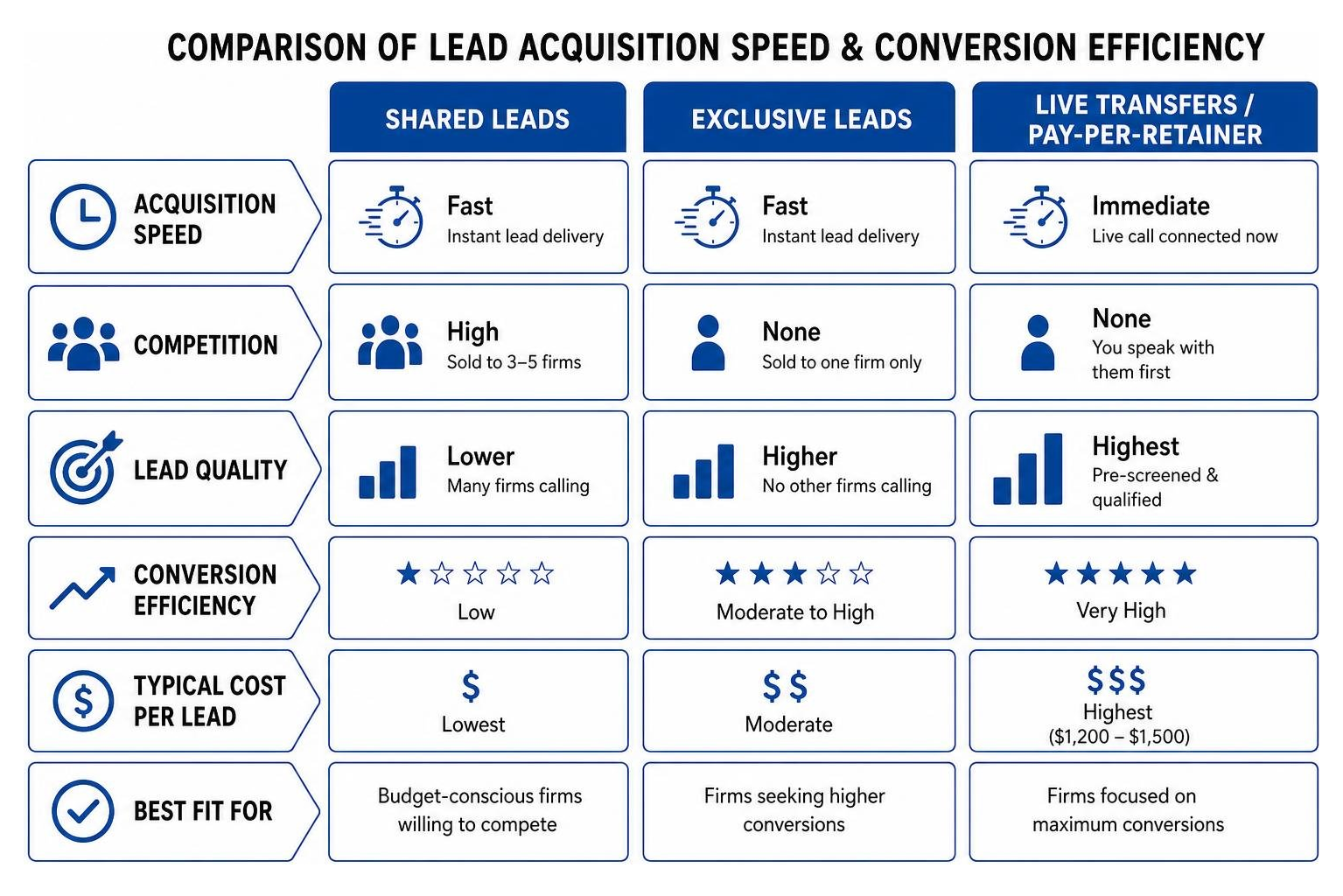
There are three primary models for buying personal injury leads:
- Shared Leads: These are leads generated through generic legal directories or information portals. The lead gen agency sells the exact same lead to 3 to 5 different law firms simultaneously. This triggers a frantic race where the first attorney to dial the prospect usually wins, leaving the other firms with wasted money and annoyed prospects who are tired of being called.
- Exclusive Leads: These leads are sold to only one law firm. Because the prospect is not being hounded by multiple competitors, the conversion rates are significantly higher. However, if an exclusive lead sits unanswered for several hours, the prospect will likely continue searching on Google and call another firm anyway—effectively turning your exclusive lead into a shared one through your own delay. To learn more about securing these high-intent prospects, see Personal Injury Leads for Attorneys: Exclusive from Google Ads .
- Live Transfers and Pay-Per-Retainer: In this premium model, the lead generation agency screens the prospect using a call center, verifies their eligibility, and immediately transfers the live call to your intake team. Some agencies even handle the intake entirely, delivering a signed retainer agreement and HIPAA authorization directly to your firm. While live transfers price out significantly higher—ranging from $1,200 to $1,500 each—they eliminate the friction of chasing down leads and boast the highest conversion rates.
To help you visualize these differences, here is a comparison of how these models perform:
Navigating Ethics in Paid Personal Injury Lead Generation
Before you sign a contract with any lead generation provider, you must understand the ethical rules governing attorney advertising and fee-splitting. This is especially true for firms operating in New Jersey, where the regulatory oversight is exceptionally strict.
The New Jersey Ethics Committee has issued clear warnings regarding third-party marketing services. Attorneys must ensure that they are not paying for leads in a way that constitutes illegal fee-splitting (giving a percentage of your legal fee to a non-lawyer) or improper solicitation.
To protect your license and your firm, review the advisory opinions detailed in New Jersey Ethics Committee: Beware Marketers that “Lead” to … .
Any lead generation service you use must charge a flat, performance-based fee per lead rather than a percentage of the settlement. Additionally, the marketing materials used by the lead generation company must comply with state bar rules regarding truthful advertising and must not mislead the public. Working with an experienced marketing partner who understands these strict local regulations is essential for maintaining compliance while scaling your practice.
Qualifying, Screening, and Converting High-Value Leads
Whether you buy leads or generate them in-house, your conversion rate depends entirely on your intake system. In personal injury law, speed is everything. Leads contacted within five minutes convert at 4 to 5 times the rate of those contacted hours later. If you wait more than 30 minutes to call an accident victim back, the likelihood of signing that case drops close to zero.
To prevent lead leakage, your website must be optimized to capture information instantly and guide prospects toward a phone call or live chat. To improve your site’s conversion performance, implement these Boost Your Case Lead Volume Instantly with These 5 Attorney Website Design Tips.

When a lead is captured, your intake team must immediately screen them using a strict qualification checklist. A high-value personal injury lead must meet five critical criteria:
- Clear Liability: The accident must have been caused by the negligence of another party.
- Documented Injuries: The prospect must have sustained physical injuries that required medical treatment (ideally within 14 days of the incident).
- Insurance Coverage: There must be an active insurance policy (or sufficient corporate assets) to cover the damages.
- Statute of Limitations: The claim must fall within the state’s legal timeframe (e.g., New Jersey’s strict 2-year statute of limitations under N.J.S.A. § 2A:14-2).
- No Prior Representation: The prospect must not already be represented by another attorney.
For specialized cases, such as medical malpractice, the screening process must be even more rigorous due to the high cost of litigation. To learn how to build a specialized pipeline for these complex claims, read our guide on How to Build a Scalable Lead Generation Engine for Medical Malpractice Lawyers.
Key Metrics to Track for Campaign Success
To run a highly profitable lead generation engine, you must track the correct data. Many firms make the mistake of focusing solely on Cost-Per-Lead (CPL). While a low CPL looks great on paper, it is a vanity metric if those leads are “tire-kickers” who never sign a retainer.
Instead, we advise tracking these four critical performance metrics:
- Cost-Per-Signed-Case (CPA): The total amount of marketing spend required to secure one signed retainer agreement.
- Lead-to-Case Conversion Rate: The percentage of total leads that successfully convert into signed clients.
- Average Case Value: The average settlement or verdict amount generated by your signed cases.
- Return on Investment (ROI): The total revenue generated by your cases divided by the total marketing spend.
To optimize these metrics and ensure your intake team is performing at its peak, read our essential guide on Attorney Lead Generation Tips Must-Follow to Win Clients. Additionally, to explore how online and offline tactics work together to lower your overall acquisition costs, refer to Getting Clients for Law Firm: Online & Offline Marketing Tactics.
Frequently Asked Questions about Legal Lead Generation
Navigating legal lead generation can be overwhelming. To help you make the best decisions for your firm, we have compiled answers to the most common questions we receive from personal injury attorneys.
How much do personal injury leads typically cost in 2026?
The cost of personal injury leads varies significantly based on geographic competition, case type, and exclusivity. In July 2026, general web-form leads range from $20 to $350 per lead. However, exclusive, search-intent leads sourced directly from Google Ads typically range from $125 to $865+ depending on the severity of the case.
Highly specialized cases—such as commercial trucking accidents, wrongful death, or product liability—carry higher upfront lead costs because the potential settlement values are much larger. Geographic location also plays a massive role; targeting highly competitive urban areas in New Jersey like Newark or Jersey City will cost significantly more per lead than targeting smaller, less-saturated markets.
Why is speed of response so critical for converting injury leads?
Speed is the ultimate deciding factor in legal lead conversion. When an injured person submits a form online, they are in an acute state of stress, dealing with pain, vehicle damage, and medical bills. The attorney who contacts them first signs the case 78% of the time.
If your firm does not respond within five minutes, the prospect will simply click on the next search result or submit a form to a competitor. To combat this, we recommend setting up automated SMS auto-responders that engage the prospect within 90 seconds of form submission, followed by immediate phone calls from your intake team.
How does personal injury lead generation differ from other practice areas?
Personal injury lead generation is unique because it operates almost entirely on a contingency-fee model. Unlike family law, criminal defense, or estate planning where clients pay hourly fees or flat upfront retainers, personal injury clients pay nothing out of pocket. This makes the initial screening process incredibly high-leverage; if you sign a weak personal injury case, your firm will waste valuable hours and litigation costs with zero return.
In contrast, other practice areas require different marketing approaches. For example, to understand how lead generation differs in the transactional legal space, read about the 7 Mistakes You’re Making with Estate Planning Lawyer Lead Generation.
Conclusion
At DIGIniche Solutions, we believe that buying leads is like renting an apartment—it can provide temporary shelter, but it builds zero long-term equity. To achieve sustainable, highly profitable growth, your law firm must own its marketing assets.
We help personal injury law firms build their own scalable client-acquisition systems using our proprietary V.E.R.A. Formula. By delivering:
- Visibility: Ensuring your firm ranks at the top of local search results and Google Maps when accident victims need you most.
- Engagement: Designing high-converting, mobile-friendly websites that turn casual visitors into active leads.
- Retention: Implementing automated intake systems and SMS nurturing sequences so no lead ever slips through the cracks.
- Amplification: Leveraging multi-channel marketing—including targeted social media and video testimonials—to turn your successful cases into a flood of new referrals.
Stop relying on expensive, shared leads that drain your budget. Let us help you build a compounding marketing asset that belongs entirely to your firm.
Ready to dominate your local market? Partner with DIGIniche Solutions for Scalable Growth and let’s start building your caseload today.
