

Why Lead Generation for Lawyers Is the Foundation of a Growing Practice
Lead generation for lawyers is the process of attracting people who need legal help and turning them into paying clients — and it’s one of the biggest challenges law firms face today.
Here’s a quick answer if you’re looking for the fastest path forward:
How to generate leads for your law firm:
- Optimize your website for local search (Google Business Profile, local keywords, fast load speed)
- Run Google Ads or Local Service Ads for immediate visibility
- Publish helpful content (blog posts, FAQs, practice area pages) to rank organically
- Join legal lead platforms like Avvo, Nolo, or FindLaw to reach high-intent prospects
- Respond fast — research shows 78% of clients hire the first attorney who responds
- Use AI tools and CRM software to qualify leads and automate follow-up
The legal market is crowded. In many cities, dozens of firms compete for the same clients searching Google right now.
The good news? Most of your competitors are doing this poorly.
77% of people searching for an attorney start online — yet many law firms still rely almost entirely on word-of-mouth referrals. That’s an unpredictable strategy that leaves real money on the table.
The firms growing fastest aren’t just waiting for referrals. They’re building systems — websites, content, ads, and intake tools — that bring in qualified clients consistently, month after month.
This guide breaks down exactly how to build that system, whether you’re starting from scratch or trying to fix what’s not working.
Understanding Lead Generation for Lawyers
To build a reliable system, we first need to define what a “lead” actually is in the legal industry.
A lead is not just a random visitor to your website or someone who clicks on your social media post. A true legal lead is a prospective client who has a specific legal issue, falls within your geographic practice area, and has taken action to contact your firm.

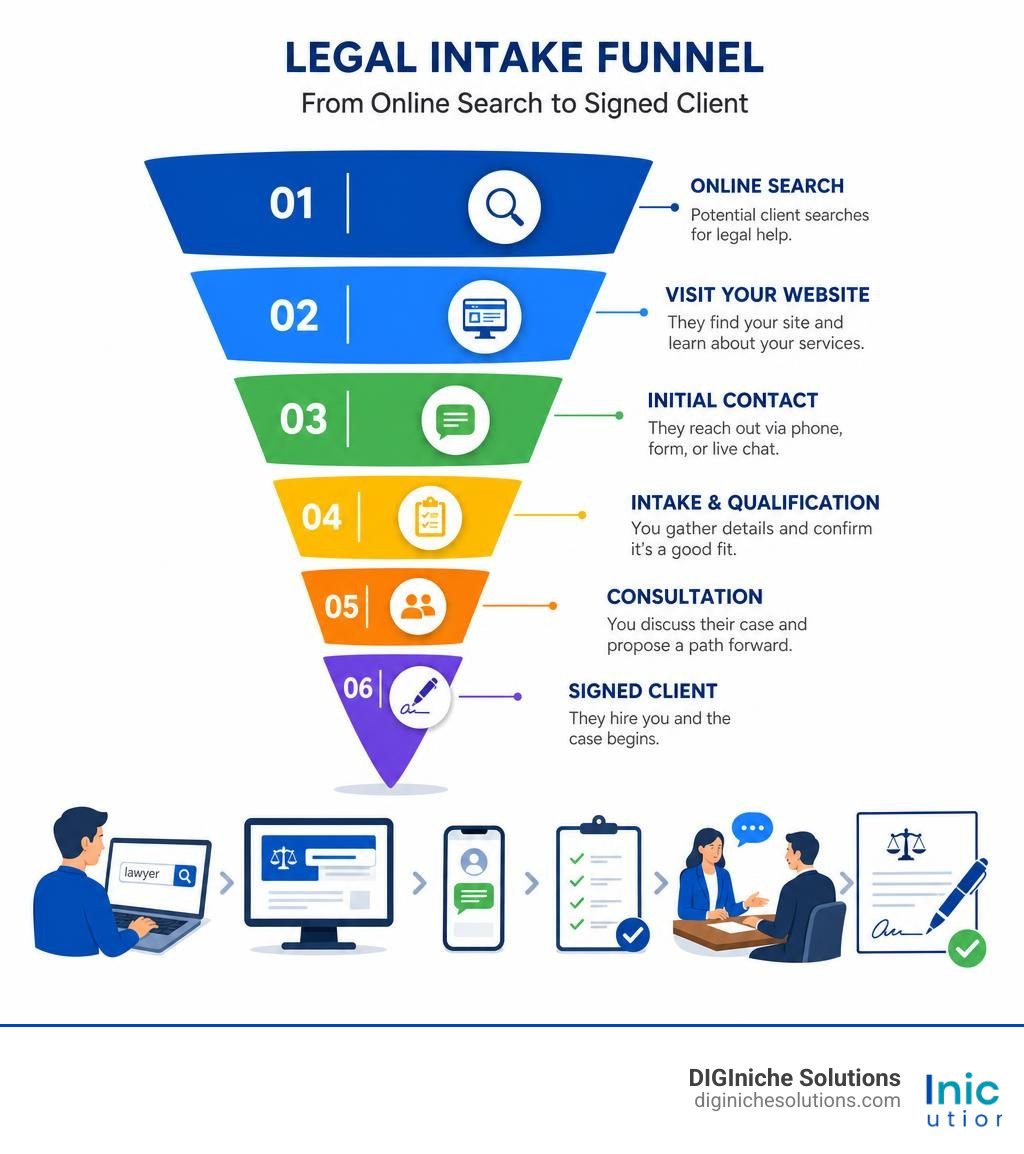
When we talk about lead generation for lawyers, we are looking at a structured funnel that takes a person from a state of worry and uncertainty to a signed retainer agreement. This process is divided into distinct stages:
- Cold Audience: Individuals who have a potential legal issue but do not know your firm exists.
- Warm Audience: Prospects who are actively researching their problem and have discovered your website, blog, or local listings.
- Hot Audience: High-intent prospects who are actively seeking to speak with an attorney immediately.
- Client: The prospect has been qualified, consulted, and signed.
For many years, firms viewed active marketing with skepticism, worried it might look “too salesy.” But in June 2026, modern legal marketing is about education and accessibility. When someone is dealing with a stressful divorce, a sudden car accident, or a complex business dispute, they need answers immediately. Effective lead generation simply positions your firm as the trusted solution at the exact moment they need you.
To explore how these digital tactics fit alongside traditional networking, check out our guide on Getting Clients for Law Firm Online Offline Marketing Tactics.
Organic vs. Paid Client Acquisition
When building your pipeline, you must balance two primary approaches: organic client acquisition (earning visibility over time) and paid client acquisition (buying visibility instantly).
To help you decide where to allocate your marketing budget, we have compiled a comparison of how these two methodologies perform across key business metrics:
| Metric | Organic SEO & Content | Paid Advertising (PPC & LSAs) | Third-Party Lead Purchases |
|---|---|---|---|
| Upfront Cost | Moderate to High (Time/Agency) | High (Direct Ad Spend) | Variable (Pay-per-lead) |
| Time to Results | 3 to 6 Months | 7 to 14 Days | Immediate |
| Cost Per Lead (CPL) | $50 – $150 (Long-term average) | $150 – $350+ (Practice area dependent) | $20 – $350 (Shared vs. Exclusive) |
| Lead-to-Client Conversion | High (Built on organic trust) | Moderate | Low to Moderate |
| Residual Asset Value | Permanent (You own the rankings) | Zero (Traffic stops when spend stops) | Zero (One-time transaction) |
| Long-Term ROI | Extremely High ($26+ return per $1 spent) | Moderate (~$10 return per $1 spent) | Low to Moderate |
Why Organic Lead Generation for Lawyers Outperforms Paid Leads
While buying leads or running ads can provide a quick boost, investing in organic search engine optimization (SEO) and brand building is the ultimate strategy for sustainable growth.
When you purchase leads from third-party directories, you are essentially renting someone else’s traffic. The moment you stop paying, the leads vanish. Furthermore, directories often sell the exact same lead to three or four competing law firms, forcing you into a frustrating race to the phone.
Organic SEO, on the other hand, builds compounding value. When we rank your website at the top of Google search results, we are creating a digital asset that continues to attract high-intent clients 24/7 without a per-click cost.
Organic traffic converts at a significantly higher rate because of established brand authority. When a prospect finds your educational blog post, reads your client reviews, and navigates your professional site, they already trust you before they even pick up the phone.
To understand how to position your firm to dominate search results organically, read our comprehensive resource: Law Firm SEO The Ultimate Guide.
Paid Channels and PPC Advertising
While organic SEO is the long-term engine, paid search is the accelerator. If you need cases immediately, pay-per-click (PPC) advertising is highly effective.
The most powerful paid channels for law firms in 2026 include:
- Google Local Service Ads (LSAs): These ads appear at the very top of Google search results, even above traditional PPC ads. They feature the “Google Screened” badge, display your star rating, and operate on a pay-per-lead model rather than pay-per-click. This means you only pay when a qualified prospect calls or messages your firm.
- Google PPC Ads: These are keyword-targeted text ads. While highly competitive and expensive for terms like “personal injury lawyer,” they allow you to capture prospects searching for specific, high-intent phrases.
- Meta (Facebook & Instagram) Ads: Ideal for practice areas like family law, estate planning, and criminal defense. Meta ads allow us to use demographic and geographic targeting to get your educational content and lead magnets in front of the right local audiences.
To learn more about optimizing your paid search campaigns to prevent budget waste, explore our strategic guide on PPC Advertising for Law Firms.
Key Strategies to Build a Scalable Lead Engine
To build a lead generation system that scales, we must move away from disjointed, one-off marketing tactics. Instead, we focus on creating a unified client acquisition ecosystem.

At DIGIniche Solutions, we achieve this through our proprietary V.E.R.A. Formula:
- Visibility: Ensuring your firm dominates search engines, local maps, and social channels.
- Engagement: Capturing attention through optimized web design, educational content, and interactive tools.
- Retention: Keeping prospects warm through automated email sequences and seamless intake.
- Amplification: Leveraging reviews, case results, and social proof to compound your growth.
If you are looking to build a highly specialized pipeline, you can read our deep-dive on How to Build a Scalable Lead Generation Engine for Medical Malpractice Lawyers.
Optimizing Your Law Firm Website
Your website is the digital front door of your law firm. If it is slow, difficult to navigate on a mobile phone, or lacks clear calls-to-action (CTAs), you are wasting your marketing budget.
An optimized, high-converting law firm website must include:
- Mobile-First Design: Over 60% of legal searches happen on mobile devices. Your site must load in under two seconds and look flawless on smartphones.
- Clear Calls to Action: Do not make prospects search for your phone number. Place a prominent “Call Now” button and a simple contact form above the fold on every page.
- Trust Signals: Highlight your professional credentials, successful case results, and client testimonials right on the homepage.
- Educational Practice Pages: Instead of a generic “Services” page, create dedicated, in-depth pages for every specific sub-practice area you handle.
To see what sets industry-leading websites apart from the rest, check out our analysis of what the Best Law Firm Websites Have in Common.
Leveraging AI in Lead Generation for Lawyers
In 2026, artificial intelligence has completely transformed legal intake. The biggest bottleneck in law firm growth has always been response time; research consistently shows that 78% of legal clients hire the first attorney who responds to their inquiry. If a lead contacts your firm at 8:00 PM and you wait until 9:00 AM the next morning to call them back, they have likely already hired your competitor.
AI solves this speed-to-lead problem entirely. By deploying smart AI chatbots and automated qualification systems, your firm can:
- Instantly engage website visitors 24/7.
- Pre-screen leads by asking qualifying questions (e.g., checking the statute of limitations, geographic location, and case type).
- Book qualified consultations directly onto your calendar.
- Deliver automated, personalized email and SMS follow-ups within seconds of a form submission.
While leveraging these advanced tools, it is vital to remain compliant with legal ethics. Every AI tool must be configured to present necessary legal disclaimers, ensuring that automated conversations do not establish an attorney-client relationship prematurely. For details on maintaining professional standards in your digital communications, refer to the ABA Model Rule 7.1 guidelines on truthful and non-misleading marketing.
Frequently Asked Questions about Law Firm Marketing
How much do legal leads typically cost?
The cost per lead (CPL) varies significantly based on your geographic market, your practice area, and the marketing channels you choose. Highly competitive practice areas like personal injury and motor vehicle accidents typically command the highest costs, with paid search leads averaging between $150 and $350+ per lead.
On the other hand, less competitive practice areas like estate planning or business law often see a much lower average cost per lead, ranging from $50 to $150.
When evaluating costs, it is vital to measure your Cost Per Acquisition (the cost to sign a paying client) rather than just the cost of a raw lead. A cheap $20 lead that doesn’t convert is far more expensive than a $200 exclusive, high-intent organic lead that signs immediately.
How quickly can a law firm expect to see results?
The timeline for seeing results depends entirely on the acquisition channels you deploy:
- Paid Advertising (PPC & LSAs): You can expect to see your ads live and the first leads arriving within 7 to 14 days of launching your campaign.
- Third-Party Lead Purchasing: Leads typically start arriving instantly once your account is funded and configured.
- Organic SEO & Content Marketing: Because search engines take time to crawl, index, and build trust in your website, a comprehensive organic campaign typically takes 3 to 6 months to generate a steady, self-sustaining flow of highly qualified leads. However, these organic leads carry the highest long-term ROI and continue to arrive long after your initial investment.
What is the most important factor in converting legal leads?
Without question, the single most critical factor in converting legal leads is response time.
If you respond to a lead within five minutes of their inquiry, your contact and conversion rates are dramatically higher than if you wait even thirty minutes.
To manage this volume effectively, successful law firms integrate their marketing channels with robust Client Relationship Management (CRM) software (such as Clio Grow or MyCase). These systems automate immediate email and text message touchpoints, ensuring that no lead is left waiting.
Conclusion
Building a successful law firm in 2026 requires a predictable, scalable stream of qualified clients. Relying solely on word-of-mouth referrals is no longer enough to compete in a digital-first marketplace.
By combining the immediate power of paid search with the compounding, long-term asset value of organic SEO, you can build a client acquisition system that fuels your firm’s growth month after month.
At DIGIniche Solutions, we specialize in helping law firms nationwide build these high-performing marketing engines. Through our proprietary V.E.R.A. Formula, we handle the complexities of digital marketing — from local SEO and professional web design to advanced lead qualification systems — so you can focus on what you do best: winning cases for your clients.
Ready to take control of your firm’s growth and dominate your local market? Master online advertising with our law firm PPC practices or contact us today to schedule your custom digital marketing strategy session.
