

Designing an End-to-End Estate Planning Engagement Strategy
An effective estate planning engagement strategy combines structured engagement agreements, tiered flat-fee packaging, automated intake and follow-up, trust funding audits, and annual review programs. These components move a practice away from one-off transactional drafting toward a complete client journey. When an estate planning practice operates without clear systems, prospective clients slip through the cracks, files stall mid-drafting, and attorneys face administrative drag.
Implementing a structured onboarding framework mitigates malpractice risks under the ABA Model Rules while dramatically enhancing client satisfaction. At DIGIniche Solutions, we often see law practices in communities like Clifton, NJ, Newark, NJ, and across Bergen County struggle with intake friction because they treat client onboarding as administrative paperwork rather than the foundation of client trust.
Workflow automation solves this bottleneck. By integrating automated pre-consultation questionnaires, digital document delivery, and milestone notifications, you eliminate administrative lag. Automating these touchpoints allows your legal team to focus on high-value client advisory work rather than chasing signatures or scheduling callbacks.
Structuring the Engagement Letter within Your Estate Planning Engagement Strategy
The engagement letter is the most critical operational document in your practice. It establishes professional boundaries, defines expectations, and serves as your first line of defense against fee disputes and bar grievances. As outlined in the Estate Planning Engagement Letter: What to Include + Free Template (2026), every solid agreement must clearly define the scope of representation, payment schedules, and explicit file closure terms.
An airtight engagement letter should include several vital elements:
- Specific Inventory of Deliverables: List exact documents (e.g., Revocable Living Trust, Pour-Over Will, Healthcare Proxy, Durable Power of Attorney) rather than vague promises like “comprehensive estate services.”
- Explicit Exclusions: Clearly state excluded services, such as real estate deed transfers, tax court representation, or contested probate litigation.
- Client Obligations: Detail client requirements to submit financial disclosures, provide asset schedules, and review drafts within set timeframes.
- Document Retention Policy: Define how long client files and digital records will be retained (typically 7 to 10 years depending on local rules) and the method for disposing of inactive physical documents.
- Termination and File Closure Triggers: State unequivocally that the formal attorney-client relationship terminates upon the delivery and execution of the final estate portfolio.
Establishing clear boundaries from day one prevents scope creep and ensures that subsequent plan updates are handled under new, separate agreements.
Navigating Joint Spousal Representation and Conflict Waivers
Representing married couples is standard practice, but it presents inherent ethical risks under ABA Model Rule 1.7. Spouses often begin with shared objectives, but subtle divergences regarding children from prior marriages, separate property allocations, or business succession can create conflicts of interest.
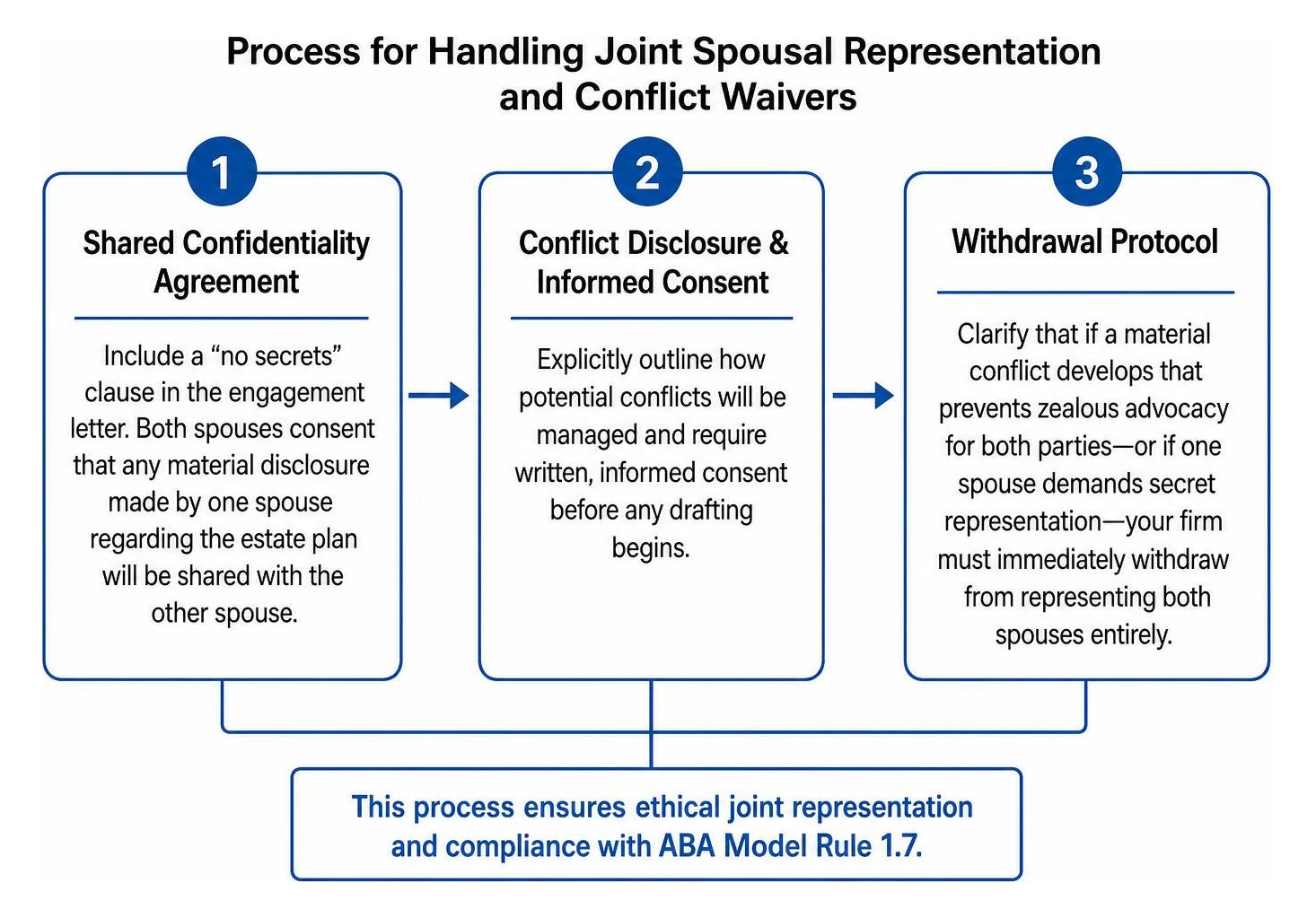
To handle joint representation ethically:
- Shared Confidentiality Agreement: Include an explicit “no secrets” clause in your engagement letter. Both parties must consent that any material disclosure made by one spouse regarding the estate plan will be shared with the other spouse.
- Conflict Disclosure & Informed Consent: Explicitly outline how potential conflicts will be managed and require written, informed consent before any drafting begins.
- Withdrawal Protocol: Clarify that if a material conflict develops that prevents zealous advocacy for both parties—or if one spouse demands secret representation—your firm must immediately withdraw from representing both spouses entirely.
This transparency protects your firm’s integrity while fostering trust between you and the couple throughout the planning process.
Transparent Flat-Fee Pricing and Scope Control
Hourly billing for foundational estate planning creates friction, breeds client anxiety, and rewards inefficiency. Modern consumers demand pricing transparency. Moving to a standardized flat-fee product shelf removes uncertainty, shortens the sales cycle, and allows your firm to capture higher margins as your operational efficiency improves.
A structured flat-fee pricing model eliminates surprises and aligns client expectations with your workflow.
Three-Tier Service Packaging and Value Alignment
Rather than treating every client with a custom, unstandardized pricing quote, implement a three-tier service packaging structure. This categorizes client needs by complexity and asset dynamics:
| Service Tier | Plan Count Target | Target Client Profile | Core Deliverables | Typical Flat-Fee Range |
|---|---|---|---|---|
| Tier 1: Essential Plan (Will-Based) | 30% of total volume | Young families, straightforward assets, guardianships needed | Simple Last Will, Healthcare Directive, Financial Power of Attorney, Guardianship Designations | $1,500 – $2,500 |
| Tier 2: Comprehensive Plan (Revocable Trust) | 50% of total volume | Homeowners, blended families, probate avoidance priorities | Revocable Living Trust, Pour-Over Will, Healthcare Directives, Durable POA, Certificate of Trust | $2,800 – $5,400 |
| Tier 3: Advanced Plan (Tax-Sensitive/Asset Protection) | 20% of total volume | High-net-worth households, business owners, taxable estates | Irrevocable Trusts, ILITs, SLATs, Business Succession Provisions, Advanced Gifting Strategies | $5,000 – $8,500+ |
Targeting a balanced distribution across these tiers—30% Tier 1, 50% Tier 2, and 20% Tier 3—enables an individual attorney to comfortably target 120 to 180 funded plans per year while maintaining a high benchmark of $850 to $1,100 of revenue per staff-hour.
Protecting Revenue with Explicit Trust Funding Add-Ons
The most common area of revenue leakage in estate planning practices centers on trust funding and asset retitling. When clients leave an office with a binder of documents assuming real estate deeds, brokerage accounts, and corporate shares will retitle themselves, plans fail and disputes arise.
Avoid this breakdown by establishing trust funding as an explicit, separate billable service:
- Self-Directed Funding Kit (Included in Base Fee): Provide instructional checklists, transfer letters, and balance sheet schedules for clients who choose to transfer bank accounts independently.
- Concierge Funding Add-On ($400 – $900+): Offer direct in-house handling of real estate deed preparation, county recording coordination (such as across Passaic County, NJ or Essex County), entity interest assignments, and formal coordination with financial institutions.
Separating drafting from execution safeguards your margins and ensures your team is properly compensated for administrative coordination.
Converting Consultations into Retained Clients
Securing high consultation volumes through digital marketing yields little value if prospective clients routinely leave meetings saying, “We will think about it.” The key to closing these cases lies in streamlining the decision process.
Mandatory Dual-Spouse Attendance and Pre-Meeting Discovery
Unilateral consultations produce extended delays. When one spouse attends alone, they inevitably act as an incomplete messenger to their partner, diluting urgency and inviting confusion.
- Mandate Joint Attendance: Require both decision-makers to attend initial intake meetings in person or via video conference. If one spouse is unavailable, reschedule the consultation.
- Pre-Consultation Discovery: Send a streamlined questionnaire 48 to 72 hours before the meeting to gather basic asset profiles and family milestones. This ensures your intake time is spent discussing values and strategies rather than collecting account numbers.
Attorneys looking to streamline this top-of-funnel intake can leverage automated systems to improve lead quality. Exploring modern lead generation for lawyers helps ensure prospects arrive educated and ready for productive consultations.
Overcoming the Extended Consideration Cycle and Decision Stalls
Industry research shows the average consumer spends 18 to 24 months contemplating estate planning before taking formal action. This delay rarely stems from a lack of interest; it arises from decision fatigue and the natural discomfort associated with discussing mortality.
To overcome client hesitation:
- Shift to Positive Motivation: Frame planning around love, asset protection, family harmony, and legacy rather than worst-case fear tactics.
- Present a Single Clear Recommendation: Avoid overwhelming prospects with five different structural choices. Recommend the exact plan tier that addresses their goals.
- Provide a One-Page Written Summary: Quote the flat fee clearly on a single page and schedule the drafting design review before they walk out the door.
- Deploy an Automated Follow-Up Cadence: If a prospect does not sign on the spot, follow up promptly: a same-day summary email, a personal check-in call within 7 days, and educational email touchpoints delivered across a 90-day sequence.
Firms seeking to capture high-intent prospects who are ready to make decisions benefit significantly from strategic search advertising. Implementing high-intent PPC management for estate planning attorneys connects your firm with prospects actively seeking solutions, dramatically reducing sales cycles.
Building a Predictable High-Value Pipeline
A growing estate planning practice cannot rely solely on sporadic word-of-mouth recommendations. A resilient practice requires diversified, repeatable acquisition channels that reliably deliver qualified prospects month after month.
To achieve sustainable growth, practices should build balanced acquisition channels across advisor networks, community education, and local search visibility. Combining localized organic visibility with targeted search optimization for trust and estate practices ensures your firm remains top-of-mind across target regions like Wayne, NJ, Paterson, NJ, and surrounding communities.
Scaling Lead Generation Through an Advisor-Led Estate Planning Engagement Strategy
Financial advisors, CPAs, and insurance professionals are among the most effective referral sources for estate planning attorneys. An advisor-led model should generate 50% to 65% of your firm’s annual revenue.
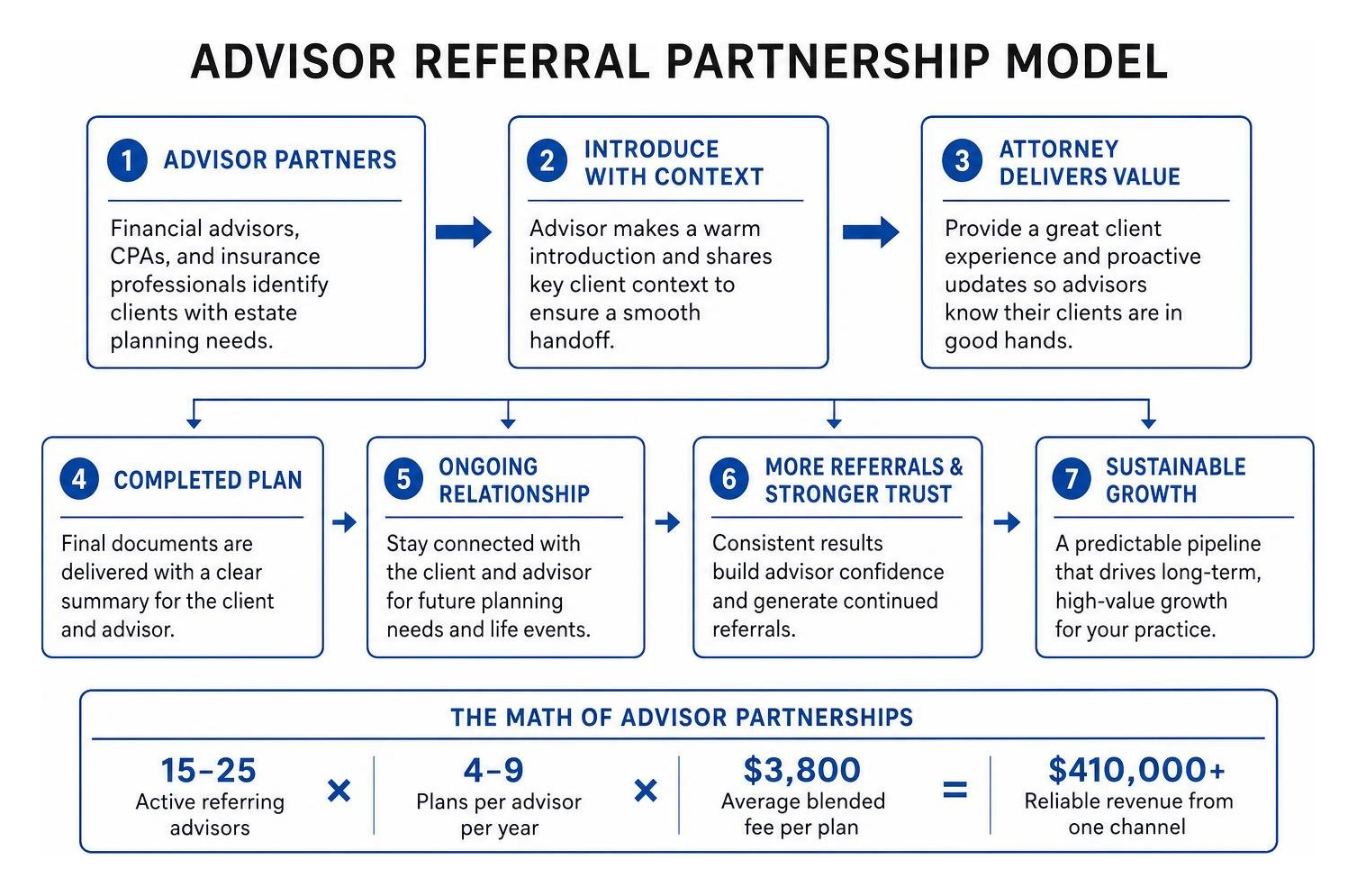
According to insights from Steve Lockshin’s Estate Planning Playbook, integrating legal structures with ongoing financial advisory workflows transforms estate planning from an isolated transaction into a holistic, ongoing relationship.
- The Math of Advisor Partnerships: A solo or two-attorney firm needs 15 to 25 active referring advisors, with each partner sending 4 to 9 plans per year. For example, maintaining active partnerships with 18 advisors who each refer 6 clients annually at an average blended fee of $3,800 generates over $410,000 in reliable revenue from a single channel.
- Operational Cadence: Maintain a weekly touchpoint rhythm. Host regular lunch meetings, share practical trigger cheat-sheets, and provide proactive file updates so advisors always know their clients are in good hands.
- Channel Concentration Rule: Ensure that no single advisor or firm accounts for more than 55% of your referral pipeline to protect your practice against sudden partner transitions.
Leveraging Life Trigger Events and Community Seminars
Major life changes serve as the primary catalyst for estate planning action. Tailor your marketing assets to speak directly to these seven critical triggers:
- Purchasing a new home or relocating across jurisdictions
- Birth or adoption of a child
- Marriage, second marriage, or entering a blended family dynamic
- Retirement milestones or business succession events
- Unexpected medical diagnoses or aging parent support
- Substantial liquidity events or inheritance receipts
- Federal and state tax exemption adjustments

Community seminars provide an exceptional, high-converting channel to reach prospects experiencing these triggers. Local educational workshops—hosted at public libraries, senior centers, or community rooms across towns like Lyndhurst, NJ and Bloomfield, NJ—typically generate booked consultations in the $140 to $220 range and close at roughly double the rate of standard broad-match digital leads.
For firms looking to complement seminar outreach with direct, high-intent client inquiries, acquiring exclusive legal leads provides a steady volume floor without unpredictable ad spend.
Driving Lifetime Retention and Recurring Revenue
An estate plan should not be treated as a one-time deliverable. Families evolve, assets grow, and statutory environments change. Establishing an ongoing retention model turns transactional matters into recurring relationships that support clients throughout their lives.
Enforcing the 90-Day Trust Funding Audit
The greatest vulnerability of a trust-based plan is the failure to transfer title of assets to the trust. An unfunded or partially funded trust exposes clients to the probate proceedings they paid to avoid, damaging firm reputation and partner relationships.
- Assign a Dedicated Coordinator: Designate a paralegal or client services specialist to monitor asset verification across every open matter.
- Conduct the 90-Day Checkpoint: Schedule an automated 90-day post-signing audit to review recorded deeds, bank account titles, and updated beneficiary designations.
- Formal Resolution: If accounts remain unfunded, send an audit letter outlining outstanding items and offering administrative support to finalize retitling.
This simple operational checkpoint resolves unfunded trusts, protects clients, and reinforces your firm’s commitment to thorough legal work.
Establishing an Annual Maintenance and Review Program
Implementing an annual membership or maintenance program creates a predictable, recurring revenue stream while keeping client portfolios up to date.
An annual review checklist provides clear value to enrolled clients:
- Review changes in family dynamics (births, marriages, divorces, or passing of beneficiaries)
- Audit updated digital assets, cryptocurrency, and login credentials
- Re-verify designated fiduciaries, executors, trustees, and healthcare agents
- Confirm beneficiary designations on retirement accounts, life insurance policies, and annuities
- Evaluate recent legislative, federal, and state estate tax exemption adjustments
- Track newly acquired real estate, investment accounts, or business interests
- Provide certified copies of updated healthcare directives to medical providers
Maintaining an ongoing dialogue keeps your firm connected with client families across generations, ensuring that when changes occur, your practice is the first call they make.
Frequently Asked Questions About Estate Planning Engagement
What essential clauses prevent scope creep in estate planning?
To eliminate scope creep, your engagement agreement must clearly delineate what is and is not included in the flat fee. Essential protective clauses include:
- Explicit Document Schedules: Detail every document produced under the agreement.
- Draft Revision Limits: Limit client draft revisions to a specific number (typically two rounds) within a defined 30- to 60-day window.
- Trust Funding Exclusions: State clearly whether real estate deeds and asset retitling are handled in-house or by the client.
- Hourly Out-of-Scope Rates: Establish default hourly rates for additional revisions or unforeseen family negotiations.
- Automatic File Closure: Confirm that the representation formally concludes upon document execution.
How do attorneys handle confidentiality during joint spousal representation?
Under ABA Model Rule 1.7 and Model Rule 1.6, attorneys must obtain informed, written consent from both spouses confirming a policy of joint confidentiality. The agreement must explain that the attorney cannot withhold relevant legal or financial information shared by one spouse from the other. If one spouse later insists on withholding critical information, a conflict arises that requires the firm to withdraw from representing both clients.
How many referring financial advisors are needed for a predictable pipeline?
A healthy, sustainable solo or small-firm practice requires 15 to 25 active referring financial advisors, with each advisor delivering an average of 4 to 9 plans annually. Maintaining this network ensures your practice achieves a consistent volume of 120 to 180 plans per attorney per year while adhering to the 55% channel concentration safety rule.
Conclusion
Building a sustainable, high-value estate planning practice requires shifting from transactional document drafting to an intentional, end-to-end client engagement framework. By implementing structured engagement agreements, transparent flat-fee packaging, disciplined advisor referral networks, and systematic annual review programs, your firm can build predictable revenue, eliminate operational bottlenecks, and provide genuine long-term value to client families.
At DIGIniche Solutions, we help forward-thinking law practices build systematic client acquisition engines. Through our proprietary V.E.R.A. Formula—delivering Visibility, Engagement, Retention, and Amplification—we help firms throughout New Jersey, from Wayne to Newark and across Passaic and Bergen Counties, dominate their local markets.
Ready to scale your practice and build a predictable client pipeline? Explore our customized, scalable digital marketing and client acquisition plans to see how we can help grow your firm today.
