

When Potential Clients Search for a Lawyer, Will They Find You?
Local SEO for lawyers is the practice of optimizing a law firm’s online presence so it appears prominently when nearby prospects search for legal help — think “divorce lawyer near me” or “criminal defense attorney in Chicago.”
Here’s a quick answer to what that actually means in practice:
What local SEO for lawyers includes:
- Google Business Profile optimization — Claiming and fully completing your GBP listing with accurate categories, services, photos, and descriptions
- Local citations and NAP consistency — Making sure your firm’s Name, Address, and Phone number match exactly across every directory
- Review management — Generating and responding to Google reviews to build trust and ranking signals
- Location-specific content — Creating pages that reference local courts, neighborhoods, and jurisdiction-specific legal procedures
- Local backlinks — Earning links from bar associations, local news outlets, and community organizations
- Schema markup — Adding structured data so Google understands your firm’s practice areas and location
The stakes are high. According to the research, 96% of people seeking legal advice use a search engine, and 75% never scroll past page one. If your firm isn’t showing up locally, a competitor is getting those cases instead.
Local searches for legal help are not casual browsing. Someone searching for an attorney is usually dealing with an urgent situation — an arrest, an accident, a divorce filing. They need help now, and they’re choosing from whoever appears first in Google Maps.
I’m Frank Demming, a legal digital marketing specialist with over a decade of experience helping law firms improve their local SEO lawyers strategies to generate consistent, qualified case leads. In this guide, I’ll walk you through exactly what works in 2026 — no fluff, no vague advice.
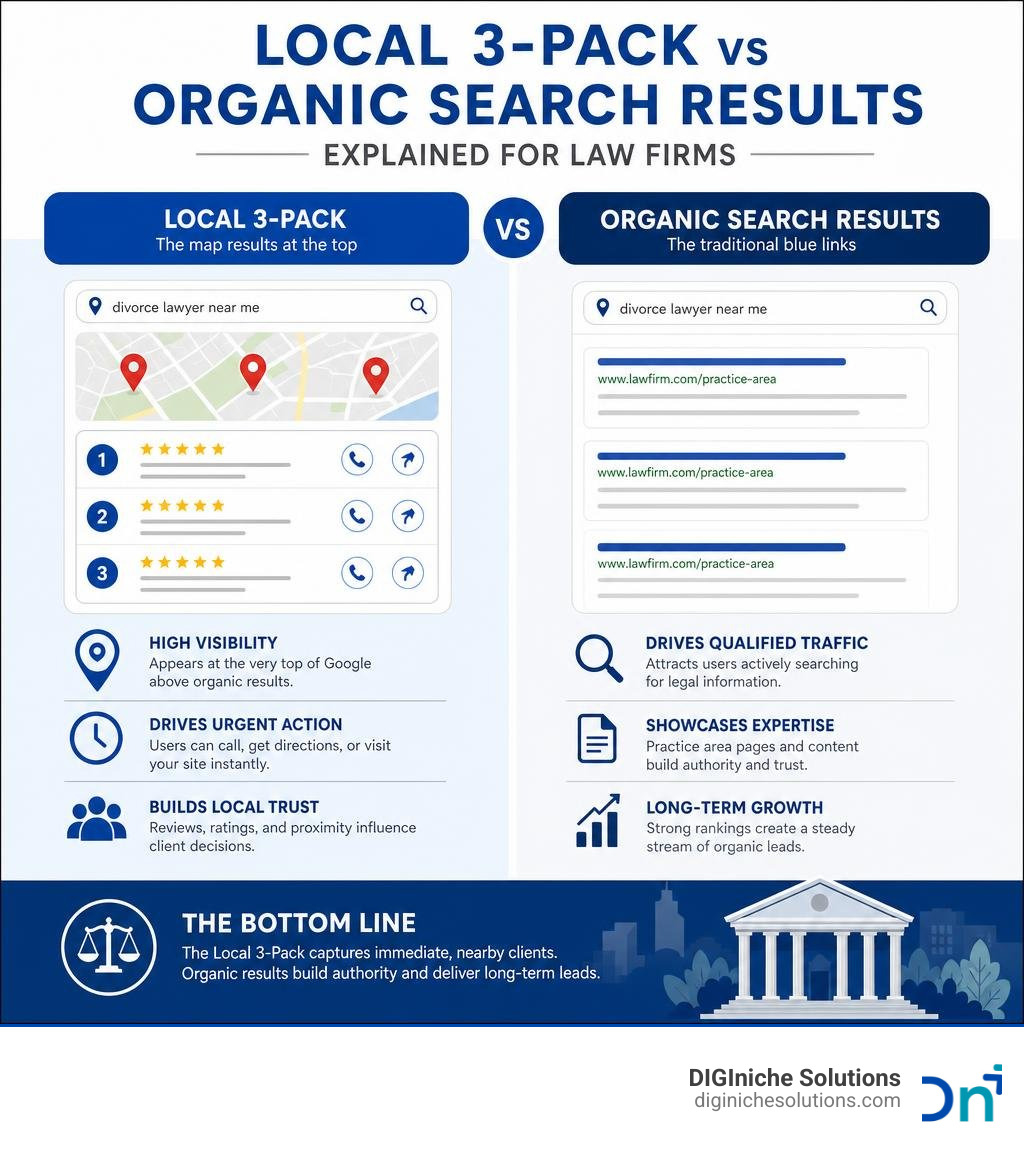
Local seo lawyers vocabulary:
Why Local SEO Lawyers Are Essential for Modern Law Firms
In the digital landscape of June 2026, relying solely on word-of-mouth referrals is a risky gamble. Traditional networking still has value, but the modern consumer journey for finding legal representation begins and ends on a smartphone screen. When an individual faces a sudden legal issue, they do not flip through directories or wait days for a recommendation; they turn to Google and type in highly localized, high-intent keywords.

This shift in behavior makes local search visibility the lifeblood of a thriving modern law practice. Whether you are a solo practitioner in New Jersey or part of a nationwide firm, local search algorithms determine whether your office phone rings or remains silent. To build a sustainable pipeline of new cases, you must understand how Google connects physical proximity with search intent.
By implementing an advanced Law Firm SEO: The Ultimate Guide approach, you position your firm directly in front of prospects at the exact moment they are ready to sign a retainer. This is particularly crucial for high-stakes practice areas where clients need immediate assistance, demonstrating clearly Why Personal Injury SEO Is Worth It as local visibility leads directly to high-value case acquisitions.
Core Ranking Factors Used by Local SEO Lawyers
Google’s local search algorithm is not a mystery. It relies on three primary pillars to determine which law firms appear in the coveted Google Local 3-Pack:
- Relevance: How closely your business listing and website content match the searcher’s query. If someone searches for an “estate planning attorney,” Google will prioritize firms that clearly specialize in wills, trusts, and probate, rather than general practitioners who rarely mention these services online.
- Distance: The physical proximity of your law office to the searcher’s location (or the location specified in their search query). While you cannot control where a searcher is standing, you can optimize your presence to maximize your visibility radius.
- Prominence: How well-known and trusted your law firm is in the digital space. This is determined by your review scores, the volume of local citations, your organic backlink profile, and your overall online activity.
Understanding how these three factors interact is the first step toward climbing the rankings. For a practical breakdown of how to make these factors work in your favor, explore our checklist of Local SEO for Lawyers: Simple Fixes to Get More Clients.
The Economic Impact of Local Search for Attorneys
From an economic perspective, local search marketing offers an unparalleled return on investment (ROI) compared to traditional pay-per-click (PPC) campaigns. Legal keywords are notoriously some of the most expensive in Google Ads, with highly competitive phrases easily exceeding $150 per click in major metro areas.
Local SEO, on the other hand, operates on a compounding model. While it requires an upfront investment of time and resources, the organic traffic and Map Pack placements you secure continue to deliver qualified leads long after your initial optimization is complete. In fact, mature local search strategies often result in a 50% to 70% lower cost-per-lead (CPL) than paid search within the first 12 months.
| Lead Acquisition Channel | Average Cost Per Lead (CPL) | Conversion Rate | Long-Term ROI Potential |
|---|---|---|---|
| Google Pay-Per-Click (PPC) | $150 – $400+ | 3% – 5% | Linear (Stops when budget stops) |
| Local SEO & Map Pack | $50 – $100 | 14.6% (SEO average) | Compounding (Grows over time) |
| Traditional Print/Billboard | High / Untrackable | Low | Minimal |
Optimizing Your Google Business Profile and Citations
Your Google Business Profile (GBP) is the absolute foundation of your local search presence. Think of it as your digital storefront. If your profile is incomplete, outdated, or inconsistent, Google will lack the confidence to recommend your firm to local searchers.
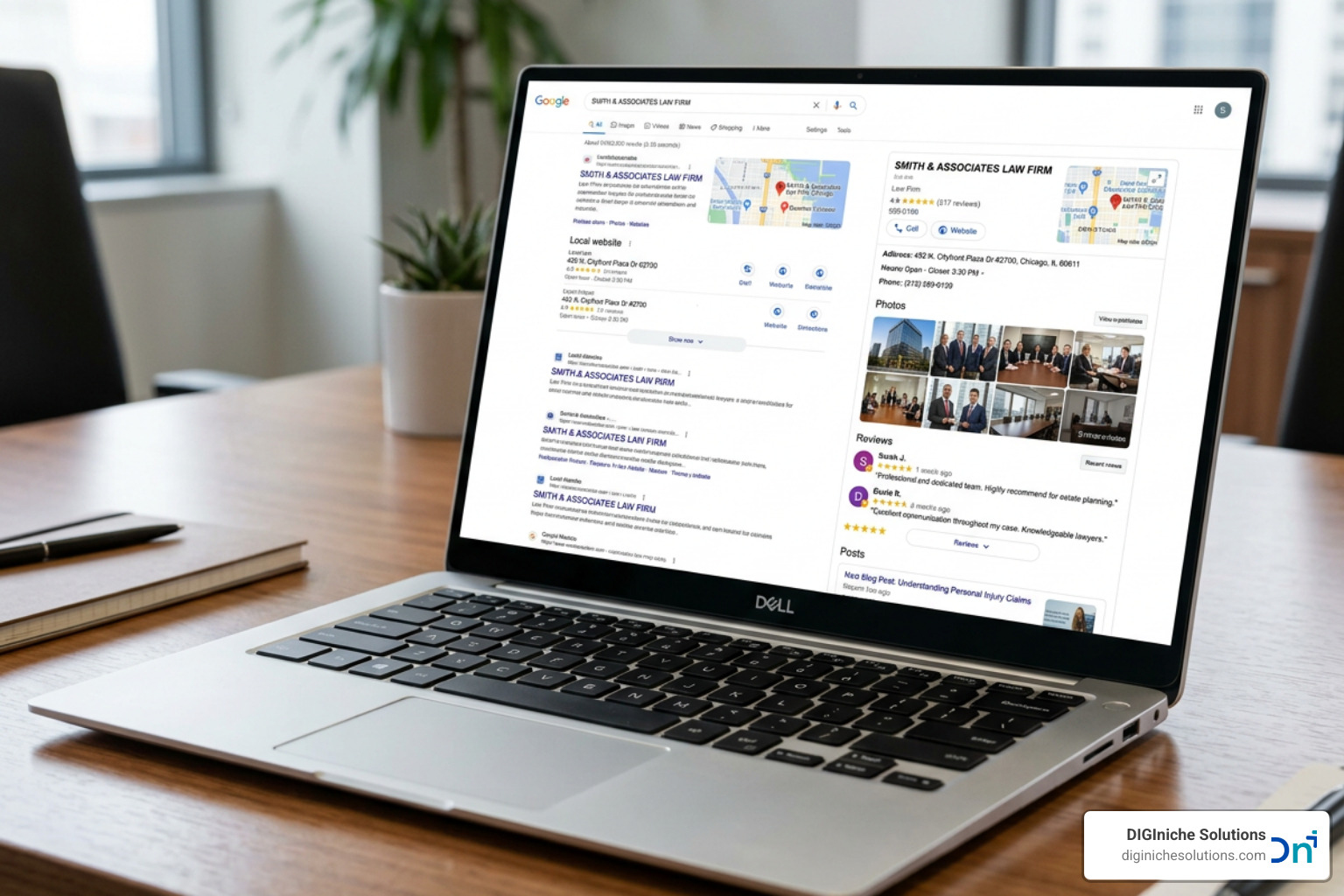
To fully optimize your profile, start by selecting the most accurate primary business category. If you are a personal injury firm, do not simply choose “Lawyer” or “Law Firm.” Select “Personal Injury Attorney” as your primary category, and use secondary categories for your other practice areas, such as “Trial Attorney” or “Legal Services.”
Next, write a compelling, keyword-rich business description (up to 750 characters) that speaks directly to your ideal client’s pain points rather than trying to trick search engine algorithms. Keep your operating hours completely accurate, upload high-resolution photos of your office exterior and team, and utilize Google Posts to share weekly updates, legal FAQs, and firm news. For a deeper dive into ranking well within specific local jurisdictions, refer to the official Google’s Guide on Local Rankings and review our dedicated insights on SEO for Lawyers New Jersey.
Managing Reviews and Building Local Prominence
Online reviews are both a powerful ranking signal and a vital conversion tool. In fact, 98% of consumers trust reviews they find online and consider them ‘personal recommendations’, and 87% of consumers read online reviews for local businesses. To win the local prominence game, your firm must build a systematic, ethical review acquisition process.
When managing your reviews, keep these statistical insights in mind:
- The star rating is the most critical review factor compared to recency, legitimacy, sentiment, and quantity.
- About 75% of users only pay attention to reviews in the most recent month, meaning a steady stream of fresh feedback is essential.
- Almost 50% of consumers would consider using a business with fewer than four stars, but in the highly competitive legal field, aiming for a 4.7+ rating is crucial to stand out.
- More than 70% of consumers have written a review for a local business, which means your clients are highly likely to share their experience if you simply make the process easy for them.
To learn how to organically generate positive reviews while staying compliant with state bar advertising regulations, check out our 5 Proven Strategies for Family Law Attorneys to Dominate Google Results.
Directory Listings and Citation Management
A citation is any online mention of your law firm’s Name, Address, and Phone number (NAP). Google cross-references these citations across the web to verify that your business is legitimate and physically located where you claim it is. Discrepancies in your NAP data—such as a different suite number or an old phone number on an outdated directory—can severely damage Google’s trust in your listing and suppress your local rankings.
To keep your data pristine, we recommend performing a comprehensive citation cleanup. Ensure your NAP information matches character-for-character across major aggregators and high-value legal directories. For actionable steps on auditing and cleaning up your citations, refer to our guide on Local SEO for Lawyers: Simple Fixes to Get More Clients. Additionally, you can find valuable step-by-step optimization strategies in external resources like FindLaw’s guide to local SEO for lawyers and DiPietro Marketing Group’s law firm local SEO overview.
High-value directories that move the needle for law firms include:
- Avvo
- Justia
- FindLaw
- Martindale-Hubbell
- Super Lawyers
Creating Location-Specific Content and Backlinks
To rank organically for localized searches, your website must demonstrate deep geographic relevance. This goes far beyond simply repeating your city’s name on your homepage. Google looks for comprehensive, localized content that proves you are active in, and knowledgeable about, your specific legal jurisdiction.
Creating high-quality location pages and localized blog posts is a highly effective way to signal this geographic authority to search engines. For firms operating in competitive regions like the Garden State, check out our specialized strategies for SEO for Lawyers New Jersey and our comprehensive playbook on Law Firm SEO: The Ultimate Guide.
Structuring Multi-Location Law Firm Websites
If your law firm has multiple physical offices or serves several distinct suburbs, your website structure must reflect this without creating duplicate content issues. Never copy-paste the exact same text across different city pages while only swapping out the city names. Google’s algorithms are highly adept at identifying this tactic, and it will result in your pages being filtered out of search results.
Instead, build genuinely unique location pages for each office. Every page should feature:
- Custom-written content detailing the specific legal services offered at that office.
- An embedded Google Map pointing directly to that specific Google Business Profile.
- Clear, localized directions, parking information, and photos of the local office.
- Localized Schema markup (such as
PostalAddressandGeoCoordinates). - References to local courts, county offices, and community landmarks.
Ethical Link Building and Local PR
Backlinks from authoritative, locally relevant websites are incredibly powerful signals of digital prominence. However, legal marketing requires strict adherence to ethical guidelines. Avoid low-quality link schemes or spammy guest posting networks, and focus instead on building authentic, local relationships.
Excellent sources of high-quality local backlinks include:
- Local and State Bar Associations: Links from organizations like the New Jersey State Bar Association carry immense topical authority.
- Local Charities and Sponsorships: Sponsoring a local youth sports league, a community 5K run, or a food drive often earns you a high-quality link on the organization’s sponsor page.
- Legal Publications and Blogs: Contributing expert commentary to local news outlets or writing guest articles for respected legal journals.
- University and Law School Scholarships: Creating a annual scholarship for local students can earn highly valued
.edubacklinks.
For additional insight into local search engine optimization strategies, you may also find the resources provided by the Premier Legal Marketing local SEO page and Accel Marketing Solutions’ New Jersey law firm marketing guide helpful for understanding regional campaign dynamics.
Measuring Success and Navigating AI Search in 2026
As we move through June 2026, the search landscape is undergoing a massive evolution. Generative search experiences, such as Google’s AI Overviews and conversational engines like ChatGPT, are changing how users find information. Rather than simply presenting a list of links, these AI systems synthesize data from across the web to recommend specific law firms directly to users.
To ensure your firm is recommended by AI search engines, you must focus on entity verification. AI models rely heavily on structured data, consistent citations across legal directories, and positive sentiment in client reviews to determine which attorneys are trustworthy. If your digital footprint is fragmented, AI search engines will simply overlook your firm.
To make sure your marketing agency is accurately tracking these shifts and delivering real results, read our eye-opening report: Tracking Your Law Firm’s SEO: What Your Agency Isn’t Telling You.
How to Choose the Best Local SEO Lawyers for Your Practice
Selecting the right digital marketing partner can make or break your law firm’s growth. Many agencies rely on vanity metrics—such as keyword rankings that don’t drive phone calls or arbitrary traffic spikes—to justify their monthly retainers.
At DIGIniche Solutions, we do things differently. Our proprietary V.E.R.A. Formula focuses on delivering:
- Visibility: Securing dominant placements in both the Map Pack and organic local search.
- Engagement: Creating high-value, localized content that resonates with prospects.
- Retention: Designing seamless user experiences that keep visitors on your site.
- Amplification: Leveraging digital PR and ethical review acquisition to boost your online authority.
By focusing on these four pillars, we build a scalable client-growth ecosystem that converts search engine impressions into signed cases. To learn what to look for when hiring a legal marketing partner, consult The Law Firm Guide to SEO: What to Look for in a Legal Marketing Agency.
Key Metrics for Tracking Local SEO Performance
To measure the true ROI of your local marketing efforts, you must look beyond basic keyword tracking. Focus on actionable data points that correlate directly with firm revenue:
- Google Business Profile Actions: Track the number of direct phone calls, website clicks, and driving direction requests generated through your GBP.
- Call Attribution: Use unique call-tracking phone numbers on your website and local listings to accurately attribute incoming leads to specific local search channels.
- Local 3-Pack Share of Voice: Monitor how frequently your firm appears in the top three map results for your primary practice area keywords across your target geographic radius.
- Organic Conversion Rate: Measure the percentage of website visitors from organic search who complete a consultation request form or initiate a live chat.
For a detailed roadmap on setting up your tracking systems, read our comprehensive guide on Monitoring SEO Performance: Guide for Law Firms.
Frequently Asked Questions About Local Legal SEO
How long does it take to see results in the Google Map Pack?
While minor technical fixes and citation cleanups can produce positive movement within 30 to 60 days, achieving a stable, dominant position in the Google Map Pack for highly competitive terms typically takes 6 to 12 months of consistent optimization, content creation, and review acquisition.
Can a law firm rank in a city without a physical office?
You cannot rank in the Google Map Pack/3-Pack for a city where you do not have a verified, physical office address. However, you can rank in the localized organic search results beneath the Map Pack by building dedicated, high-quality city landing pages optimized for those specific service areas.
What are the ethical rules for lawyers requesting online reviews?
According to ABA Model Rules and state bar associations, lawyers may ethically request reviews from clients, but they must never offer incentives (such as discounts, gift cards, or free consultations) in exchange for a review. Additionally, when responding to reviews, attorneys must ensure they do not disclose any confidential client information.
Conclusion
In the competitive legal landscape of June 2026, local search engine optimization is no longer optional—it is a fundamental requirement for sustainable firm growth. By fully optimizing your Google Business Profile, maintaining pristine NAP consistency, generating authentic client reviews, and creating localized content, you can outshine larger competitors and claim your place at the top of local search results.
At DIGIniche Solutions, we specialize in helping law firms across New Jersey and nationwide leverage our proprietary V.E.R.A. Formula to build scalable, highly profitable client-growth ecosystems. Let us handle the complexities of local search algorithms so you can focus on what you do best: representing your clients.
Ready to dominate your local market? Partner with DIGIniche Solutions for Law Firm SEO and claim your free local visibility audit today.
