

Why Local Attorney SEO Is the Difference Between a Full Caseload and an Empty Waiting Room
Local attorney SEO is the process of optimizing your law firm’s online presence so it shows up when nearby potential clients search for legal help — think “divorce lawyer near me” or “personal injury attorney in Tampa.”
Here’s what that looks like in practice:
| Step | What It Involves |
|---|---|
| 1. Google Business Profile | Claim, verify, and fully optimize your listing |
| 2. Local Keywords | Target practice area + city phrases with high intent |
| 3. NAP Consistency | Match your name, address, and phone across every directory |
| 4. Reviews | Generate and respond to genuine client reviews |
| 5. Local Citations | List your firm on Avvo, Justia, FindLaw, and similar sites |
| 6. Location Pages | Create dedicated pages for each city or practice area you serve |
The numbers make the stakes clear. 96% of people seeking legal advice turn to a search engine first. And 75% of those users never scroll past the first page of results. If your firm isn’t ranking locally, those potential clients are calling your competitors — not you.
The challenge? The legal market is competitive. Dozens of firms are chasing the same high-intent searches in every city. And on top of the usual SEO hurdles, attorneys face an extra layer of complexity: professional ethics rules that govern how you can market your services online.
Getting local SEO right means balancing technical optimization, content strategy, and ethical compliance — all at the same time.
I’m Frank Demming, and for more than a decade I’ve specialized in local attorney SEO and digital lead generation exclusively for law firms — helping attorneys dominate their local markets without cutting ethical corners. In the sections below, I’ll walk you through exactly how to do the same.
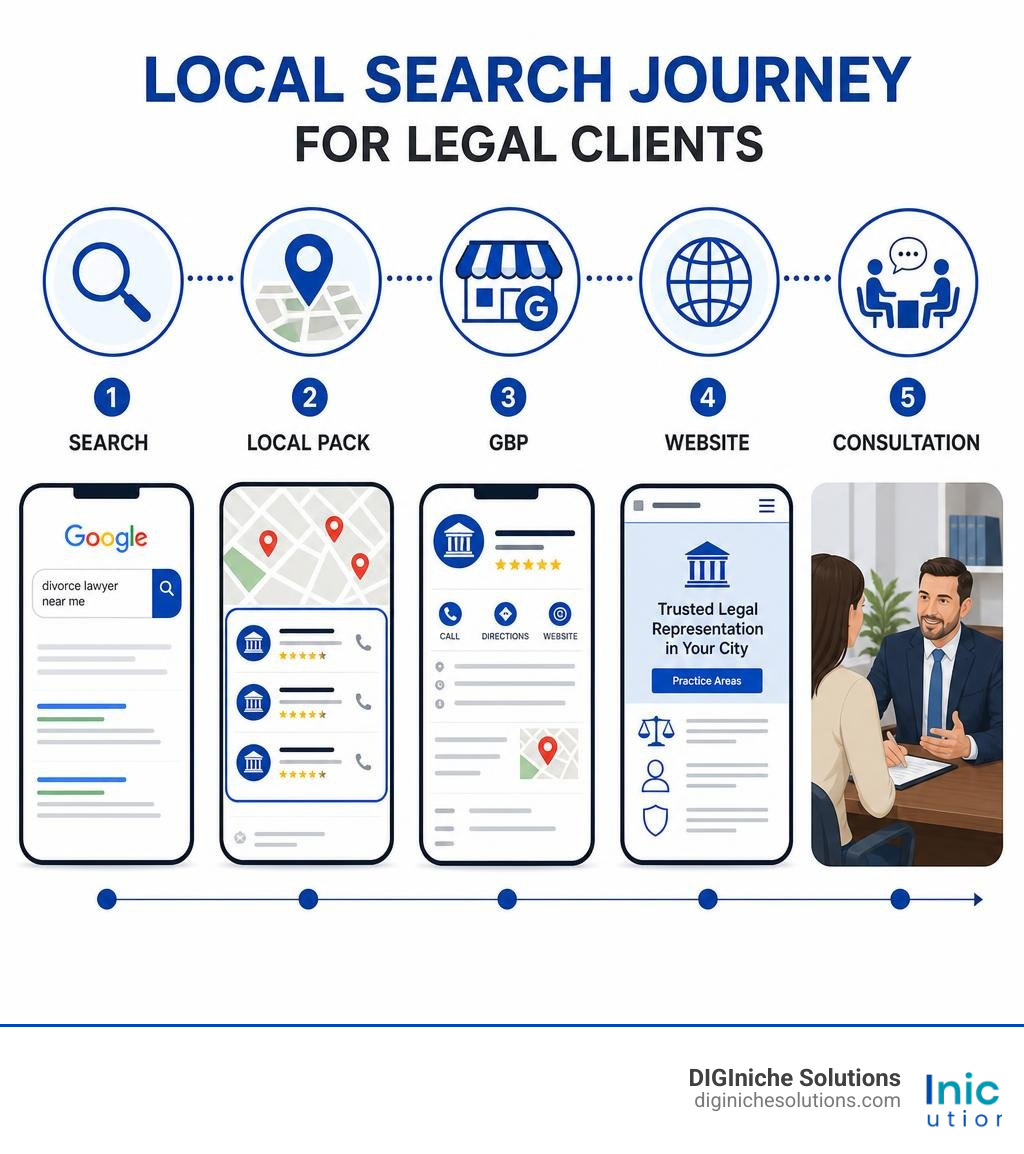
What is Local Attorney SEO and Why Does It Matter?
When we talk about search engine optimization, it is easy to lump everything into one big digital bucket. However, traditional SEO and local SEO are two entirely different beasts—especially in the legal sector.
Traditional SEO focuses on ranking a website for broad, informational queries on a national or global scale. If you write an exhaustive blog post explaining “how are lawsuit settlements taxed,” you are targeting traditional organic search.
Local attorney SEO, on the other hand, is hyper-targeted. It is designed to capture high-intent users in a specific geographic area who are ready to hire an attorney right now. When someone searches “criminal defense attorney near me” or “car accident lawyer in Newark,” they aren’t looking for a casual weekend read. They are looking for immediate representation.
| Feature | Traditional SEO | Local SEO for Lawyers |
|---|---|---|
| Primary Goal | National/global informational authority | Driving local phone calls, office visits, and consultations |
| Key Search Intent | Informational (“How does a deposition work?”) | Commercial & Transactional (“best DUI lawyer in New Jersey”) |
| Primary Real Estate | Standard organic search results (blue links) | Google Local 3-Pack, Google Maps, Local Services Ads |
| Core Ranking Signals | Backlink profile, site speed, content depth | Proximity, Google Business Profile optimization, reviews |
| Conversion Focus | Newsletter sign-ups, ebook downloads | Direct phone calls, contact form submissions, live chat |
This local intent is incredibly powerful. Because legal issues are inherently bound by state jurisdictions and physical proximity, clients prefer to hire someone they can meet in person. Whether you are operating in highly competitive markets nationwide—such as Tampa, Virginia, or right here in New Jersey—appearing at the very top of Google Maps is the fastest way to secure high-intent leads.
If you are a personal injury attorney, for instance, you already know that pay-per-click (PPC) advertising is a brutal, expensive battlefield. With some legal keywords costing upwards of $150 to $400 per click, relying solely on paid ads can drain your budget in a heartbeat. This is Why Personal Injury SEO Is Worth It; a mature local organic strategy can deliver highly qualified leads at a fraction of the cost, compounding in value over time.
To achieve this, many firms partner with a specialized law firm SEO agency to build a sustainable pipeline of new cases. By optimizing for local search, you ensure that your firm is the welcoming face that greets potential clients the moment they experience a legal crisis.
Why is Local Attorney SEO Crucial for Multi-Location Firms?
For multi-location practices, managing local search presence requires a careful, strategic approach. You cannot simply list five different addresses on a single contact page and expect Google to rank you in all five cities. Each physical office needs its own localized footprint, separate Google Business Profile (GBP), and dedicated geographic landing pages.
Geographic expansion is one of the most effective ways to scale a law firm, but it requires structural precision. When expanding your reach, you must signal to search engines that you have a genuine, verified physical presence in each target market.
Furthermore, smart firms look beyond English-only search terms to find untapped opportunities. For example, implementing a Spanish-language SEO expansion can dramatically boost your firm’s reach. In many highly populated regions, Spanish-speaking individuals actively search for legal representation in their primary language.
By building culturally relevant, accurately translated practice pages and local listings, firms have seen local search campaign ROIs climb significantly—in some cases, moving from a healthy 282.61% to an incredible 326.84% ROI. This is Why Geo Will Change the Way You Think About SEO for Small Law Firms; local targeting is no longer just about zip codes, but about deeply understanding and serving the diverse demographics within those zip codes.
The Core Ranking Factors and Optimization Strategies for Law Firms
To win the local SEO game, we have to understand exactly how Google decides who gets those coveted top three spots in the Google Maps Local Pack.
Google’s local algorithm relies on three core pillars:
- Relevance: How well your business profile and website content match the searcher’s query. If someone searches “estate planning attorney,” Google wants to make sure it doesn’t show a personal injury lawyer.
- Distance: How far your physical office is from the searcher (or from the city center specified in their search).
- Prominence: How well-known and trusted your business is. Google measures this through your review profile, local citations, backlink authority, and overall web presence.
To build prominence, you need a robust local search engine optimization campaign that coordinates off-site signals with on-site authority. For a deep dive into how these factors interact, check out Law Firm SEO: The Ultimate Guide.
Google Maps Keyword Strategy for Local Attorney SEO
Ranking in Google Maps requires a distinct approach compared to traditional search. In local search, we target “map qualifying keywords.” These are search terms that trigger a local map pack because Google recognizes the user’s local and commercial intent.
To optimize your Google Maps presence, you must weave local modifiers into your keyword strategy. This includes phrases like:
- “best [practice area] attorney in [city]”
- “[practice area] lawyer near me”
- “free consultation [practice area] lawyer [city]”
Understanding user intent is half the battle. If a user searches “how to file for divorce in NJ,” they have informational intent. But if they search “divorce attorney Cherry Hill,” they have commercial intent.
Your map strategy must align with these commercial queries. For family law practices, for example, implementing these exact keyword structures is covered in our guide on 5 Proven Strategies for Family Law Attorneys to Dominate Google Results.
Structuring Your Website and Google Business Profile
Your Google Business Profile (GBP) is the absolute cornerstone of your local search presence. Think of it as your digital storefront.

To turn your GBP into a conversion engine, you must optimize every single element:
- Business Name: Use your official, registered law firm name. Do not stuff it with keywords (e.g., “Smith Law Firm – BEST CHEAP ACCIDENT LAWYERS”), as this is a fast track to profile suspension.
- Primary Category: Choose the absolute most accurate primary category (e.g., “Personal Injury Attorney,” “Divorce Lawyer,” or “Criminal Defense Attorney”). This dictates your relevance for local queries.
- Practice Areas & Services: List every legal service you offer under your category, matching the exact terminology your clients use.
- Photos: Upload high-quality, professional photos of your office, your team, and your building’s exterior. This builds immediate trust and helps clients find your physical office.
Beyond your GBP, your website’s structural health is vital. You must maintain strict NAP (Name, Address, Phone) consistency across your entire digital footprint. Your address on your website’s footer must match your GBP and directory listings down to the exact suite number.
Additionally, you should implement attorney schema markup (structured data) on your website. This is code that helps search engine crawlers easily identify your firm’s name, physical address, phone number, operating hours, and specific legal services.
For multi-location firms, build dedicated local landing pages for each office, embedding a custom Google Map and localized content on each page. For step-by-step guidance, explore these 7 Tips for Improving a Law Firm Website’s SEO and discover how specialized Law Firm SEO Services: Boost Your Legal Website’s Rankings can transform your site’s architecture.
On-Page Optimization and Citation Management
Your on-page SEO must reflect your physical location. Every local landing page should feature at least 200 to 300 words of highly localized content. This isn’t just about repeating the city name; it’s about mentioning local landmarks, court systems, neighborhoods, and community involvement.
In addition to your own website, Google looks at external directories to verify your firm’s legitimacy and prominence. This is where local citations come in. You must claim and optimize your listings on prominent legal directories, including:
- Avvo
- Justia
- FindLaw
Maintaining consistent NAP details across these directories signals to Google that your business is real and active. If you are practicing in New Jersey, working with a local specialist who understands the regional landscape is key.
To learn more about local directory dominance, check out our insights on Attorney SEO NJ: Law Firm SEO Expert and our localized playbook for SEO for Lawyers New Jersey.
For firms operating in the tri-state area, aligning your New Jersey local efforts with neighboring regional markets can provide a major competitive advantage in highly saturated markets.
Ethical Considerations and ABA Compliance in Local Search
As attorneys, your marketing is bound by strict ethical rules. While a local plumber can make wild, unverified claims on their website, a law firm must operate with complete integrity.
Under ABA Model Rule 7.1, an attorney shall not make false or misleading communications about themselves or their services. State bar rules may vary, so every local attorney seo strategy should be reviewed through the lens of the jurisdictions where the firm practices. This has massive implications for your local search strategy:
- No Claims of Specialization (Unless Certified): Avoid calling yourself the “best” or a “specialist” in your website content, meta descriptions, or GBP descriptions unless you hold an officially recognized state bar certification. Instead, focus on process-based credibility and objective facts.
- Review Solicitation Ethics: Never, under any circumstances, offer incentives (like gift cards, discounts, or free consultations) in exchange for client reviews. Reviews must be entirely organic and unsolicited, or requested neutrally without compensation.
- No Fake Reviews: Buying reviews or having employees post fake testimonials is not only highly unethical and a violation of bar rules, but it also triggers swift Google Business Profile suspensions.
- Keyword Stuffing & Spam: Stuffing your GBP name with keywords or creating fake listings in cities where you do not have a physical office to manipulate the Map Pack is a direct violation of Google’s guidelines. It frequently leads to permanent listing suspensions, destroying your local search presence overnight.
Ethical marketing isn’t just about avoiding penalties; it is about building sustainable, long-term trust with your future clients. For a clean, compliant approach to optimizing your site, refer back to our 7 Tips for Improving a Law Firm Website’s SEO to ensure you stay firmly on the right side of the ethical line.
Frequently Asked Questions about Local Search for Law Firms
How long does it typically take to see results from local SEO for lawyers?
The timeline for seeing measurable results from local SEO depends heavily on the competitiveness of your practice area and your geographic market. In moderately competitive areas, you can expect to see positive movement in your local rankings and organic traffic within 3 to 6 months.
However, in highly saturated markets (such as personal injury law in major metropolitan areas), achieving top Map Pack visibility requires a sustained, strategic campaign over 6 to 12 months. The beauty of local SEO is that it compounds over time. Unlike PPC ads, which stop generating leads the second you turn off your budget, a mature local SEO presence continues to deliver high-intent leads and a compounding ROI for years to come.
How can law firms measure and track the ROI of their local SEO efforts?
You cannot manage what you do not measure. To track the exact return on investment of your local SEO efforts, you should utilize a suite of free and premium tracking tools:
- Google Analytics (GA4): Track organic website traffic, user engagement, and conversion events (such as contact form completions and live chat starts).
- Google Search Console: Monitor your keyword impressions, organic click-through rates, and overall site health.
- Call Tracking Software: Use dynamic number insertion (DNI) to track exactly how many phone calls originate from your Google Business Profile versus your organic website pages.
By attributing every lead to its specific digital source, you can clearly calculate your cost-per-lead and overall campaign ROI. For a comprehensive roadmap on setting up your tracking systems, read our dedicated guide on Monitoring SEO Performance: A Guide for Law Firms.
What are the biggest mistakes law firms make with local SEO?
Through our years of helping law firms grow, we have seen several recurring mistakes that sink local search campaigns:
- Inconsistent NAP Data: Having different phone numbers, old addresses, or misspelled firm names scattered across various online directories confuses search engines and drops your rankings.
- Keyword Stuffing: Attempting to force-feed keywords into your GBP title or your website’s footer looks unprofessional, violates Google’s terms of service, and leads to suspensions.
- Fake or Incentivized Reviews: Violating state bar rules and Google guidelines by fabricating reviews or offering rewards for positive feedback.
- GBP Suspension Risks: Making frequent, drastic changes to your GBP address or category, which can trigger automatic Google suspensions and wipe your firm off the map.
Conclusion
Winning local clients in 2026 does not require aggressive, borderline-unethical marketing tactics. By focusing on a clean, compliant, and highly structured local attorney seo strategy, you can build a highly visible online presence that naturally attracts and retains quality cases.
At DIGIniche Solutions, we help law firms nationwide and across New Jersey build sustainable digital growth. Our proprietary V.E.R.A. Formula is designed to deliver:
- Visibility: Dominating the Google Map Pack and organic search results.
- Engagement: Connecting with potential clients through authoritative, empathetic content.
- Retention: Creating seamless user journeys that convert visitors into consultations.
- Amplification: Leveraging local PR, reviews, and authority signals to scale your firm’s reach.
If you are ready to stop guessing and start growing your firm ethically, explore our actionable guide on Local SEO for Lawyers: Simple Fixes to Get More Clients or reach out to us today to build your custom local growth strategy.
