

Why Most Law Firms Waste Their Marketing Budget Online
Digital marketing for law firms is one of the highest-stakes investments you can make as an attorney — and one of the easiest to get completely wrong.
Here’s a quick answer if you need it fast:
The most effective digital marketing strategies for law firms are:
- Local SEO — rank in Google’s map pack for “[practice area] near me” searches
- Google Ads & Local Services Ads — generate immediate, high-intent leads
- Practice area pages — SEO-optimized pages targeting specific legal keywords
- Content marketing — build trust and authority through helpful legal content
- Google Business Profile optimization — capture 42% of clicks on local legal queries
- Email marketing — nurture leads and stay top of mind with past clients
- Social media marketing — build credibility on LinkedIn and Facebook
- Reputation management — generate reviews systematically to win trust before the first call
The problem isn’t that these strategies don’t work. They do — when executed correctly.
The real problem is that over 80% of potential clients research law firms online before ever picking up the phone. If your firm isn’t showing up, isn’t converting visitors, or isn’t following up fast enough, you’re handing those cases to a competitor.
And the waste adds up fast. Many law firms pour thousands of dollars into ads, websites, and agencies — and see little to show for it. Not because digital marketing doesn’t work for attorneys. But because most legal marketing is set up to look busy rather than generate cases.
This guide cuts through that. You’ll learn exactly where most law firm marketing budgets break down, which channels actually drive qualified leads, and how to build a system that turns online visibility into signed clients.
I’m Frank Demming, and for more than a decade I’ve specialized exclusively in digital marketing for law firms — helping attorneys generate consistent, high-quality leads through SEO, PPC, and conversion-focused strategy. I’ve seen what separates the firms that grow from the ones that keep wasting budget, and everything in this guide is built on that experience.
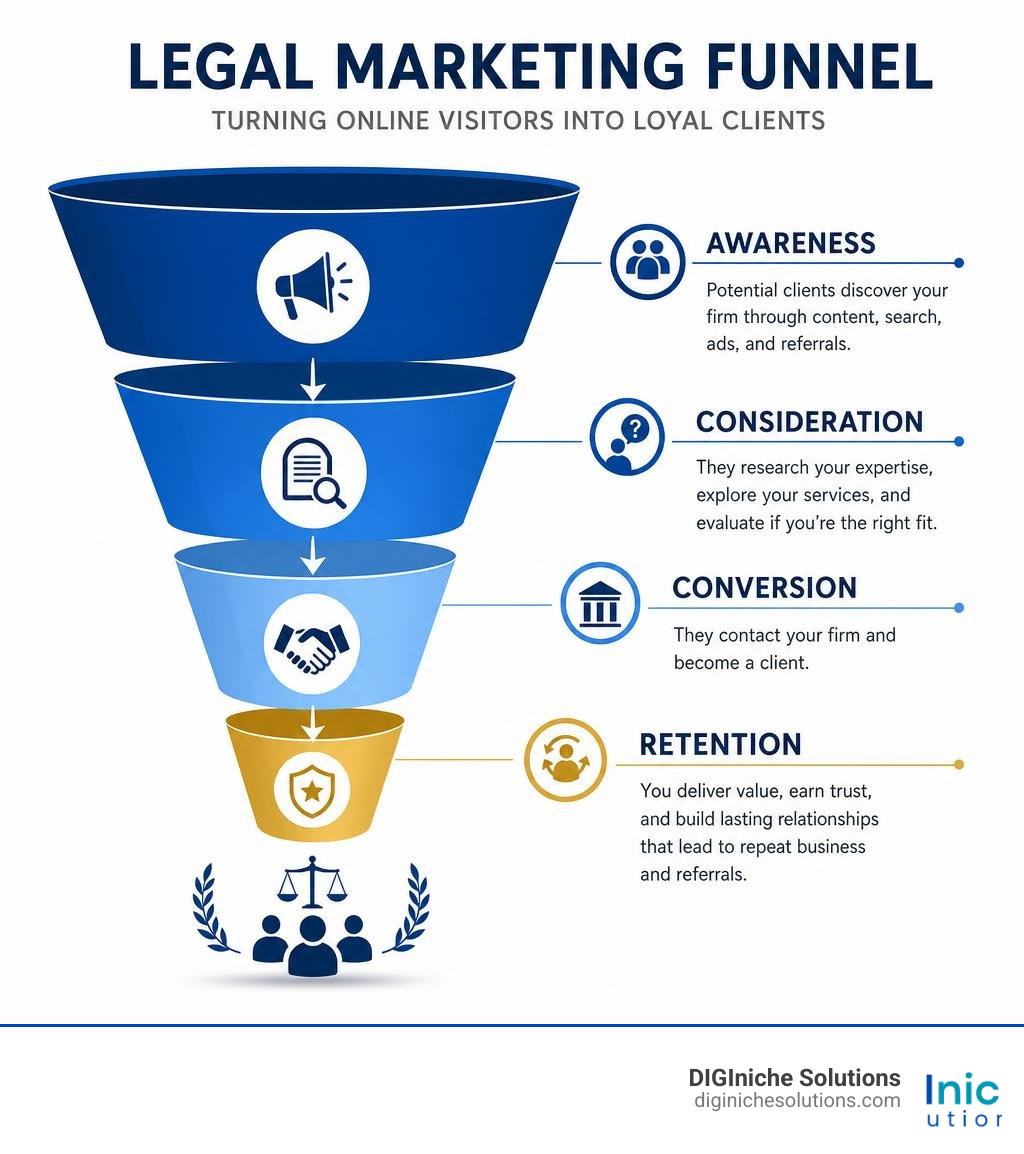
Why Most Legal Marketing Budgets Fail in 2026
It is an alarming industry reality: according to the American Bar Association, roughly 43% of law firms do not even have a structured annual marketing budget. Of those that do, 65% allocate the majority of their marketing expenditures to online platforms. Yet, a massive portion of these digital dollars is completely wasted.
Why? Because many firms treat online marketing like a billboard. They pay for traffic, watch people land on their site, and wonder why the phone isn’t ringing.
The truth is, traffic is only one part of the equation. If you want to see a real return on your investment, you have to look at the leaks in your conversion funnel. Many agencies will boast about “impressions” or “clicks”—these are classic vanity metrics. Clicks don’t pay the bills; signed cases do. To prevent your hard-earned cash from vanishing into the digital ether, you need a strategy that prioritizes the metrics that actually impact your bottom line.
If you are looking to audit your current spending, we have put together a guide with practical Tips to Maximize Law Firm Marketing Budget to help you reallocate resources to high-performing channels.
The Cost of Slow Response Times
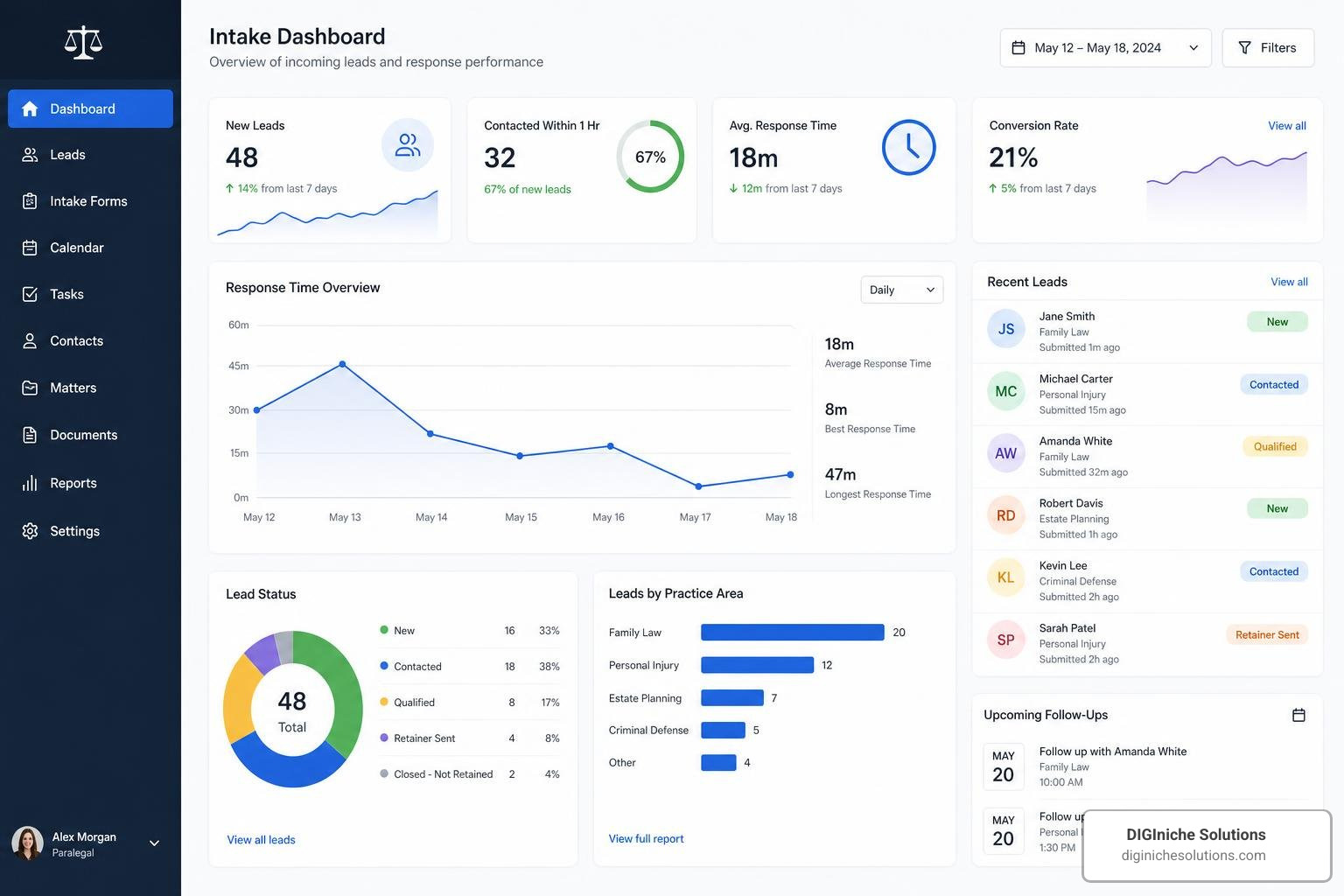
Let’s talk about a silent killer of legal marketing ROI: response time.
In 2026, the modern legal consumer has zero patience. Research shows that 66% of people expect a response from an attorney within a single day, and many will hire the first qualified lawyer who gets back to them. If a prospect fills out a contact form on your website and you wait two hours to call them back, they have already contacted three other firms.
In fact, leads contacted within the first five minutes are 80% more likely to convert than those reached after an hour. Speed-to-lead is not just a customer service metric; it is a direct driver of your cost-per-signed-case. If you are spending $150 to $300 to generate a high-intent lead through Google Ads, but your intake team takes half a day to follow up, you are essentially throwing money away.
To fix this, forward-thinking firms are implementing intake automation, CRM integrations, and AI-driven chatbots to capture and pre-qualify leads the second they reach out, even if it’s 2:00 AM on a Sunday.
Directing Traffic to the Homepage Instead of Landing Pages
Another massive source of budget waste is directing paid traffic directly to your website’s homepage.
Your homepage is like a digital brochure. It has navigation menus, attorney bios, links to your community involvement, and a list of twelve different practice areas. For a user who just got into a car accident or is looking for immediate help with a divorce, this is overwhelming. They don’t want to go on a treasure hunt to find out if you can solve their specific problem.
Instead, paid traffic from Google Ads or Facebook Ads should always be directed to highly targeted, psychology-driven landing pages. A landing page has one job: to convert that specific visitor into a consultation.
| Feature | Homepage | High-Converting Landing Page |
|---|---|---|
| Primary Goal | Inform and introduce the entire firm | Convert a specific visitor into a lead |
| Navigation | Full menu (About, Practice Areas, Blog, Contact) | Minimal or no navigation (keeps user focused) |
| Content Focus | Broad overview of all services and firm history | Hyper-focused on one specific legal problem |
| Call to Action (CTA) | Multiple (Read bio, view blog, call us, email us) | Single, prominent CTA (e.g., “Get a Free Case Review”) |
| Conversion Rate | Typically 1% to 3% | Often 10% to 25%+ when optimized |
By directing a New Jersey resident searching for “family law attorney near me” to a dedicated page explaining your divorce services—complete with client testimonials, clear FAQs, and a simple booking widget—you drastically lower your cost-per-lead.
The Core Pillars of Digital Marketing for Law Firms
To build a sustainable client acquisition machine, you cannot rely on a single marketing channel. If you only run paid ads, your lead flow stops the moment you turn off the budget. If you only focus on long-term SEO, you might wait months to sign your next client.
A truly successful program relies on a multi-channel ecosystem. At DIGIniche Solutions, we address this through our proprietary V.E.R.A. Formula, which stands for Visibility, Engagement, Retention, and Amplification. By combining these four elements, we help law firms nationwide build scalable client-growth engines that compound in value over time.
To understand how these pieces fit together to capture your ideal target audience, check out our guide on how to Target and Connect Through Law Firm Internet Marketing.
Content Marketing: Building Trust Through Digital Marketing for Law Firms
Content marketing is the ultimate trust-builder. Unlike paid ads that scream “hire me,” content marketing quietly proves why you are the authority in your field. This is particularly crucial because Google classifies legal content as YMYL (Your Money or Your Life). Because your advice can fundamentally impact a reader’s financial or physical well-being, search engines hold legal websites to exceptionally high standards of E-E-A-T (Experience, Expertise, Authoritativeness, and Trustworthiness).
To succeed, your content must be written or thoroughly reviewed by experienced legal professionals, avoiding generic AI-generated fluff. When you publish high-quality, plain-language resources that answer high-intent questions—such as “What is the statute of limitations for a personal injury claim in New Jersey?”—you build immediate credibility.
For actionable ideas on how to craft content that converts, read our Digital Marketing for Lawyers: Content Marketing Tips. Additionally, to understand why cookie-cutter articles won’t help you stand out from local competitors, explore Why Your Law Firm Needs Custom Content Marketing.
Social Media: Engaging Audiences with Digital Marketing for Law Firms
Many attorneys scoff at social media, believing it is only for lifestyle influencers or retail brands. But social media is a powerful touchpoint for building brand equity and professional referrals.
For business-to-business practices, such as corporate law or intellectual property, LinkedIn is an absolute goldmine. It allows you to connect with business owners, in-house counsel, and other attorneys who can become consistent sources of referral cases. For consumer-facing practices like family law, estate planning, or criminal defense, platforms like Facebook and Instagram allow you to humanize your firm and share educational content that demystifies the legal process.
However, you must always navigate these platforms with strict adherence to state bar ethics rules. For example, in New Jersey, you must include appropriate disclaimers stating that your posts are for informational purposes only and do not constitute formal legal advice or create an attorney-client relationship. If you are considering paid social campaigns, we break down the nuances in our guide on Facebook Ads for Lawyers Explained.
Local SEO: Dominating Your Local Map Pack
If you want to acquire local clients without paying hundreds of dollars per click, you must dominate local search. When someone in your city searches for a “criminal defense lawyer” or “estate planning attorney,” Google displays the Map Pack (or Local 3-Pack) at the very top of the organic search results.

Because the local map pack captures roughly 42% of all clicks for local-intent queries, ranking here is non-negotiable. To improve your local search footprint quickly, start with our checklist of Local SEO for Lawyers: Simple Fixes to Get More Clients.
Optimizing Your Google Business Profile
Your Google Business Profile (GBP) is the absolute foundation of your local SEO strategy. To ensure your profile is fully optimized, you should:
- Claim and Verify Your Profile: Ensure your primary category is highly accurate (e.g., “Personal Injury Attorney” rather than just “Attorney”).
- Maintain NAP Consistency: Your Name, Address, and Phone number must be identical across your website, Google Business Profile, and all online directories. Even minor variations (like “Suite 100” vs. “#100”) can confuse search engine algorithms.
- Systematically Gather Reviews: Reviews are not just social proof; they are a direct ranking signal. Implement a system to text or email a direct review link to clients immediately after positive milestones.
- Engage Active Users: Upload high-quality office photos, post weekly updates, and answer FAQs directly on your profile.
For a deeper dive into how local SEO integrates with your broader organic search campaign, read our comprehensive Law Firm SEO: The Ultimate Guide.
Building High-Authority Legal Backlinks
In the eyes of search engines, links from other websites act as votes of confidence. However, in the legal space, quality matters infinitely more than quantity. A single link from an authoritative site like the New Jersey State Bar Association or a respected local news outlet carries more weight than a hundred low-quality directory links.
To build lasting authority, focus on:
- Legal Directories: Maintain complete, optimized profiles on authoritative legal directories such as Avvo, Justia, FindLaw, and Martindale-Hubbell.
- Local Digital PR: Sponsor local community events, offer scholarships, or provide expert commentary on local legal issues to secure high-quality local backlinks.
- Thought Leadership: Write guest articles for legal publications or participate in legal podcasts.
For professional assistance in building a highly authoritative link profile that outpaces your competition, learn more about our Law Firm SEO Services: Boost Your Legal Website’s Rankings.
Paid Advertising: Maximizing Immediate Client Acquisition
While organic SEO is a compounding long-term investment, paid advertising is like a faucet: you turn it on, and leads can start flowing almost immediately. However, because legal keywords are among the most expensive in the world—with highly competitive terms in personal injury or mass torts sometimes exceeding $150 to $200 per click—you must approach paid campaigns with absolute precision.
To keep your acquisition costs under control, read our dedicated resource on PPC Advertising for Law Firms and discover advanced tactics for Maximizing Your Law Firm Ads.
Google Ads vs. Local Services Ads (LSAs)
For most law firms, the best paid search strategy involves a strategic combination of traditional Google Search Ads and Google Local Services Ads (LSAs).
- Google Search Ads (PPC): These are traditional text ads that appear at the top of search results. You pay every time someone clicks on your ad, regardless of whether they call you. This gives you complete control over your ad copy, landing page design, and targeting, but requires careful monitoring of negative keywords (such as adding “free,” “cheap,” or “pro bono” to prevent wasted spend).
- Local Services Ads (LSAs): These ads appear at the very top of Google, displaying your firm’s Google rating, hours, and a “Google Screened” badge. The biggest benefit of LSAs is that they operate on a pay-per-lead model rather than pay-per-click. You only pay when a prospect calls or messages you directly through the ad.
To explore the distinct advantages of various paid channels, check out our guide on the 4 Types of Local Law Firm Ads.
Maintaining Bar Compliance in Paid Campaigns
When running paid campaigns, you must never prioritize performance over ethics. Every piece of ad copy, every landing page headline, and every automated text message must comply with your state’s attorney advertising regulations.
For example, you must avoid making misleading statements, promising specific outcomes, or referring to your firm as “the best” or “expert” unless you hold specific, state-approved certifications. If you practice in New Jersey, you must align your campaigns closely with local rules to ensure your paid campaigns remain fully compliant while scaling.
Frequently Asked Questions About Legal Marketing
Navigating legal digital marketing can be overwhelming. To help you make informed decisions, we have answered some of the most common questions we hear from managing partners. For additional perspective on selecting marketing partners, you can also consult the Clio resource on Best Legal Marketing Practices.
How long does it take to see results from law firm SEO?
SEO is a long-term strategy, not an overnight fix. While some technical improvements can yield minor ranking boosts within a few weeks, most law firms begin seeing measurable improvements in organic traffic within 3 to 6 months. Significant, consistent lead generation typically starts between months 6 and 12.
The beauty of SEO is that it compounds. Unlike paid ads, which stop producing leads the moment you stop paying, an optimized organic presence continues to generate highly qualified leads for years to come. To understand how to balance short-term wins with long-term organic growth, read our guide on Getting Clients for Law Firm: Online & Offline Marketing Tactics.
How much should a law firm spend on digital marketing?
As a general benchmark, competitive law firms typically invest 5% to 12% of their gross revenue into marketing. For a firm generating $1 million annually, this equates to roughly $50,000 to $120,000 per year (or $4,000 to $10,000 per month) across all digital channels.
If you are a solo practitioner or a brand-new firm, you may want to start on the lower end, focusing heavily on Google Local Services Ads and local SEO. If you are in a highly competitive metro area like Northern New Jersey, you may need to invest more aggressively to capture meaningful market share. We help firms map out these budgets in our guide to Law Firm Marketing Plans.
How do we track the ROI of our digital marketing campaigns?
To stop wasting money, you must track every single lead back to its original source. This requires:
- Dynamic Number Insertion (DNI): This technology displays unique phone numbers to website visitors based on how they found you (e.g., Google Organic, Google Ads, Facebook), allowing you to track exactly which channel drove the call.
- Form and Chat Attribution: Track form submissions and live chat sessions using tools like Google Analytics 4.
- CRM Integration: Connect your marketing platforms to your legal CRM (like Clio or Filevine). This allows you to track a lead from the first click all the way to a signed case and eventual settlement, giving you a true Cost Per Signed Case metric.
For a step-by-step framework on setting up these tracking systems, follow our Attorney Lead Generation Tips You Must Follow to Win Clients.
Conclusion
At the end of the day, digital marketing for law firms doesn’t have to feel like a financial black hole. When you stop chasing vanity metrics, automate your intake process, and align your marketing channels into a cohesive strategy, your firm will grow.
At DIGIniche Solutions, we don’t believe in one-size-fits-all marketing templates. We use our proprietary V.E.R.A. Formula to design custom, compliant, and highly scalable digital marketing programs tailored specifically to your practice area and local market. Whether you want to dominate the local map pack in New Jersey or build a nationwide client acquisition engine, we have the experience and the data-driven systems to make it happen.
Ready to stop wasting your marketing budget and start signing the cases you actually want? Contact us today to schedule a strategy session, or explore our specialized services to Boost Your Legal Website’s Rankings.
