

Why Most Law Firm Blogs Fail to Generate Clients (And What to Do Instead)
Attorney conversion keywords are the specific search phrases that signal a potential client is ready to hire — not just browse. Here’s a quick breakdown of what they look like and why they matter:
Quick Answer: What Are Attorney Conversion Keywords?
| Keyword Type | Example | Intent |
|---|---|---|
| General/Informational | “what does a personal injury lawyer do” | Browsing, not ready to hire |
| Commercial | “best car accident attorney in Dallas” | Comparing options |
| Conversion (Transactional) | “hire a DUI lawyer near me tonight” | Ready to take action |
The difference is intent. Conversion keywords attract people who are done researching and ready to pick up the phone.
Most law firm blogs attract the wrong readers. They rank for informational queries — “how does workers’ comp work?” — and pull in people who will never become clients. Meanwhile, a competing firm ranks for “workers’ comp attorney in [city]” and signs three new cases that week.
The problem isn’t publishing more content. It’s publishing content built around the wrong keywords.
Personal injury searches alone generate over 60 million annual queries per year. But raw volume means nothing if your content isn’t targeting the phrases that convert. A single well-placed, high-intent keyword can be worth thousands of dollars in case revenue. A page full of low-intent traffic? It’s just server cost.
This guide will show you exactly how to find, prioritize, and use attorney conversion keywords to turn your blog from a traffic magnet into a client acquisition machine.
I’m Frank Demming, and for over a decade I’ve specialized in helping law firms identify and act on attorney conversion keywords that drive real case volume — not just clicks. At DIGIniche Solutions, I combine data-driven keyword research with legal content strategy to help attorneys dominate their local markets and convert more of the right visitors into signed cases.
Understanding the Power of Attorney Conversion Keywords
When many law firms approach search engine optimization (SEO), they fall into the “traffic trap.” They look at a keyword tool, see a massive search volume of 50,000 monthly searches for a broad term, and think, “If we rank for that, we will be rich!”
Unfortunately, that is rarely how legal marketing works. High search volume often correlates with incredibly low conversion rates. If someone searches “what is negligence,” they might be a high school student writing a social studies paper, a law student cramming for finals, or a competitor doing research. They are not looking to sign a retainer agreement.
Conversely, attorney conversion keywords are highly targeted search terms used by individuals experiencing an immediate, pressing legal need. These searchers are actively seeking a professional to solve their problem.

What Are Attorney Conversion Keywords and How Do They Differ From General Terms?
To build an effective digital presence, we must distinguish between broad legal terminology and conversion-focused queries.
General terms are usually short-tail keywords (one or two words) like “divorce” or “car accident.” They have massive search volume, but their search intent is highly ambiguous.
On the other hand, conversion-focused keywords are precise. They often include terms like “hire,” “law firm,” “attorney,” “consultation,” or “near me.” They reflect a specific, immediate situation. For example, “how to file for divorce in New Jersey” or “emergency DUI defense attorney Newark.”
According to the comprehensive HubSpot: How to Do Keyword Research for SEO, understanding the difference between user query types is the foundation of any successful SEO strategy. When we apply this to the legal sector, we see that broad terms draw in informational browsers, while conversion queries capture ready-to-hire clients.
To truly understand how these keywords fit into your broader website strategy, you can explore Law Firm SEO: The Ultimate Guide. It outlines how to structure your site’s architecture so that your homepages, practice pages, and blog posts work together rather than competing against one another.
Why High-Intent Keywords Are Critical for Law Firm Marketing Success
Focusing on high-intent keywords is the most direct way to lower your client acquisition cost (CAC) and maximize your return on investment (ROI).
In legal marketing—especially in highly competitive fields like personal injury or criminal defense—bidding on broad terms in paid search or fighting for them in organic search is a recipe for a drained budget. Personal injury clicks can easily cost between $50 and $200+ each, and in major metropolitan areas, some highly competitive terms can soar even higher.
If you are paying that much per click, or investing months of organic SEO effort into a single term, you cannot afford to waste traffic on people who are just “window shopping.”
By focusing your blog strategy on high-intent terms, you ensure that every visitor landing on your site has a high probability of needing your services. This efficiency is why targeted legal SEO consistently outperforms generic campaigns. To dive deeper into the financial viability of this approach, read our analysis on Why Personal Injury SEO Is Worth It.
Understanding user search intent is not just a marketing trick; it is a fundamental shift in how search engines like Google rank websites in 2026. As detailed in Search Engine Journal: Understanding Search Intent for SEO, search engines prioritize content that directly answers the user’s implicit needs. If your content perfectly matches the intent of a conversion-ready searcher, Google is far more likely to place you at the top of the search results.
How to Identify and Map High-Converting Legal Keywords
Identifying the right attorney conversion keywords requires a mix of qualitative insight (understanding your clients) and quantitative data (using keyword research tools).
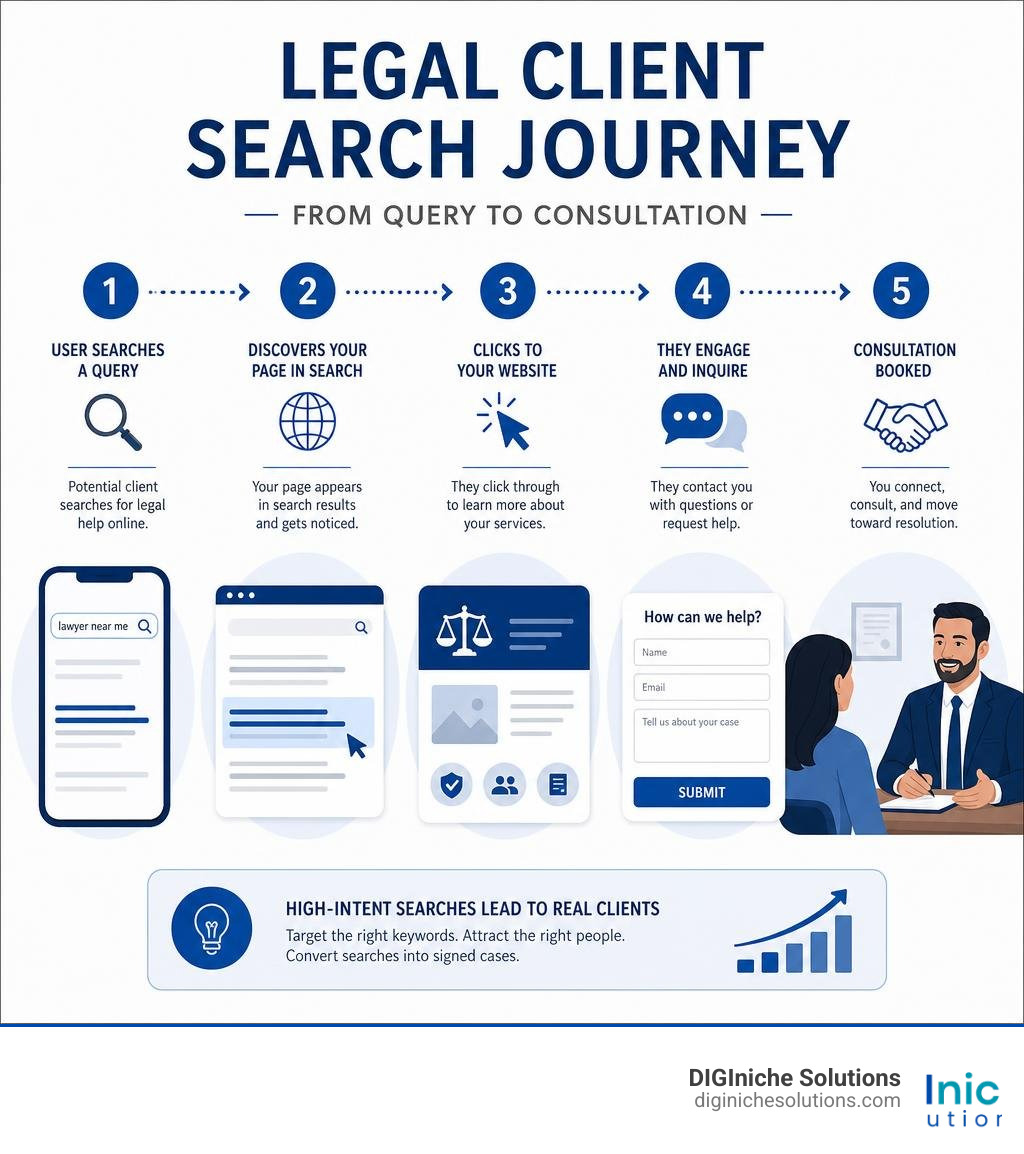
To help visualize how search queries shift as a prospect gets closer to making a hiring decision, we have mapped out the legal search journey below:
| Search Phase | Intent Type | Example Query | Action Needed |
|---|---|---|---|
| Early Stage | Informational | “what is the statute of limitations for slip and fall in NJ” | Educational blog post answering the question clearly |
| Middle Stage | Commercial | “best personal injury lawyer reviews New Jersey” | Case studies, testimonials, and comparison content |
| Late Stage | Transactional | “hire New Jersey truck accident attorney” | Highly optimized landing page with a direct call-to-action |
To uncover these late-stage, transactional keywords, we must analyze your existing search traffic, observe competitor gaps, and implement a strategic topic clustering methodology.
Analyzing Search Intent: Informational vs. Commercial vs. Transactional
Every search query falls into one of three primary intent buckets:
- Informational Intent: The user wants to learn something. Example: “what happens at a custody hearing?”
- Commercial Intent: The user is researching options and comparing providers. Example: “best family law attorneys in Cherry Hill.”
- Transactional Intent: The user is ready to take immediate action, such as booking a consultation or calling an attorney. Example: “consultation with estate planning lawyer near me.”
For a deeper dive into the mechanics of search intent, refer to Semrush: What Is Search Intent?.
While informational blog posts are great for building topical authority, your primary client acquisition engine should focus heavily on commercial and transactional queries. When writing blog content, you can bridge the gap by answering an informational question first, and then immediately guiding the reader toward a transactional next step.
For practical ways to structure your content to capture these high-intent leads, check out our guide on Attorney Lead Generation Tips Must Follow to Win Clients.
Leveraging Long-Tail Attorney Conversion Keywords for Niche Practice Areas
One of the biggest mistakes we see law firms make is ignoring “long-tail” keywords. Long-tail keywords are longer, more specific phrases (typically 4 to 7 words). While they have lower monthly search volumes, they offer two massive advantages:
- They have significantly less competition, making them much easier and faster to rank for.
- They convert at a much higher rate because they reflect precise user intent.
For example, instead of trying to compete for “criminal lawyer,” a boutique firm in New Jersey can target “first offense DUI attorney in Jersey City.”
This level of specificity is incredibly powerful. A user searching for a first-offense DUI attorney is facing a highly specific, stressful situation. If your blog post addresses exactly what happens to first-time offenders in Jersey City, details local court procedures, and offers a clear path to contact you, that reader is highly likely to convert.
For criminal defense practices, targeting these highly specific niches is a core strategy. You can see how this structural approach works in our breakdown of 7 Must-Haves for Criminal Defense Websites.
Furthermore, because search engines heavily personalize results based on location, combining long-tail keywords with geo-targeting is essential for local practices. To see how to apply this to New Jersey’s unique legal landscape, read more about SEO for Lawyers New Jersey.
Strategic Implementation: Optimizing Your Blog and Landing Pages
Once you have identified your high-converting keywords, the next step is strategic implementation. It is not enough to simply “stuff” these keywords into your text. You must build a seamless user experience that guides the reader from search query to signed client.
Balancing Broad, Localized, and Practice-Specific Keywords
To dominate search results, you must strike a balance between broad practice terms, localized modifiers, and practice-specific long-tail queries.
In the legal world, proximity is everything. Because law is highly jurisdictional, potential clients want representation close to home. Therefore, almost all of your high-converting keywords should include geographic modifiers (e.g., city, county, or state names).
Google uses localized signals, including your physical location and IP address, to serve search results. To ensure your firm appears when local clients search, optimizing your Google Business Profile is critical. You can learn how to boost your local rankings directly from Google Business Profile Help: Improve Your Local Ranking.
To complement your Google Business Profile, your website content must be highly localized. This means creating dedicated location pages and integrating localized terms naturally into your blog posts. For a step-by-step approach to local optimization, read our guide on Local SEO for Lawyers: Simple Fixes to Get More Clients.
Structuring Content and Landing Pages to Maximize Conversions
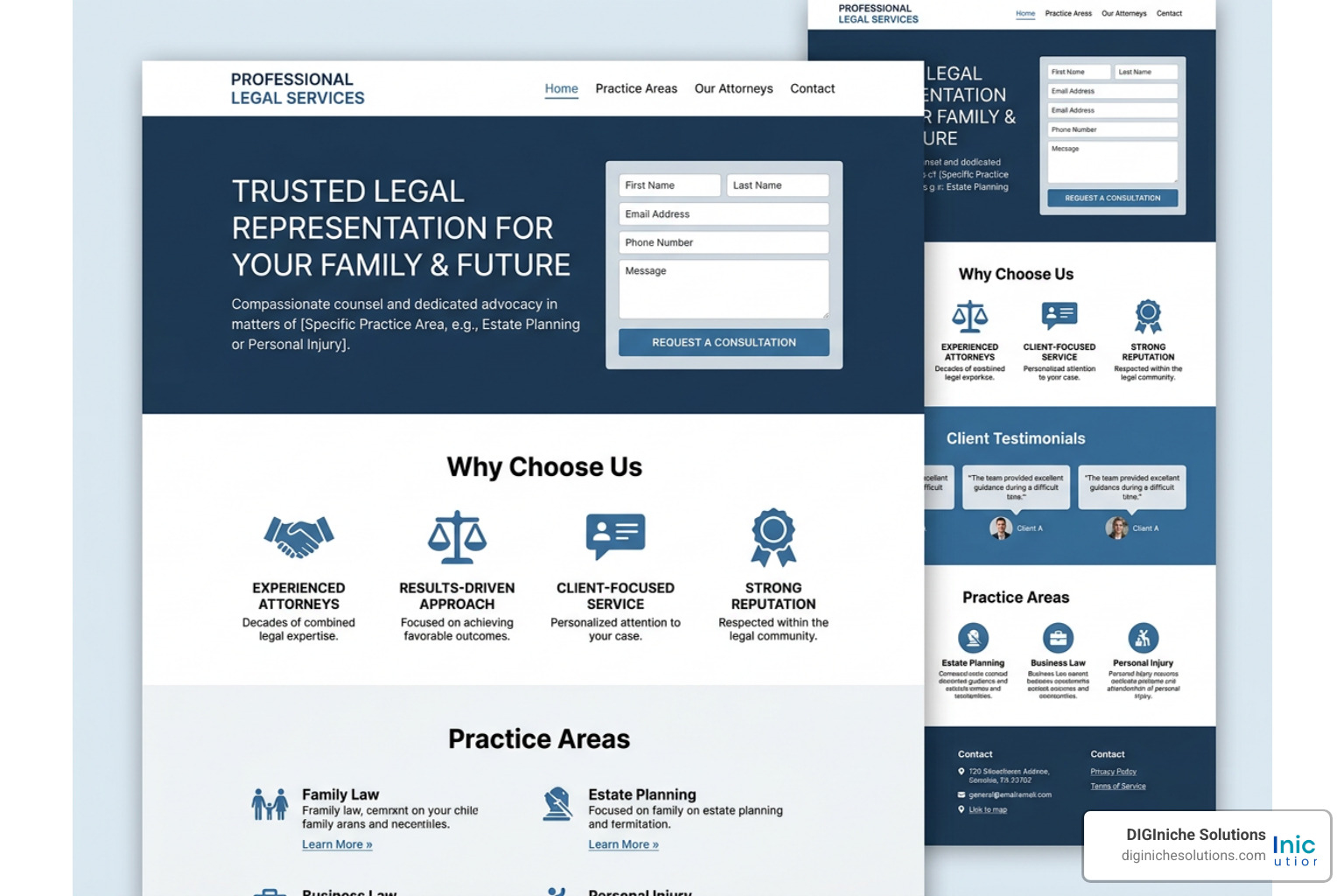
Getting a potential client to click on your website is only half the battle. If your page is cluttered, slow to load, or lacks clear trust signals, that visitor will hit the back button and click on a competitor.
To maximize conversions, send transactional traffic to dedicated, optimized landing pages rather than your generic homepage. While a homepage typically converts at 2% to 4%, an optimized landing page can achieve conversion rates of 8% to 15% or higher.
To benchmark your firm’s performance against broader trends, check out the Unbounce: Landing Page Conversion Rate Benchmarks.
For an in-depth framework on how to construct these high-converting pages, we highly recommend reading Law Firm Landing Page Optimization: The Conversion Framework That Works | 2026 Guide .
To ensure your entire website is set up for success, make sure you have the foundational pages covered by reviewing Attorney Website Content: Must-Have Pages for Your Website.
Frequently Asked Questions About Legal Keywords
How do I find the search volume and difficulty of legal keywords?
To find accurate search volume and keyword difficulty, you should utilize a mix of professional keyword tools. Google Keyword Planner is an excellent, free starting point for identifying basic search volumes and commercial intent (indicated by high advertiser competition and top-of-page bid prices).
For more advanced analysis, tools like SEMrush, Ahrefs, and Moz provide a “Keyword Difficulty” (KD) score on a scale of 1 to 100. This score tells you how hard it will be to rank organically for a specific term based on the strength of the websites currently on page one.
When analyzing these metrics, you do not always need to avoid high-difficulty keywords. Instead, balance your strategy: target a few highly competitive “money keywords” while building a strong foundation of low-difficulty, long-tail terms. For more tips on optimizing your site’s structure for these tools, see our 7 Tips for Improving a Law Firm Website’s SEO.
What are some examples of high-converting keywords for personal injury and criminal defense?
High-converting keywords are defined by their transactional intent. Here are some highly effective examples across key practice areas:
- Personal Injury:
- “hire car accident lawyer in [City]”
- “best truck injury attorney near me”
- “medical malpractice law firm [City]”
- “slip and fall attorney consultation [City]”
- Criminal Defense:
- “emergency DUI lawyer [City] overnight”
- “affordable criminal defense attorney near me”
- “top domestic violence defense lawyer [City]”
- “hire drug offense attorney [City]”
By structuring your blog posts and service pages around these exact phrases, you speak directly to individuals who are actively looking to hire. If you want professional assistance in identifying and ranking for these terms, explore our Law Firm SEO Services: Boost Your Legal Website’s Rankings.
How do negative keywords protect my law firm’s marketing budget?
While keyword research helps you identify what to target, “negative keywords” tell search engines what not to target. This concept is incredibly important for paid search campaigns (PPC), where you pay for every single click.
If you are running a Google Ads campaign for a family law firm, you might target the keyword “divorce lawyer.” However, without negative keywords, your ad could appear for searches like “divorce lawyer salary,” “free divorce templates,” or “how to divorce without a lawyer.”
By adding negative keywords such as “salary,” “jobs,” “pro bono,” “free,” and “DIY,” you prevent your ads from showing to searchers who have no intention of hiring an attorney. This keeps your budget focused strictly on high-intent prospects.
When managing paid campaigns, it is vital to keep ethical considerations in mind. The American Bar Association: Ethics of Search Engine Marketing provides strict guidelines on how attorneys can advertise. For example, some jurisdictions have specific rules regarding bidding on competitor names. To learn more about setting up a highly efficient, compliant paid search campaign, check out our guide on PPC Advertising for Law Firms.
Conclusion
In the highly competitive legal landscape of 2026, you cannot afford to waste your marketing budget on generic traffic. Success is not about how many people visit your blog; it is about how many of those visitors pick up the phone and become signed clients.
By shifting your focus toward attorney conversion keywords, you target the exact searchers who are ready to hire. This high-intent approach reduces waste, lowers your acquisition costs, and drives predictable, scalable growth for your firm.
At DIGIniche Solutions, we help law firms build high-converting digital marketing systems using our proprietary V.E.R.A. Formula:
- Visibility: Dominating local search results for high-intent, transactional keywords.
- Engagement: Creating compelling, empathetic content that speaks directly to the client’s pain points.
- Retention: Structuring your website and landing pages to keep users engaged and build trust.
- Amplification: Scaling your success through targeted paid ads and continuous optimization.
Stop guessing which keywords will work. Let us help you build a scalable client-growth ecosystem. To get started today, check out our guide on Local SEO for Lawyers: Simple Fixes to Get More Clients or contact us for a personalized strategy session.
