

Why Most Law Firms Struggle to Get a Steady Flow of Quality Cases
If you’re trying to solve the problem of legal leads for attorneys, here’s the short answer:
The fastest ways to get quality legal leads in 2026:
- Pay-per-lead services (e.g., 4LegalLeads, eLocal) — real-time, exclusive leads delivered to your firm only
- Pay-per-signed-case models — you pay only when a retainer is signed, shifting financial risk off your firm
- Google Local Services Ads — high-intent searchers, pay only for verified calls
- Legal directories (Avvo, FindLaw, Nolo) — low-cost visibility with millions of monthly visitors
- Organic SEO + content marketing — slower to build, but the highest long-term ROI
- Live call transfers — prospects connected to your intake team in real time, at peak intent
Running a law firm is hard enough. Chasing down new cases every month shouldn’t be part of the job description.
But for most small and mid-sized practices, that’s exactly what happens. One month the pipeline is full. The next? Crickets. Referrals help, but they’re unpredictable. And most attorneys know that depending on word-of-mouth alone is a slow way to grow — or worse, a fast way to stall.
Here’s a number worth sitting with: 77% of people searching for an attorney start their research online. That means the majority of your potential clients are out there right now, typing their problem into Google — and if your firm isn’t showing up, someone else’s is.
The good news is that the tools to fix this are better than ever. The challenge is knowing which ones are worth your money and which ones will quietly drain your budget with little to show for it.
I’m Frank Demming, and for over a decade I’ve helped law firms build predictable pipelines of legal leads for attorneys through SEO, PPC, and data-driven digital marketing strategies. In this guide, I’ll break down exactly which lead generation services and strategies are worth your attention in 2026 — and how to make them work together without overspending.
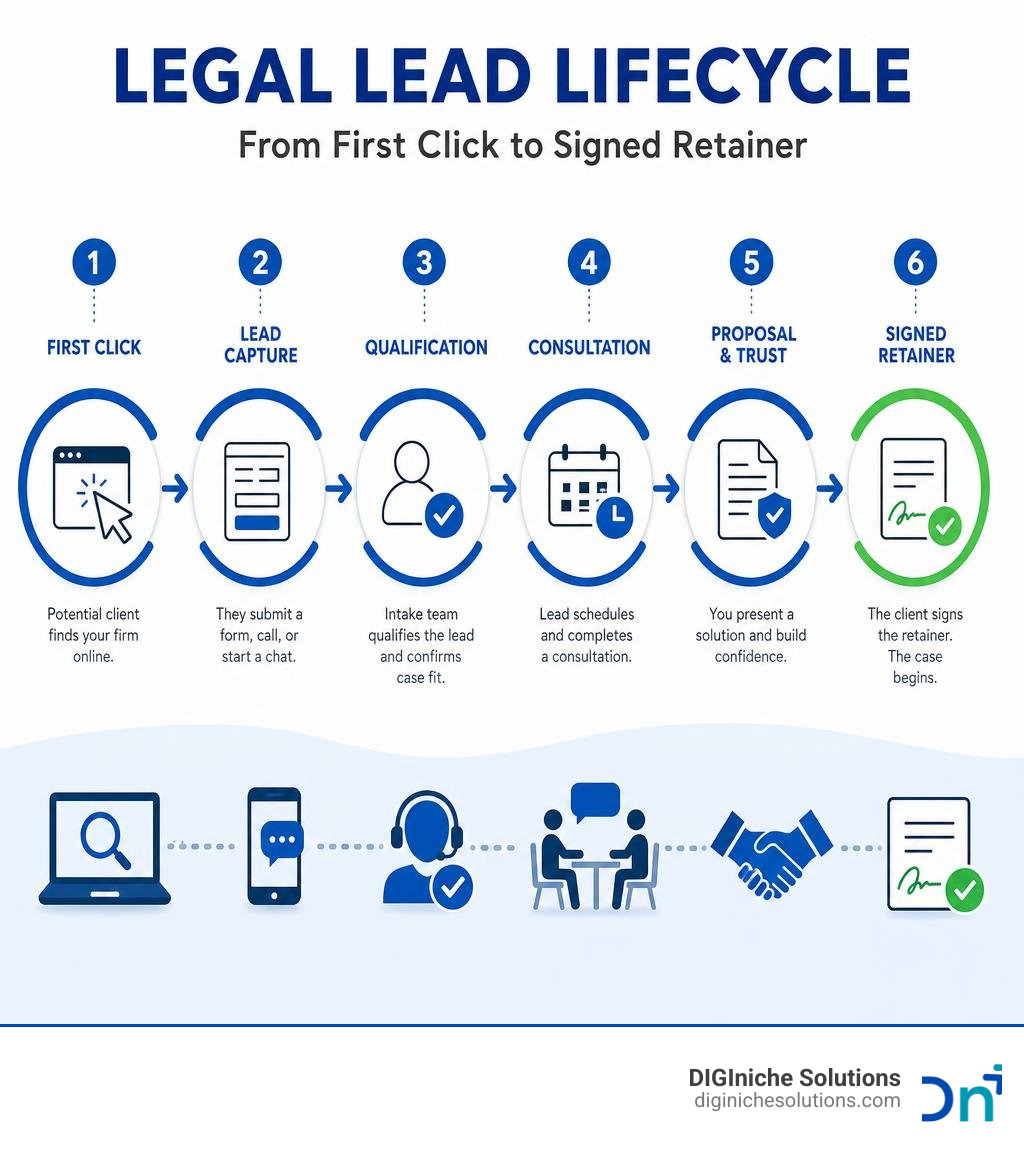
Legal leads for attorneys terms explained:
Evaluating the Cost and Quality of Legal Leads for Attorneys
Investing in lead generation can feel like a high-stakes game of poker. You want to make sure the hand you are dealt actually holds some value. In the legal space, the cost per lead (CPL) and overall case quality vary wildly depending on your practice area, geographical location, and how exclusive those leads are.

Let’s look at the numbers. Across the legal industry, a raw lead can cost anywhere from $10 to $350+. For example:
- Bankruptcy leads typically range from $10 to $60.
- Family law and divorce leads often hover between $20 and $40.
- Criminal defense and DUI leads usually cost between $20 and $100.
- Personal injury leads are the most competitive, stretching from $20 to $350+ (and sometimes much higher for premium, exclusive motor vehicle accident leads).
But looking at CPL alone is a trap. A $15 lead that doesn’t pick up the phone is infinitely more expensive than a $150 lead that signs a retainer by dinner time. That is why smart law firms focus on Return on Ad Spend (ROAS) and cost-per-signed-case rather than raw lead volume.
In our experience, campaigns built around high-intent search queries can yield incredible returns. Across various consumer-facing law practices, we have seen well-optimized campaigns produce documented returns on ad spend ranging from 350% all the way up to 6,500% for highly specialized probate and estate planning practices. The key to hitting those upper-tier numbers is having a strict, automated screening system that keeps your team from wasting time on “phantom” inquiries.
How to Screen and Qualify Legal Leads for Attorneys
If you are buying web leads or running pay-per-click ads, you must accept one fundamental truth: not everyone who fills out a form has a viable case. Some people are just looking for free advice, others do not have insurance coverage, and some might even be outside your licensed jurisdiction.
To protect your time and budget, you need a multi-layered screening process. This is where modern AI-driven screening and live call transfers shine. When a lead is generated, an automated system can instantly pre-screen the prospect using interactive voice response (IVR) or online forms to verify critical criteria. For a motor vehicle accident case, this means automatically asking:
- Did the accident happen within the statute of limitations?
- Was there physical injury or medical treatment?
- Is there a police report?
- Who was at fault?
If the prospect matches your criteria, they can be immediately routed as a live call transfer to your intake team.
Furthermore, do not underestimate the power of bilingual support. In diverse markets like New Jersey, having English and Spanish-speaking intake specialists can instantly boost your conversion rates. When prospects reach out in their moment of need, they want to speak to someone who understands them immediately. If you want to optimize your digital intake assets further, check out our boost your case lead volume instantly with these 5 attorney website design tips to see how your site’s structure affects user trust and conversion.
Integrating Legal Leads for Attorneys with Case Management Software
Let’s talk about the operational side of lead generation. If you are still copying and pasting contact information from email notifications into sticky notes, you are losing money. In legal marketing, speed-to-lead is everything.
Modern lead generation networks can deliver leads via API directly into your Client Relationship Management (CRM) or case management software, such as Clio or MyCase. When a lead is submitted, it should instantly populate a visual pipeline, trigger an automated text message to the prospect, and alert your intake team.
According to industry data, law firms utilizing integrated practice management software like MyCase experience an average caseload increase of 38%. Why? Because they do not let leads slip through the cracks. Automating the transition from a fresh lead to a sent retainer agreement minimizes friction, allowing you to secure the client before they call another firm. For more actionable advice on setting up these workflows, read our guide on attorney lead generation tips must follow to win clients.
Comparing Pay-Per-Lead vs. Pay-Per-Signed-Case Models
When shopping for legal leads for attorneys, you will generally run into two primary pricing structures: the traditional Pay-Per-Lead (PPL) model and the newer Pay-Per-Signed-Case (PPSC) model. Both have distinct advantages depending on your firm’s cash flow, risk tolerance, and intake capabilities.
| Feature | Pay-Per-Lead (PPL) | Pay-Per-Signed-Case (PPSC) |
|---|---|---|
| What You Pay For | Raw contact information or a live call transfer. | A fully screened prospect who has signed your retainer. |
| Upfront Risk | Moderate to High (you must convert the lead yourself). | Low (you only pay for results). |
| Cost per Unit | Lower ($15 – $350 depending on practice area). | Higher (reflects the cost of marketing + intake labor). |
| Exclusivity | Can be shared or exclusive (always opt for exclusive!). | 100% exclusive. |
| Best For | Firms with an active, fast-responding in-house intake team. | Solo practitioners or busy firms without dedicated intake staff. |
The PPL model is excellent if you have a highly trained, 24/7 intake department that can pounce on leads within 45 seconds of submission. However, if your lawyers are busy in court and cannot answer the phone immediately, PPL can lead to wasted budget.
On the flip side, the PPSC model shifts the intake risk entirely to the lead provider. You do not have to worry about chasing down medical records, verifying insurance, or sending follow-up texts. You simply pay a flat rate when a qualified case is delivered to your desk with a signed retainer. While the cost per signed case is naturally higher than a single raw lead, the predictability it offers to your cash flow is incredibly valuable.
Maximizing Return on Ad Spend (ROAS)
To truly maximize your ROAS, you have to treat lead generation as a continuous optimization loop. This means tracking your marketing campaigns from the initial click all the way to the final case settlement or fee collection.
If you are running paid search campaigns (like Google Ads), you must strictly monitor your cost-per-acquisition (CPA). Legal keywords are among the most expensive in the digital advertising world, with some personal injury terms exceeding $200 per click. If your campaigns are not tightly structured, you can burn through a $5,000 monthly budget in a matter of days.
To prevent this, we recommend focusing on high-intent long-tail keywords and setting up geographic parameters that match your exact target market. For instance, if you are looking to scale a highly specialized practice, you need a custom-built, scalable engine. Discover how we approach this in our deep dive on how to build a scalable lead generation engine for medical malpractice lawyers.
Ethical and Legal Compliance in Legal Lead Generation
You cannot talk about legal leads for attorneys without addressing the ethical elephant in the room. The legal industry is heavily regulated, and State Bars do not take kindly to rules violations — even if they are caused by a third-party marketing agency you hired.

The most critical ethical boundary to understand is the ban on fee-splitting with non-lawyers. Under almost all State Bar ethical rules (including ABA Model Rule 5.4), attorneys are strictly prohibited from sharing legal fees with non-lawyers. This means you cannot pay a lead generation company a percentage of your successful case winnings or a contingency fee based on the settlement. All lead generation fees must be structured as flat fees per lead, flat subscription fees, or flat fees per signed retainer that do not fluctuate based on the ultimate value of the case.
Additionally, any lead generation platform you use must comply with the Telephone Consumer Protection Act (TCPA) and healthcare privacy regulations (HIPAA) if medical information is collected. This requires using secure, consent-based web forms that document consumer opt-in using tools like TrustedForm. To protect your license, you must do your due diligence. For a deeper look at these warnings, read the discussion from the New Jersey Ethics Committee: Beware Marketers that “Lead” to ….
Navigating State-Specific Referral Regulations
Because we operate in New Jersey, we must pay close attention to the specific advisory opinions issued by the NJ Supreme Court Committee on Professional Ethics. New Jersey has strict rules regarding what constitutes a “referral service” versus “permissible attorney advertising.”
In NJ, a non-lawyer cannot run a service that appears to recommend or select a specific attorney based on a subjective evaluation of the client’s needs, unless that service is registered and compliant with state regulations. However, purchasing leads from a platform that simply matches consumers with local attorneys based on geography and practice area is generally permitted, provided the marketing is transparent and the fee is a flat rate.
NJ attorneys often utilize local, specialized services like Legal Plex LLC to legally acquire municipal and traffic court leads from public records, or align with state guidelines such as those outlined by the Outside Counsel – New Jersey Office of Attorney General when dealing with state-level representation. To ensure your marketing stays completely above board, take a look at our guide on how to win local clients without crossing ethical lines in legal seo.
Building a Sustainable Multi-Channel Lead Generation Engine
Relying on a single source for your cases is like building a house on a foundation of sand. If that one provider changes their pricing, or if Google updates its search algorithm, your steady stream of clients could vanish overnight.
The most successful law firms in 2026 build a diversified, multi-channel lead generation engine that combines immediate case-delivery channels with long-term organic assets.
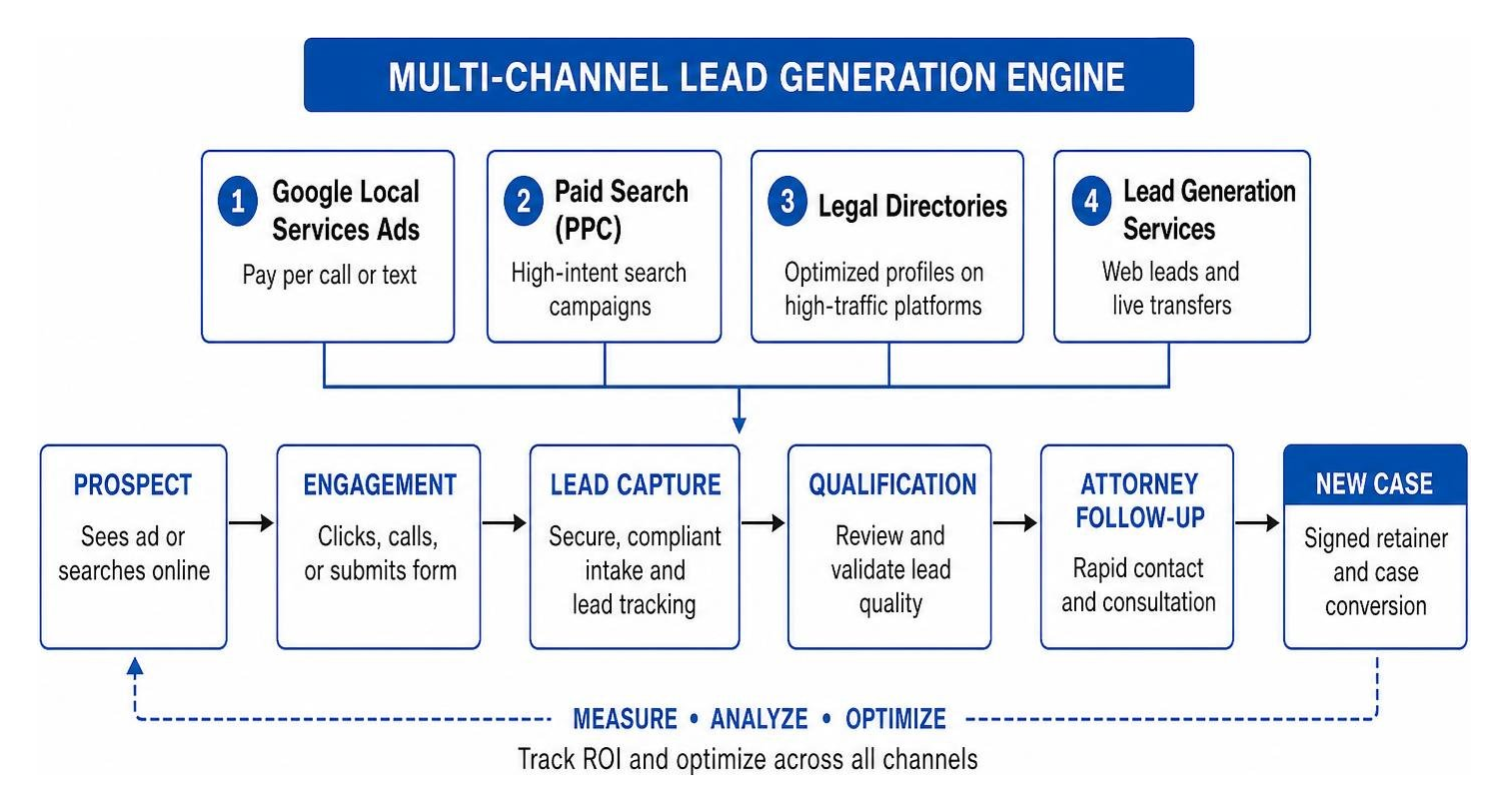
A comprehensive legal marketing ecosystem includes:
- Google Local Services Ads (LSAs): These sit at the very top of the search results, displaying your “Google Screened” badge. You pay only when a prospect calls or texts your firm directly through the ad, making it a highly cost-effective way to drive immediate phone inquiries.
- Paid Search (PPC): Targeted Google Search campaigns that capture high-intent users actively searching for terms like “best personal injury lawyer near me.”
- Legal Directories: Maintaining optimized profiles on high-traffic platforms like Avvo (which boasts over 8 million monthly visitors and facilitates 650,000+ attorney contacts monthly), FindLaw, and Nolo.
- Lead Generation Services: Utilizing established, compliant providers like 4LegalLeads: Leads for Lawyers | Attorney Lead Generation or Legal Leads for Law Firms | Exclusive & Shared Lead Programs to supplement your pipeline with real-time web leads and live transfers.
- Organic Search Engine Optimization (SEO): Building content that ranks naturally on search engines, establishing your authority and driving consistent, free traffic over time.
To see how LSAs fit into this mix, check out our article on how local service ads for law firms generate more leads.
Balancing Paid Lead Generation and Organic SEO
Think of paid lead generation and organic SEO as the “sprint” and the “marathon” of your business growth.
Paid lead generation (PPC, LSAs, and purchased leads) is your sprint. It requires immediate budget, but it gets the phones ringing within days. This is crucial for maintaining cash flow, especially if you are a newer firm or expanding into a new practice area.
Organic SEO is your marathon. It takes months of consistent effort to write educational blog posts, optimize your Google Business Profile, and earn local backlinks. However, once your website ranks on the first page of Google for competitive local keywords, the leads you generate are entirely free. The conversion rate on organic leads is also significantly higher because the prospect already trusts your brand after reading your content.
A healthy firm uses paid leads to fund their long-term SEO strategy, gradually shifting their reliance from expensive paid ads to highly profitable organic search traffic. For a complete blueprint on how to align these channels, read our guide on how to target and connect through law firm internet marketing.
Frequently Asked Questions about Legal Leads
What is the average cost per lead for personal injury cases?
The cost per lead for personal injury cases generally ranges from $75 to $350+, depending heavily on geographic competition and lead exclusivity. In highly competitive metropolitan areas (like Northern New Jersey), high-intent motor vehicle accident leads command premium prices because the potential case value is so high. Always ensure you are buying 100% exclusive leads, as shared leads will force you to race against three to five other firms to contact the prospect first.
Can non-lawyers legally sell leads to attorneys on a contingency basis?
No. Under State Bar ethical rules across the country (including New Jersey), attorneys are strictly banned from sharing legal fees with non-lawyers. This means a lead generation agency cannot take a percentage of your settlement or a “cut” of the case value. All compliant lead generation services must charge flat fees—either per lead, per signed retainer, or as a flat monthly marketing subscription.
How quickly must a law firm follow up with a new legal lead?
Ideally, within five minutes or less. Data shows that conversion rates drop by over 300% if you wait longer than five minutes to contact a web lead. Because 66% of people expect a response from an attorney within a day (and many hire the very first lawyer who answers the phone), speed-to-lead is the single most critical variable in determining your marketing ROI.
Conclusion
Getting high-quality legal leads for attorneys does not have to break your bank or keep you up at night. By understanding the true cost of leads, setting up automated screening processes, and choosing the right mix of pay-per-lead and organic marketing, you can build a highly predictable, profitable pipeline of cases.
At DIGIniche Solutions, we specialize in helping law firms cut through the marketing noise. We do not believe in vanity metrics or “phantom” rankings. Instead, we use our proprietary V.E.R.A. Formula — focusing on Visibility, Engagement, Retention, and Amplification — to build scalable client-growth engines tailored to your firm’s exact goals.
If you are ready to stop chasing cases and start growing your practice predictably, Scale Your Firm with DIGIniche Solutions today. Let us show you how we can turn your digital presence into your firm’s most valuable asset.
