

Core Pillars of Effective Personal Injury PPC Management
Here is the rest of the guide:
Personal injury PPC management delivers quality case inquiries faster by combining injury-specific campaign segmentation, strict negative keyword sculpting, dedicated landing pages, and offline conversion tracking. Instead of treating paid search as a branding exercise, we run it as a direct-response profit-and-loss engine. While consumer retail campaigns might pay a couple of dollars per click, personal injury keywords routinely run anywhere from $50 to well over $300 per click in high-density areas across New Jersey. When clicks cost as much as a nice family dinner, every click must be tied to a realistic path toward a signed retainer.
To build sustainable profitability, we evaluate paid search through the lens of lifetime case value rather than cost-per-click (CPC). An auto accident case that nets $10,000 to $50,000 in firm legal fees easily justifies an upfront acquisition cost of $2,000 to $4,000. Conversely, chasing high-volume, low-intent terms with no settlement value will quickly exhaust a firm’s monthly budget. Effective search engine marketing for legal practices requires calculating target cost-per-acquisition (CPA) thresholds before placing a single bid. For broader context on how paid search fits into the legal marketing landscape, the American Bar Association offers guidance on attorney advertising and client development.
The table below breaks down the wide variance in ad performance metrics across primary personal injury case categories based on cross-industry portfolio performance:
| Practice Category | Average Portfolio CPC | Typical Intent Level | Conversion Volatility |
|---|---|---|---|
| Auto Accidents | $90.00 | Immediate / Emergency | High volume, fast intake required |
| Truck Accidents | $23.00 – $150.00+ | Severe Liability / Complex | Low volume, exceptionally high value |
| General Personal Injury | $45.00 | Broad / Mixed Intent | Medium volume, requires heavy filtering |
| Dog Bites & Animal Attacks | $41.00 | Direct / Specific Liability | Consistent volume, clear premises liability |
| Nursing Home Abuse | $12.00 – $35.00 | Research / Family Driven | Extended research phase, high sensitivity |
| Medical Malpractice | $4.00 – $25.00 | High Inquiry / Complex Claim | High lead volume, strict intake vetting |
Why Specialized Personal Injury PPC Management Outperforms General Legal Ads
Generalist marketing agencies often make the mistake of creating a single catch-all campaign for a legal firm. When you lump motor vehicle accidents, premises liability, and catastrophic injuries into a unified ad group, Google’s automated bidding algorithms become confused about real search intent.
Different injury types reflect entirely different prospect mindsets:
- Auto and rideshare accidents: Searchers are stressed, mobile-first, and need help now—often from a hospital or roadside in Clifton or Newark.
- Commercial truck litigation: Searchers face catastrophic losses, extensive medical bills, and require a firm with heavy trial resources.
- Medical malpractice and nursing home claims: Queries are made by family members conducting detailed, multi-week research.
A focused approach ensures tailored ad copy and landing page experiences that speak directly to the claimant’s precise situation, an essential element of any well-run personal injury paid search strategy.
Structuring Personal Injury PPC Management for Multi-Injury Portfolios
The backbone of a profitable paid search account is strict structural segmentation. We build campaigns using a service-specific architecture that keeps budgets, ad copy, and landing pages completely isolated.
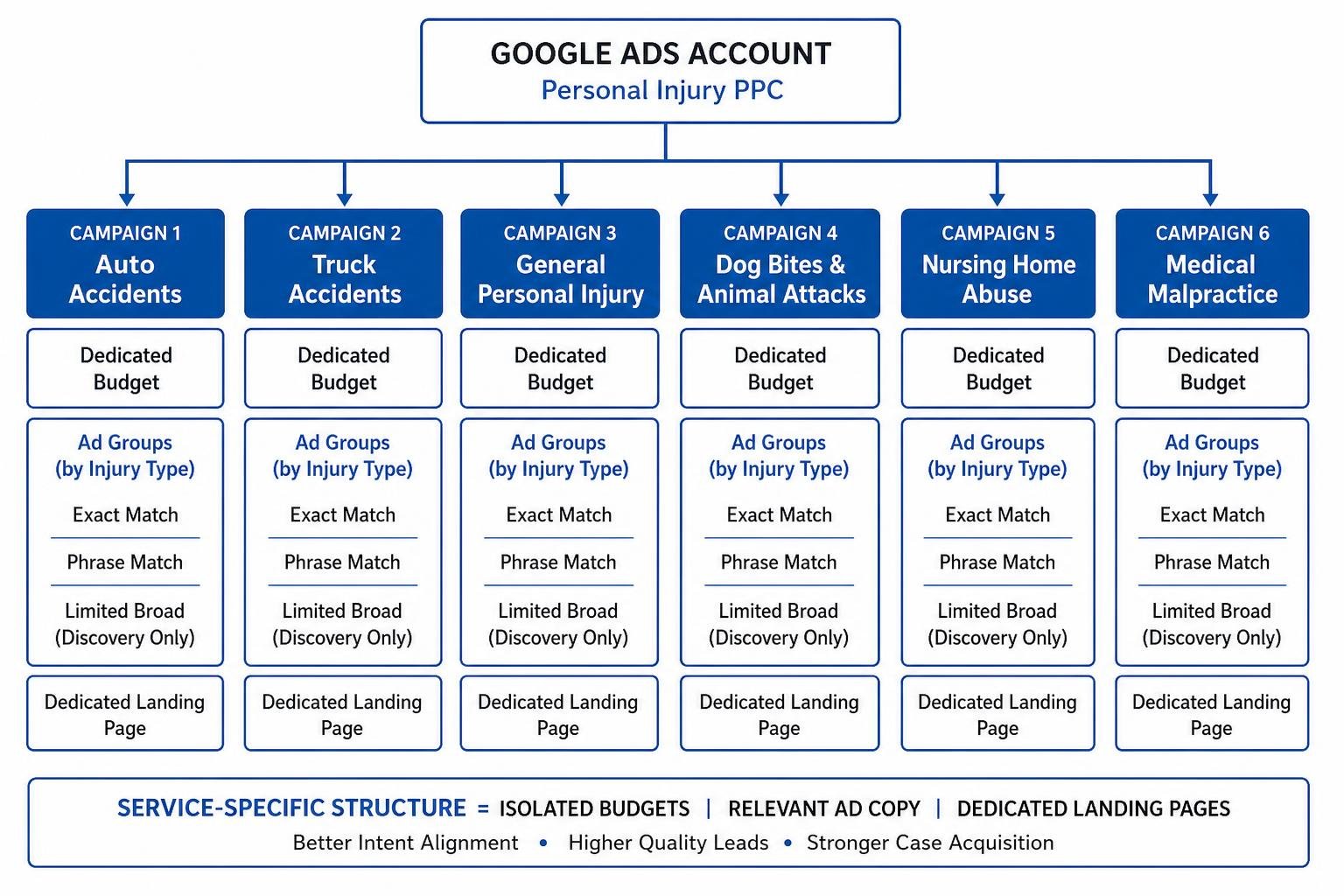
Instead of dumping dozens of keywords into a single bucket, our framework employs targeted ad groups built around a strict match-type hierarchy. Core high-intent terms use Exact Match to secure immediate visibility, supplemented by tightly curated Phrase Match variations to capture local intent (such as “car accident lawyer in Paterson NJ”). Broad match is strictly limited to isolated discovery campaigns with lower target bids to prevent budget drain. By deploying these proven law firm PPC management tactics, firms maintain 100% control over where every marketing dollar is spent.
Step-by-Step Campaign Execution for Faster Signed Retainers
Achieving a sustainable flow of signed retainers requires rigorous execution across eight foundational disciplines. When campaigns properly combine geographic bid adjustments, day-parting schedules, negative keyword management, ad-extensions, landing-page alignment, dynamic call tracking, LSA integration, and TCPA-compliant forms, law firms routinely see a 20% to 30% reduction in their cost-per-signed-retainer.
Execution order matters immensely. Setting up bidding algorithms before finalizing call tracking or intake response workflows causes expensive clicks to go completely unrecorded. Understanding how strategic PPC management secures high-value cases means aligning your technical account infrastructure with your firm’s real-world intake capacity. If your front desk in Wayne or Passaic cannot answer calls on Saturday afternoon, your ads should not bid aggressively during those exact hours.
Negative Keyword Sculpting and Search Query Audits
Without aggressive negative keyword discipline, personal injury campaigns can bleed 15% to 30% of their total ad spend on completely irrelevant search queries. Searchers frequently look for traffic court representation, pro bono assistance, police accident reports, or DIY legal advice.
We maintain negative keyword libraries of 300+ terms before any campaign launches, continuously updating them through weekly search term audits. Unqualified queries like “how to file a minor claims report” or “free legal aid for car damage” are systematically eliminated. This ensures ad spend is directed exclusively toward commercial-intent searches where a claimant actively seeks representation.
Landing Page Alignment and Quality Score Optimization
Sending expensive paid traffic to your firm’s general homepage is the fastest way to burn your budget. Visitors will bounce within seconds if they have to search through navigation menus to find the relevant practice area.
Dedicated, case-specific landing pages solve this problem:
- Implementing a landing-page-per-ad-group architecture delivers a 30% to 60% lift in conversion rates compared to shared generic pages.
- Matching the landing page H1 headline directly with the search ad triggers a substantial Quality Score lift.
- Improving your Quality Score from 3/10 to 9/10 can reduce your average cost-per-lead by up to 84% (dropping from $3,750 down to $605 in real-world environments).
Prominently showcasing client reviews, board certifications, and verified case results directly on these tailored pages establishes immediate trust and reinforces conversion intent.
Dynamic Call Tracking and Offline Conversion Import
Because 60% to 80% of all personal injury leads initiate via inbound phone calls, standard form tracking alone leaves you flying blind. Dynamic Number Insertion (DNI) through tools like CallRail swaps the phone number on your landing page based on the visitor’s traffic source.
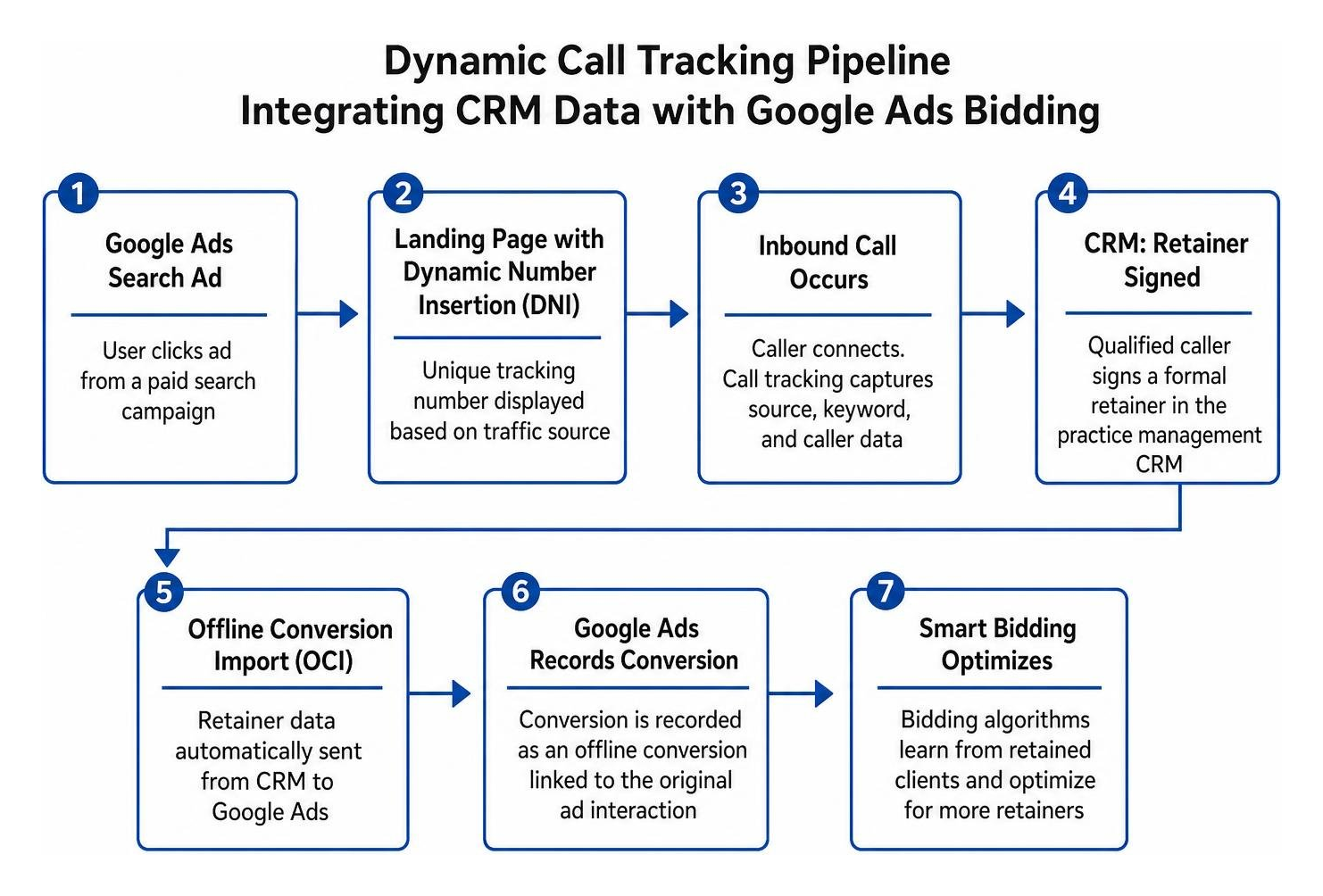
Once a call occurs, call-tracking platforms record source, keyword, and caller data. The true power unlocked here is Offline Conversion Import (OCI): when a qualified caller signs a formal retainer in your practice management CRM, that milestone is automatically transmitted back to Google Ads. This teaches Smart Bidding algorithms to optimize for actual retained clients rather than unqualified form fills.
Balancing Google Search Ads, LSAs, and Multi-Channel Opportunities
Relying on a single advertising channel creates strategic vulnerability. Modern personal injury growth requires a balanced ecosystem that balances traditional Google Search, Google Local Services Ads (LSAs), and supplementary search engines.

A comprehensive legal marketing mix balances immediate visibility with cost-effective lead generation. For a complete tactical overview, explore our modern PPC management guide for attorneys.
Here is how we prioritize channel allocation:
- Google Local Services Ads (LSAs): Capture top-of-page mobile real estate on a cost-per-lead basis.
- Google Search Ads (Exact & Phrase Match): Target specific, high-value injury queries with full creative control.
- Bing Ads (Microsoft Advertising): Capture older, high-income demographics at substantially lower CPCs.
- Geo-Fenced Search Retargeting: Keep your firm top of mind while prospects evaluate representation options.
Google Local Services Ads vs. Traditional Google Search
Google Local Services Ads (LSAs) appear at the absolute top of the search engine results page, above traditional paid search ads. They operate on a direct pay-per-lead model rather than pay-per-click, displaying the “Google Screened” badge alongside attorney reviews.
Across legal portfolios, LSAs deliver an average cost-per-lead of roughly $249. However, LSA volume is capped by search velocity in specific zip codes. While LSAs provide high-intent leads at stable costs, traditional Google Search remains essential for scaling case acquisition and targeting specific injury types that LSAs cannot isolate. We recommend an initial budget split of roughly 30% to LSAs and 70% to Google Ads, adjusting dynamically based on weekly signed-case volume.
Capturing Untapped Traffic with Bing Ads and Hyper-Local Targeting
Overlooking Microsoft Advertising (Bing Ads) is a missed opportunity for personal injury attorneys. Search data indicates that Bing Ads CPCs are typically 30% to 50% cheaper than Google Ads for identical personal injury keywords, with tests showing average legal CPCs of $1.54 on Bing versus $2.69+ on Google.
Bing searchers frequently lean toward desktop users, older demographics, and higher-income households. By targeting hyper-local geographic boundaries—such as specific municipalities in Passaic County and Bergen County, including Lyndhurst, Bloomfield, and Nutley—solo practitioners and boutique practices can secure qualified case inquiries at a fraction of the cost of statewide campaigns.
Maintaining Strict Compliance and Preventing Budget Drainage
Legal advertising is subject to rigorous regulatory standards. Running compliant campaigns requires close attention to state ethics rules, consumer privacy standards, and fraud mitigation.
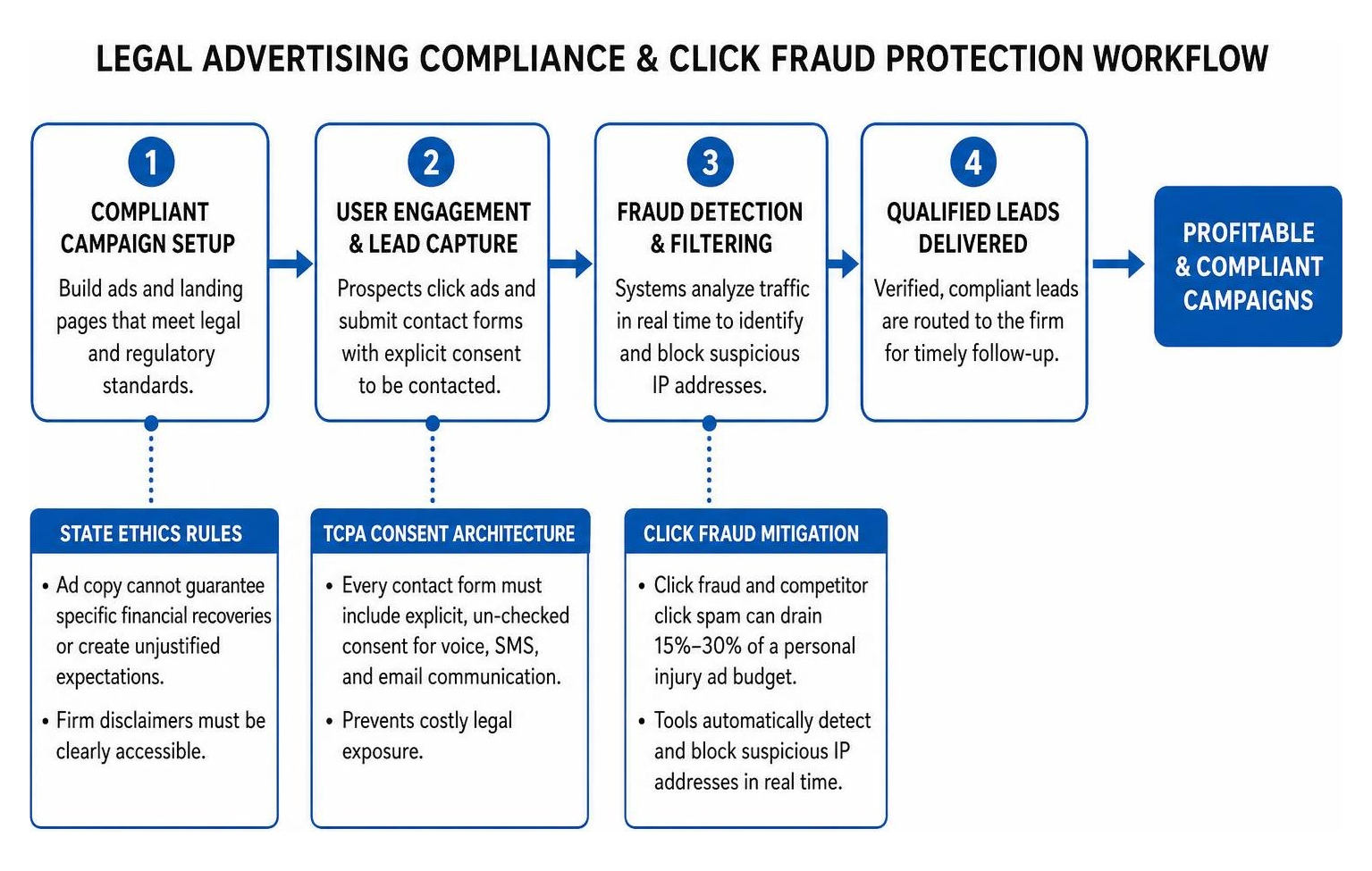
To keep campaigns profitable and fully compliant, law firms must account for several structural requirements:
- State Ethics Rules: Ad copy cannot guarantee specific financial recoveries or create unjustified expectations. Firm disclaimers must be clearly accessible.
- TCPA Consent Architecture: Every digital contact form must feature explicit, un-checked consent language for voice, SMS, and email communication to prevent costly legal exposure.
- Click Fraud Mitigation: Click fraud and competitor click spam can drain 15% to 30% of a personal injury ad budget. Enterprise filtering tools automatically identify and block suspicious IP addresses in real time.
For an in-depth breakdown of how strategic adjustments protect your capital, review our guide on how to avoid wasted marketing spend in legal campaigns.
Frequently Asked Questions About Personal Injury PPC
What is a realistic cost per signed case in personal injury PPC?
A healthy cost per signed case generally ranges between $1,200 and $3,500 for standard auto accident and slip-and-fall claims in regional markets. For complex, high-stakes matters like commercial trucking litigation, brain injuries, or wrongful death, signed case acquisition costs can range between $4,000 and $10,000+. Because a single catastrophic injury settlement can generate significant legal fees, these acquisition numbers provide substantial returns on investment when intake processes are executed properly.
How long does it take for a personal injury PPC campaign to stabilize?
Expect an initial optimization period of 60 to 90 days. In the first week, negative keyword filtering immediately cuts wasted spend. By weeks 6 to 8, Smart Bidding algorithms gather sufficient conversion data to accurately calibrate bids. True cost-per-lead stabilization and accurate cost-per-signed-case reporting fully mature around the 90-day mark once offline CRM milestones cycle through your intake pipeline.
How can smaller law firms compete against massive advertising budgets?
Smaller practices can dominate larger billboard and TV advertisers by avoiding broad, generic terms and focusing entirely on hyper-local, long-tail intent. By targeting specific towns (such as Elizabeth or Clifton), running tightly scoped radius modifiers around local medical centers, maintaining higher Quality Scores (which lowers actual CPC), and utilizing Bing Ads, boutique firms can consistently secure 15 to 20 qualified leads per month with exceptional ROI.
Conclusion
Maximizing returns from paid search requires treating your advertising pipeline as an integrated revenue engine. From day-parting ad schedules around your intake team’s availability to importing offline signed retainer milestones back into Google Ads, every dollar must be tied directly to case revenue.
At DIGIniche Solutions, our proprietary V.E.R.A. Formula—driving Visibility, Engagement, Retention, and Amplification—empowers personal injury law firms to build scalable, sustainable client-growth ecosystems. By eliminating wasted spend and prioritizing high-intent case inquiries, we help law practices outpace local competition and sign higher-value cases.
Ready to transform your paid advertising into a predictable case acquisition engine? Explore our specialized data-driven pay-per-click management services or contact us today to audit your current search performance.
