

Why SEO for Law Firm Case Studies Is the Best Way to Evaluate Real Results
SEO for law firm case studies is the clearest way to see what actually works in legal marketing — not theories, not promises, but documented results from real firms.
Quick Answer: What do law firm SEO case studies show?
| What They Measure | Why It Matters |
|---|---|
| Organic traffic growth | More potential clients finding your firm |
| Lead volume (consultations) | Direct impact on new cases signed |
| Keyword rankings | Visibility against competitors and directories |
| Cost per acquisition | SEO vs. paid ads efficiency |
| Traffic value (equivalent ad spend) | True ROI of organic rankings |
| Timeline to results | Realistic expectations (typically 6–18 months) |
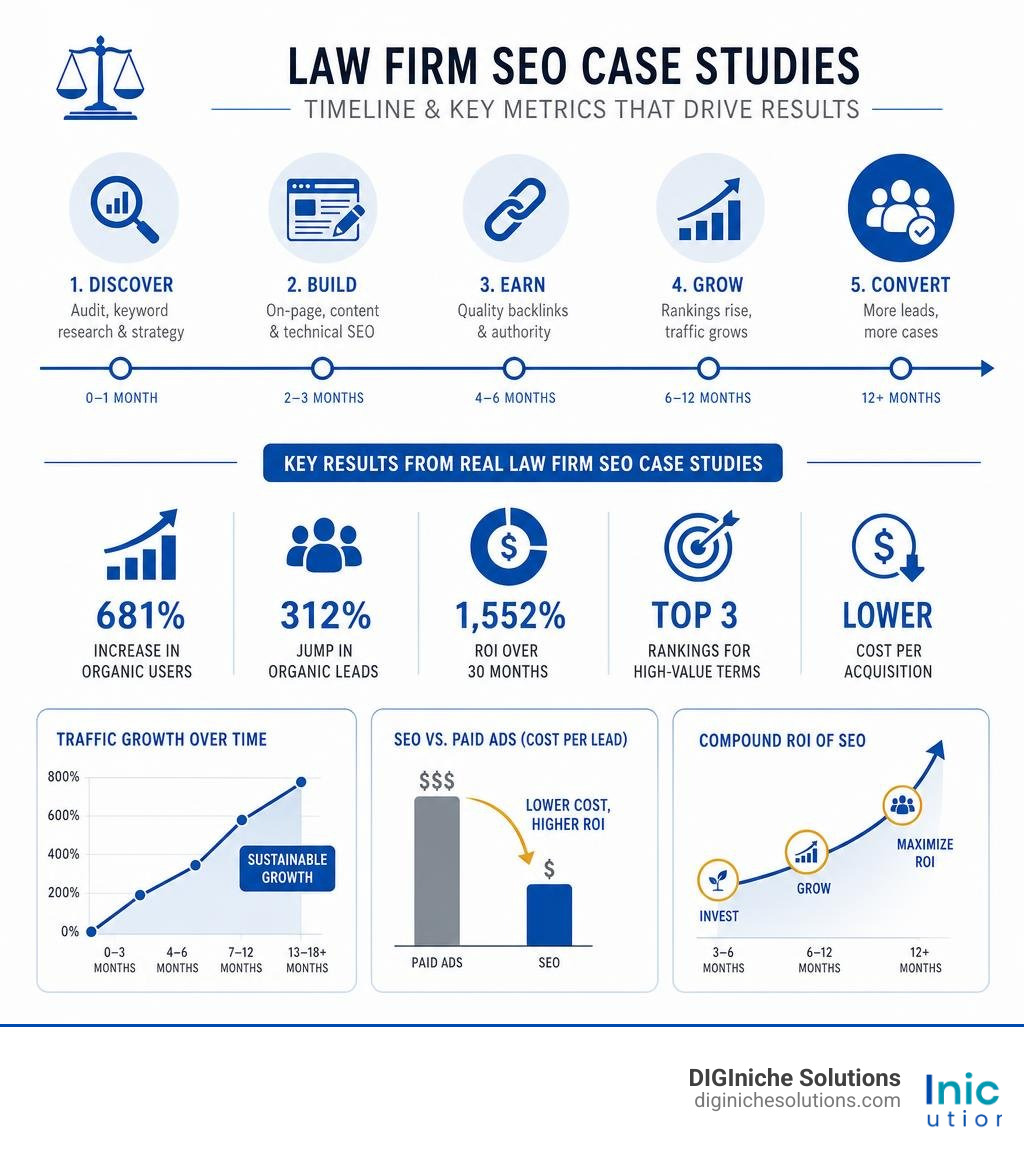
Real case study results from law firms include things like a 681% increase in organic users for a small DUI defense firm, a 1,552% ROI over 30 months for a Las Vegas law firm, and a 312% jump in organic leads for a family law firm in just 8 months. These numbers come from applying specific, repeatable strategies — not luck.
Legal SEO is harder than most industries. Google applies stricter standards to legal websites because the advice can directly affect someone’s life. Competition is fierce. National directories dominate the first page. And paid search in legal can run $15–$50+ per click.
That’s exactly why studying what has actually worked for other law firms is so valuable before you invest a dollar.
I’m Frank Demming, and I’ve spent more than a decade helping law firms generate consistent inbound leads through SEO, PPC, and digital marketing — including deep work with seo for law firm case studies to build data-driven strategies that get real results. In this guide, I’ll walk you through what the evidence actually shows, so you can evaluate what’s worth doing for your own firm.
Analyzing the Evidence: What We Learn from SEO for Law Firm Case Studies
When we look at seo for law firm case studies, we are looking at real-world blueprints of how websites climb from obscurity to the top of search engine results pages (SERPs). These studies reveal that sustainable growth is never accidental; it is the result of a sequenced, multi-phase system.
For example, looking at nationwide performance data, a common pattern emerges. Firms that struggle with flat organic performance for years often see compounding growth once they address their underlying structural issues. In one notable nationwide campaign, a firm achieved a staggering 1,552% ROI over 30 months, generating approximately $1 million in estimated added revenue. This was not achieved through a single magic trick, but by systematically executing a multi-phase campaign that prioritized content pruning, technical rebuilding, and local authority infrastructure.
At DIGIniche Solutions, we analyze these trends to refine our own strategies. Through our proprietary V.E.R.A. Formula, we look at how these historical data points can be applied to firms looking to scale. If you want to see how we compile and evaluate these success stories, you can explore our dedicated Case Studies page.
To replicate these high-performing campaigns, we must first understand that a bloated website is often its own worst enemy. Many law firm websites are cluttered with “zombie pages”—outdated blog posts, thin practice area descriptions, or duplicate geographic landing pages that have zero traffic or rankings. Case studies show that pruning these pages (either deleting them or consolidating them using 301 redirects) immediately frees up search engine crawl budgets, allowing Google to index and rank the high-value pages that actually drive business.
Once the dead weight is removed, firms can transition to building targeted, high-intent assets. By reviewing these proven methodologies, you can begin to see why professional DIGIniche Solutions Law Firm SEO Services are designed to treat SEO as a science, focusing on compounding results rather than short-term spikes.

Key Performance Indicators in SEO for Law Firm Case Studies
To truly evaluate the success of any legal marketing campaign, we must look past “vanity metrics” like overall impressions or keyword rankings for obscure terms. While ranking #1 for a hyper-specific phrase feels great, it doesn’t pay the bills. Successful law firms evaluate their campaigns using three primary Key Performance Indicators (KPIs):
- Organic Leads: This is the ultimate metric. How many actual phone calls, contact form submissions, or live chat inquiries are generated directly from organic search? For example, a family law firm case study documented a 312% increase in organic leads, moving from 11 to 45 qualified inquiries per month in just eight months.
- Traffic Value: This metric calculates how much it would cost to buy the same amount of traffic using Google Ads (PPC). If a firm ranks #1 for “personal injury lawyer” and receives 1,000 organic visits from that term, and the CPC (cost-per-click) for that term is $50, the traffic value of that single ranking is $50,000 per month. Case studies show mid-sized firms regularly reaching traffic values of $54,000 to $112,000 per month, effectively displacing massive advertising budgets.
- Cost Per Acquisition (CPA): How much does it cost to sign a new client through organic search versus paid channels? Data shows that while a paid ad campaign might yield a CPA of $428, a fully optimized organic campaign can drop that acquisition cost by up to 61%, bringing it down to around $41 per client.
By keeping a close eye on these metrics, firms can make informed decisions about where to allocate their marketing dollars. To learn more about setting up these tracking frameworks, read our detailed guide on Monitoring SEO Performance: Guide for Law Firms.
Practice Area Nuances: Personal Injury, Family Law, and Criminal Defense
SEO is not a one-size-fits-all strategy; the approach must be tailored to the specific practice area. The search behavior, intent, and competitive landscape vary dramatically between personal injury, family law, and criminal defense.
- Personal Injury Law: This is arguably the most competitive vertical in digital marketing. Search terms like “car accident lawyer” or “motorcycle accident attorney” carry some of the highest CPCs on the internet, sometimes exceeding $100 per click in major metropolitan markets. Because of this, personal injury SEO must focus heavily on local map pack dominance and high-authority link building to stand out. The ROI here is massive because a single catastrophic injury case can yield six or seven figures for a firm. To understand why this highly competitive space is worth the effort, check out our analysis on Why Personal Injury SEO Is Worth It.
- Family Law: Family law prospects are often highly emotional and require a significant amount of trust before reaching out. They search for terms like “how is child custody decided” or “how to protect my assets in a divorce.” Consequently, family law SEO must prioritize deep, empathetic informational content, comprehensive FAQs, and a robust review generation system. Case studies show that family law firms succeed by positioning themselves as compassionate guides. For a deep dive into this strategy, see our guide on Search Engine Optimization for Family Law Attorneys.
- Criminal Defense: Criminal defense search behavior is highly urgent. A prospect (or their family member) searching for a “DUI lawyer near me” or “jail release attorney” needs help immediately. For these campaigns, mobile optimization, click-to-call functionality, and local SEO are paramount. The website must load in under three seconds, and the local Google Business Profile must display outstanding social proof to win the immediate click.
The Technical and Local Foundations of Legal Search
Before you write a single blog post or launch a link-building campaign, your website’s technical foundation must be flawless. Think of technical SEO as the structural integrity of your digital office. If the front door is locked (crawl errors) or the hallway is cluttered (slow load times), prospective clients will leave before they ever speak to you.
Technical SEO Audits and Site Architecture
A technical SEO audit is the first step in any successful campaign. In many case studies, firms discover that technical issues are actively blocking their content from ranking. Common culprits include:
- Crawl Budget Waste: If your site has hundreds of non-canonicalized files, broken links, or redirect loops, search engine bots will waste their limited crawl budget on useless pages, ignoring your high-value practice area pages.
- Canonical Tags: Ensuring that search engines understand the “master” version of a page prevents duplicate content penalties, which often happen when firms copy location pages or service descriptions.
- Site Speed: A slow site kills conversions. Studies show that a legal website should load in under 3 seconds on mobile devices. Migrating to fast, secure hosting (like WP Engine) and optimizing images can resolve these speed bottlenecks.
Building a logical, intuitive site architecture is equally vital. Successful firms structure their sites using a clear hierarchy: the homepage links to primary practice area pages, which then link to sub-practice areas and supporting informational blog posts. This clean structure helps search engines crawl the site efficiently and understand the relationships between topics. For practical action items you can implement today, read our 7 Tips for Improving a Law Firm Website’s SEO.
If your firm is based in New Jersey, technical and structural optimizations must be tailored to compete in one of the most densely populated legal markets in the country. To see how we approach technical site setups for local firms, explore our guide on SEO for Lawyers New Jersey.
Local SEO and Google Business Profile Optimization
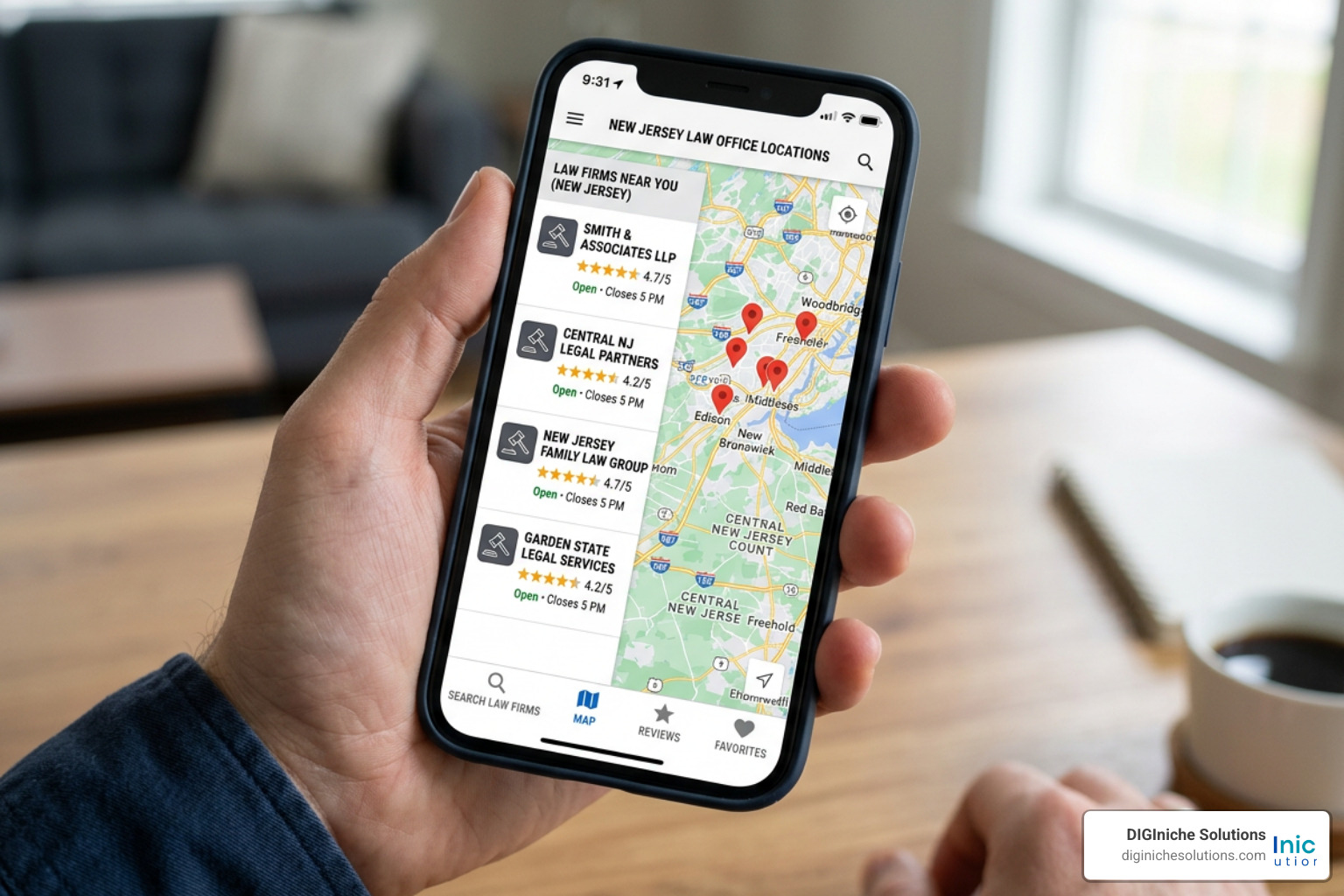
For law firms, local search is where the majority of high-intent leads are won. When someone searches for an attorney, Google almost always displays the “Local 3-Pack”—the map listings at the top of the search results.
To rank in the Local 3-Pack, your Google Business Profile (GBP) must be meticulously optimized. This includes choosing the correct primary and secondary categories, uploading high-quality photos of your office and staff, posting regular updates, and answering local FAQs. If you need help setting up or managing your profile, you can refer directly to the official Google Business Profile Help resource.
Beyond profile optimization, three factors drive local search visibility:
- Local Citations: Having your firm’s Name, Address, and Phone number (NAP) listed consistently across hundreds of authoritative business directories (such as Yelp, YellowPages, and legal-specific directories like Avvo and Justia).
- Review Generation: A systematic process for requesting reviews from satisfied clients at the close of their cases. Case studies show that moving a firm’s Google rating from a 3.8 to a 4.9 while increasing the review count can rapidly accelerate local map rankings.
- NAP Consistency: Any discrepancy in your business details across the web can confuse search engine algorithms, leading to lower rankings.
For New Jersey attorneys, local optimization requires a deep understanding of the local geography, from Bergen County down to Cape May. Working with a local expert who understands these regional nuances is critical. To learn how we build local authority for Garden State firms, check out our page on Attorney SEO NJ: Law Firm SEO Expert.
Content Strategy, Semantic SEO, and E-E-A-T
In 2026, search engines are far smarter than they were a few years ago. They no longer look for simple keyword repetitions. Instead, they use semantic search to understand the searcher’s true intent and the depth of your website’s topical authority.
Content and E-E-A-T Strategies in SEO for Law Firm Case Studies
Google categorizes legal websites under the “Your Money or Your Life” (YMYL) classification. Because legal advice can heavily impact a person’s finances, safety, and freedom, Google demands the highest levels of Experience, Expertise, Authoritativeness, and Trustworthiness (E-E-A-T).
To satisfy these strict standards, successful content strategies rely on several key elements:
- Attorney Attribution: Every piece of legal content should be attributed to a named attorney with a link to their bio page. This signals to Google that the content is written or reviewed by a qualified expert.
- Topical Authority: Rather than writing random blog posts, firms should build comprehensive “topical maps.” This involves creating a core practice area page (the “hub”) and surrounding it with highly detailed, interlinked supporting articles (the “spokes”) that cover every conceivable question a client might have about that topic.
- Bar Compliance: All legal content must strictly adhere to state bar advertising rules. This means avoiding outcome guarantees, misleading claims, or unverified superlatives (like “the best lawyer in town”).
By focusing on deep, helpful content that answers real user questions, firms can build a semantic content network that search engines trust. To see how these pieces fit together, read our comprehensive resource, Law Firm SEO: The Ultimate Guide. If you want to dive deeper into how search engines evaluate content quality, you can review the official Google Search Quality Rater Guidelines.
Adapting to AI Overviews and Generative Search
The search landscape is evolving rapidly with the introduction of AI Overviews and generative search engines. Today, users are increasingly asking conversational, long-tail questions rather than typing simple keyword queries.
To ensure your firm’s content is cited in AI-generated search results, your content must be structured specifically for machine readability. This involves:
- Answer-First Structure: Start your articles or sections with a clear, concise answer to the target question in the very first paragraph, then follow up with detailed analysis.
- Conversational Query Targeting: Optimize for phrases like “what should I do immediately after a minor car accident in NJ” rather than just “NJ car accident steps.”
- Schema Markup: Implement structured data (such as Attorney, LegalService, and FAQ schema) to help AI systems easily parse and understand your content’s context.
By adapting your content for these modern search behaviors, you can capture high-intent users who are using AI platforms to find attorney recommendations. To stay ahead of these technical shifts, you can read more about how Google handles these features on Google Search Central: AI Overviews in Search.
Off-Page Authority: Link Building and Digital PR
While on-page content and technical optimization set the stage, off-page authority is the engine that drives your site to the top of highly competitive search results. In the eyes of search engines, a backlink from an external website is a vote of confidence in your firm’s credibility.
High-Authority Backlinks and Niche Outreach
Not all links are created equal. A single link from a highly authoritative, relevant legal website carries more weight than dozens of links from low-quality, generic directories. In fact, low-quality link building can actually trigger search engine penalties.
Successful off-page strategies rely on natural, high-quality acquisition methods:
- Digital PR and Media Outreach: Pitching original research, legal commentary, or unique insights to local and national journalists. When a news outlet quotes your attorneys and links to your website, it builds immense authority.
- Help a Reporter Out (HARO) / Connectively: Actively responding to journalist queries looking for legal expert opinions. This is a highly effective way to earn links from major publications.
- Niche Guest Posting: Contributing high-quality, educational articles to reputable legal blogs, local business associations, and industry publications.
To understand the core principles of building a healthy, natural backlink profile, you can read the comprehensive Moz: Beginner’s Guide to Link Building. Additionally, for an interesting look at how advanced semantic structuring and domain authority can drive massive traffic value, you can view this Another law firm case study, this time, it’s a directory that … – Facebook post.
Balancing Organic SEO with Paid Advertising
Many law firms wonder whether they should invest in organic SEO or paid advertising (PPC). The truth is, the most successful firms use a balanced, integrated approach. While PPC offers immediate visibility and is great for testing keyword conversions, organic SEO builds a permanent, compounding asset that delivers a much higher long-term ROI.
Here is how the two channels compare:
| Feature | Organic SEO | Paid Search (PPC) |
|---|---|---|
| Time to Results | 6–12 months (gradual build) | Instant (as soon as ads launch) |
| Cost Structure | Fixed monthly investment | Pay-per-click (costs rise with traffic) |
| Long-Term Value | Compounding (traffic continues if budget stops) | Zero (traffic stops immediately when budget ends) |
| Trust & Credibility | High (users trust organic search results more) | Moderate (users recognize paid ads) |
| Cost Per Lead | Low to moderate over time | High (can be very expensive in legal) |
Frequently Asked Questions about Legal SEO
How long does it typically take for law firms to see significant results from SEO?
SEO is a long-term investment. While you can expect to see technical improvements and early traffic growth within the first 6 months, significant lead generation and consistent first-page rankings typically take 12 to 18 months of continuous optimization. This timeline varies based on your local market’s competitiveness and your website’s starting authority.
What are the biggest challenges law firms face when implementing SEO?
The biggest challenges include navigating strict state bar advertising compliance rules, competing against massive national directories that dominate the first page, and resolving legacy technical issues on old, poorly structured websites. Additionally, many firms struggle to produce the high-quality, attorney-attributed content required to satisfy Google’s strict YMYL standards.
How do law firms measure and report ROI from their SEO campaigns?
Firms should track signed cases back to their original traffic source using advanced call tracking (like CallRail) and form submission analytics. By comparing the total cost of the SEO campaign against the revenue generated from cases acquired through organic search, firms can calculate their exact ROI. Additionally, tracking “traffic value” shows how much money the firm saved by not having to buy that traffic through paid ads.
Conclusion: Partner with DIGIniche Solutions to Scale Your Firm
Evaluating seo for law firm case studies makes one thing clear: winning the search engine battle requires a highly strategic, multi-disciplinary approach. From technical foundation-building to semantic content creation and authoritative digital PR, every piece of the puzzle must fit together perfectly to drive consistent, high-value cases.
At DIGIniche Solutions, we don’t believe in guesswork or generic marketing templates. We use our proprietary V.E.R.A. Formula to deliver:
- Visibility: Placing your firm in front of high-intent prospects at the exact moment they need legal help.
- Engagement: Designing high-converting, fast-loading websites that turn casual searchers into consultations.
- Retention: Building a strong digital brand that keeps your firm top-of-mind.
- Amplification: Leveraging advanced local SEO and digital PR to dominate your local market.
If you are ready to stop relying on unpredictable lead sources and build a scalable, predictable client-growth ecosystem, we are here to help. Contact us today to learn More info about law firm SEO services and let’s start building your firm’s digital authority together.
