

Why a Law Firm Marketing Director Matters for Growth
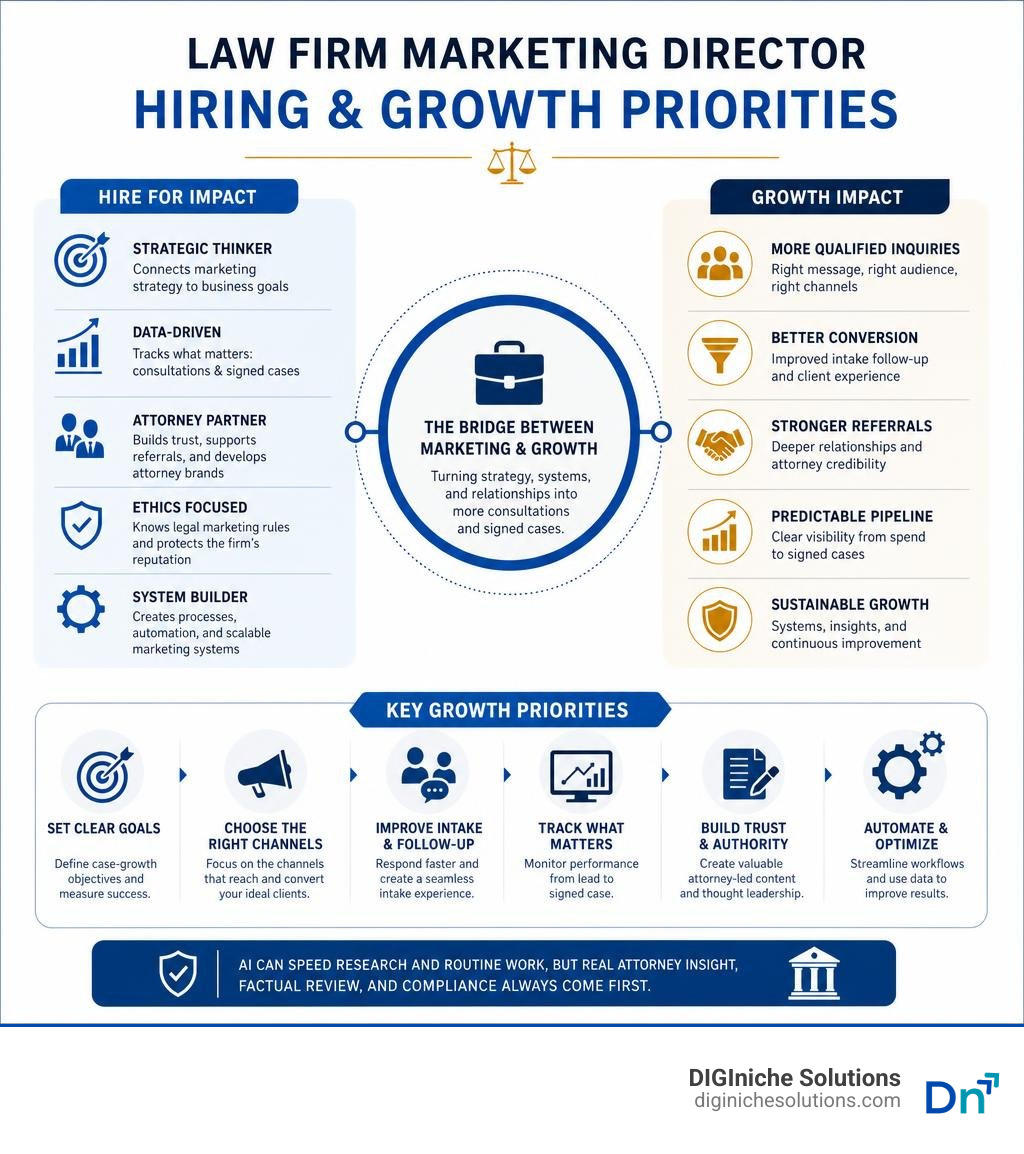
A law firm marketing director turns scattered marketing efforts into a clear growth system. For a small or mid-sized firm, that means setting case-growth goals, choosing the right channels, improving intake follow-up, tracking signed cases, and helping attorneys build trust with the clients they want most.
If you are hiring, look for someone who can connect strategy to revenue, not just manage social posts or order brochures. If you want to become one, build skills in business development, legal ethics compliance, CRM reporting, content strategy, attorney coaching, and marketing automation.
The role reaches far beyond advertising. A strong director helps shape the firm’s brand, supports proposals and referral relationships, creates useful attorney-led content, manages website and reputation priorities, and gives leadership a clear view of what marketing spend is producing. This matters because traffic, clicks, and leads are not the end goal – qualified consultations and signed cases are.
Modern legal marketing also requires careful coordination. AI can speed research and routine work, but legal content still needs real attorney insight, factual review, and compliance with applicable bar advertising rules. The best marketing leaders make the firm easier to find, easier to trust, and faster to respond when a prospect reaches out.
I am Frank Demming, and I have spent more than a decade helping attorneys build lead-generation systems through SEO, PPC, website optimization, and data-driven legal marketing. In this guide, I will explain what a law firm marketing director does, how to hire or become one, and how the role can create a more predictable pipeline of better cases.
Core Roles and Responsibilities of a Law Firm Marketing Director

A legal marketing director bridges the gap between high-level legal practice and sustainable business development. At its core, the position is not about pushing vanity metrics like impressions or social media likes. Instead, it focuses on positioning attorneys as definitive authorities in their respective practice areas and establishing operational systems that reliably convert prospective inquiries into retained clients.
Managing partners often find themselves caught in a cycle of juggling billable hours while attempting to oversee advertising campaigns, field media queries, and steer firm growth. A dedicated director steps in as an executive partner, orchestrating cross-practice marketing initiatives, facilitating lateral partner onboarding, and aligning individual attorney goals with the firm’s overarching revenue targets.
Strategic Business Development and RFP Management
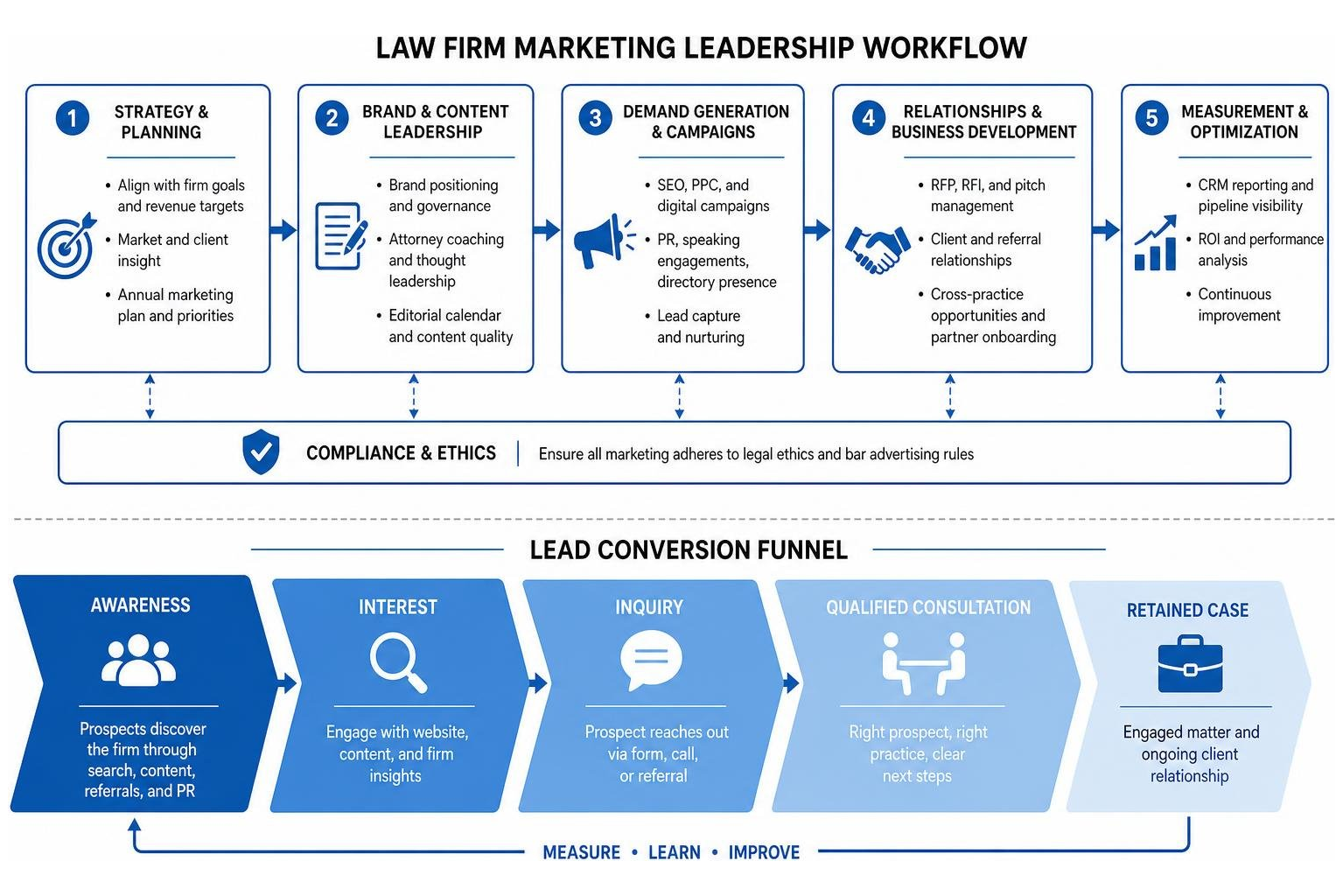
One of the most revenue-critical duties of the position involves spearheading client pitching and managing high-stakes Requests for Proposals (RFPs) and Requests for Information (RFIs). Winning institutional or corporate legal business requires far more than generic capability decks; it demands competitive intelligence, corporate relationship mapping, and tailored messaging that directly addresses client pain points.
An experienced director creates repeatable proposal workflows, builds structured pitch playbooks, and identifies cross-selling opportunities across complementary practice groups. Furthermore, they oversee critical third-party benchmark submissions—such as Chambers USA and The Legal 500—ensuring practice achievements and attorney profiles are framed strategically to drive commercial credibility. To align these complex efforts, leaders build comprehensive Marketing Plans that integrate formal business development targets with everyday promotional tactics.
Digital Brand Strategy and Marketing Operations
On the public-facing side, the marketing director protects and amplifies the firm’s reputation across search engines, digital media, and local communities. They oversee public relations, secure high-profile speaking engagements, manage directory citations, and direct thought leadership output to ensure consistent brand governance.
With content serving as the backbone of online client acquisition, marketing directors implement structured editorial calendars. Rather than churning out dry case summaries, they collaborate directly with attorneys to produce authoritative commentaries that solve tangible client problems. For an in-depth breakdown of high-impact editorial strategies, review our guide on Digital Marketing for Lawyers Content Marketing Tips.
Essential Skills, Tech Stacks, and Modern Toolsets
The modern legal marketing landscape has transformed into an operations-driven and technology-intensive discipline. Today’s marketing directors must balance strategic brand vision with deep technical fluency across analytics pipelines, digital attribution tools, and lead management platforms. Industry leaders like Danielle Wuschke Paige | Chief Marketing and Growth Officer | Nixon Peabody LLP illustrate how modern marketing executives blend brand storytelling with marketing technology and client experience systems to drive institutional growth.
Marketing Automation and CRM Infrastructure
A high-performing marketing department relies on an integrated technology stack to capture, nurture, and track client interactions from initial contact through case resolution. Modern directors manage platforms such as HubSpot CRM or LexisNexis InterAction to maintain clean relationship databases, configure automated lead scoring, and eliminate intake bottlenecks.
By leveraging workflow automation platforms like Zapier alongside call tracking software such as CallRail, directors ensure that inquiries from digital ads or organic search are instantly routed to the intake team. This level of automation is essential: industry benchmarks show that approximately 66% of prospective legal clients expect a response within a single day, and many make hiring decisions within hours of their initial search. Connecting call tracking, intake forms, and practice management software ensures no qualified matter slips through the cracks.
AI-Driven Content and Search Engine Optimization
Artificial intelligence has altered search behaviors and digital research workflows. While generative AI tools can assist with preliminary keyword grouping, competitive research, and topic outlining, high-performing legal marketing directors understand that published thought leadership must rely on original attorney commentary and deep jurisdictional insights.
With the emergence of Answer Engine Optimization (AEO), generic AI-generated articles fail to rank or earn consumer trust. Legal content must provide authentic professional judgment, reference local statutes accurately, and strictly adhere to state bar advertising ethics. Directors establish editorial review protocols to ensure all materials project genuine authority while maintaining full regulatory compliance.
In-House vs. Part-Time Retainer: Choosing the Right Leadership Model
Not every law firm requires or can sustain a full-time, six-figure executive overhead on day one. Selecting the appropriate leadership structure depends on practice size, caseload complexity, annual marketing budgets, and organizational readiness.
| Leadership Model | Best Suited For | Primary Benefits | Key Considerations |
|---|---|---|---|
| Full-Time Marketing Director | Mid-to-large firms (15+ attorneys) with dedicated marketing staff | Dedicated daily focus, direct internal collaboration, deep practice integration | High executive salary, benefits overhead, requires existing task delegation |
| Part-Time / Fractional Retainer (PTMD) | Small-to-midsize practices building scalable foundations | Executive CMO-level strategy, lower financial commitment, risk mitigation | Limited on-site hours, requires efficient internal administrative support |
| External Marketing Agency | Solo, boutique, and mid-sized practices scaling acquisition | Turnkey execution (SEO, PPC, web design, intake systems), multi-specialist team | Requires an internal attorney point of contact to approve campaigns |
Understanding these trade-offs allows managing partners to allocate capital intelligently. For actionable methods to align campaign spend with firm revenue, read our insights on How to Maximize Your Law Practice Marketing Budget.
What to Expect from a Fractional Law Firm Marketing Director
A Part-Time Marketing Director (PTMD) retainer serves as an effective bridge for practices that need seasoned guidance without committing to full-time executive compensation. Fractional directors conduct comprehensive marketing audits, resolve operational inefficiencies, train existing administrative personnel, and implement structured business development plans.
The average tenure for firms in a structured PTMD engagement is three years. Some firms leverage fractional leadership for six to twelve months to navigate leadership transitions or major RFP demands, while others use the program over three to six years as a stepping stone toward hiring a permanent in-house director. To maintain high focus and strategic exclusivity, reputable fractional programs often limit capacity to just 10 firms per year nationally.
Solo and boutique practices seeking external strategic clarity can explore how Law Firm Marketing Consultants the Secret Weapon for Solo and Small Firms deliver executive-grade leadership on a flexible basis.
How to Hire a Law Firm Marketing Director for Your Practice
When your firm reaches the scale to recruit an in-house director, vetting candidates requires looking beyond traditional agency resumes. You need a leader who understands the unique nuances of professional services marketing, partnership governance, and state bar advertising compliance.
Candidates possessing cross-disciplinary backgrounds—such as journalism, legal communications, or JD/MBA degrees—frequently excel because they combine sharp editorial judgment with business acumen. Active recruitment data from the 1000+ Law Firm Marketing Director Jobs in United States – LinkedIn directory indicates that of the 252 active legal marketing leadership listings nationwide, 138 are categorized as Mid-Senior level and 55 as Director-level, with hybrid work arrangements representing the majority (145 listings). Evaluate candidates on their ability to build CRM infrastructure, coach reluctant attorneys on business development, and translate analytics into signed legal retainers.
Career Paths, Compensation Benchmarks, and Measuring ROI

The career trajectory for legal marketers has evolved from tactical administrative support to core executive leadership. Marketing directors frequently ascend to Chief Marketing Officer (CMO) or Chief Growth Officer positions, actively participating in partnership strategy, geographic expansion, and lateral practice acquisitions.
Salary Expectations and Career Trajectories in Legal Marketing
Compensation for law firm marketing directors reflects the specialized demands of the role. Industry compensation data indicates that Director and Vice President-level marketing positions in major metropolitan areas command base salaries ranging from $125,000 to over $250,000 annually, depending on firm size, regional cost of living, and department scope.
Mid-Senior legal marketing managers stepping into director roles generally bring 8 to 12+ years of progressive professional services experience. Professional organizations such as the Legal Marketing Association (LMA) provide continuous education, benchmark studies, and leadership standards that help marketers advance toward executive practice management.
Key Performance Indicators and Revenue Attribution Metrics
To demonstrate tangible business impact to managing partners, marketing directors must anchor their reporting around revenue attribution rather than superficial traffic metrics. Core key performance indicators include:
- Signed Case Volume: The total number of fully retained clients directly tied to marketing initiatives.
- Client Acquisition Cost (CAC): Total marketing spend (including agency retainers, media spend, and operational software) divided by the number of signed cases.
- Intake Response Velocity: The average time elapsed between a prospective client’s form submission or call and the intake team’s initial contact.
- Consultation-to-Retainer Conversion Rate: The percentage of qualified consultations that convert into active, fee-generating clients.
- Cost Per Qualified Lead (CPQL): Spend efficiency measured specifically against prospective clients who meet practice area criteria, filtering out non-viable inquiries.
By maintaining transparent reporting across these metrics, directors ensure every dollar allocated to digital and traditional campaigns is directly accountable to firm profitability.
Frequently Asked Questions About Legal Marketing Leadership
What does a law firm marketing director do on a daily basis?
A law firm marketing director oversees growth campaigns, reviews daily intake reports, audits paid advertising spend, coordinates thought leadership drafts with attorneys, edits high-priority RFP proposals, and ensures all published content adheres to relevant ethical rules.
How does marketing director scope differ between boutique firms and Big Law?
In a boutique or mid-sized practice, a marketing director operates as a hands-on generalist, directly managing web updates, paid search budgets, CRM workflows, and local PR. In large Am Law firms, the director oversees specialized sub-teams handling lateral partner integration, global directory submissions, proposal departments, and corporate communications.
When should a growing practice transition from fractional consulting to a full-time director?
Firms typically transition to a full-time in-house marketing director when practice headcount reaches 15 to 20+ attorneys, annual marketing budgets exceed $200,000 to $300,000, and managing partners no longer have the capacity to coordinate external vendors, intake pipelines, and business development initiatives internally.
Conclusion
A successful law firm requires a deliberate growth framework that bridges high-quality legal representation with strategic marketing execution. Whether you hire an in-house director, engage a fractional marketing executive, or partner with a specialized agency, establishing clear accountability across your intake systems, brand positioning, and digital campaigns is essential for long-term practice expansion.
At DIGIniche Solutions, we help law firms build scalable client-acquisition systems using our proprietary V.E.R.A. Formula—driving Visibility, Engagement, Retention, and Amplification. If you want to enhance your search footprint, streamline intake conversions, and grow your caseload with qualified matters, explore our specialized SEO for Lawyers New Jersey solutions and discover how a data-driven marketing foundation can transform your practice.
