

What Does an Estate Planning Lawyer in NJ Actually Do?
Many people assume an attorney in this field only drafts a simple will when someone reaches retirement age. In reality, a qualified practitioner provides comprehensive legal counsel that shields your family from chaotic court interventions, unexpected tax bills, and stressful medical dilemmas.
When you partner with a legal professional in communities like Clifton, Passaic, or Wayne, their core responsibilities span several vital areas:
- Fiduciary Selection and Guidance: Helping you select and legally empower executors, trustees, guardians, and powers of attorney who possess the capability and character to manage your legacy.
- Surrogate Court Representation and Probate Navigation: Assisting executors through the local county Surrogate’s Court to ensure legal qualification, statutory compliance, and smooth administration.
- Asset Protection and Long-Term Care Planning: Structuring your property holdings to protect against future creditors, lawsuits, and the devastating costs of nursing home care.
- Incapacity Management: Setting up enforceable legal safeguards so that if you suffer an unexpected stroke, cognitive decline, or traumatic accident, trusted individuals can immediately make financial and medical decisions on your behalf without judicial red tape.
- Probate Avoidance Strategies: Implementing advanced instruments that keep your personal financial affairs private and allow assets to pass smoothly outside the public court system.
At DIGIniche Solutions, we work closely with attorneys across Passaic County and Bergen County to help them communicate these critical legal safeguards. For firms looking to expand their reach, learning how to attract more probate and trust clients through search optimization is essential for connecting with local families in need of proactive guidance.
Core Documents Drafted by an Estate Planning Lawyer in NJ
A complete estate plan is not a single generic form; it is an integrated portfolio of specialized legal instruments tailored to your exact family dynamic and financial reality.
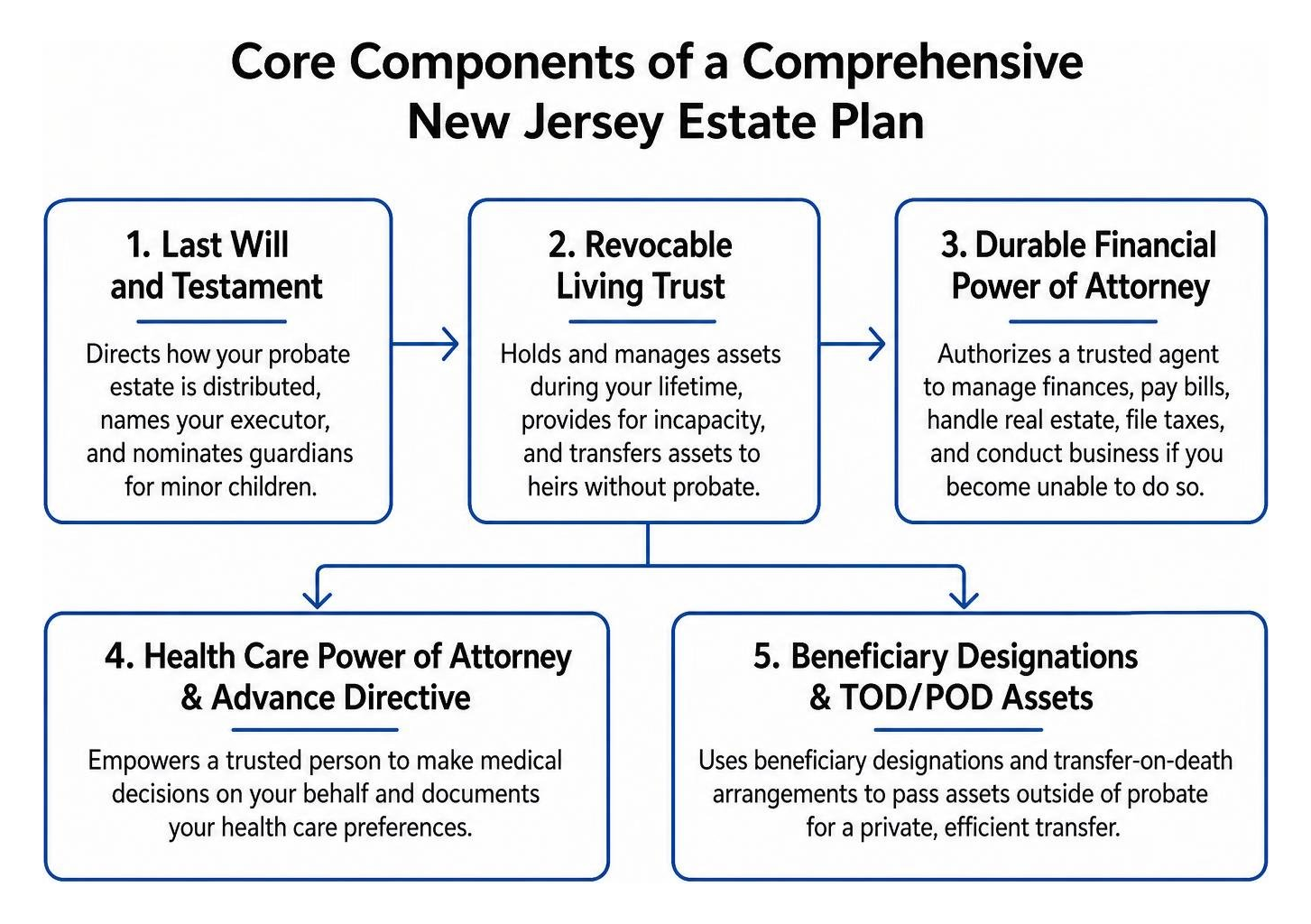
The primary instruments your attorney will draft include:
- Last Will and Testament: The foundational document that declares how your probate estate should be divided, names your executor to oversee the process, and officially nominates legal guardians for your minor children.
- Revocable Living Trust: A flexible private agreement holding legal title to your assets during your lifetime, managing them seamlessly if you become incapacitated, and transferring them directly to your heirs upon death without public court proceedings.
- Durable Financial Power of Attorney: A powerful legal tool granting a designated agent the authority to manage your bank accounts, pay bills, handle real estate, file taxes, and conduct business transactions if you cannot do so yourself.
- Advance Healthcare Directive (Living Will & Medical Proxy): A combined instrument appointing a trusted healthcare representative to make medical choices for you while clearly recording your specific wishes regarding ventilators, feeding tubes, and end-of-life care.
- HIPAA Authorizations: Specific privacy release forms that permit healthcare providers to discuss your diagnosis and medical prognosis with designated family members without violating federal privacy laws.
- Guardianship Designations: Formal legal instruments preventing a family custody fight by detailing exactly who should care for your minor children or dependent adult family members.
Wills vs. Trusts Under New Jersey Law
Understanding the operational differences between a will and a revocable living trust is critical for making informed legacy decisions. While 41% of people admit they lack confidence understanding how trusts work, the distinction boils down to timing, control, privacy, and court oversight.
A will only becomes active upon your death and must pass through the New Jersey Surrogate Court probate system before an executor can distribute assets. Conversely, a revocable living trust takes effect the moment it is signed and funded. Because the trust legally owns the assets, your successor trustee can step in immediately upon your death or incapacity to manage the property without court permission.
| Feature | Last Will and Testament | Revocable Living Trust |
|---|---|---|
| Effective Date | Only upon death | Immediately upon signing and funding |
| Probate Required? | Yes, must be admitted to Surrogate Court | No, bypasses probate entirely |
| Privacy Protection | Becomes a public court record | Completely private document |
| Incapacity Protection | None (wills do not operate during life) | Yes, successor trustee manages trust assets |
| Cost to Establish | Lower initial drafting cost | Higher initial drafting and funding cost |
| Asset Administration | Often requires 9 to 18 months | Can distribute or manage assets immediately |
Understanding New Jersey Probate, Intestacy, and Tax Laws
New Jersey’s probate system is relatively straightforward compared to neighboring states, but it still requires strict compliance with statutory procedural steps. When a resident dies with a valid will, the named executor must visit the Surrogate Court in the county where the decedent resided (such as Essex, Passaic, or Bergen County).
By New Jersey law, the Surrogate Court cannot formally admit a will to probate until at least ten full days have elapsed following the date of death. Once that statutory window passes, the executor presents the original will, an official death certificate, and a list of next of kin. If the will includes a self-proving affidavit signed before a notary public, the court can issue Letters Testamentary without tracking down the original witnesses.
These Letters Testamentary empower the executor to open estate bank accounts, settle valid creditor claims, liquidate or retitle real estate, and handle distributions. However, disputes over executor qualifications or ambiguous clauses can cause severe delays, which is why residents in high-density areas frequently consult reputable professionals like those featured among the Best Estate Planning Lawyers in Newark, NJ to steer clear of costly litigation.
New Jersey Inheritance Tax vs. Federal Estate Tax
There is widespread confusion surrounding death taxes in the Garden State. New Jersey officially repealed its standalone state estate tax for individuals dying on or after January 1, 2018. However, New Jersey continues to impose a distinct Inheritance Tax based entirely on the relationship between the deceased and the beneficiary.
New Jersey groups heirs into distinct beneficiary classifications:
- Class A Beneficiaries (Completely Exempt): Spouses, civil union partners, children, stepchildren, grandchildren, great-grandchildren, parents, and grandparents pay 0% New Jersey inheritance tax, regardless of the inheritance amount.
- Class C Beneficiaries (Taxed at 11% to 16%): Siblings, half-siblings, sons-in-law, and daughters-in-law receive a small $25,000 exemption. Inheritances exceeding that threshold are taxed progressively from 11% up to 16%.
- Class D Beneficiaries (Taxed at 15% to 16%): Nieces, nephews, cousins, unmarried domestic partners, friends, and non-relatives receive no exemption (unless the total transfer is under $500). Amounts up to $700,000 are taxed at 15%, and balances above that are taxed at 16%.
- Class E Beneficiaries (Completely Exempt): Qualified charitable institutions, religious organizations, and public educational bodies pay 0%.
On the federal level, the federal estate tax exemption sits at historically elevated levels ($13.99 million per individual for 2025). High-net-worth families must keep careful track of evolving federal legislation, as changes to these thresholds can expose sizable estates to a 40% federal tax bracket. With 87% of Americans expressing deep concern over how taxes will impact their heirs, strategic gifting, irrevocable life insurance trusts (ILITs), and spousal lifetime access trusts (SLATs) remain essential tools in an experienced attorney’s arsenal.
What Happens if You Die Without a Will in New Jersey?
When you die without an enforceable will in New Jersey, you pass away “intestate.” In this scenario, you forfeit all control over your property, your healthcare decisions during life, and the selection of who raises your minor children. The state of New Jersey imposes a statutory distribution hierarchy found under N.J.S.A. 3B:5-3 and 3B:5-4:
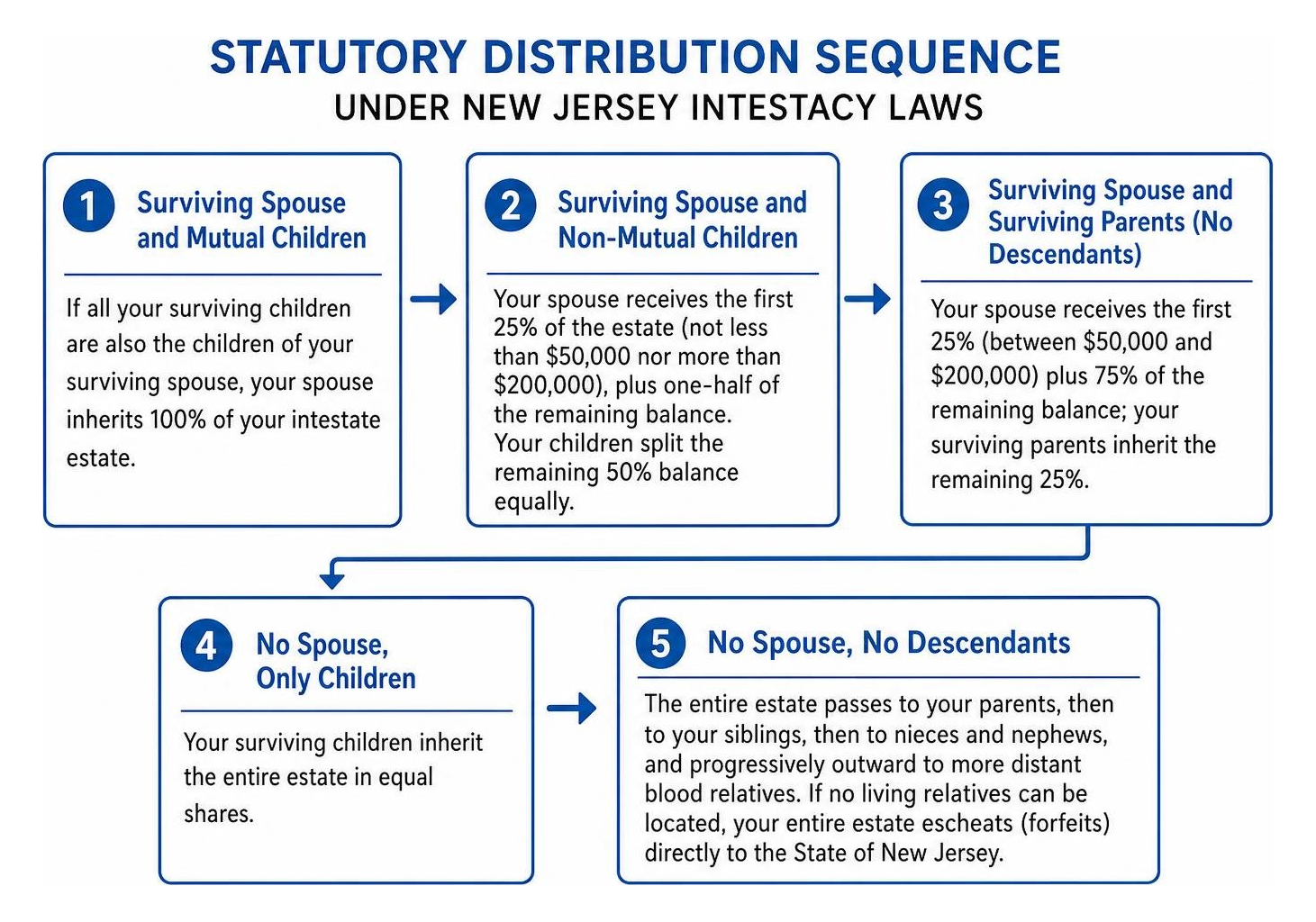
- Surviving Spouse and Mutual Children: If all your surviving children are also the children of your surviving spouse, your spouse inherits 100% of your intestate estate.
- Surviving Spouse and Non-Mutual Children: If you leave behind children from a prior relationship, your surviving spouse receives the first 25% of the estate (not less than $50,000 nor more than $200,000), plus one-half of the remaining balance. Your children split the remaining 50% balance equally.
- Surviving Spouse and Surviving Parents (No Descendants): Your spouse receives the first 25% (between $50,000 and $200,000) plus 75% of the remaining balance; your surviving parents inherit the remaining 25%.
- No Spouse, Only Children: Your surviving children inherit the entire estate in equal shares.
- No Spouse, No Descendants: The entire estate passes to your parents, then to your siblings, then to nieces and nephews, and progressively outward to more distant blood relatives. If no living relatives can be located, your entire estate escheats (forfeits) directly to the State of New Jersey.
Beyond asset division, dying intestate means the Surrogate Court must appoint an estate administrator, which frequently requires posting an expensive surety bond paid from estate funds. Worst of all, if both parents pass away without a will, a family court judge—who does not know your personal values—will decide who raises your minor children.
Specialized Planning: Veterans, Blended Families, and Special Needs
Cookie-cutter legal templates downloaded from the internet cannot account for unique family realities or complex federal benefit rules. Specialized legal planning ensures that your legacy supports your loved ones without causing unintended legal or financial harm.
When to Consult an Estate Planning Lawyer in NJ for Complex Estates
Complex estate structures require customized drafting to prevent emotional family disputes and financial losses:
- Blended Families and Second Marriages: Without customized trust planning, assets left outright to a second spouse may ultimately be inherited by that spouse’s own children upon their death, inadvertently disinheriting the children from your first marriage. Qualified Terminable Interest Property (QTIP) trusts provide income to a surviving spouse for life while preserving the underlying principal for your biological children.
- Closely Held Business Succession: Business owners across Nutley, Bloomfield, and Paterson must integrate buy-sell agreements, cross-purchase plans, and key-person coverage to prevent a deceased partner’s unvetted family members from seizing control of daily commercial operations. Law practices building these complex services can study why your law firm needs topic clusters to establish real authority to position their specialized corporate-estate services effectively.
- Multi-State and International Real Estate: Holding vacation properties down the Jersey Shore or out-of-state requires ancillary probate proceedings unless those parcels are deeded into a revocable living trust.
Special Needs Trusts and Veteran Estate Planning
Families supporting a child or adult relative with disabilities face unique challenges. Leaving an outright monetary inheritance can instantly disqualify an individual from need-based public assistance programs like Supplemental Security Income (SSI) and Medicaid.
An attorney can draft a First-Party or Third-Party Special Needs Trust (SNT). This trust holds financial assets to pay for specialized therapies, travel, electronics, entertainment, and personal care without interfering with baseline government benefits.
For military veterans residing in New Jersey, estate plans must coordinate VA pensions, disability compensation, Dependency and Indemnity Compensation (DIC), and specialized burial honors. Veterans requiring long-term care can utilize specific asset-restructuring tools that protect their primary residence and liquid savings while qualifying for the VA Aid and Attendance benefit. For compassionate local counsel in Union County, families often turn to an Estate Planning & Elder Law Attorney in Elizabeth, NJ | The Himmel Law Firm to integrate healthcare directives with long-term Medicaid spend-down plans.
Cost of Estate Planning in New Jersey and Attorney Selection
The cost of drafting an estate plan in New Jersey varies depending on the complexity of your family structure, your total asset value, and the fee model used by your attorney.

Across Northern and Central New Jersey, legal fee arrangements typically fall into two main categories:
- Transparent Flat-Fee Packages: Many modern practitioners offer predictable flat fees for core estate planning packages. A basic package for an individual (comprising a simple will, power of attorney, and healthcare directive) generally ranges from $600 to $1,500. For a married couple, complete reciprocal packages generally range from $950 to $2,500. Comprehensive revocable living trust packages (including deed preparation, trust agreements, and pour-over wills) typically range between $2,500 and $6,000+.
- Hourly Billing Rates: Complex estates involving tax controversies, multi-tiered business entities, international assets, or contested guardianship battles are usually billed at standard hourly rates ranging from $350 to $650+ per hour, supported by an initial retainer deposit.
When vetting an attorney to handle your family’s future, consider asking these essential questions during your consultation:
- What percentage of your daily legal practice is dedicated specifically to New Jersey trusts, estates, and elder law?
- Do you charge a flat fee for drafting and revising documents, or do you bill by the hour for follow-up questions?
- Does your trust package include formal funding assistance to help me retitle real estate deeds and update bank beneficiary designations?
- How frequently should we review my estate documents, and do you notify clients when New Jersey statutes change?
- If my loved ones need assistance with probate administration later, will your firm guide the executor through the Surrogate Court process?
Frequently Asked Questions About Estate Planning in New Jersey
Do I need an estate plan in New Jersey if I am not wealthy?
Yes. Estate planning is fundamentally about maintaining personal control over your life, not just managing massive fortunes. If you do not have an estate plan, the State of New Jersey relies on statutory defaults to decide who makes your medical decisions if you fall unconscious, who handles your bank accounts if you become incapacitated, and who steps in to raise your minor children.
40% of Americans say passing down family values is their top priority—ahead of any purely financial goal. Having foundational documents in place saves your loved ones from the painful expense of filing emergency guardianship petitions at the county courthouse.
How long does the probate process take in New Jersey?
In an uncontested matter with an original, self-proving will, the New Jersey Surrogate Court can officially admit the will to probate and issue Letters Testamentary within a few weeks following the statutory 10-day waiting period.
However, fully administering an estate—which involves establishing dedicated estate accounts, identifying and valuing assets, notifying creditors, liquidating real estate, filing relevant tax returns, and obtaining formal refunding bonds and releases from all beneficiaries—typically takes between 9 and 18 months. If family members contest the will or dispute asset valuations, the probate administration timeline can stretch on for multiple years.
How often should I update my New Jersey estate plan?
As a general rule, you should review your estate planning documents with an attorney every 3 to 5 years. In addition to regular timeline reviews, you should immediately update your estate plan whenever you experience major life transitions, including:
- Marriage, remarriage, separation, or divorce
- The birth, adoption, or maturation of children or grandchildren
- The death, severe illness, or incapacity of an appointed executor, trustee, or guardian
- Purchasing real estate in another state or forming a new business entity
- Receiving a sizable financial inheritance or sudden windfall
- Significant updates to federal tax exemptions or New Jersey elder law regulations
Conclusion
Securing your family’s future through intentional, comprehensive estate planning provides lasting peace of mind. By taking the time to draft a clear will, establish protective trusts, and formalize powers of attorney, you eliminate future confusion, protect hard-earned assets from avoidable taxes, and safeguard the people who matter most.
At DIGIniche Solutions, we are dedicated to helping law practices thrive across New Jersey, including Wayne, Clifton, Passaic, Lyndhurst, Paterson, Bloomfield, Newark, Elizabeth, and Nutley. Our proprietary V.E.R.A. Formula delivers unmatched visibility, engagement, retention, and amplification to create scalable client-growth ecosystems for attorneys. If your legal firm is ready to establish authority, outrank competitors, and connect with families searching for trusted guidance, discover our proven approaches to SEO for lawyers New Jersey today.
