

When Debt Becomes Overwhelming: What New Jersey Residents Need to Know
Finding a qualified New Jersey bankruptcy lawyer is often the most important step you can take when debt spirals out of control. Here’s a quick overview to address your most pressing questions:
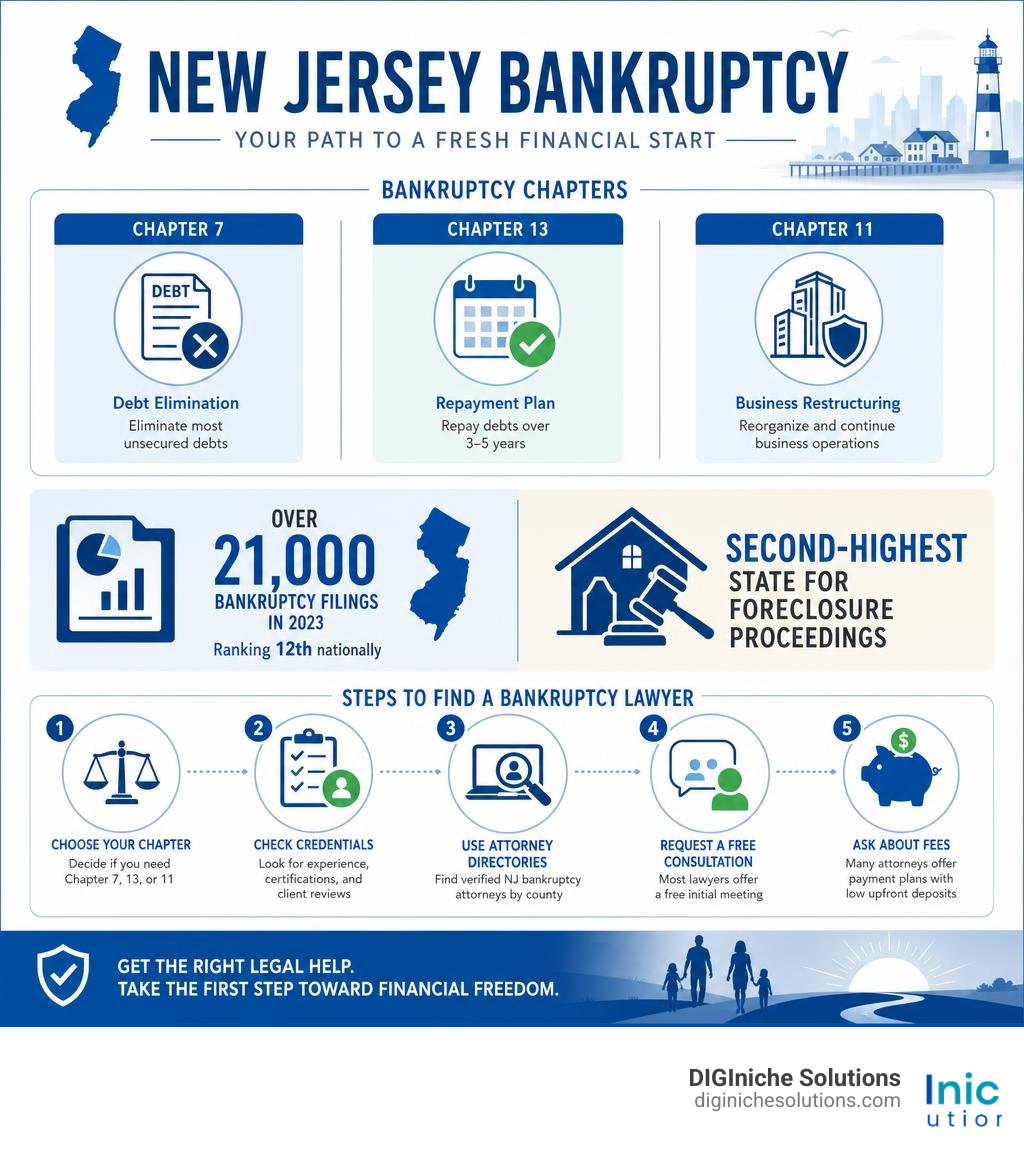
Quick Answer: How to Find a New Jersey Bankruptcy Lawyer
- Search by chapter type – Decide if you need Chapter 7 (debt elimination), Chapter 13 (repayment plan), or Chapter 11 (business restructuring)
- Check credentials – Look for board certification, years of experience, and client reviews
- Use attorney directories – Sites like Justia list verified NJ bankruptcy attorneys by county
- Request a free consultation – Most NJ bankruptcy lawyers offer free initial consultations
- Ask about fees – Many attorneys offer payment plans with low upfront deposits
New Jersey residents are under real financial pressure. The state recorded over 21,000 bankruptcy filings in 2023 — ranking 12th nationally. It also holds the troubling distinction of being the second-highest state for foreclosure proceedings. That means tens of thousands of families and business owners are navigating serious debt challenges every year.
And yet, many people wait too long to get help. Some try to handle bankruptcy filings on their own — only to lose critical protections because of a missed document or a misunderstood court rule.
The hard truth is this: bankruptcy law is highly technical. A single misstep can result in your case being dismissed — and you could lose the right to file again.
This guide is here to help you understand your options, know what to look for in an attorney, and take confident action toward a fresh financial start.
I’m Frank Demming, a legal marketing specialist with over a decade of experience helping law firms — including New Jersey bankruptcy lawyer practices — build stronger online visibility and attract more qualified clients. In this guide, I’ll walk you through everything you need to know to find the right legal representation for your situation.
Understanding Bankruptcy Options in the Garden State
Bankruptcy is not a sign of personal failure. Historically, the concept of debt relief dates back to biblical times, even inspiring the Italian phrase banca rotta (“broken bench”), which referred to the physical destruction of a bankrupt money dealer’s table. Today, it is a highly structured, federal legal mechanism designed to give individuals and businesses a genuine fresh start.
In New Jersey, the bankruptcy system acts as a financial reset button. The moment your New Jersey bankruptcy lawyer files your petition, a powerful legal shield called the automatic stay goes into effect. By federal law, the automatic stay instantly halts all collection actions, including:
- Harassing phone calls and collection letters
- Creditor lawsuits and bank levies
- Wage garnishments
- Utility shutoffs
- Foreclosure proceedings and sheriff’s sales
Depending on your financial situation, your assets, and your goals, you will generally look at one of three primary bankruptcy chapters.
Chapter 7 Bankruptcy: The Liquidating Fresh Start
Chapter 7 bankruptcy is the most common form of consumer debt relief in New Jersey, accounting for approximately 60% of all consumer bankruptcy cases in the state.
Often referred to as a “liquidation” bankruptcy, Chapter 7 allows you to completely eliminate (discharge) unsecured debts like credit card balances, medical bills, personal loans, and certain older tax debts. While a court-appointed trustee technically has the authority to sell non-exempt assets to pay back creditors, the vast majority of consumer filings are designated as “no-asset” cases. This means debtors keep all of their personal belongings, cars, and homes because they fall within protected legal exemptions. The entire process is remarkably swift, typically taking less than four months to secure a complete discharge.
Chapter 13 Bankruptcy: Reorganization and Foreclosure Defense
If you do not qualify for Chapter 7 due to a higher disposable income, or if you are fighting to save your home from a pending foreclosure, Chapter 13 bankruptcy is your primary tool.
Chapter 13 is a reorganization bankruptcy. Instead of wiping out your debts immediately, your attorney helps you draft a customized, court-approved repayment plan lasting between three and five years. This plan allows you to catch up on missed mortgage or car payments over time while paying a reduced, affordable percentage of your unsecured debts. It is a highly effective tool for foreclosure defense, stopping real estate tax sales, and managing vehicle loan arrears.
Chapter 11 and Subchapter V: Reorganizing Businesses and High-Debt Individuals
Chapter 11 bankruptcy serves businesses, corporations, and individuals whose debt levels exceed the strict statutory limits of Chapter 13. It allows a business to continue operating while restructuring its debts, renegotiating unfavorable leases, rejecting bad contracts, and stripping certain liens.
For small businesses, Chapter 11 Subchapter V offers a streamlined, significantly less expensive path to reorganization, making it easier for local New Jersey business owners to survive economic downturns without closing their doors.
Comparing Chapter 7 and Chapter 13 in New Jersey
| Feature | Chapter 7 Bankruptcy | Chapter 13 Bankruptcy |
|---|---|---|
| Primary Purpose | Eliminate unsecured debt quickly | Save assets, catch up on secured arrears, reorganize |
| Typical Duration | Under 4 months | 3 to 5 years |
| Key Benefit | Fast discharge of medical bills, credit cards | Stops foreclosure, restructures car and mortgage payments |
| NJ Filing Share | ~60% of consumer cases | ~40% of consumer cases |
| Eligibility | Must pass the “Means Test” | Must have regular income to support a payment plan |
Why You Need a Qualified New Jersey Bankruptcy Lawyer

While the law technically allows individuals to file for bankruptcy pro se (representing themselves), doing so is highly risky. The U.S. Bankruptcy Court for the District of New Jersey actively warns debtors about the immense difficulty of navigating these rules alone. You can read the official court perspective on the risks of self-representation directly on the Finding a Lawyer | District of New Jersey – U.S. Bankruptcy Court – NJ information portal.
A single procedural error — such as failing to file a required credit counseling certificate within the strict statutory timeline — can lead to your case being dismissed. Worse, a dismissal can cause you to lose the protection of the automatic stay, leaving your home, bank accounts, and wages vulnerable to immediate creditor actions.
An experienced New Jersey bankruptcy lawyer provides invaluable services, including:
- The Means Test Evaluation: Determining whether your household income qualifies you for Chapter 7 or requires a Chapter 13 filing.
- Exemption Planning: Strategically applying federal or state bankruptcy exemptions to ensure you do not lose your home, car, or personal savings.
- Creditor Management: Handling all communications and legal paperwork so you don’t have to face aggressive collection agencies.
- Credit Counseling Guidance: Coordinating the mandatory pre-filing and post-filing financial education courses.
For attorneys looking to help these stressed individuals find their services, building a clear, educational online presence is vital. If you run a legal practice, check out our Beginner’s Guide to Bankruptcy Attorney Marketing to learn how to reach families in need of your debt relief services.
How to Choose the Right Legal Representation

Choosing the right New Jersey bankruptcy lawyer requires looking beyond basic advertisements. You want an attorney who specializes in bankruptcy law, understands local court dynamics, and treats you with compassion.
When evaluating potential attorneys, look for the following criteria:
- Board Certification: Attorneys who are Board Certified in Consumer Bankruptcy Law by the American Board of Certification have passed rigorous testing and demonstrated exceptional case results. This certification is rare; for instance, specialized practitioners like Ralph A. Ferro Jr., Esq represent some of the highly vetted, board-certified options in Northern New Jersey.
- Focused Practice: Avoid general practitioners who handle divorces, traffic tickets, and real estate transactions alongside occasional bankruptcies. You want a law firm that focuses its practice heavily on debt relief and bankruptcy.
- Flexible Fees and Payment Plans: Many reputable bankruptcy lawyers offer flexible payment structures. It is common for firms to accept low upfront deposits (sometimes as low as $200) and establish manageable payment plans for the remaining legal fees.
- Direct Communication: Ensure you will work directly with your attorney rather than being passed off entirely to paralegals or junior associates.
Finding a New Jersey Bankruptcy Lawyer by Region
New Jersey’s bankruptcy courts are divided into three vicinages: Newark, Trenton, and Camden. Depending on where you live, you will want a local attorney who regularly practices before the trustees in your specific region.
- Northern New Jersey (Essex, Monmouth, Bergen, Hudson Counties): If you reside in Northern or Coastal Jersey, you’ll want representation familiar with the Newark or Trenton court systems. Firms like Lombardi Law Firm Bankruptcy serve Essex and Monmouth Counties, while the Law Office of Stuart Nachbar provides personalized consumer bankruptcy counsel to residents across Northern and Central Jersey communities.
- Southern & Central New Jersey (Burlington, Camden, Gloucester Counties): Southern New Jersey presents unique economic landscapes. For example, Mount Laurel boasts a median household income of $103,399 — significantly higher than the national average of $69,021. Yet, high-income regions are not immune to debt, often due to high property taxes and substantial mortgages. Residents in these areas can find localized guidance through resources like Sadek Law Offices Mount Laurel or consult regional directories such as Best Bankruptcy Lawyers in New Jersey – Justia to compare local advocates. Additionally, long-standing practitioners like Lee M. Perlman, Esq. offer deep regional experience across South Jersey.
What to Expect in Your Consultation with a New Jersey Bankruptcy Lawyer
Your initial consultation is your opportunity to evaluate the attorney and get a clear picture of your financial recovery strategy. Most firms, including The Law Offices of Roger J. Yehl, offer free initial strategy sessions via phone, video, or in-person meetings.
To make the most of your 15-to-20-minute consultation, you should gather and present the following financial documents:
- Income Records: Your pay stubs or proof of income for the last six months.
- Tax Returns: Your federal and state tax returns for the last three years.
- Debt Statements: Recent credit card statements, medical bills, mortgage statements, car loan details, and student loan balances.
- Legal Notices: Any active lawsuits, foreclosure complaints, foreclosure notices, or wage garnishment orders.
Frequently Asked Questions About New Jersey Bankruptcy
Will I lose my home or car if I file for bankruptcy in New Jersey?
In the vast majority of cases, no. Bankruptcy laws include exemptions specifically designed to protect your primary residence and personal vehicle.
If you file Chapter 7, you can keep your home and car as long as your equity does not exceed the allowed exemptions and you remain current on your monthly payments. If you are behind on your mortgage, Chapter 13 is the preferred route, allowing you to cure your mortgage arrears over a 3-to-5-year period while keeping your home. Experienced advocates like Lee Abt, NJ Bankruptcy Attorney specialize in helping clients debunk the myth that filing for bankruptcy means losing everything you own.
How long does the bankruptcy process take in NJ?
The timeline depends heavily on the chapter you file:
- Chapter 7: Usually takes about four months from the date of filing to receive a formal discharge order from the court.
- Chapter 13: Lasts between three and five years, matching the duration of your court-approved repayment plan.
Regardless of the chapter, you will only be required to attend one brief court meeting — the 341 Meeting of Creditors. This meeting is typically conducted remotely via Zoom or phone, lasts only 5 to 10 minutes, and is overseen by the bankruptcy trustee rather than a judge. Local firms like the Law Office of Anthony J. Vignier can guide you through preparing for this meeting to ensure a seamless process.
Are there free or pro bono bankruptcy services available in New Jersey?
Yes. If you cannot afford a private attorney, you may qualify for free legal representation. Organizations like Legal Services of New Jersey (LSNJ) and various county bar associations offer pro bono bankruptcy programs for low-income residents who meet specific financial guidelines. You can access these resources and legal aid directories through the federal bankruptcy court’s official website.
Conclusion: Taking the First Step Toward Financial Recovery
Filing for bankruptcy is not an ending; it is a proactive, legal step toward rebuilding your financial life. Many individuals find that their credit scores recover far faster after discharging their debts than they ever would have while struggling to make minimum payments on insurmountable balances.
At DIGIniche Solutions, we understand that local legal practices play a crucial role in helping New Jersey families navigate these difficult moments. If you are a bankruptcy attorney looking to connect with clients searching for a fresh start, our proprietary V.E.R.A. Formula (Visibility, Engagement, Retention, and Amplification) can help build a scalable client-growth ecosystem for your firm.
From specialized digital campaigns to high-converting web presence, we help lawyers stand out in a competitive market. Explore our tailored strategies for growth on our SEO for Lawyers New Jersey page, and let us help you reach the people who need your legal expertise the most.
