

Why Search Optimization Differs for Debt Relief Law Firms
To succeed with SEO for bankruptcy attorneys and generate a steady flow of qualified clients, law practices must target three tiers of crisis-to-transactional keyword intent, structure dedicated Chapter 7 and Chapter 13 topic silos, dominate local Google Map pack visibility, and adhere to mandatory 11 U.S.C. § 528 regulatory disclosures. When distressed filers face immediate financial crises like wage garnishment or foreclosure, they need fast, confidential confirmation of available legal relief.
Optimizing a digital presence for a debt relief practice is entirely distinct from running marketing for personal injury or criminal defense. In personal injury, searchers look for an aggressive champion to win a settlement following a sudden accident. In contrast, bankruptcy clients experience a private, prolonged crisis. They carry significant emotional shame, delay their decisions for months, and then experience an acute breaking point that demands immediate resolution.
When that breaking point hits, conversion velocity accelerates dramatically. An individual whose paycheck was garnished on Friday or who received a final sheriff’s sale notice will not spend three weeks evaluating brochures. They need immediate confirmation that legal relief is real, accessible, and confidential.
At the same time, bankruptcy operates in federal bankruptcy courts governed by specific district jurisdictions, yet user search behavior remains hyper-local. Aligning your digital marketing with this dynamic requires balancing deep empathy, geographic relevance, and procedural precision.
Understanding Debtor Search Psychology and Late-Night Crises
Most bankruptcy searches do not occur during standard business hours. Instead, prospective filers search at 11 PM or 2 AM from a mobile phone at the kitchen table, surrounded by past-due bills, collection letters, and court notices.
This late-night search behavior defines the emotional state of your target audience:
- High shame and isolation: Debtors rarely ask friends, family, or colleagues for word-of-mouth recommendations. Search engines act as their sole confidential confidant.
- Acute panic vs. avoidance: Prospects alternate between ignoring debt collectors and desperately searching for emergency solutions to stop wage garnishments, repossession, or utility shutoffs.
- Extreme mobile reliance: Over 60% of debt relief queries happen on smartphones, often under strained network conditions on older mobile devices.
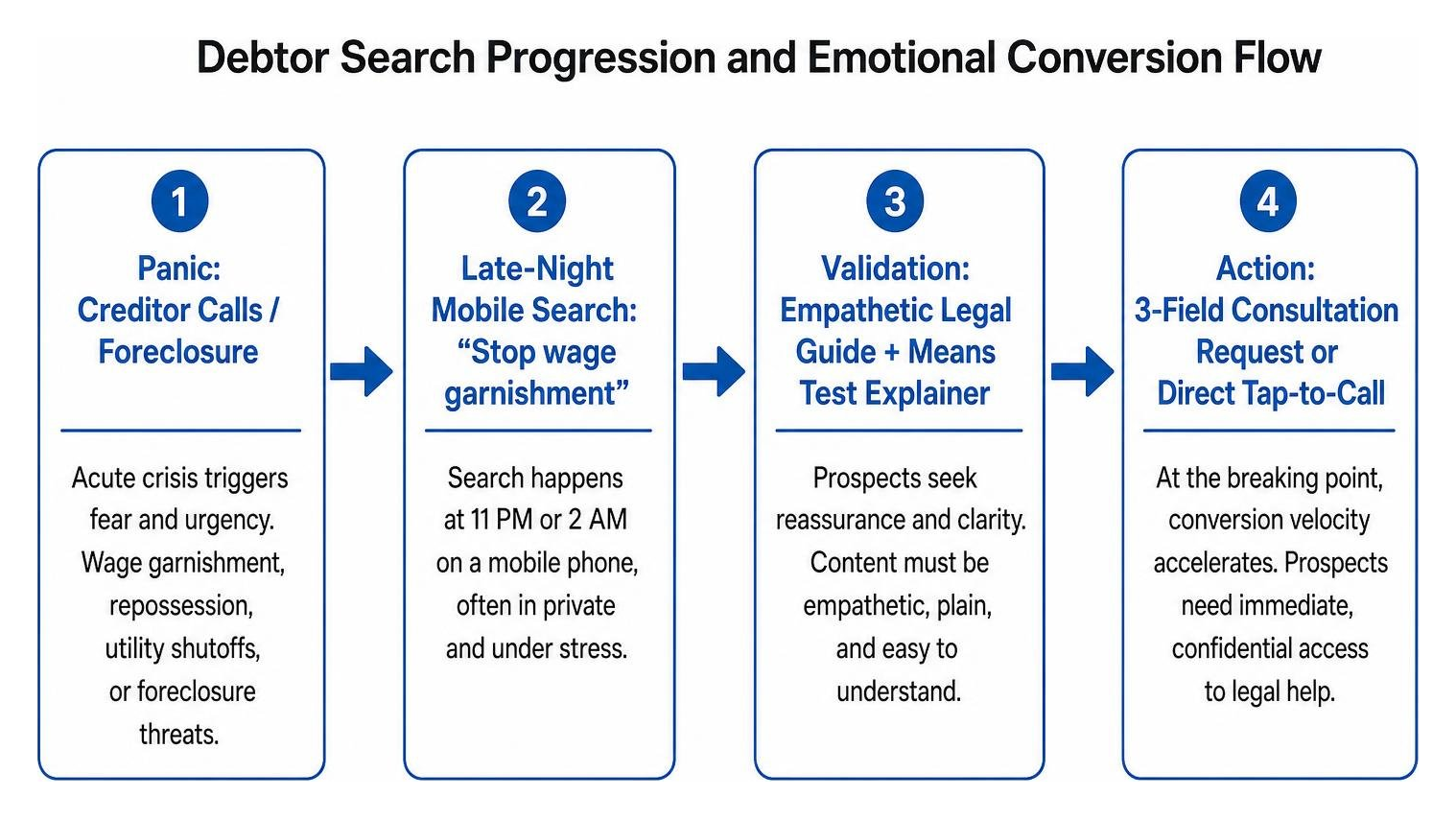
Understanding this emotional arc is essential. Our Beginners Guide to Bankruptcy Attorney Marketing highlights why your copy must never rely on aggressive sales tactics. Reassurance, clarity, and rapid access to consultation options win over distressed searchers every single time.
Regulatory Disclosures and 11 U.S.C. § 528 Compliance
Because bankruptcy attorneys fall under the federal statutory classification of “Debt Relief Agencies,” search optimization in this niche involves strict regulatory boundaries. Under 11 U.S.C. § 528(a)(4), any marketing asset promoting debt relief or bankruptcy services must clearly disclose:
“We are a debt relief agency. We help people file for bankruptcy relief under the Bankruptcy Code.”
From an algorithmic perspective, search engines categorize bankruptcy content under the strictest Your Money or Your Life (YMYL) evaluation standards. Google’s quality algorithms prioritize sites displaying high Experience, Expertise, Authoritativeness, and Trustworthiness (E-E-A-T). Omitting federal statutory disclosures, displaying outdated means test income thresholds, or making unsubstantiated claims (such as promising to “erase all debt effortlessly”) triggers algorithmic penalties and state bar ethics violations.
Incorporating proper disclosures directly into website footers, intake form microcopy, and structured metadata reinforces algorithmic trust while keeping your practice fully compliant. For a deeper breakdown of ethical positioning, review our guide on How to Win Local Clients Without Crossing Ethical Lines in Legal SEO.
The Multi-Step Blueprint of SEO for Bankruptcy Attorneys
Building an authoritative organic search engine requires a structured framework that guides prospective filers from initial panic to signed retainers.
We execute this using our proprietary V.E.R.A. Formula (Visibility, Engagement, Retention, Amplification), ensuring your website does not merely generate arbitrary traffic, but filters and converts qualified filers.
Keyword Strategy and Intent Mapping in SEO for Bankruptcy Attorneys
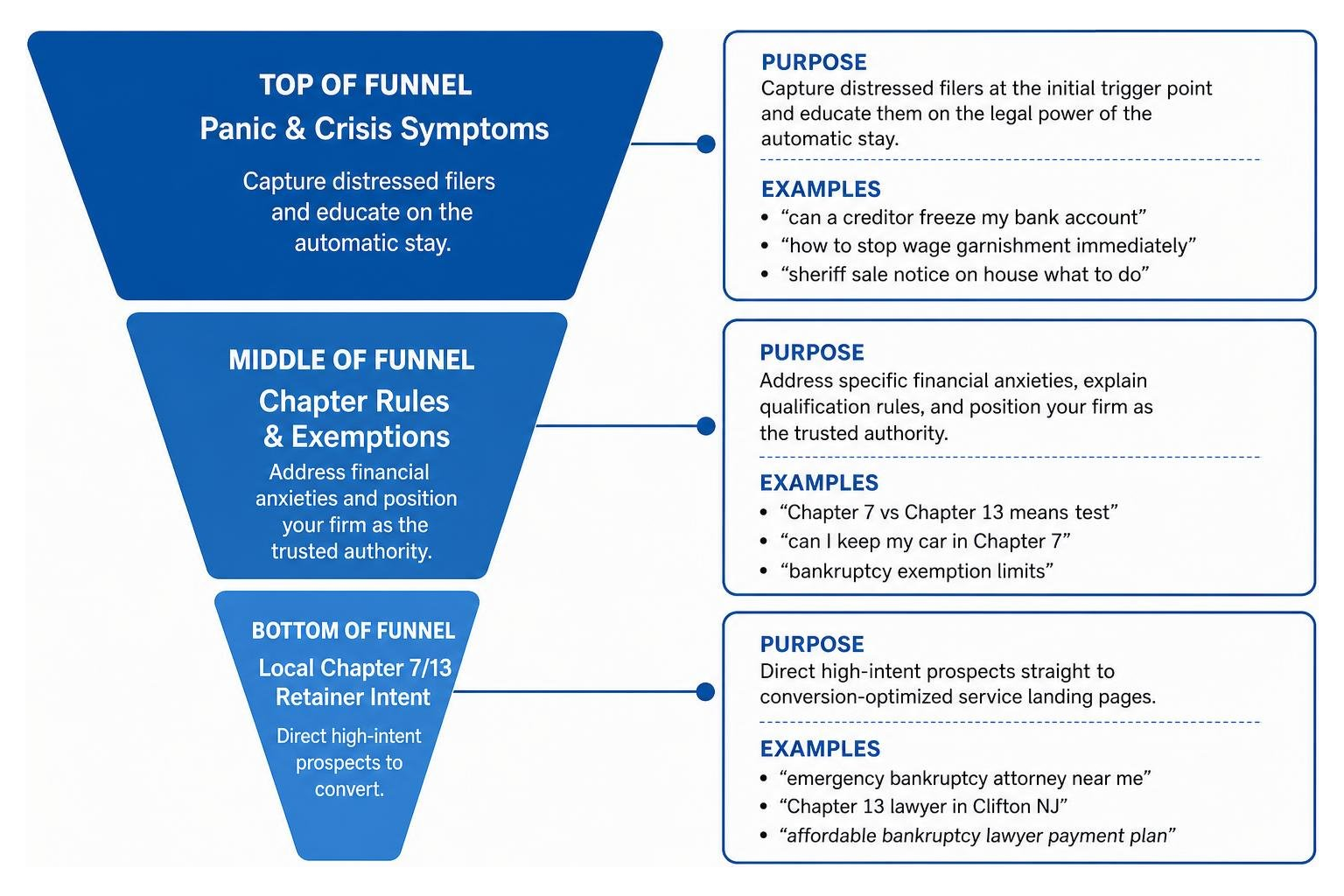
Effective keyword research for bankruptcy attorneys requires segmenting search queries across three distinct intent tiers:
- Panic & Symptom Queries (Top-of-Funnel):
- Examples: “can a creditor freeze my bank account,” “how to stop wage garnishment immediately,” “sheriff sale notice on house what to do.”
- Purpose: Capture distressed filers at the initial trigger point and educate them on the legal power of the automatic stay.
- Evaluation & Option Queries (Middle-of-Funnel):
- Examples: “Chapter 7 vs Chapter 13 means test,” “can I keep my car in Chapter 7,” “bankruptcy exemption limits.”
- Purpose: Address specific financial anxieties, explain qualification rules, and position your firm as the trusted authority.
- Transactional Hiring Queries (Bottom-of-Funnel):
- Examples: “emergency bankruptcy attorney near me,” “Chapter 13 lawyer in Clifton NJ,” “affordable bankruptcy lawyer payment plan.”
- Purpose: Direct high-intent prospects straight to conversion-optimized service landing pages.
To attract wage earners capable of funding retainers or Chapter 13 repayment plans, apply negative filtering within your content. Avoid targeting phrases like “free bankruptcy filing” or “pro bono debt relief,” which attract non-viable leads and burden your intake staff. Instead, optimize for terms like “bankruptcy attorney payment options” and “Chapter 13 debt reorganization.”
For detailed keyword discovery frameworks, read our guide on How to Pick Attorney Blog Keywords That Turn Readers Into Clients.
Topic Clusters for Chapter 7 and Chapter 13 Filings
Search engines evaluate legal websites based on topical completeness. Rather than relying on a single, generic “Bankruptcy Services” page, build dedicated practice silos structured around clear semantic hierarchies:
- Chapter 7 Liquidation Silo:
- Pillar Page: Complete Guide to Chapter 7 Bankruptcy in [Target Area]
- Supporting Nodes:
- The Bankruptcy Means Test: Income Limits and Qualification Rules
- State Property Exemptions: Protecting Your Home, Car, and Retirement
- Non-Dischargeable vs. Dischargeable Debts Explained
- Chapter 13 Reorganization Silo:
- Pillar Page: How Chapter 13 Reorganizes Debt and Protects Assets
- Supporting Nodes:
- Stopping Foreclosure: Curing Mortgage Arrears Over 3 to 5 Years
- Vehicle Cramdowns: Lowering Auto Loan Balances Through Chapter 13
- Understanding the 36 to 60-Month Repayment Plan Calculation
Every supporting article must incorporate bidirectional internal links back to the primary chapter pillar page. To understand how structured content models create commanding domain authority, see Why Your Law Firm Needs Topic Clusters to Establish Real Authority.
Technical Foundations of SEO for Bankruptcy Attorneys
When a distressed user visits your website, technical friction destroys conversion rates. If a page takes five seconds to load, a user in crisis will hit the back button and call the next firm on the search results page.
Key technical requirements for bankruptcy law firms include:
- Core Web Vitals & Mobile Speed: Achieve a Largest Contentful Paint (LCP) under 2.5 seconds and eliminate Cumulative Layout Shift (CLS). Clean code and optimized media assets ensure rapid loading even on older mobile devices.
- Structured Legal Schema (JSON-LD): Implement
LegalService,Attorney, andFAQPageschema markup. This helps Google’s neural matching systems interpret your physical address, bar credentials, accepted payment methods, and practice jurisdictions for rich snippet inclusion. - Low-Friction Intake Design: Position direct tap-to-call buttons permanently on mobile screens and limit intake forms to three essential fields (Name, Phone Number, Brief Debt Description).
A complete bankruptcy SEO audit should verify technical infrastructure, on-page optimization, compliance language, local signals, and conversion pathways before new content campaigns scale.
Dominating Local Search and Google Business Profile for Debt Relief
Because bankruptcy is local, dominating the Google Local Map 3-Pack is the fastest way to drive immediate consultation calls.
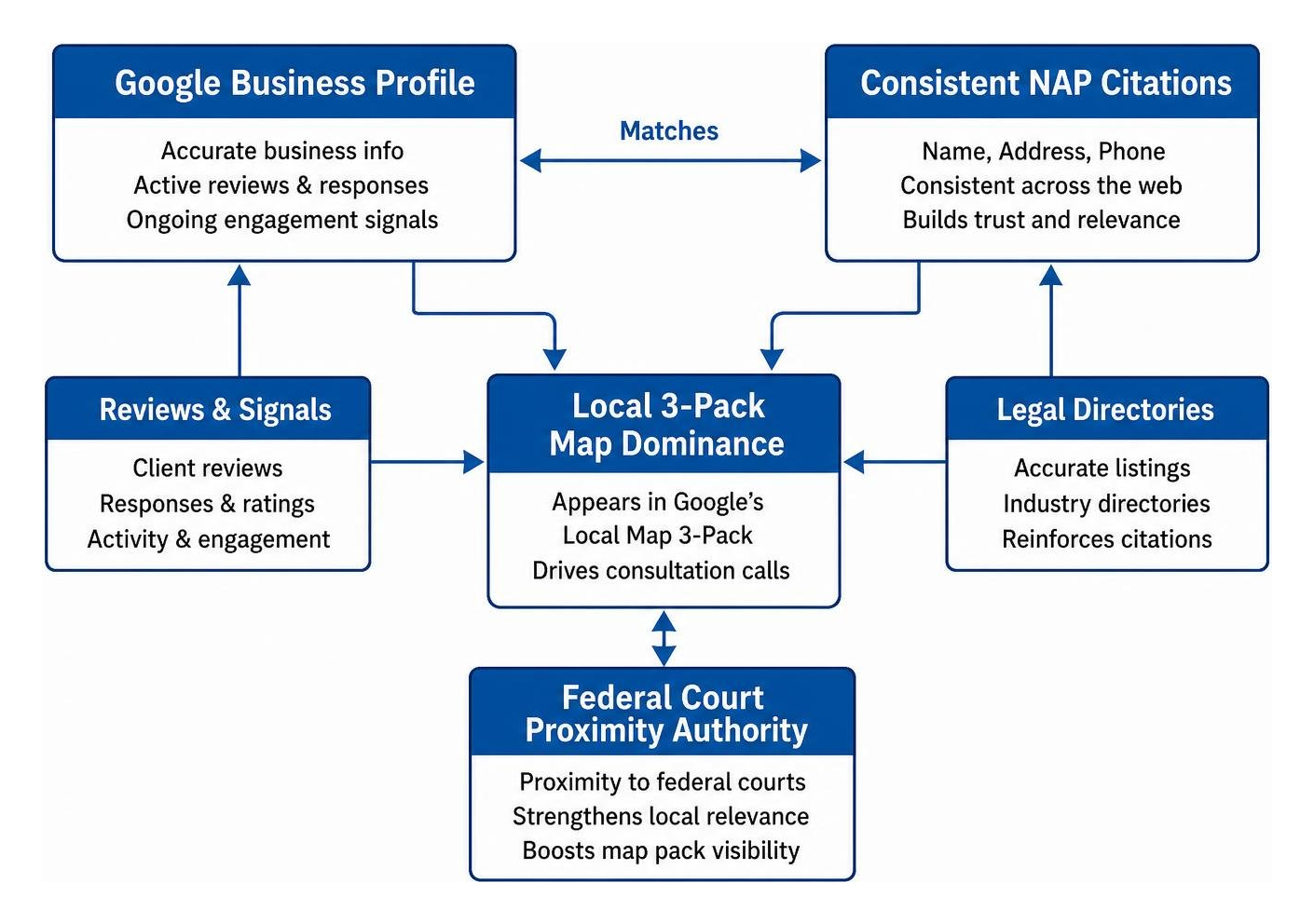
When an individual searches “bankruptcy attorney near me” from their smartphone, the map pack captures over 70% of total click volume.
Local Map Pack Optimization and Proximity Signals
To maximize local pack visibility across your target geographic market:
- Set Primary Category Correctly: Ensure your primary Google Business Profile (GBP) category is explicitly set to Bankruptcy Attorney, with secondary categories like Legal Services or Trial Attorney added where appropriate.
- Optimize Geo-Relevance: Bankruptcy filings occur in specific federal districts, but clients evaluate proximity based on municipal and county convenience. Ensure your profile and localized website pages clearly mention the specific counties and federal courthouses you practice in.
- Maintain Perfect NAP Consistency: Your Name, Address, and Phone number must remain identical across your website, Google profile, and authoritative legal directories like Justia’s New Jersey Bankruptcy Directory, Avvo, and the state bar directory.
- Seed GBP Q&A and Regular Posts: Publish regular updates answering frequent debt relief questions, and utilize the Q&A section to address common concerns regarding consultations, costs, and court appearances.
For advanced local map ranking strategies, read our deep-dive on Insights on Google Business Profile for Lawyers.
Overcoming Privacy Barriers to Secure Client Reviews
Online reviews are among the strongest local ranking signals, yet bankruptcy attorneys face a distinct challenge: satisfied clients rarely want to post their financial troubles publicly.
You can overcome this barrier by implementing a systematic, compassionate review acquisition process:
- Timing the Request: Ask for a review immediately after the court issues the final discharge order or confirms the Chapter 13 plan—the exact moment the client feels immense relief and gratitude.
- Prioritizing Privacy: Explicitly inform clients that Google permits the use of first-name initials or pseudonyms to protect their privacy while leaving honest feedback.
- Focusing on Outcome Sentiment: Encourage clients to comment on the professionalism, compassion, and emotional relief they experienced (e.g., “helped save our family home” or “stopped creditor harassment immediately”).
To select the best automated review management tools for your law practice, explore Platforms for Gathering Online Reviews for Lawyers.
Comparing Organic Search and Paid Ads for Sustainable Case Acquisition
Law firms seeking rapid growth often debate whether to invest in pay-per-click (PPC) advertising or organic search engine optimization.

Understanding the performance dynamics of both channels is essential for managing your law firm’s marketing budget efficiently.
| Dimension | Organic Search Optimization (SEO) | Pay-Per-Click Advertising (PPC) |
|---|---|---|
| Initial Lead Velocity | Takes 3 to 6 months for initial traction; 6 to 12 months for market dominance. | Generates clicks and calls within 24 to 48 hours of campaign launch. |
| Cost Dynamics | Fixed monthly retainer; cost per retained case declines as rankings compound. | Variable per-click cost ($50 to $100+ per click); stops immediately when budget ends. |
| Lead Quality & Intent | High trust; 66% of legal call conversions originate from organic search. | High intent, but requires aggressive negative keyword filtering to avoid junk leads. |
| Long-Term Equity | Builds owned digital authority that generates leads for years. | Rented visibility; delivers zero ongoing value once ad spend ceases. |
| Conversion Conversion | Empathetic educational content builds trust before the phone call. | Relies on high-pressure landing pages with short decision windows. |
While paid ads provide immediate visibility, relying exclusively on PPC leaves a law practice vulnerable to escalating click costs and ad fatigue. To examine the core drivers of long-term legal marketing success, see our analysis on SEO for Law Firms What Actually Moves the Needle.
Balancing Immediate Visibility with Compounding ROI
The most profitable legal practices utilize a coordinated hybrid approach:
- Short-Term Cash Flow via Paid Ads: Launch highly targeted Google Ads campaigns focused strictly on urgent transactional terms (such as “stop wage garnishment attorney” or “emergency Chapter 7 filing”) to generate immediate case revenue.
- Long-Term Asset Building via SEO: Reinvest cash flow into building comprehensive practice silos, earning directory backlinks, and dominating local map rankings.
- Cost Reduction Over Time: As organic search rankings mature across high-volume terms, gradually taper paid ad spend or refocus paid budgets exclusively on competitive geographic margins.
For guidance on navigating regional legal positioning and attorney selection criteria, refer to Debt Free Jersey Your Guide to Choosing a New Jersey Bankruptcy Lawyer.
Frequently Asked Questions About Bankruptcy Law Firm Marketing
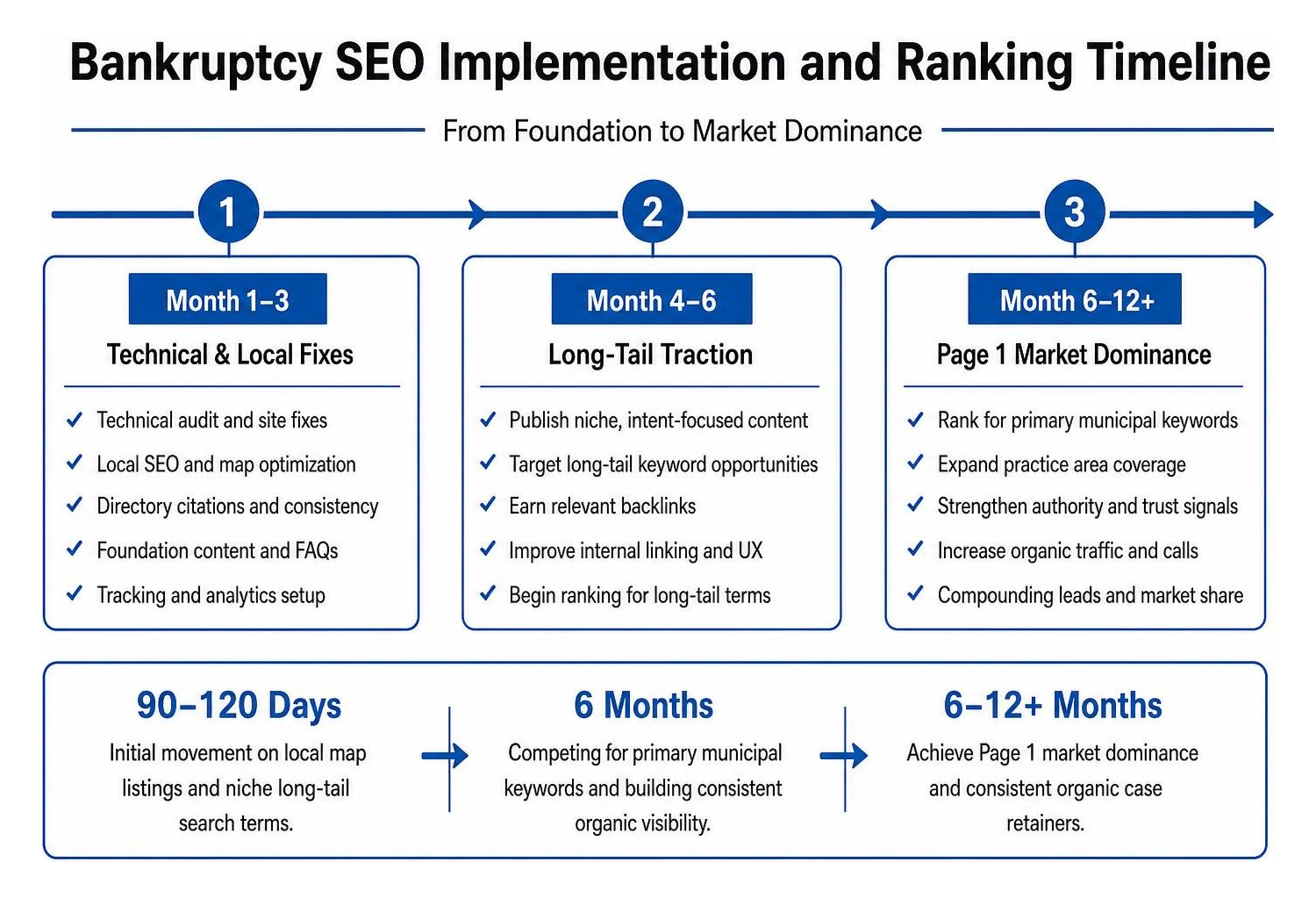
How long does it take to see results from bankruptcy SEO?
Most bankruptcy law practices begin seeing initial movement on local map listings and niche long-tail search terms within 90 to 120 days. Competing for competitive, primary municipal keywords (such as “bankruptcy attorney in [major city]”) and achieving consistent organic case retainers typically requires 6 to 12 months of structured content publishing, technical refinement, and citation building.
How does bankruptcy SEO help screen out non-paying inquiries?
SEO utilizes strategic content positioning and negative filtering to qualify prospective clients before they call your intake team. By explicitly targeting employed debtors seeking wage garnishment defense, homeowners needing Chapter 13 mortgage restructuring, and individuals researching fee structures and payment plans, your content naturally repels judgment-proof filers who cannot afford legal retainers.
Can solo bankruptcy practitioners outrank large regional firms?
Yes. Solo and boutique bankruptcy attorneys frequently outrank large regional firms. Large aggregators often rely on generic, boilerplate service pages that lack localized context. A solo practitioner who publishes hyper-localized content referencing specific county court procedures, local bankruptcy trustees, and authentic client case outcomes builds superior topical relevance and local trust signals.
Conclusion
Distressed filers are actively searching for a fresh financial start. When foreclosure looms or creditors freeze bank accounts, people turn to search engines for discreet, compassionate, and authoritative legal representation.
By executing a dedicated strategy around crisis-driven keyword mapping, structured Chapter 7 and Chapter 13 topic clusters, local Google Business Profile dominance, and strict regulatory compliance, your firm can establish a compounding pipeline of qualified retainers.
At DIGIniche Solutions, we leverage our proven V.E.R.A. Formula to help bankruptcy attorneys transform their online presence into a predictable case generation engine. To discover how our tailored search strategies can grow your caseload, explore our specialized solutions for SEO for Lawyers New Jersey and take command of your local market today.
