

Why Law Firm Marketing in New York Demands Specialized Talent
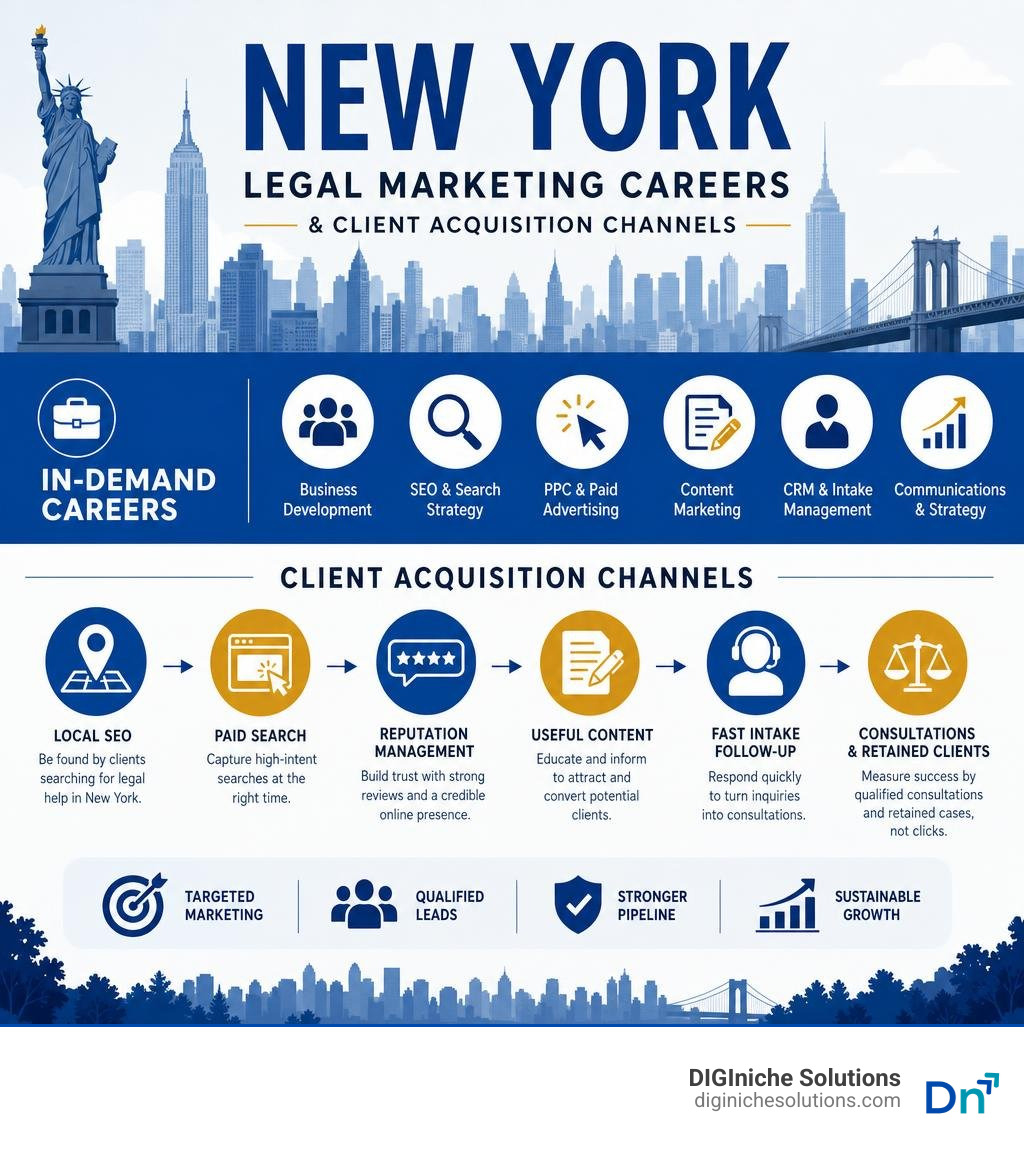
Law firm marketing in New York is a high-stakes field because firms must compete for attention, comply with strict advertising rules, and turn expensive leads into signed cases. For legal marketers and law firm leaders, the strongest path is to combine local SEO, paid search, reputation management, useful content, and fast intake follow-up – then measure success by qualified consultations and retained clients, not clicks alone.
New York’s market creates real demand for people who can do that work well. More than 550 law firm marketing jobs were listed in Manhattan in the research reviewed, with hybrid and on-site roles far more common than fully remote positions. The opportunity spans business development, communications, SEO, PPC, legal content, CRM management, attorney recruiting support, and emerging AI search strategy.
For a small or mid-sized firm, this is not just a hiring trend. It is a warning: referrals may still matter, but a firm without strong search visibility, credible reviews, and a reliable intake process can lose cases to competitors who are easier to find and faster to contact.
I am Frank Demming, and for more than a decade I have helped attorneys build lead-generation systems through SEO, PPC, website optimization, and conversion strategy for law firm marketing New York and other competitive legal markets. In this guide, I will break down the skills, channels, and measurement systems that help firms and legal marketers compete with purpose.
1. The High-Demand Employment Landscape for Legal Marketers in NYC

The legal ecosystem in the New York metropolitan area represents one of the most intense concentrations of legal talent in the world. With Manhattan serving as a central hub, the sheer volume of attorneys competing for high-value business, commercial litigation, and personal injury matters has created a massive employment market for legal marketing specialists.
Core Career Paths in Law Firm Marketing New York
Demand for in-house legal marketing talent remains strong across regional firms. Job market data reveals hundreds of active openings, with mid-to-senior roles making up the majority of listings. When reviewing Manhattan legal marketing career opportunities, several structural workforce trends stand out:
- Workplace Models: The legal sector heavily favors in-person collaboration. Hybrid roles (accounting for 264 listings) and on-site positions (257 listings) dominate the landscape, while fully remote positions represent a modest fraction (28 listings).
- Employment Types: Full-time permanent positions account for the vast majority of openings (521 roles), compared to limited contract, temporary, or part-time positions.
- Compensation Tiers: Compensation reflects the high-stakes nature of the market. Over 380 active roles offer base salaries above $40,000, with more than 325 roles reaching $80,000+, 292 positions topping $100,000+, and nearly 250 roles surpassing $120,000 annually.
Marketers in this arena typically progress through distinct stages, starting as marketing coordinators or digital specialists before moving into business development management, practice group marketing leadership, and ultimately Chief Marketing Officer (CMO) roles.
In-Demand Skills: From Business Development to AI Integration
Law firms no longer look for generalists who merely manage event logistics or update brochures. Today’s competitive market requires specialized professionals who understand the intersection of technology, commercial growth, and legal service delivery.
Key competencies driving law firm growth include:
- Lateral Partner Integration: Helping newly hired attorneys transition their books of business, cross-sell within existing practice groups, and build immediate pipeline visibility.
- Competitive Intelligence (CI): Monitoring regional litigation filings, market trends, and rival firm movements to position practice groups ahead of emerging legal developments.
- Legal CRM Automation: Implementing systems like Clio or Lawmatics to ensure automated lead nurturing, milestone tracking, and systematic past-client communication.
- Generative AI Search Strategy: Structuring brand entities and digital assets so that artificial intelligence search platforms recognize the firm as a primary authority.
Solo practitioners and boutique practices that lack internal marketing departments frequently partner with specialized law firm marketing consultants to guide strategy, audit digital performance, and deploy scalable growth campaigns without the overhead of an enterprise internal team.
2. Navigating the Competitive Arena of Law Firm Marketing New York

Standing out in the New York legal space requires an integrated approach that connects organic visibility, regulatory compliance, and targeted paid acquisition.
Hyper-Local SEO and Manhattan Map Pack Domination
Search visibility is crucial for sustainable client acquisition. Research shows that approximately 78% of people searching for legal counsel hire an attorney from page one of Google search results, with the #1 organic ranking securing roughly 50% of all organic clicks. Furthermore, roughly 46% of high-intent clicks occur within the Google Map Pack (the local 3-pack).
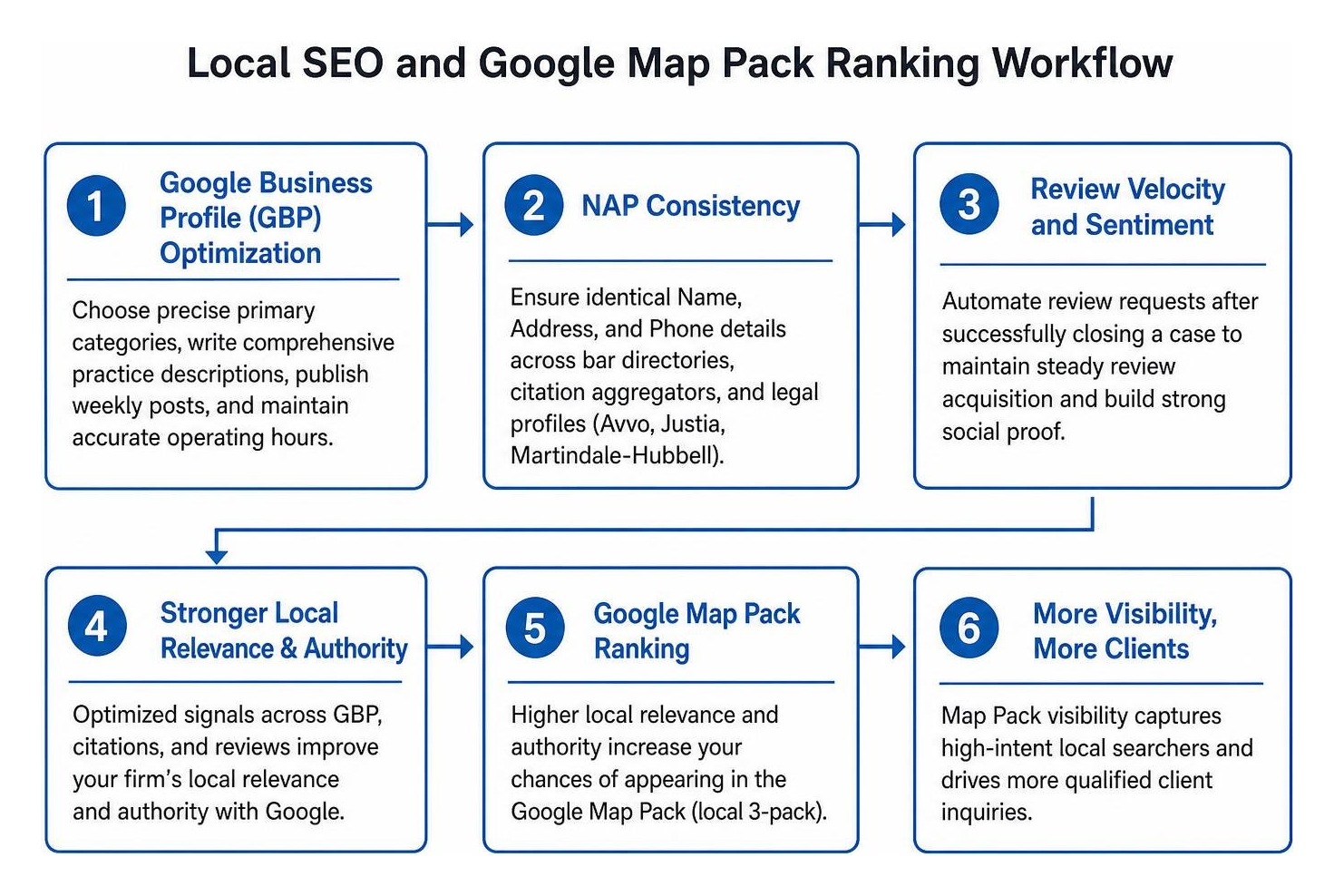
Winning the local pack requires dedicated local SEO for lawyers, with a focus on several critical factors:
- Google Business Profile (GBP) Optimization: Choosing precise primary categories, writing comprehensive practice descriptions, publishing weekly posts, and maintaining accurate operating hours.
- NAP Consistency: Ensuring identical Name, Address, and Phone details across bar directories, citation aggregators, and legal profiles (such as Avvo, Justia, and Martindale-Hubbell).
- Review Velocity and Sentiment: Client reviews represent the single most influential factor prospective clients examine when selecting representation. An automated review-request process after successfully closing a case ensures steady review acquisition, building social proof.
NY Bar Ethics Compliance Under 22 NYCRR Part 1200
All legal promotional materials, digital advertisements, social media campaigns, and website copy must strictly adhere to New York’s Rules of Professional Conduct under 22 NYCRR Part 1200 (specifically Rules 7.1 through 7.5).
Key compliance mandates include:
- Mandatory Labeling: Digital advertisements and landing pages must clearly display the disclaimer “ATTORNEY ADVERTISING” on homepages and landing pages.
- Prohibited Claims: Attorneys cannot claim to be “specialists” or “experts” unless certified by an authorized certifying body recognized by the state bar.
- Past Results Disclaimers: References to prior settlements or courtroom victories must include the prominent notice: “Prior results do not guarantee a similar outcome.”
- Fact-Based Messaging: Statements regarding fees, experience, or capabilities must be verifiable and free from deceptive assertions.
Marketers who fail to understand these regulations expose their firms to disciplinary inquiry. Adhering to professional ethics preserves institutional reputation while building authentic trust with potential clients, reinforcing the specialized guidelines outlined in New York advertising law guidelines.
High-Intent Paid Search and Google Local Services Ads
Paid digital marketing delivers immediate consultation inquiries while organic search rankings build momentum. However, because personal injury, criminal defense, and complex commercial litigation feature high cost-per-click auctions in metro areas, paid media campaigns must be structured with precision.
Firms achieve the best performance by combining standard Google Ads with Google Local Services Ads (LSAs):
| Marketing Feature | Google Local Services Ads (LSAs) | Traditional Google Search Ads (PPC) |
|---|---|---|
| Pricing Model | Pay-Per-Lead (qualified calls/messages) | Pay-Per-Click (ad traffic clicks) |
| Search Placement | Top of SERP (above standard PPC) | Above and below organic results |
| Trust Badge | Includes “Google Screened” verification badge | Ad extension highlights |
| Targeting Control | Practice area categories and zip codes | Keywords, match types, demographics, negative lists |
| Landing Page Need | Direct phone call / platform lead flow | Requires custom, dedicated conversion landing pages |
| Budget Control | Weekly target budget caps | Daily ad spend caps with bid management |
When managing paid campaigns, deploying comprehensive negative keyword lists (excluding non-intent phrases like “pro bono,” “free legal advice,” or “court forms”) prevents wasted ad spend. For comprehensive paid strategy execution, mastering advanced PPC advertising for law firms ensures every dollar spent contributes directly to qualified consultation opportunities.
3. Modern Client Acquisition: Search Visibility, Content, and AI
The search landscape is moving beyond traditional blue links toward conversational, AI-driven discovery and multi-format media consumption.
Why Generative AI Is Reshaping Law Firm Marketing New York
Generative search platforms like ChatGPT, Google Gemini, Perplexity, and Claude have transformed how consumers research legal dilemmas. When users prompt conversational AI tools for attorney recommendations, these models do not merely scan keyword tags; they retrieve information based on entity authority and web-wide corroboration.
To ensure your firm appears in generative AI answers, implement Generative Engine Optimization (GEO):
- Format Machine-Readable Answers: Place clear, 1-to-3 sentence direct answers immediately below H2 and H3 question headers across practice area pages.
- Establish Entity Consistency: Maintain matching practice areas, attorney names, and office addresses across authoritative legal databases, bar records, and major directories.
- Third-Party Corroboration: AI models rely heavily on external consensus. Press coverage, industry awards, and reputable legal directory profiles signal domain authority to language models.
- Schema Markup Integration: Implement structured JSON-LD schema (LegalService, Attorney, FAQPage) to explicitly declare credentials, office locations, and service areas to search engine crawlers.
Aligning your technical infrastructure with foundational SEO for law firms helps capture visibility across traditional search results and emerging AI search overviews.
High-Impact Content Marketing and Video Authority
While only 37% of law firms maintain an active legal blog, approximately 34% of firms with blogs confirm that a client hired them directly because of their published content. Furthermore, websites that publish authoritative, regular blog articles gain 97% more backlinks on average, compounding their domain ranking strength.
Effective legal content creation focuses on addressing specific client questions rather than publishing dense statutory text:
- Client-Centered FAQs: Break down complex legal scenarios into accessible guidance (e.g., explaining the division of marital property or steps to take following a commercial breach of contract).
- Video Marketing Integration: Just over 30% of law firms produce video marketing, creating an opportunity for differentiation. Short video explainers, practice overview videos, and client onboarding clips establish personal connections before an initial consultation.
- Practice Area Clusters: Build comprehensive topic hubs that link core practice overview pages to detailed supporting articles, avoiding internal keyword cannibalization.
By applying structured digital marketing for lawyers content tips, law firms transform static websites into dynamic educational resources that nurture prospective clients.
4. Budget Allocation, Intake Optimization, and Calculating True ROI
Generating leads is only half the battle. Sustainable firm profitability requires disciplined financial planning paired with conversion-focused client intake workflows.
SBA Budget Benchmarks vs. Aggressive Metro Spend
Only 57% of law firms operate with a formal marketing budget. The U.S. Small Business Administration (SBA) recommends allocating 7% to 8% of gross annual revenue to marketing for businesses seeking consistent growth. While established firms maintaining caseloads often allocate 2% to 5%, firms operating in highly competitive metropolitan markets typically invest more aggressively to gain market share.
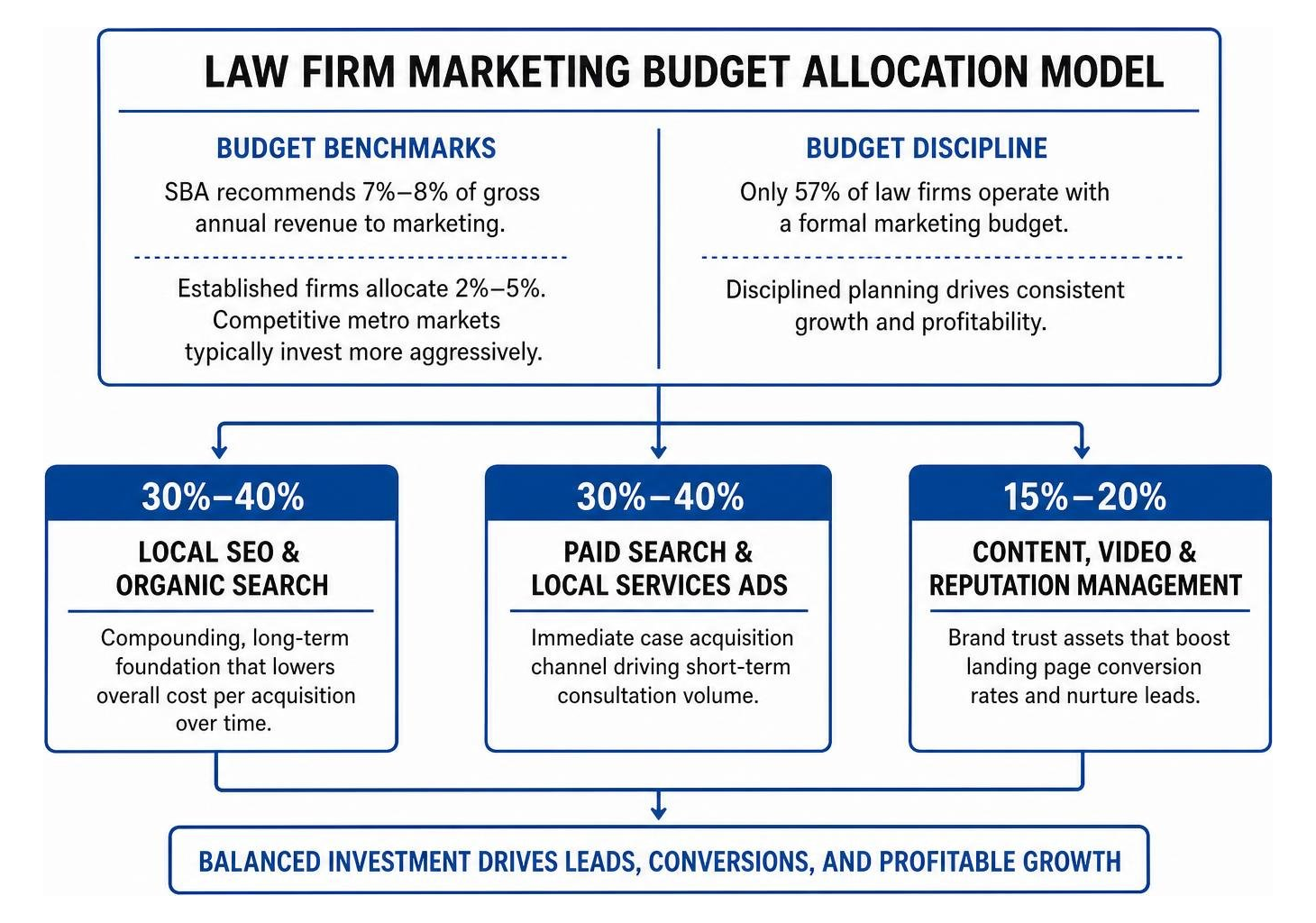
When balancing marketing investments, firms should diversify spend across predictable pillars:
- Local SEO & Organic Search (30-40%): Compounding, long-term foundation that lowers overall cost per acquisition over time.
- Paid Search & Local Services Ads (30-40%): Immediate case acquisition channel driving short-term consultation volume.
- Content, Video & Reputation Management (15-20%): Brand trust assets that boost landing page conversion rates and nurture leads.
- Software, Tracking & Intake Tools (10%): CRM platforms, call tracking numbers, and automated follow-up tools that protect ad spend.
For firms looking to optimize their marketing budget, learning how to maximize your law practice marketing budget ensures resources are deployed efficiently across high-performing channels.
Closing the Intake Gap: Turning Inquiries into Retained Cases
A common cause of stalled firm growth is not lead generation volume, but lead leakage during intake. Inquiries that wait hours for a response often retain competing counsel.
To maximize marketing return on investment, implement structured intake protocols:
- Immediate Response Protocols: Implement instant AI chat, 24/7 answering services, or automated SMS replies so potential clients receive immediate acknowledgment.
- End-to-End Call Tracking: Deploy unique call tracking numbers across paid campaigns, organic directories, and social media to trace every signed client back to its origin channel.
- Measuring Cost-Per-Signed-Case (CPSC): Shift focus away from vanity metrics (clicks, website visitors, impressions) toward financial return metrics:
$$\text{CPSC} = \frac{\text{Total Channel Marketing Spend}}{\text{Total Retained Cases Signed}}$$
When law practices combine strategic visibility with fast intake workflows, their marketing functions as a predictable, measurable engine for firm growth.
Frequently Asked Questions About Law Firm Marketing in New York
What is the average salary range for legal marketing roles in Manhattan?
Salary ranges vary by experience and functional specialization. Mid-level marketing coordinators and digital specialists typically earn between $60,000 and $85,000 annually. Senior marketing managers and business development directors often earn between $100,000 and $150,000+, while executive-level Chief Marketing Officers at large regional or national practices command compensation packages exceeding $200,000 to $300,000+.
How much should a New York law firm budget for digital marketing?
Budget requirements depend on practice area, local competition, and revenue goals. Most small-to-mid-sized firms investing in digital marketing allocate between $3,000 and $10,000+ per month across SEO, content, and paid search. Practices competing in high-stakes practice areas (like personal injury or complex commercial litigation) often deploy larger paid advertising budgets to secure consistent lead volume in competitive ad auctions.
How do New York State Bar advertising rules impact digital campaigns?
New York Rules of Professional Conduct (22 NYCRR Part 1200, Rules 7.1–7.5) govern all promotional communications. Key requirements include labeling landing pages and ads as “ATTORNEY ADVERTISING”, ensuring prior case results include mandatory disclaimers (“Prior results do not guarantee a similar outcome”), avoiding uncertified claims of being an “expert” or “specialist”, and retaining copies of advertising materials for state bar compliance records.
Conclusion
Succeeding in legal marketing requires a clear strategy that connects brand discovery with client intake. Whether you are building an in-house marketing career or leading an ambitious law firm, relying solely on unmanaged word-of-mouth or disjointed advertising is no longer enough to maintain a competitive advantage.
At DIGIniche Solutions, we help law practices scale predictably using our proprietary V.E.R.A. Formula:
- Visibility: Capturing prime search positions through technical SEO, Google Local Services Ads, and local 3-pack optimization.
- Engagement: Building trust with custom web design, practice-area content hubs, and professional video authority.
- Retention: Strengthening client loyalty and past-client referral networks through CRM automation and timely communication.
- Amplification: Scaling campaign performance across multi-channel paid ads, AI search optimization, and targeted digital channels.
Ready to build a lead generation system that delivers qualified consultations and measurable ROI? Explore our strategic legal marketing plans to see how our team helps legal practices grow with confidence.
