

How SEO for Estate Planning Lawyers Brings in More Qualified Clients
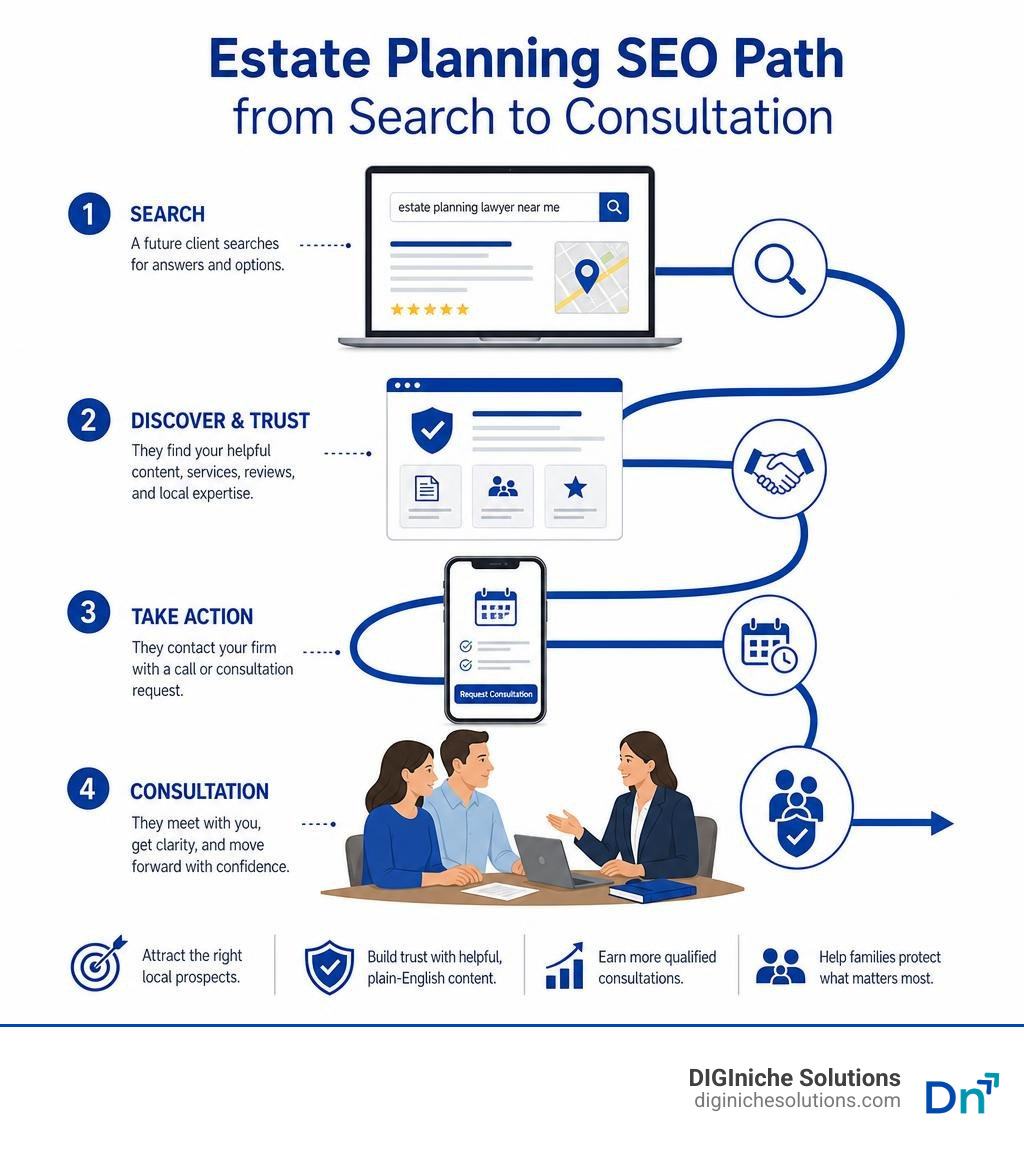
SEO for estate planning lawyers works when it helps your firm appear where local people are already looking for answers about wills, trusts, probate, and powers of attorney. Start by focusing on four essentials:
- Build separate, clear pages for each core service, such as wills, living trusts, probate, and elder planning.
- Optimize your Google Business Profile for your city and service area.
- Publish plain-English content that answers real client questions, including life-event concerns like a new child, a second marriage, or an aging parent.
- Track calls, consultation requests, and signed matters – not just rankings or website visits.
Estate planning search is different from many legal practice areas. Prospects may research for weeks before calling because the decision is personal, emotional, and often tied to family finances. They also compare attorneys with DIY document services, so your website must show the value of tailored legal advice, local knowledge, and a trustworthy client experience.
For law firms that want steadier case flow, search visibility can support referrals rather than replace them. A referred prospect will often still search your name, read reviews, and compare your firm before booking.
I am Frank Demming, and for more than a decade I have helped law firms improve lead generation through SEO, PPC, website optimization, and digital strategy. In SEO for estate planning lawyers, my focus is turning local search demand into qualified consultations and better cases.
Why SEO for Estate Planning Lawyers Differs from General Legal Search
General legal marketing frequently treats prospective clients as crisis-driven consumers needing an immediate fix. If a driver gets arrested for a DUI or a pedestrian suffers an injury in a collision, they search online and hire the first qualified professional who answers the phone. Estate planning operates in a fundamentally different psychological realm.
Over 450,000 monthly searches occur across the country for estate planning-related topics. Yet, unlike emergency legal niches, prospective clients frequently spend weeks or months researching before scheduling a consultation. Potential clients are not casually browsing during normal business hours—they are often lying awake at 2 AM worrying about what happens to their children or how their assets will be handled after they pass away.
Google categorizes estate planning under its strictest YMYL (Your Money or Your Life) standards. Because estate distribution, tax liabilities, and healthcare directives carry severe personal and financial consequences, search algorithms enforce rigorous E-E-A-T (Experience, Expertise, Authoritativeness, and Trustworthiness) standards. Anonymous blog articles or generalized templates do not rank well. Instead, Google rewards named attorneys with verifiable credentials, demonstrable state-specific knowledge, and clear community presence.
| Feature / Dimension | Proactive Estate Planning | Urgent Probate Administration |
|---|---|---|
| Search Intent Trigger | Major life events (marriage, new baby, retirement, asset accumulation) | Death of a family member, court filings, executor duties |
| Decision Cycle | 2 to 12 weeks of education, comparison, and spousal discussion | Immediate to 2 weeks due to statutory deadlines and court dates |
| Key Search Terms | “living trust attorney near me”, “revocable trust vs will”, “estate planning lawyer” | “probate attorney near me”, “how to file probate without a will”, “letters of administration” |
| Conversion Focus | Educational authority, plain-English guides, downloadable checklists | Direct click-to-call, fast phone intake, compassionate guidance |
| Average Matter Value | $3,000 to $5,000+ for comprehensive trust packages | Varies by estate size; often significant statutory percentages |
Crisis vs. Proactive Intent: Navigating Extended Decision Cycles
Understanding client intent dictates how you shape your website’s content and conversion paths. A proactive searcher looking for a living trust is rarely in a rush. They want to read about the difference between revocable and irrevocable trusts, how to avoid probate, and how to protect assets for blended families or minor children. They often discuss options over dinner, delay making a decision, and return weeks later.
Conversely, probate searches represent high-urgency commercial intent. When someone loses a family member, they suddenly face probate court filings, creditor notices, and executor responsibilities. Searches such as “probate lawyer in Passaic County” or “letters of administration Bloomfield NJ” require direct, clear answers and prominent phone numbers that connect callers immediately to intake staff.
By building dedicated content tracks for both proactive planning and urgent estate administration, your website captures visitors across every stage of the legal journey.
Outranking DIY Form Mills and Legal Document Competitors
Every estate planning attorney competes against automated form builders like LegalZoom and boilerplate document templates. These platforms dominate generic informational queries by marketing speed and low costs.
To outrank these services and attract qualified clients who value professional representation, your website must highlight what automated software cannot provide: customized legal advice rooted in municipal and state-specific statutory nuances.
For instance, potential clients searching among the Best Estate Planning Lawyers in New Jersey need to know how New Jersey inheritance tax thresholds, local probate court procedures, and unique statutory trust rules impact their families. When your content explains how DIY forms fail to protect blended families, miss out on tax-saving mechanisms, or end up costing thousands in probate litigation, search engines reward that expertise, and high-net-worth clients take notice.
Local SEO Strategies to Dominate the Google Map Pack

With 46% of all online searches carrying local intent, winning the Google Local Map Pack (the top three local business listings displayed beneath the search bar) is critical. Organic and local search clicks generate 69% of all web traffic for local firms, making localized search visibility the bedrock of sustainable caseload growth.
To capture high-intent searches like “wills and trusts lawyer near me,” your firm must execute a cohesive local strategy. Our detailed breakdown in The Ultimate Guide to Local SEO Services for Law Firms: Helping Estate Planning Attorneys Win the Local Map explores the mechanics of local rankings, but it begins with precise geographic signals and listing consistency.
Google Business Profile Optimization and Local Pack Signals
Your Google Business Profile (GBP) is the single most influential asset for driving direct local calls. To maximize its ranking power across targeted communities:
- Primary Category: Set your primary category to “Estate planning attorney”. Complement it with secondary categories such as “Lawyer” and “Legal services”.
- Service Listings: Add granular practice areas to your profile, including Revocable Living Trusts, Last Will and Testament, Probate Administration, Power of Attorney, Healthcare Directives, and Asset Protection.
- Location Alignment: Ensure your primary physical office address matches your legal documentation, state bar listings, and website footer.
- Photos & Media: Upload high-resolution photos of your actual office exterior, reception area, conference rooms, and attorney headshots to establish authentic local proximity.
- Ongoing Updates: Publish weekly GBP updates highlighting legal tips, firm updates, and answers to common estate questions to signal continuous operational activity to Google.
Local Citations, Directory Listings, and Review Acquisition
Search engines validate your firm’s authenticity through Name, Address, and Phone number (NAP) consistency across verified web directories. Claim and align your profiles across authoritative legal directories like Justia, Avvo, FindLaw, Martindale-Hubbell, and local Chambers of Commerce.
Online reputation is equally important: 87% of consumers read online reviews before contacting a local business. However, roughly 22% of law firms mistakenly believe online ratings do not matter in relationship-focused practices. In reality, Google utilizes review count, sentiment, velocity, and recency as primary ranking factors for local map listings.
Establishing a steady post-engagement workflow to request reviews ensures a continuous stream of feedback. When prospective clients see clear reviews discussing comprehensive planning, such as Estate Plan Maintenance in Lyndhurst, NJ | Leeds Law Firm, their confidence in booking an initial consultation increases significantly.
High-Intent Keyword Strategy and Content Architecture
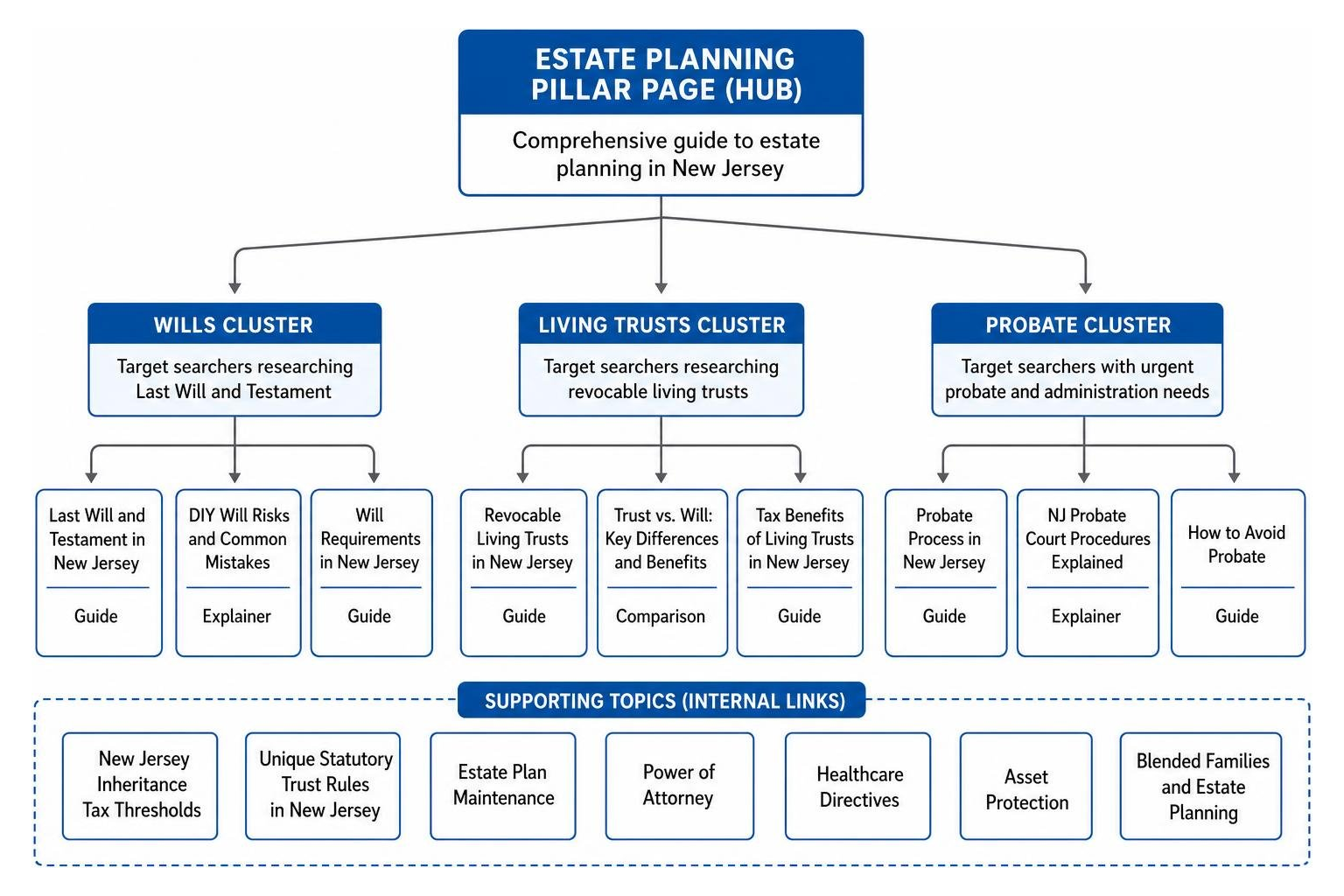
Estate planning search volume jumped over 53% in recent years, with the top 60+ core keywords accounting for roughly 324,000 monthly searches. Winning this traffic requires moving beyond generic “catch-all” services pages toward a structured hub-and-spoke content architecture. Understanding SEO for Law Firms: What Actually Moves the Needle means recognizing that isolated blog posts rarely rank without a strong internal linking foundation.
Mapping Search Intent: Wills, Living Trusts, and Urgent Probate Clusters
Your website must target searchers based on their underlying commercial value and specific needs:
- Topical Hubs (Core Service Pages): Create in-depth (1,500+ word) pillar pages for your primary practice areas:
/wills-attorney//living-trusts-lawyer//probate-administration//asset-protection/
- Subtopic Clusters (Spokes): Publish focused articles that answer specific client questions, linking back to the primary hub:
- Revocable vs. Irrevocable Trusts: Which Do You Need?
- How to Appoint a Guardian for Minor Children in New Jersey
- Understanding NJ Inheritance Tax vs. Federal Estate Tax
- Digital Asset Succession: Protecting Crypto, Passwords, and Online Accounts
- Location-Specific Landing Pages: If you serve multiple nearby municipalities, build unique, individualized location pages (such as dedicated pages for Wayne NJ, Clifton NJ, Passaic NJ, Lyndhurst NJ, Paterson NJ, Bloomfield NJ, Newark NJ, Elizabeth NJ, or Nutley NJ) tailored to local probate courts and regional client needs.
Best Content Practices in SEO for Estate Planning Lawyers
- Write in Clear, Plain English: Most estate planning websites fail because they are packed with dense statutory jargon. Explain complex legal concepts in simple, conversational language so everyday families feel comfortable reaching out.
- Incorporate Structured FAQ Sections: Add 3–5 high-value FAQs to every service page using clear headings to capture featured snippets and voice search queries.
- Feature Prominent Author Bios: Include named attorney bylines, state bar license numbers, professional certifications, and professional associations on every piece of published legal advice.
- Offer Helpful Lead Magnets: Provide downloadable resources, such as an “Estate Planning Readiness Checklist” or a “Probate Administration Timeline Guide,” to capture middle-of-funnel visitors who are not quite ready to schedule a formal consultation.
Technical SEO, Schema Markup, and Site Performance
A clean, authoritative website will struggle to convert if technical search barriers prevent search engines from crawling your content or frustrate visitors trying to read it.
Mobile Usability, Core Web Vitals, and UX for Aging Demographics
Over 55% of all estate planning searches occur on mobile devices. Furthermore, demographic data shows that while 81% of individuals aged 72 and older have arranged wills, only 24% of adults aged 18 to 34 have done so. Because estate planning clients span diverse age groups—from young parents setting up their first wills to retirees reviewing their trusts—website design must prioritize digital accessibility:
- Site Speed: Pages taking more than 3 seconds to load experience significantly higher bounce rates. Optimize images, leverage modern browser caching, and ensure your Largest Contentful Paint (LCP) loads in under 2.5 seconds.
- Readable Typography: Use large, readable fonts (at least 16px to 18px body copy) with sharp color contrast to assist older readers on mobile and desktop screens.
- Accessible Contact Points: Keep click-to-call phone numbers and simple consultation forms accessible in sticky header menus across every screen size.
LegalService Schema and Structured Data Implementation
Structured data acts as a translator for search engine crawlers and AI search platforms. Implementing JSON-LD structured schema helps search engines understand the exact entities, credentials, and geographic regions your law practice serves:
- LegalService & Attorney Schema: Declares your business name, operating hours, geographical coordinates, physical address, bar admissions, and accepted payment methods.
- FAQPage Schema: Marks up frequently asked questions on practice pages, increasing the likelihood of earning rich snippet answer boxes in search results.
- BreadcrumbList Schema: Defines site hierarchy for search engines, making page navigation clear and accessible.
Authority Link Building and Measuring Measurable ROI
Acquiring authoritative backlinks remains a core ranking signal for competitive legal search terms. However, buying cheap links from generic marketplaces puts law firms at risk of search engine penalties. In high-stakes legal niches, authority is earned through strategic local and industry relationships. Avoiding the common pitfalls outlined in 7 Mistakes You’re Making With Estate Planning Lawyer Lead Generation requires a clean, relationship-first approach to digital PR and backlink acquisition.
Strategic Partnerships: Financial Planners, CPAs, and Bar Associations
The most effective backlink strategies mirror real-world professional networking:
- Allied Professional Partnerships: Collaborate with local CPAs, wealth managers, financial planners, and insurance brokers on joint educational articles, market updates, or co-hosted webinars.
- Bar Associations & Legal Councils: Secure listings and editorial contributions through local and regional bar associations, including county bar organizations across Passaic County NJ and Bergen County NJ.
- Civic & Community Engagement: Sponsor local youth sports leagues, community educational seminars, or senior living resources to earn authentic local
.organd regional links. - Educational & Estate Registries: Maintain current profiles on vetted industry platforms like NAELA (National Academy of Elder Law Attorneys) and regional estate planning councils.
Tracking Consultations and Signed Cases in SEO for Estate Planning Lawyers
Tracking total website visits or broad keyword positions alone does not reflect true business growth. An effective marketing campaign focuses strictly on business-level metrics:
- Qualified Consultation Requests: Monitoring form submissions and inbound appointment requests originating from organic landing pages.
- Call Tracking Attribution: Using dynamic call tracking numbers to determine which specific search terms and service pages drive inbound calls.
- Conversion Rate by Practice Area: Evaluating whether probate pages or revocable trust pages generate higher intake rates.
- Signed Retainer Value: Tracking client lifetime revenue back to the original organic acquisition channel to calculate true marketing return on investment.
Frequently Asked Questions About Estate Planning SEO
How long does it realistically take to see results from estate planning SEO?
Most estate planning law practices begin seeing upward movement in keyword positions, organic impressions, and local map visibility within 3 to 6 months. Achieving first-page rankings for highly competitive commercial terms in dense metropolitan areas typically requires 6 to 12 months of consistent content publishing, local optimization, and link building.
What is the biggest mistake estate planning attorneys make with digital marketing?
The single most common mistake is combining wills, living trusts, probate, and elder law onto a single, generic “Services” page. Search engines evaluate relevance on a page-by-page basis. Without dedicated, comprehensive pages for each practice area, your firm will struggle to rank against competitors with deep, topical content hubs.
Can organic search replace financial advisor referrals and word-of-mouth?
Organic search is designed to complement and protect your referral network, not replace it. Today, when a financial advisor or former client recommends your firm, that prospect will almost always search your name online to check reviews, read your background, and inspect your website before calling. A strong organic search presence captures new inbound clients while validating your reputation for referred prospects.
Conclusion
Building a sustainable, high-performing estate planning practice requires moving away from unpredictable, passive lead sources toward an asset you control: your firm’s organic search visibility. By establishing dedicated service hubs, dominating the Google Local Map Pack, creating plain-English client guides, and optimizing your technical infrastructure, your website becomes an automated engine for qualified consultations.
At DIGIniche Solutions, we help legal practices build scalable client-growth ecosystems. Our proprietary V.E.R.A. Formula delivers comprehensive Visibility, Engagement, Retention, and Amplification to turn local search demand into signed cases. Ready to expand your caseload across New Jersey? Contact us today to grow your firm with specialized New Jersey legal SEO and build your digital legacy.
