

Why Most Law Firms Are Invisible Online (And How Video Changes That)
Law firm video marketing is one of the fastest ways for attorneys to build trust, attract better cases, and stand out in a crowded market.
Here’s a quick overview of what it involves and why it works:
- What it is: Creating and distributing video content — FAQs, attorney introductions, testimonials, explainers — to attract and convert potential clients online
- Why it works: Viewers retain 95% of a message watched on video, compared to just 10% when reading text
- Where to use it: Your website, YouTube, LinkedIn, Facebook, Instagram, and email campaigns
- How long to see results: Most firms see meaningful traction within 60–90 days, with stronger SEO gains in 6–12 months
- What it costs to start: A smartphone, a $50 lapel mic, and a window — that’s enough to begin
Picture this: a potential client is scrolling through search results at 9 p.m., anxious, overwhelmed, and comparing three law firms. Two have text-heavy websites. The third has a short, clear video of an attorney speaking directly to them. That firm gets the call in the morning.
That trust gap is exactly what video solves — and right now, only about one in three law firms is using it. That means firms that act early have a real competitive edge.
Despite the clear opportunity, many attorneys still hold back. They worry about production costs, camera confidence, or simply not knowing where to start. This guide cuts through all of that.
I’m Frank Demming, a digital marketing specialist with over a decade of experience helping law firms generate consistent, high-quality leads through SEO, content strategy, and law firm video marketing. I’ll walk you through everything you need to go from zero to a working video strategy — without the guesswork.
Important law firm video marketing terms:
- Lead Generation for Lawyers
- PPC Management for Estate Planning Attorneys
- PPC Management for Real Estate Lawyers
Why Law Firm Video Marketing Is Essential for Building Trust
When people look for legal representation, they are rarely in a calm, relaxed state of mind. Whether they are dealing with a stressful divorce, recovering from a severe car accident, or facing criminal charges, they are experiencing high levels of vulnerability. They do not want to hire a faceless corporate logo; they want to hire a human being who can guide them through the storm.
Text-heavy websites force highly stressed people to read a textbook when they actually want a lifeline. Video collapses the trust-building timeline by letting prospective clients see your face, hear the tone of your voice, and feel your empathy before they ever pick up the phone. It humanizes your practice.

In a crowded market like New Jersey, where there are thousands of practicing attorneys, video is the ultimate differentiator. It is incredibly hard to stand out when every firm’s website features the same stock photos of gavels, leather-bound books, and scales of justice.
By putting yourself on camera, you create a distinct, memorable brand. Your competitors might have decades of trial experience, but if they remain invisible behind a wall of text, they will lose high-value cases to the approachable, authoritative attorney who speaks directly to the client’s concerns.
To maximize this impact, video must be woven into your broader digital footprint. Discover why your law firm needs custom content marketing to see how video and written content work together to establish unmatched local authority.
Mapping Video Content to the Legal Client Journey
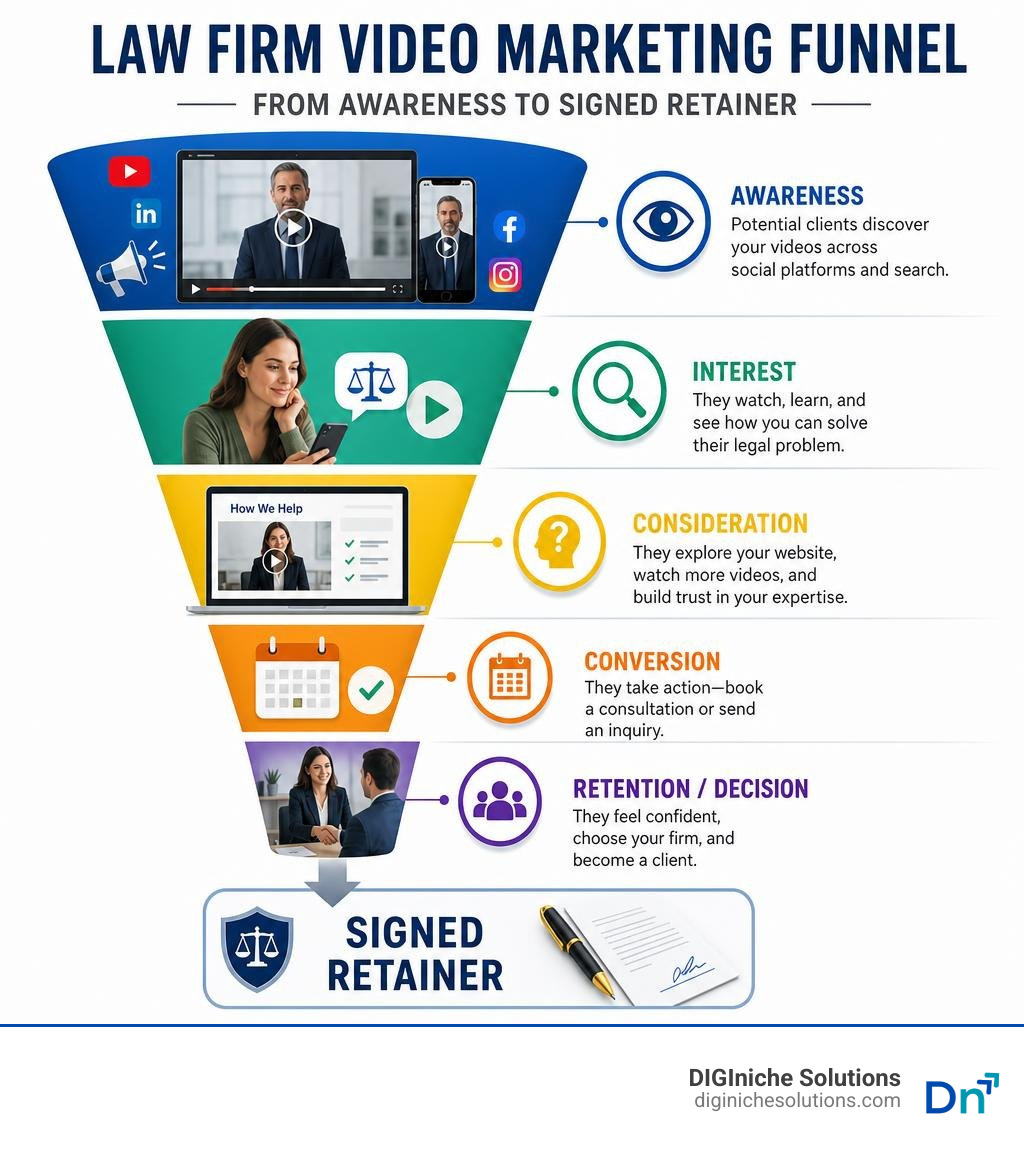
A common mistake is assuming one generic brand video can handle all your marketing needs. In reality, prospective clients go through distinct psychological stages before hiring an attorney. Your video content must map directly to these stages: Awareness, Consideration, Decision, and Retention.
By segmenting your video production around this journey, you ensure that you are delivering the right message at the exact moment your prospect needs to hear it.
Awareness Stage: Educational and FAQ Videos for Law Firm Video Marketing
At the start of their journey, prospects are looking for answers, not a sales pitch. They are typing highly specific, stress-fueled questions into Google and YouTube: “How is child custody decided in NJ?” or “What should I do immediately after a car accident?”
FAQ and educational videos are designed to capture this high-intent search traffic. By creating short, 1-to-2-minute videos that answer these exact questions, you establish immediate authority.
For instance, a New Jersey family law attorney can record a video explaining how spousal support is calculated under state guidelines. You aren’t giving formal legal advice, but you are demystifying a complex process and positioning your firm as the go-to resource. For more ideas on structuring your educational assets, check out these digital marketing for lawyers content marketing tips.
Consideration and Decision Stages: Testimonials and Firm Introductions
Once a prospect understands their legal situation, they move into the consideration and decision stages. Now, they are comparing firms and asking: “Do I trust this specific attorney to handle my case?”
This is where attorney bios, firm introductions, and client testimonials become your most powerful conversion tools:
- Attorney Bio Videos: Keep these under two minutes. Instead of reciting your resume, explain why you became an attorney and how you fight for your clients. Speak directly to their peace of mind.
- Client Testimonial Videos: Research shows that 92% of consumers read testimonials before making a decision. An authentic, unscripted video of a past client explaining how you helped them rebuild their life carries far more weight than any self-promotional copy.
- Case Study Videos: Walk viewers through a complex legal victory while maintaining strict client confidentiality. Explain the problem, the strategy you used to fight it, and the ultimate resolution.
Technical Blueprint: Scripting, Length, and Production Quality
You do not need a Hollywood budget to succeed with law firm video marketing. In fact, over-produced, highly polished corporate videos can sometimes feel cold and insincere. Authenticity and clarity are far more important than expensive production values.
DIY Smartphone Setup vs. Professional Production
Can you use a smartphone? Absolutely. Modern iPhones and Android devices are capable of shooting stunning 4K video. If you are going the DIY route, follow this simple checklist to ensure professional results:
- Audio is King: Viewers will tolerate average video quality, but they will instantly click away from muffled, echoey audio. Invest $50 to $80 in a reliable clip-on lapel microphone or a USB desktop mic.
- Lighting: Never sit with a window directly behind you, as this will turn you into a dark silhouette. Instead, face a window to utilize clean, natural light, or position a simple ring light directly behind your camera setup.
- Stabilization: Use a basic tripod to eliminate shaky, handheld footage.
- Delivery: Do not read from a rigid, word-for-word script. It makes you look stiff and rehearsed. Instead, write down 3 to 4 bullet points and speak naturally, as if you were explaining the concept to a client sitting across your desk.

While DIY is excellent for high-volume FAQ videos, we highly recommend investing in professional production for your primary homepage brand video. A professional crew can capture the “gravitas” and polished authority of your firm, ensuring your first impression is flawless.
Optimizing Your Videos for Search Engines and Local SEO
Creating a great video is only half the battle; you must also ensure your target audience can actually find it. This is where video SEO comes into play.
Google increasingly prioritizes video content in search results, and web pages with embedded videos are 53 times more likely to rank on Google’s first page. This is largely because videos keep visitors on your site longer. Google uses this “dwell time” as a major ranking signal, indicating that your page provides high-quality, relevant information.
To get the most out of your organic visibility, you need a structured search strategy. Read our comprehensive law firm SEO the ultimate guide to see how video fits into a complete search engine optimization plan.
Best Practices for YouTube and Website Video SEO
To ensure search engines can read and index your video content, implement these technical optimization steps:
- Keyword-Rich Titles & Descriptions: Name your video files and titles using local, high-intent keywords (e.g., “How to File for Divorce in NJ | New Jersey Family Law”). Write a detailed description of at least 200 words explaining what the video covers.
- Add Transcripts and Closed Captions: Search engines cannot watch videos, but they can read text. Uploading a complete SRT transcript file improves accessibility and gives search crawlers indexable text to analyze.
- Use Video Schema Markup: Implement schema markup on your website. This tells Google the video’s title, description, thumbnail URL, and duration, allowing it to display your video as a “rich snippet” directly in search results.
- Custom Thumbnails: Design clean, eye-catching thumbnails with high-contrast text overlay. A compelling thumbnail can dramatically increase your click-through rate (CTR) on both YouTube and Google search.
Multi-Channel Distribution and Promotion Strategies
A video sitting quietly on a hard drive helps no one. To achieve a true “ripple effect,” your video assets must be deployed relentlessly across every digital touchpoint.
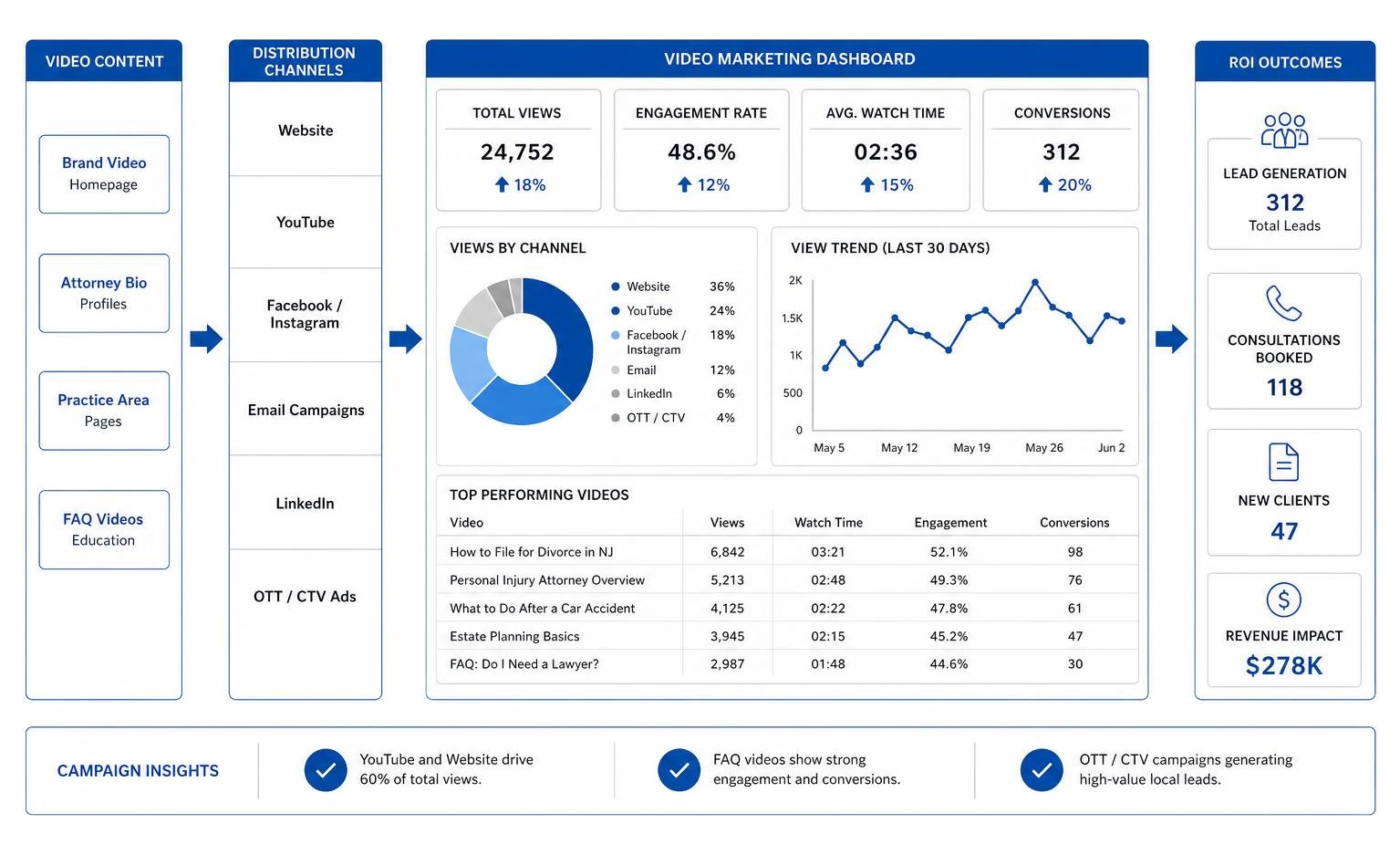
- Website Embedding: 68% of legal practices embed videos on their websites. Place your primary brand video on your homepage, conversational bio videos on your attorney profile pages, and specific FAQ videos on corresponding practice area pages.
- Email Campaigns: Integrating video into your email newsletters or client intake sequences can boost click-through rates by up to 65%. To avoid spam filters, do not embed the actual video file. Instead, use a static image or GIF with a play button that hyperlinks directly to the video page on your website.
- OTT and Connected TV (CTV): Modern streaming platforms (Hulu, Peacock, Roku) allow local law firms to run hyper-targeted video ads. You can target specific ZIP codes in New Jersey, reaching your exact local demographic without paying for wasted national airtime.
Maximizing Reach with Law Firm Video Marketing on Social Media
Social media algorithms heavily favor video content over standard text or images. However, each platform requires a slightly different approach:
- LinkedIn: This is the absolute gold standard for professional networking and referral marketing. Interestingly, horizontal video formats on LinkedIn currently achieve 2 to 3 times more reach than vertical formats. Share professional updates, case studies, and thought leadership pieces here.
- Facebook & Instagram Reels: Upload your videos natively to these platforms rather than sharing external YouTube links. Native uploads perform significantly better in social feeds.
- TikTok & Mobile-First Formats: If you are targeting consumer-facing practice areas like personal injury, criminal defense, or family law, short-form vertical videos with large captions are highly effective. That 85% of social media videos are watched without sound, so open or closed captions are non-negotiable.
Ethical Compliance and Avoiding Common Video Marketing Mistakes
Attorney advertising is heavily regulated, and video marketing is no exception. Before you publish a single clip, you must ensure your content complies with the American Bar Association (ABA) Model Rules and local state regulations, such as those set by the New Jersey State Bar Association.
Key ethical considerations include:
- Avoid Guarantees of Outcomes: Never state or imply that you can guarantee a specific result for a client.
- Required Disclaimers: In New Jersey, you must include necessary legal disclaimers. For example, when showcasing past case results, always include a clear, legible disclaimer stating that “prior results do not guarantee a similar outcome” and that the video “does not constitute formal legal advice.”
- Written Consent for Testimonials: Never feature a past client in a video without obtaining their express, written consent. Respect client confidentiality at all times.
- Attorney Identification: Every marketing video must clearly state the name and office location of at least one attorney responsible for its content.
Avoiding Common Mistakes
Many law firms fail to see a return on their video investment because they fall into common traps. Here is how to avoid them:
- Focusing on Vanity Metrics: Do not obsess over views, likes, or shares. A video that gets 10,000 views from people outside your geographic practice area is useless. Focus on business metrics: consultations booked, case origination rates, and signed retainers.
- Lack of a Clear Call-to-Action (CTA): Every video must end with a clear, spoken, and visual invitation. Tell the viewer exactly what to do next: “If you have questions about your case, call our New Jersey office today for a free consultation.”
- Inconsistent Branding: Maintain a consistent tone, style, and visual identity across all videos to build a recognizable local brand.
To keep your campaigns on track, use this quick reference table to shift your focus from superficial metrics to actual business growth:
| Vanity Metrics (What to Ignore) | Business Metrics (What to Track) |
|---|---|
| Video Views & Impressions | Inbound Phone Calls & Web Form Submissions |
| Social Media Likes & Shares | Qualified Consultations Scheduled |
| Video Completion Rates | Signed Retainers & New Case Origination Rate |
| Channel Subscribers | Average Case Value & Overall Marketing ROI |
Frequently Asked Questions About Legal Video Marketing
How long does it take to see SEO results from video marketing?
While video can improve your website’s conversion rates almost instantly, organic search engine optimization is a long-term strategy. Most law firms begin to see meaningful search ranking improvements and organic traffic growth within 6 to 12 months. Over time, these videos act as compounding assets, continuing to earn trust and attract leads years after they are published.
What is the recommended length for different types of legal videos?
Video length should always match the viewer’s intent and platform:
- Paid Video Ads (YouTube, OTT, Social Ads): Keep these to a crisp 15 to 30 seconds.
- Homepage Brand Videos: Aim for 60 to 90 seconds to capture attention quickly.
- Educational & FAQ Videos: Keep these between 1 and 3 minutes to keep the viewer engaged.
- Complex Case Studies & Thought Leadership: These can run from 5 to 10 minutes, as viewers seeking detailed information on complex legal topics are willing to watch longer content.
Can attorneys produce high-quality videos on a budget?
Yes. As outlined in our technical blueprint, a modern smartphone, a quiet room with good natural lighting, and an inexpensive external lapel microphone are all you need to start producing highly engaging, authoritative educational videos. Focus on delivering clear, empathetic value rather than worrying about expensive editing tricks.
Conclusion
Law firm video marketing is no longer a luxury reserved for massive national firms with million-dollar advertising budgets. In 2026, it is an essential tool for any attorney who wants to build immediate trust, stand out from local competitors, and capture high-value cases.
At DIGIniche Solutions, we help law firms transform their digital presence from invisible to unforgettable. Through our proprietary V.E.R.A. Formula, we deliver:
- Visibility: Putting your firm in front of local prospects who need your help right now.
- Engagement: Using high-impact video and custom content to build immediate trust.
- Retention: Keeping your brand top-of-mind so you are the only firm they think to call.
- Amplification: Deploying your video assets across search, social, and email for maximum reach.
Stop letting great cases click away to your competitors. Let us help you build a scalable client-growth ecosystem that works for you 24/7. Ready to dominate your local market? Partner with a New Jersey law firm SEO expert at DIGIniche Solutions today, and let’s take your practice from script to screen.
