

What Real Attorney SEO Case Studies Actually Tell You About Legal Marketing
The short answer: Attorney SEO case studies show that law firms can achieve dramatic results — from 289% to 3,400%+ organic traffic growth — but outcomes vary widely based on market competitiveness, strategy quality, and timeline. Here are the most important patterns the data reveals:
- Personal injury firms consistently show the highest traffic gains, with some reaching over 3,400% organic growth
- Timelines matter: Expect 4-6 months for ranking improvements and 8-12 months for meaningful lead growth
- Local SEO is non-negotiable: Google Business Profile optimization and citation building directly impact Map Pack visibility
- Technical debt kills results: Broken canonicals, zombie pages, and crawl waste often block growth before a single piece of content is written
- SEO outperforms PPC long-term: One case showed organic cost per lead at $44 vs. $428 for paid ads
- AI search is now part of the equation: Firms optimizing for AI Overviews and generative answers are gaining an early competitive edge
Most law firms start their digital marketing journey the same way: spending heavily on ads, seeing diminishing returns, and wondering why their website barely shows up in search. The gap between a firm that dominates Google and one that’s invisible often comes down to strategy, execution, and patience — not budget alone.
Real-world data backs this up. A Las Vegas law firm generated close to $1 million in added revenue over 30 months through a structured SEO campaign. A New York personal injury firm cut its cost per lead from $340 to $44 while growing qualified leads by 320%. A Dallas boutique firm slashed its paid ad spend from $12,000 to $3,500 per month — without losing consultation volume.
These aren’t outliers. They’re what happens when SEO is done right.
But for every success story, there’s a firm stuck with a slow website, thin content, and an agency that overpromised and underdelivered. Understanding why some campaigns work and others fail is exactly what this guide is for.
I’m Frank Demming, and for over a decade I’ve specialized in SEO, lead generation, and digital marketing exclusively for the legal industry — helping law firms turn their websites into consistent, high-performing case pipelines using real attorney SEO case studies as the foundation for strategy. Everything in this guide is grounded in documented results and proven methodology, not guesswork.
Why Most Law Firms Fail Before Launching an SEO Campaign
Before we look at the hockey-stick growth charts and the seven-figure revenue wins, we have to talk about the starting line. When we audit law firm websites in New Jersey and across the country, we rarely find a blank canvas. Instead, we find websites that are actively working against themselves.
Many firms believe their SEO isn’t working because they aren’t writing enough blog posts or buying enough backlinks. In reality, their growth is being choked by technical debt, “zombie pages,” and a severely wasted crawl budget. To fix these issues, we recommend starting with foundational adjustments, which we detail in our guide on 7 Tips for Improving a Law Firm Website’s SEO.
Overcoming the Legacy Agency Trap
One of the most common hurdles attorneys face is recovering from previous marketing agencies. Many legacy agencies use a “cookie-cutter” approach: they lock firms into long-term contracts, publish thin, AI-generated content that Google’s helpful content systems completely ignore, and build low-quality or toxic backlinks that put the site at risk of algorithmic penalties.
When a firm is locked into a rigid contract with zero transparency, they often watch their rankings slowly tank while paying thousands of dollars a month. Breaking free from this cycle requires knowing what to look for in a true partner. For a detailed roadmap on selecting a transparent, performance-driven provider, check out our resource on How to Choose a Law Firm SEO Agency.
The Crawl Budget and Technical Blockers
If Google’s search bots cannot easily crawl and index your website, your content will never rank — no matter how well-written it is. Technical SEO is the foundation of any successful campaign, yet it is often the most neglected.
In one notable local SEO study for a Texas personal injury firm, technical analysis revealed that 90% of the website’s crawl budget was being entirely wasted on non-canonicalized pages and non-HTML files. This meant Google’s crawlers were spending all their energy scanning junk files instead of indexing high-value practice area pages. Once the technical team cleaned up the canonical tags, resolved indexation issues, and optimized site speed, the homepage saw an immediate ranking boost in regional search engine results pages (SERPs) within an hour.
To make sure your technical foundation is solid, look out for these four common technical blockers:
- Broken Canonical Tags: Confusing search engines about which version of a page is the definitive “master” copy.
- Slow Site Speed & Failing Core Web Vitals: Google prioritizes user experience; a site that takes longer than 3 seconds to load on mobile will struggle to rank.
- Indexation Bloat (Zombie Pages): Keeping dozens of old, thin, or low-quality pages live on your site drains crawl budget. In a case study involving a family law firm, pruning 75 “zombie pages” (pages with zero traffic or rankings) and setting up clean 301 redirects immediately funneled search engine authority to the core service pages, sparking a massive traffic turnaround.
- Poor Internal Linking Structure: Failing to pass link equity (or “ranking juice”) from high-authority pages (like your homepage) to deeper, high-intent practice area pages.
Analyzing Real-World Attorney SEO Case Studies
When we analyze attorney SEO case studies, we aren’t just looking at vanity metrics like keyword rankings. We look at the metrics that actually keep the lights on: organic sessions, qualified lead volume, cost per acquisition (CPA), and overall return on investment (ROI).

To see how these elements come together to drive real business growth, you can explore our curated collection of successful campaigns on our Case Studies page. For external context, you can also look at real-world legal outcomes like the NJ Legal Case Studies & Success Stories – Hamilton Law Firm.
What We Can Learn from Personal Injury Attorney SEO Case Studies
Personal injury is widely recognized as the single most competitive vertical in digital marketing. With pay-per-click (PPC) costs routinely exceeding $100 to $300+ per click in major metropolitan areas, organic search is the ultimate competitive battleground.
The data shows that when personal injury firms commit to a comprehensive, technical-first SEO strategy, the results are unmatched:
- Massive Traffic Scaling: A New York personal injury firm achieved a staggering 3,400% organic traffic growth by restructuring its site architecture and focusing on highly localized, intent-driven search terms.
- Direct Revenue Impact: A Florida personal injury firm generated $170K in monthly recurring revenue directly attributed to organic leads within their SEO campaign.
- Dramatic Lead Increases: Another personal injury firm saw a 411% increase in website traffic and a 60% increase in new signed cases in just 12 months by aligning their content with their Ideal Customer Profile (ICP).
- Dominating Local Markets: A Northern California firm achieved a 3,942.32% website traffic increase and quintupled their monthly leads, establishing absolute dominance across six highly competitive local markets.
These case studies prove that organic search is not just a branding play; it is a highly scalable client-acquisition engine. If you are wondering whether the high upfront investment is worth it for your firm, we break down the math in Why Personal Injury SEO Is Worth It and reveal the exact tactics top firms use in Personal Injury SEO Secrets Revealed: What Experts Don’t Want You to Know About Ranking in 2026.
Key Takeaways from Multi-Location Attorney SEO Case Studies
For law firms operating out of multiple offices or looking to expand their geographic reach, SEO requires a highly structured multi-location approach. You cannot simply build one page and expect to rank in five different cities.
The most successful multi-location case studies point to a clear strategy:
- Unique, Localized Landing Pages: Each office location must have its own dedicated, highly optimized landing page. Do not copy-paste the content and swap out the city name; Google’s duplicate content filters will penalize you.
- Localized Keyword Targeting: Target borough-specific or neighborhood-specific terms. For example, a Manhattan personal injury firm shouldn’t just target “New York personal injury lawyer.” They see far better conversion rates targeting borough-specific terms like “Brooklyn car accident attorney” or “Queens slip and fall lawyer.”
- Geographic Link Building: Acquiring backlinks from local business directories, community organizations, and local bar publications signals geographic relevance to Google.
- Cohesive Internal Linking: Bridge your local office pages back to your main practice area hubs to distribute authority evenly across your digital footprint.
To see how we design and execute these expansive, multi-office campaigns, read through our detailed DIGIniche Case Studies.
Niche Practice Areas: Family Law, DUI, and Bankruptcy Results
While personal injury gets a lot of attention, niche practice areas like family law, DUI defense, and bankruptcy offer incredible opportunities for rapid, high-ROI search engine growth. Because these verticals are generally less competitive than personal injury, firms can often secure first-page rankings much faster.
Let’s look at what the data shows for these practice areas:
- DUI Defense: A Missouri DUI defense firm saw a 681% increase in organic users over a 12-month period (growing from 573 to 4,478 organic users) by focusing heavily on localized content and consistent link-building outreach to high-authority directories.
- Bilingual and Multilingual SEO: A law firm focusing on bilingual outreach achieved a 580% increase in organic sessions and a 1,050% increase in organic phone calls by optimizing content specifically for Spanish-speaking audiences and resolving the technical language-tagging issues that often confuse Google’s crawlers.
- Employment Law: An employment and labor law firm tripled its organic traffic in 12 months, displacing thousands of dollars in monthly PPC spend by ranking #1 for highly transactional terms like “wrongful termination attorney” and “hostile work environment lawyer.”
- Directory-Level Scale: In some instances, directories and highly scaled resource hubs can achieve massive traffic values by structuring deep topical maps. For example, a legal directory case study shared on Facebook reached over $150,000 in organic traffic value by leveraging programmatic semantic SEO structures.
For firms in the family law space, where clients are often looking for highly empathetic and informative content, we have put together a specialized guide: Search Engine Optimization for Family Law Attorneys.
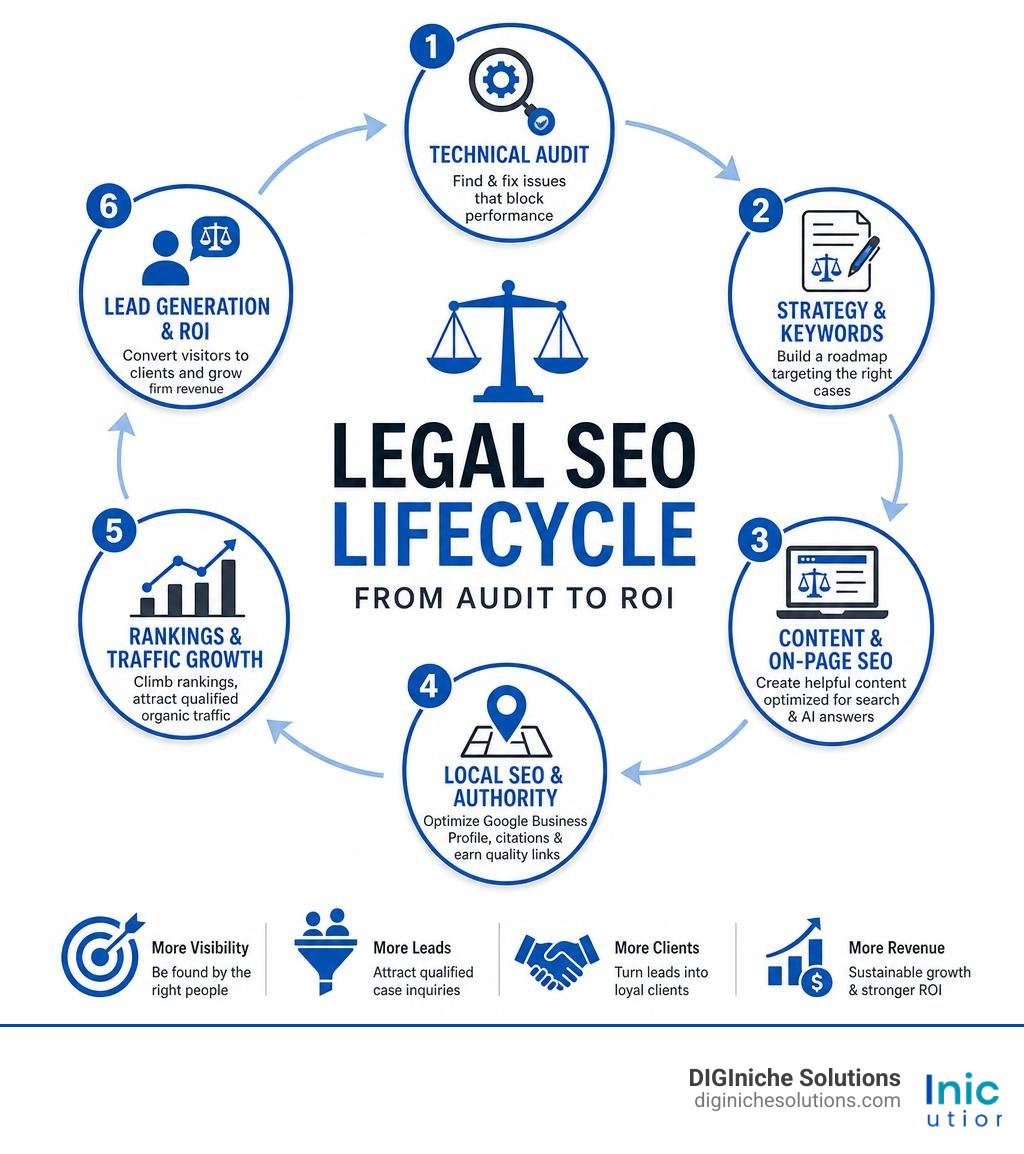
The Anatomy of a High-ROI Legal SEO Strategy
What separates a campaign that generates a 1,552% ROI from one that falls flat? It isn’t luck. It’s a structured, multi-phase system that treats SEO as an integrated ecosystem rather than a series of isolated tricks.

To build a sustainable client-growth engine, your strategy must focus on three core pillars: topical authority, local search presence, and optimization for the next generation of search. For a comprehensive look at how we build these campaigns from the ground up, read our flagship guide, Law Firm SEO: The Ultimate Guide.
Building Topical Authority and E-E-A-T
Google classifies legal websites as “Your Money or Your Life” (YMYL) pages. Because the information on your site can directly impact a user’s financial well-being or physical safety, Google holds legal content to the highest possible standards of E-E-A-T (Experience, Expertise, Authoritativeness, and Trustworthiness).
To build true topical authority that satisfies these strict guidelines, we utilize a highly structured content framework:
- Practice Area Content Clusters: Instead of writing random, disconnected blog posts, build deep “hub-and-spoke” content clusters. If you want to rank for “car accident lawyer,” you must build supporting articles covering everything from “how to get a police report” to “understanding no-fault insurance limits.”
- Named-Attorney Attribution: Every legal article should be attributed to a real, licensed attorney with a detailed bio link, schema markup, and links to their professional profiles (like Avvo or state bar listings) to prove real-world expertise.
- No-Guarantees Compliance: All content must be jurisdiction-appropriate and strictly compliant with state bar advertising guidelines, avoiding any direct or implied outcome guarantees.
Local SEO, Google Business Profile, and Citations
For most consumer-facing law firms, the local Map Pack is where the vast majority of calls and high-intent leads are generated. If you aren’t in the top three local map results, you are missing out on the majority of search traffic.
To dominate the Map Pack, you need to execute three key tasks:
- Optimize Your Google Business Profile (GBP): Ensure your business name, address, and phone number (NAP) are 100% accurate and match your website exactly. Regularly upload high-resolution photos of your office and staff, and post weekly updates.
- Build Local Citations: Distribute your NAP data across 150+ high-quality business directories and legal platforms (like FindLaw, Justia, and local chambers of commerce). Consistent citations act as “votes of confidence” for Google regarding your physical location.
- Generate a Consistent Flow of Reviews: Set up an automated intake system to ask satisfied clients for reviews. Always respond to every review you receive — both positive and negative — in a professional, bar-compliant manner.
For firms operating in highly competitive East Coast markets, we’ve developed specific local blueprints. Discover how to win the local search battle in our dedicated guides: SEO for Lawyers New Jersey and Attorney SEO NJ Law Firm SEO Expert.
Optimizing for AI Overviews and Generative Search (GEO)
As we navigate 2026, the search landscape is undergoing its most massive shift in a decade. With the integration of Google’s AI Overviews, ChatGPT, and other generative search engines, users are increasingly getting direct answers without clicking through to traditional websites.
To maintain visibility in this new era of Generative Engine Optimization (GEO), your content strategy must adapt:
- Answer-First Writing: Structure your articles with clear, concise, “answer-first” paragraphs. Start your pages with a direct answer to the search query before diving into deep legal analysis.
- FAQ Sections with Schema: Implement detailed FAQ sections on your pages and mark them up with clean
FAQPageandLegalServiceschema to make it easy for AI engines to crawl and cite your content. - Original Data and Research: AI engines love citing original sources. Conducting local surveys or publishing unique legal studies makes your site highly linkable and referenceable by generative platforms.
To understand how this shift impacts small-to-mid-sized firms, check out our analysis on Why Geo Will Change the Way You Think About SEO for Small Law Firms.
Measuring Success: Timelines, Attribution, and SEO vs. PPC
One of the biggest mistakes law firms make is failing to set up proper tracking systems before launching their campaigns. If you cannot attribute a signed case directly to the specific marketing channel that generated it, you are flying blind.
To help you build a transparent, data-driven tracking system, we’ve compiled a comprehensive guide on Monitoring SEO Performance: Guide for Law Firms.
Realistic Timelines for Legal SEO Results
SEO is a long-term investment, not an overnight switch. Anyone promising first-page rankings in 30 days is likely using black-hat tactics that will eventually get your site penalized.
Based on our analysis of dozens of attorney SEO case studies, here is what a realistic, sustainable timeline looks like in most markets:
- Months 1 to 3: Focus is entirely on technical rebuilds, resolving crawl budget waste, pruning zombie pages, and mapping out topical content clusters.
- Months 3 to 6: Initial content clusters are published, local GBP optimization is completed, and high-authority link-building campaigns begin. You will start to see early ranking improvements for long-tail keywords.
- Months 6 to 12: Organic search traffic begins to climb consistently. High-intent search terms start landing on the first page, and qualified leads begin to flow in consistently.
- Months 12 to 24+: Your organic pipeline begins to compound. The authority you’ve built makes it easier to rank for competitive head terms, drastically lowering your cost-per-lead compared to paid channels.
To see how this compounding effect plays out over multi-year campaigns, review our detailed DIGIniche Case Studies.
Organic SEO vs. Paid Advertising (PPC) ROI
Many law firms rely heavily on Google Ads because they offer immediate visibility. However, PPC is a renting model — the moment you stop paying for ads, your lead flow drops to zero. SEO, on the other hand, is an asset-building model. The rankings you earn today will continue to generate leads for years to come.
Let’s look at a direct comparison of the two channels based on real-world campaign data:
| Metric | Paid Search (PPC) | Organic Search (SEO) |
|---|---|---|
| Upfront Cost | Low (Immediate ad spend required) | Moderate to High (Strategic investment) |
| Time to Results | Immediate (Minutes after launch) | Compounding (6 to 12 months) |
| Average Cost Per Lead | High (e.g., $340 to $428+ per lead) | Low (e.g., $41 to $44 per lead) |
| Long-Term Asset Value | Zero (Leads stop when budget stops) | High (Permanent, compounding visibility) |
| Average ROI | Moderate (Typically 3:1 to 4:1) | Extremely High (Often exceeding 15:1 to 40:1) |
While PPC is excellent for short-term lead spikes, SEO is the only sustainable, high-ROI channel for long-term growth. To read more about how leading firms balance these two channels, explore our detailed DIGIniche Case Studies.
Frequently Asked Questions About Legal SEO Results
How long does it take to see results from attorney seo case studies?
In moderately competitive markets, you can expect to see measurable traffic increases within 4 to 6 months. In highly competitive markets (like New York City or major personal injury niches), it typically takes 8 to 12 months of consistent optimization to generate substantial, consistent lead growth.
How do law firms measure and attribute leads to attorney seo case studies?
We utilize dynamic call tracking (like CallRail) to swap out phone numbers based on the visitor’s traffic source, alongside GA4 (Google Analytics 4) event tracking for form submissions. This allows us to trace every phone call, chat, and form submission back to the exact search query and landing page that brought them to the site.
What is the average ROI of legal SEO compared to PPC?
While a successful PPC campaign typically yields a 3:1 or 4:1 return on ad spend, mature legal SEO campaigns routinely achieve ROIs of 15:1 to over 40:1. This is because organic search clicks are free, meaning your cost-per-lead decreases over time as your organic traffic grows.
Conclusion
The data from real-world attorney SEO case studies is clear: when law firms move away from short-term fixes and invest in a comprehensive, technical-first, and semantically structured organic strategy, the growth is highly predictable and incredibly scalable.
At DIGIniche Solutions, we don’t believe in cookie-cutter marketing or empty promises. We utilize our proprietary V.E.R.A. Formula (Visibility, Engagement, Retention, and Amplification) to build custom, scalable client-growth ecosystems for law firms in New Jersey and nationwide. By resolving technical debt, building deep topical authority, and optimizing for the next generation of AI search, we help firms reduce their reliance on expensive paid ads and build a permanent, high-performing lead generation asset.
Ready to stop renting your leads and start building a high-ROI digital asset? Take the first step toward dominating your local market today by exploring our Law Firm SEO Services to Boost Your Legal Website.
