

Why Law Firm Analytics Leads to Smarter Decisions
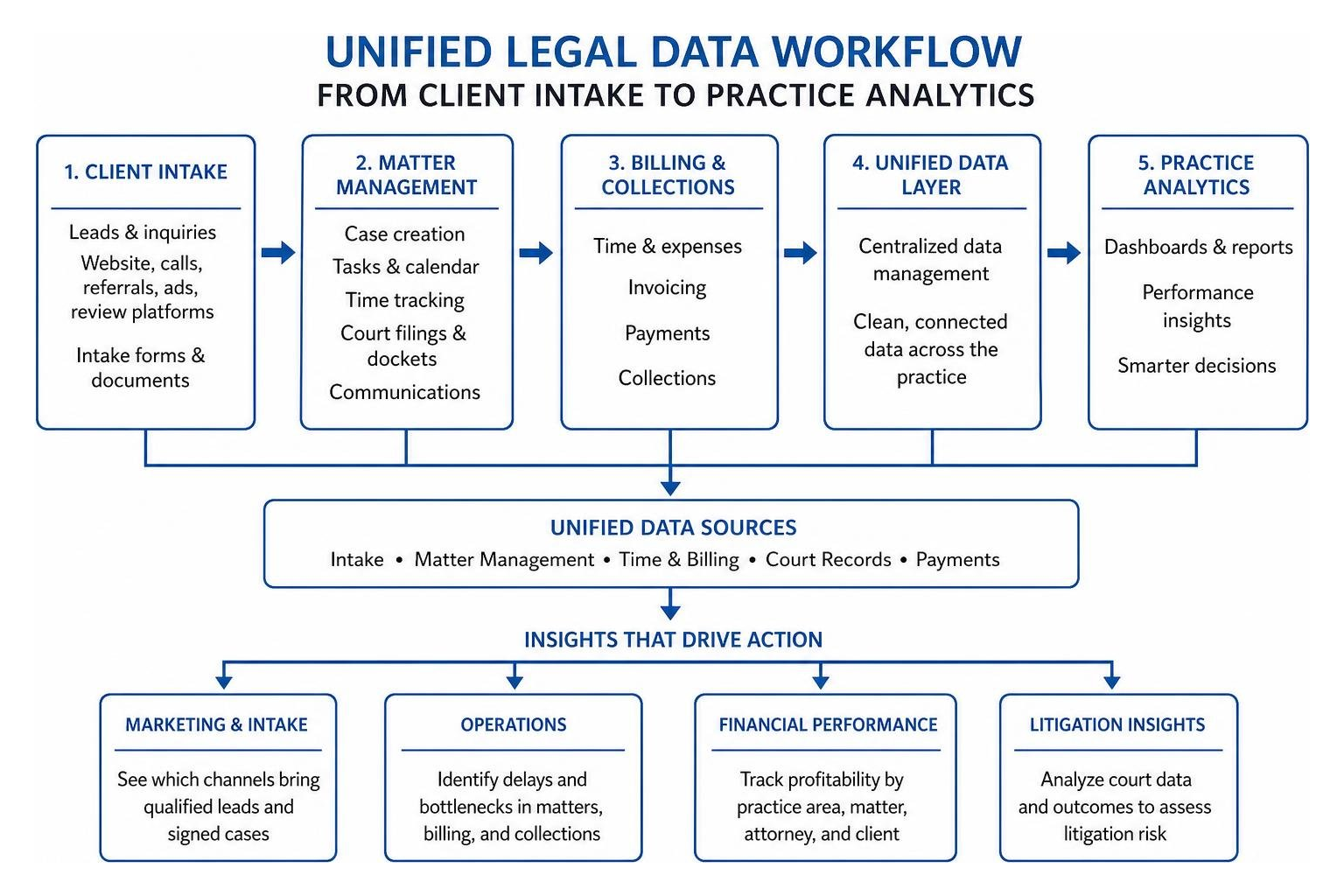
Law firm analytics turns data from your cases, billing, intake, marketing, and court records into decisions you can act on. The right tools help you see which marketing channels bring signed cases, where matters get delayed, which practice areas are most profitable, and what past court data may reveal about litigation risk.
For a small or mid-sized firm, start with four questions:
- Which lead sources produce the best clients and signed cases?
- Where do potential clients drop out during intake?
- Which matters, services, and attorneys create the strongest margins?
- What bottlenecks slow billing, collections, case progress, or settlement demands?
This is more than a dashboard project. It is a way to replace guesswork with evidence. For example, website and intake data can show whether your SEO, paid ads, referrals, or review platforms generate qualified cases – not just traffic or phone calls. That matters when 70% of people research lawyers online before choosing one.
Legal analytics also reaches beyond marketing. Litigation tools can compare a judge’s historical motion rulings, while practice-management reporting can flag aging work in progress, low realization, slow collections, and uneven workload. AI is making these insights easier to access, but the value still depends on clean data and sound legal judgment.
I am Frank Demming, and for more than a decade I have helped law firms use SEO, PPC, website optimization, and lead-generation data to create more reliable case pipelines. In this guide, I will show how law firm analytics can connect marketing results to the operational decisions that help a growing practice win better cases.

Transforming Practice Performance with Law Firm Analytics
Running a modern legal practice without structured intelligence is like driving at night with the headlights turned off. You might stay on the road for a while, but navigating sharp turns becomes pure luck. Legal informatics and business intelligence transform the everyday data your firm generates into a roadmap for growth.
Traditional practice management software often acts as a passive digital filing cabinet. In contrast, modern business intelligence platforms ingest operational data from client intake, calendar entries, active time tracking, and court dockets, turning passive records into dynamic performance forecasts. Deploying dedicated Law Firm Data Management & Analytics Software | Elite enables firms to establish a centralized system of record. Connecting front-end matter intake directly to back-end accounting eliminates duplicate data entry, reduces billing rejections, and accelerates your work-to-cash pipeline.
Litigation Intelligence and Predictive Outcome Modeling
Litigation intelligence mines millions of structured court filings, dockets, and judicial rulings to reveal empirical patterns that traditional legal research misses. Rather than relying solely on anecdotal impressions, attorneys can use platforms like Lex Machina and Bloomberg Law to evaluate objective metrics across federal and state jurisdictions:
- Judicial Motion Grant Rates: Benchmark a specific judge’s historical rulings on motions to dismiss and motions for summary judgment against district and national averages.
- Opposing Counsel Strategies: Analyze your adversary’s trial track record, average case duration, and customary settlement timelines across specific Nature of Suit classifications.
- Duration Benchmarking: Calculate realistic time-to-trial benchmarks for specific case types to provide clients with data-backed litigation roadmaps.
Strategic Practice Management Through Law Firm Analytics
Strategic practice management looks inward to identify operational friction before it damages firm margins. Law firms frequently face administrative logjams where matter data is abandoned once the initial intake form is processed. By adopting Experience Management and Firm Intelligence | Epiq strategies, firms can track matter characteristics throughout the entire dispute lifecycle.
This ongoing matter profiling allows leadership to forecast capacity, allocate staff according to case complexity, and calculate true profit margins across distinct practice groups.
Grounding Litigation Strategy, eDiscovery, and Case Outcomes in Empirical Data
Data analytics brings precision to litigation strategy, transforming settlement negotiations and discovery reviews from reactive processes into calculated tactical advantages.
| Strategy Dimension | Traditional Legal Research | Predictive Litigation Analytics |
|---|---|---|
| Case Assessment | Relies on individual attorney recollection and qualitative precedent | Aggregates thousands of historical docket outcomes and ruling probabilities |
| Motion Strategy | Drafted according to broad statutory standards | Tailored using judicial language analytics and historical grant percentages |
| Settlement Valuation | Based on subjective intuition and recent local anecdotes | Benchmarked against historical compensation datasets and liability risk matrices |
| Document Discovery | Linear, manual review of expansive custodial datasets | Technology Assisted Review (TAR) culling up to 96.7% of non-responsive documents |
Judicial Behavior, Motion Forecasting, and Case Settlement Metrics
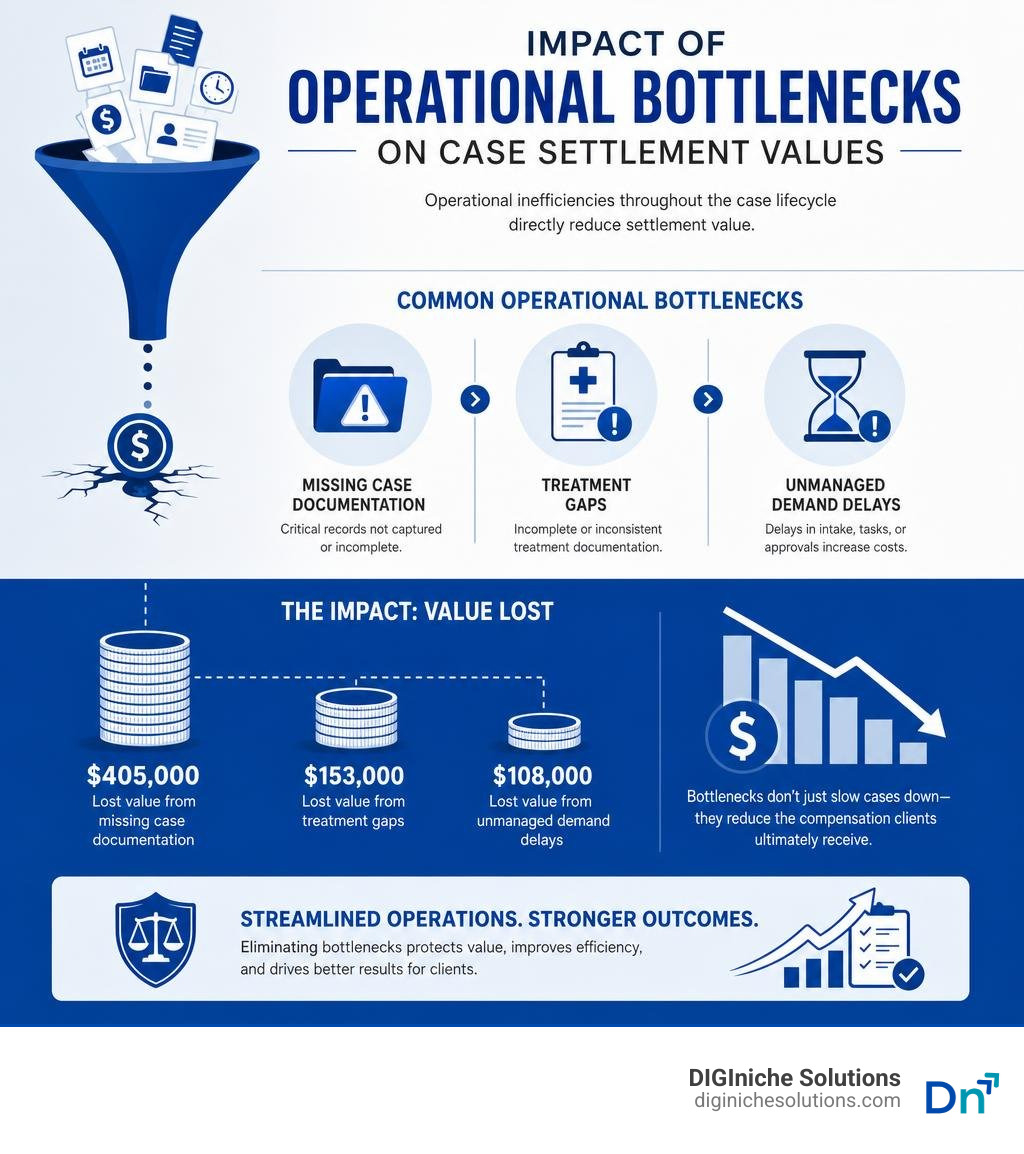
Predictive litigation tools analyze judicial opinions and citator databases to forecast how judges approach complex legal issues. In personal injury and commercial litigation, operational lapses directly damage case valuations. Research from Executive Analytics™ | Key Injury Law Firm Analytics and Insights highlights that missing case documentation leads to an average annual lost settlement value of $405,000, while treatment gaps cause $153,000 in lost value, and unmanaged demand delays add $108,000 in carrying costs.
Predictive language analytics takes this a step further by scanning a judge’s past written opinions. This helps attorneys identify the specific statutory phrasing and legal precedents most likely to persuade the bench during motion practice.
eDiscovery Data Culling and Document Review Efficiency
Document review remains one of the largest litigation expenses for clients. The application of Technology Assisted Review (TAR) and probability modeling has turned eDiscovery into an efficient, defensible workflow.
Across modern litigation, data culling reduces the volume of documents requiring manual attorney review by an average of 96.7%, yielding average savings of $58,000 per matter. In complex government inquiries, such as Department of Justice Second Requests, culling review volumes by 88% has produced over $2.5 million in direct legal cost savings. Similarly, deploying automated analytics during corporate due diligence reviews reduces lawyer time on engagements by up to 60%, delivering faster turnaround times at lower client spend.
Maximizing Financial Realization, Practice Profitability, and Talent Growth
A firm cannot thrive without strict visibility into its financial mechanics. Leveraging platforms like Swyft | Artificial Business Intelligence for Law Firms allows practice leaders to connect billing workflows, practice management software, and client CRM data into unified executive dashboards.
Key Operational Metrics: Utilization, Aged WIP, and Realization Rates
Industry benchmarks indicate that 84% of law firms report having underperforming lawyers, with nearly a quarter of all firms stating that over 10% of their roster underperforms. However, evaluating attorneys solely on raw billable hours often masks underlying inefficiencies. To protect firm health, leadership must monitor a broader set of core financial KPIs:
- Utilization Rate: The percentage of an attorney’s total working hours spent on billable client matters versus administrative overhead.
- Billing and Collection Realization: The gap between the billable value of time worked, the amount invoiced to the client, and the revenue actually collected.
- Aged Work-in-Progress (WIP): WIP aging over 90 days (particularly files exceeding $50,000) flags billing disputes or non-compliance with outside counsel guidelines before payments stall.
Pairing these metrics with structured operational systems like Lead Generation for Lawyers Made Simple ensures your legal team focuses their productive hours on profitable, high-value client matters.
Accelerating Lateral Partner Hiring with Law Firm Analytics
Strategic growth through lateral hiring carries significant financial risk when based on unverified partner projections. Platforms like Pirical | Business intelligence for data-driven law firms combine public market records with internal benchmarking data, enabling firms to save an estimated $350,000 annually in recruitment costs and 20 days of manual data gathering.
Using evidence-based insights, a Top 100 law firm uncovered a $20 million billable hours gap compared to market peers. Analytics de-risks lateral recruitment by validating historical client relationships, mapping practice mobility, and assessing whether an incoming partner’s client roster will transition successfully.
Tracking Digital Marketing ROI and Client Intake Performance
With 70% of prospective clients conducting online research prior to retaining counsel, digital marketing analytics represents a critical operational pillar. Without end-to-end attribution, law firms risk pouring capital into channels that generate raw vanity traffic rather than paying legal clients.
Our proprietary V.E.R.A. Formula (Visibility, Engagement, Retention, and Amplification) provides law firms throughout New Jersey—from Passaic County hubs like Wayne, Clifton, and Paterson to Essex and Bergen County communities including Bloomfield, Lyndhurst, and Newark—with a scalable client-growth engine grounded in conversion data.

Understanding true acquisition costs requires connecting your ad campaigns to verified conversions using Tracking Your Law Firm’s SEO: What Your Agency Isn’t Telling You.
Search Visibility, Traffic Diagnostics, and Conversion Funnels
Achieving sustainable visibility requires tracking every touchpoint along the digital user journey. Search engine optimization remains a high-ROI client generation channel when measured correctly. Organic search results in the top Google position capture roughly 34% of clicks, while search results ranking on page two capture less than 1%.
To maximize acquisition budgets, firms must monitor:
- Local Search Visibility: Local 3-Pack and Google Business Profile impression metrics across targeted towns and counties.
- Technical Performance: Core Web Vitals and page load times, ensuring desktop and mobile speeds remain under the 3-second drop-off threshold.
- Channel Profitability: Comparing paid search margins against organic acquisition using Law Firm SEO: The Ultimate Guide alongside targeted PPC Management for Law Firms: 9 Tips to Get More Clients.
Evaluating intake analytics often reveals critical conversion disparities. Top-performing intake professionals convert signed-to-closed cases at rates above 78%, while lower-performing team members can drop below 60%. Pinpointing these differences allows firms to provide targeted staff coaching and protect marketing ROI.
Client Retention, Online Authority, and Review Analytics
Securing online authority requires managing your digital footprint across public review platforms. Over 72% of consumers trust verified online reviews as much as personal recommendations, and 90% factor client reviews into their hiring decisions.
Law firms must build systematic, ethically compliant feedback systems to maintain high conversion rates, as detailed in our guide to Law Firm Reputation Management. In modern search environments, technical site architecture and content quality directly dictate client acquisition, a dynamic explored in Does Your Attorney Website Design Really Matter in 2026 The Truth About AI Discovery.
Selecting Platforms and Overcoming Enterprise Implementation Challenges
Adopting an analytics-driven approach requires deliberate change management. Business professionals spend an average of 23% of their working hours searching for disconnected information across internal systems. Simply purchasing new software without a clear integration plan only creates new data silos.
When evaluating legal analytics platforms:
- Adopt a Product Management Mindset: Treat firm intelligence as an evolving operational asset rather than a one-time IT purchase. Deliver phased rollouts that show clear wins early to secure team adoption.
- Demand Schema-Aware Integrations: Ensure platforms use open APIs to connect directly with standard legal practice management and ERP systems like Aderant and Elite 3E.
- Enforce Strict Security and Ethics: Verify that software vendors maintain verified ISO 27001 certifications, SOC 2 compliance, and strict data privacy controls to safeguard attorney-client privilege.
Frequently Asked Questions About Legal Analytics
Can legal analytics reliably predict case outcomes and judicial rulings?
Legal analytics engines identify statistical probabilities based on historical docket filings, ruling frequencies, and motion grant rates. However, they cannot guarantee future case outcomes. Judicial analytics must complement, rather than replace, qualitative legal reasoning, statutory analysis, and individual courtroom advocacy.
How do data silos and poor data hygiene undermine law firm reporting?
When matter data is trapped across disconnected spreadsheets, billing software, and email threads, firm leadership loses visibility into actual practice health. Incomplete data capture after the initial intake stage leads to skewed realization metrics, inaccurate billing forecasts, and missed settlement value. Establishing a single, governed source of truth resolves these operational blind spots.
How is artificial intelligence enhancing legal analytics platforms today?
Modern AI enhances legal analytics through schema-aware natural language querying, automated anomaly detection, and predictive language modeling. AI agents can now translate plain English prompts into complex operational queries, produce automated morning performance briefings, and analyze thousands of pages of court transcripts in seconds without requiring manual coding or SQL knowledge.
Conclusion
The legal industry has evolved beyond relying solely on intuition to make high-stakes operational choices. By integrating empirical data into litigation planning, financial management, lateral recruitment, and digital client acquisition, law firms can eliminate internal bottlenecks, protect realization rates, and drive consistent growth.
At DIGIniche Solutions, we help legal practices build data-driven client acquisition systems using our proven V.E.R.A. Formula. If your firm is ready to turn search visibility, marketing investments, and practice data into signed cases, explore our dedicated services for SEO for Lawyers in New Jersey and let us help you scale your practice with confidence.
